Hybrid Meeting Statistics: 30 Stats for 2026 | The Collaborative Organization
By The Collaborative Organization Team · November 19, 2026 · Last verified November 19, 2026 · 11 min read
A hybrid meeting mixes people in a room with people on video, and the numbers show it is the hardest meeting to run well. Owl Labs’ 2025 survey found workers lose about six minutes per meeting just getting the technology started. Below are 30 statistics from Owl Labs, Microsoft, Cisco and Logitech on hybrid meetings in 2026.
Key takeaways
- Workers lose about six minutes per hybrid meeting to setup, and 27% lose 10 minutes or more (Owl Labs, 2025).
- 77% have lost time to technical difficulties, and 67% have given up trying to set up video technology (Owl Labs, 2025).
- 98% of meetings include at least one remote participant, but only 48% of participants are likely to speak (Cisco, 2021).
- 38% of remote joiners felt less included than in-person participants, and 65% of in-room people engage more with the same room (Logitech, 2022).
- Fewer than 15% of the world’s 87 million meeting spaces are equipped with video conferencing (Cisco, 2024).
What a hybrid meeting is
A hybrid meeting has some people in a room together and others joining by video or phone. The mix is now the default: Cisco’s Hybrid Work Index found 98% of meetings have at least one person joining remotely. A meeting with everyone in one room is no longer the norm, and a meeting with everyone remote is a different format with different rules.
Research backs up the difficulty. A 2024 ACM study by Bergmann and colleagues compared meeting formats and found fully remote meetings are the most inclusive and effective overall.
Hybrid meetings scored lower on inclusion for remote attendees, even though people used chat more in them. Our guide to running a hybrid meeting turns that finding into practice: design for the remote joiner first.
Setup time: the six-minute tax
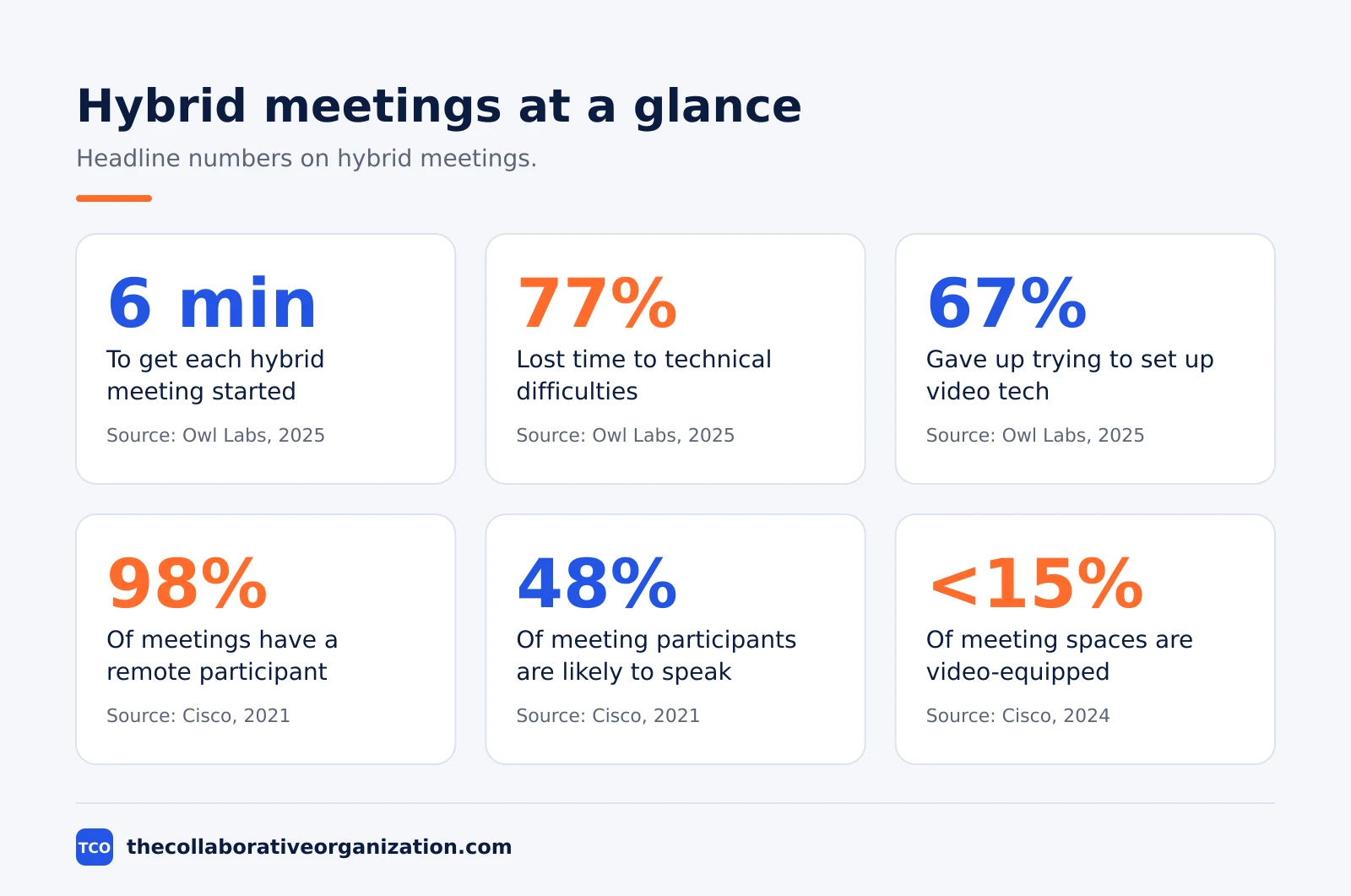
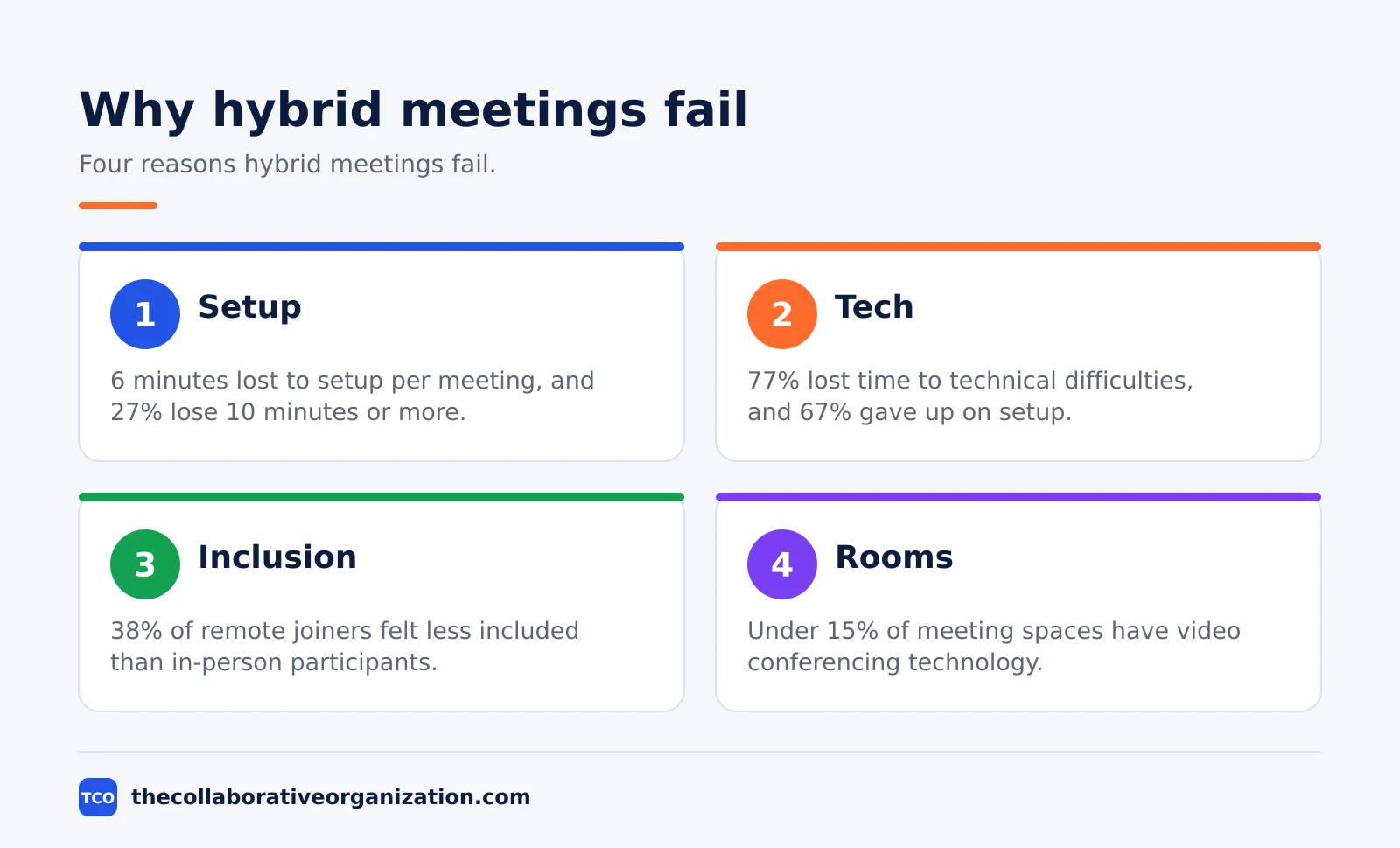
Every hybrid meeting starts with a tax of about six minutes, and a quarter of workers pay far more. Owl Labs’ 2025 survey of 2,000 U.S. full-time workers found in-office workers spend six minutes getting each hybrid meeting started. More than a quarter (27%) said they spend 10 minutes or more on setup alone, before the meeting itself begins.
The tax repeats across the week. The same survey counted an average of five online meetings and five face-to-face meetings a week, so six minutes per meeting adds up to about an hour a week lost to setup. In a 200-person company, that is roughly 200 hours a week spent waiting for cameras and microphones.
Good technology is the top fix workers name. In Owl Labs’ survey, 85% said good technology is a top factor in their work life, and employers have started to act: 27% of workers said their company added new meeting-room video and audio equipment in the past year.
Our hybrid work statistics show the same pressure from the wider return to the office.
Tech failure and rooms that are not ready
Setup time is only the start: most meetings also lose time to outright tech failure. In Owl Labs’ 2025 survey, 77% of workers said they had lost additional time because meetings started late due to technical difficulties. More than two-thirds (67%) said they had tried to set up video technology for a meeting but gave up because it was too difficult.
The rooms are part of the problem. Cisco reports that fewer than 15% of the world’s 87 million meeting spaces are equipped with video conferencing technology. That gap means most hybrid meetings run from rooms that were built for people in chairs, not for cameras and remote voices.
Federal workplaces show the same gap. Logitech’s 2025 survey of 200 federal technology leaders found 62% of agencies lack adequate technology to support hybrid collaboration.
Half of the respondents (50%) said employees often need IT help just to start or join a meeting, and 54% said conferencing systems add time spent on troubleshooting. Our guide to running an effective meeting covers the checks that prevent most of these failures.
Inclusion: who gets heard
The core problem in hybrid meetings is not the camera; it is who gets to speak. Cisco’s Hybrid Work Index found only 48% of meeting participants are likely to speak in any given meeting. When half the room stays quiet, the remote half is usually the quiet part, because the room has the eye contact, the side talk and the whiteboard.
Logitech’s 2022 survey of more than 1,000 white-collar workers in Singapore measured the gap directly. Among virtual participants, 54% felt they had fewer opportunities to build rapport with in-office peers, 39% felt their input would be valued more if they attended in person, and 38% felt less included than in-person participants.
The same survey found 65% of in-person participants tend to engage more with people in the same room.
The fix is a habit, not a purchase. In Owl Labs’ UK survey, 63% of employers trained staff on how to hold effective and inclusive hybrid meetings in 2025, and 59% trained them on mixed real-time and async communication.
Our too many meetings statistics show the same inclusion gap in meeting volume: remote workers attend far more calls than office workers.
Timing: when hybrid meetings happen
Hybrid meetings pile into the same few hours, and workers want them to end earlier. Microsoft’s 2025 Work Trend Index found 50% of meetings fall between 9 and 11am and 1 and 3pm, the peak hours for focused work. Meetings after 8pm are up 16% year over year, driven by teams that span time zones.
Most meetings are not even planned. In the same Microsoft data, 57% of meetings are ad hoc calls with no calendar invite, and 1 in 10 scheduled meetings is booked at the last minute. A third of meetings (30%) now span multiple time zones, up 35% since 2021, so one side of the call often pays with its evening.
Workers have clear preferences about the edges of the day. In Owl Labs’ 2025 survey, 82% prefer meetings to end by 4pm, and 70% say 8am or earlier is too early for a meeting. Our guide to running a virtual meeting uses those windows to protect the first and last hours of the day.
The office day that is not a meeting day
Many workers now commute to the office and still spend the day on video calls. A Federal Reserve Bank of New York study by Emanuel and Harrington found 48% of college-educated U.S. workers had no in-person meetings on their most recent day in the office. In the same study, 70.6% had at least one teammate who was not in the office that day.
The pattern has a name inside teams: when one member calls in, nearly half of teams switch the whole meeting to video, even the people sitting in the same office.
In the study, 45% of respondents said their teams follow that norm, and 37% reported at least one virtual meeting even though all its participants were in the same office that day.
Preferences still favour a mix. Morning Consult’s January 2024 survey of 6,625 adults found 29% preferred hybrid work and 23% preferred remote work, the first time hybrid led remote.
Gallup’s tracking puts the split at 52% hybrid, 27% fully remote and 21% on-site among remote-capable U.S. employees in February 2025. Our zoom fatigue statistics cover what a day of back-to-back video calls costs.
The full table: 30 hybrid meeting statistics
The table below lists all 30 statistics in this article, grouped by theme, with the source and year for each one.
| Statistic | Source | Year |
|---|---|---|
| 5 online and 5 face-to-face meetings a week on average | Owl Labs | 2025 |
| 6 minutes to get each hybrid meeting started | Owl Labs | 2025 |
| 27% lose 10 or more minutes per meeting to setup | Owl Labs | 2025 |
| 77% lost time to technical difficulties in meetings | Owl Labs | 2025 |
| 67% gave up trying to set up video technology | Owl Labs | 2025 |
| 85% say good technology is a top factor in work life | Owl Labs | 2025 |
| 82% prefer meetings to end by 4pm | Owl Labs | 2025 |
| 70% say 8am or earlier is too early for a meeting | Owl Labs | 2025 |
| 51% wish an AI avatar could sit in on a meeting | Owl Labs | 2025 |
| 69% of managers say hybrid or remote improved team performance | Owl Labs | 2025 |
| 63% of employers trained staff on inclusive hybrid meetings | Owl Labs UK | 2025 |
| 70% of UK managers say hybrid made their team more productive | Owl Labs UK | 2025 |
| 57% of meetings are ad hoc calls with no invite | Microsoft | 2025 |
| 30% of meetings span multiple time zones | Microsoft | 2025 |
| 50% of meetings fall in peak hours, 9-11am and 1-3pm | Microsoft | 2025 |
| Meetings after 8pm up 16% year over year | Microsoft | 2025 |
| 117 emails and 153 Teams messages received per weekday | Microsoft | 2025 |
| 98% of meetings have at least one remote participant | Cisco | 2021 |
| Only 48% of meeting participants are likely to speak | Cisco | 2021 |
| Fewer than 15% of 87 million meeting spaces have video tech | Cisco | 2024 |
| 83% of employers say collaboration upgrades attract and retain talent | Cisco | 2024 |
| 54% of virtual participants felt fewer chances to build rapport | Logitech | 2022 |
| 39% felt their input would be valued more in person | Logitech | 2022 |
| 38% felt less included than in-person participants | Logitech | 2022 |
| 65% of in-person participants engage more with the same room | Logitech | 2022 |
| 62% of federal agencies lack adequate hybrid collaboration tech | Logitech | 2025 |
| 50% say employees often need IT help to start or join a meeting | Logitech | 2025 |
| 48% had no in-person meetings on their most recent office day | Federal Reserve Bank of New York | 2026 |
| 37% had a virtual meeting with all participants in the same office | Federal Reserve Bank of New York | 2026 |
| 52% of remote-capable U.S. employees work hybrid | Gallup | 2025 |
What the numbers mean, and how we chose them
The numbers describe one problem from four sides: setup wastes time, tech fails, rooms are not ready, and remote voices go unheard. No single fix covers all four. Better room equipment cuts setup time, but it does not make a remote joiner speak. A trained moderator helps inclusion, but not a room with no camera. The teams that improve fastest fix the setup first, because it is the most measurable, then train moderators.
We took every number in this article from the publisher’s own report, press release or dataset, and we checked each one against that source as of November 2026. We used the latest edition of each yearly survey that includes the figure.
Several figures come via summaries and are flagged here: the Cisco 2021 figures come via Teamraderie’s summary of Cisco’s index, the Logitech figures come via FutureCIO and ExecutiveBiz reports on Logitech’s surveys, and the New York Fed figures come via NJBIA’s summary of the study.
Worked example: imagine a team of ten with six people in a room and four on video, meeting for one hour. The room spends six minutes on setup, one remote joiner drops out twice, and only three people speak.
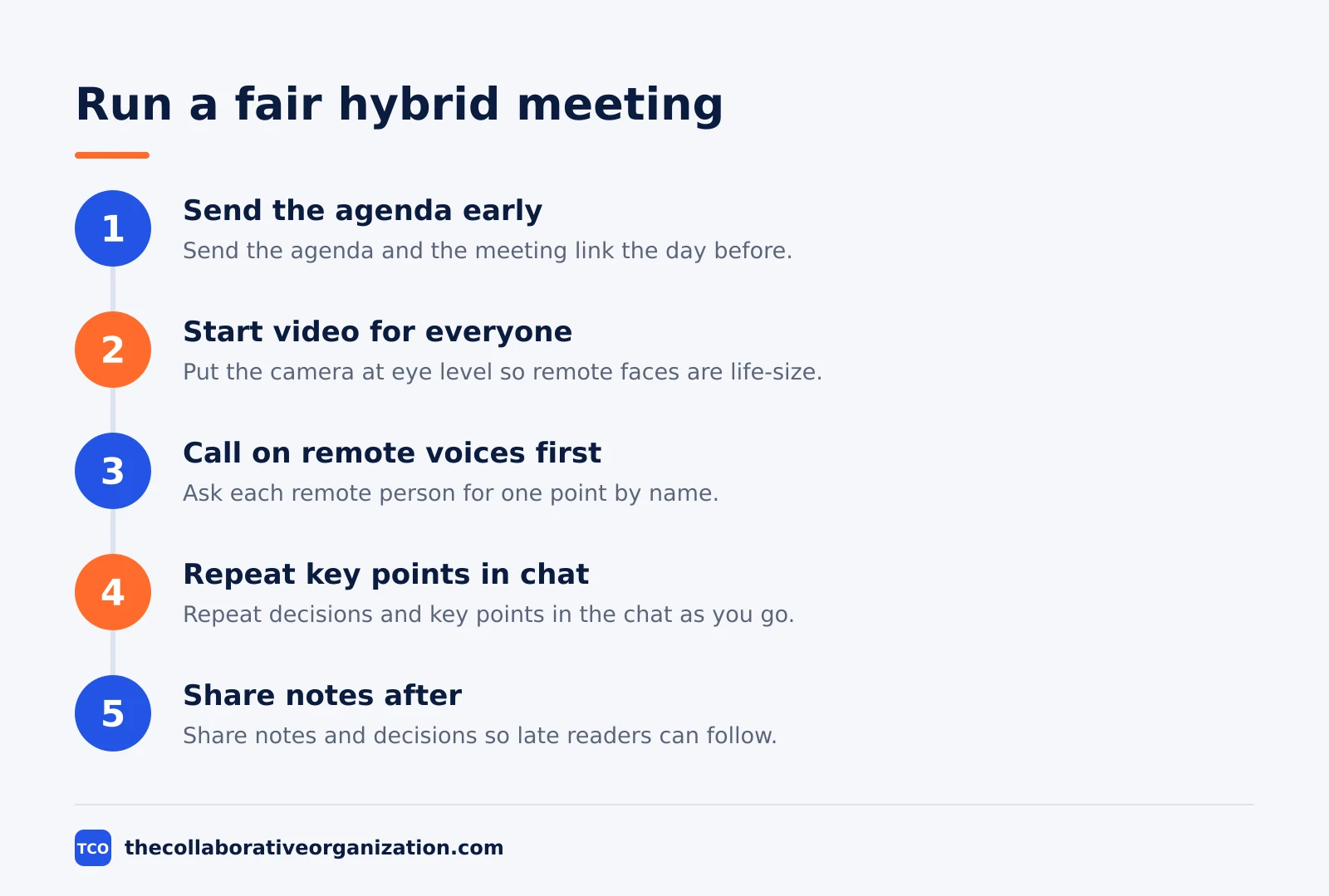
Fix three things next time: send the link and agenda the day before, put the camera at eye level so remote faces are life-size, and ask each remote person for one point by name. The meeting still lasts an hour, but the setup falls to one minute and all four remote voices are heard.
For more on the wider picture, browse our guides on meetings, hybrid work and team communication.
Common hybrid meeting statistics mistakes to avoid
Most hybrid meeting statistics go wrong in the same four ways, and all four are easy to avoid. Run through the list before you quote a number in a deck or a job post.
- Quoting Cisco 2021 as if it were new. The 98% remote-participant figure and the 48% speaking figure come from Cisco’s 2021 index. They are still widely cited, but they describe meeting habits from 2021, not 2026.
- Mixing up the two Owl Labs surveys. The U.S. and UK reports share a name and a year but different samples. The 63% training figure is from the UK survey of 2,000 workers, not the U.S. one.
- Reading a preference as a fact about behaviour. 82% prefer meetings to end by 4pm, yet Microsoft’s data shows meetings after 8pm are up 16%. What workers want and what their calendars show are two different numbers.
- Blaming the tool for a moderator problem. The inclusion gap shows up even in rooms with good cameras. Training the person who runs the meeting matters as much as the equipment in the room.
Sources
- Owl Labs - State of Hybrid Work 2025, US (2025)
- Owl Labs - State of Hybrid Work 2025, UK (2025)
- Microsoft - Breaking Down the Infinite Workday, Work Trend Index (2025)
- Teamraderie - Learnings from Cisco Hybrid Work Index (2021)
- Cisco - Achieving Distance Zero (2024)
- FutureCIO - Survey: Hybrid Meetings Create an Uneven Playing Field (2022)
- ExecutiveBiz - Logitech: 62% of Agencies Lack Hybrid Collaboration Tech (2025)
- NJBIA - Study: Workers Commute to Work but Are Still Working Remotely in Office (2026)
- ACM - Format Matters: Comparing the Inclusiveness and Effectiveness of Hybrid and Remote Meetings (2024)
- Gallup - Indicator: Hybrid Work (2026)
Frequently asked questions
How much time do hybrid meetings waste on setup?
About six minutes per meeting, on average. Owl Labs' 2025 survey found in-office workers spend six minutes getting each hybrid meeting started, and 27% spend 10 minutes or more on setup. On top of that, 77% have lost extra time because meetings started late for technical reasons, and 67% have given up trying to set up video technology.
Do remote participants feel included in hybrid meetings?
Often not. Logitech's 2022 survey found 38% of remote joiners felt less included than in-person participants, 39% felt their input would be valued more in person, and 54% felt fewer chances to build rapport. Cisco's data adds that only 48% of meeting participants are likely to speak, so the quiet half of the room is usually the remote half.
How many meetings include a remote participant?
Almost all of them. Cisco's Hybrid Work Index found 98% of meetings have at least one person joining remotely, and Cisco's later blog put the same figure at 98% of meetings today. That is why meeting design now starts with the remote joiner, not the room.
Are meeting rooms ready for hybrid meetings?
Most are not. Cisco reports that fewer than 15% of the world's 87 million meeting spaces are equipped with video conferencing technology. Logitech's 2025 federal survey found 62% of agencies lack adequate technology to support hybrid collaboration, and half say staff often need IT help just to start a meeting.
When should hybrid meetings happen?
Workers have clear views. Owl Labs' 2025 survey found 82% prefer meetings to end by 4pm, and 70% say 8am or earlier is too early. Microsoft's 2025 data shows half of all meetings fall in the peak windows of 9 to 11am and 1 to 3pm, which are also the best hours for focused work.
Related articles

guides
Free Project Management Templates: 7 to Copy (2026)
Seven free project management templates from monday, Wrike, Teamwork, Smartsheet, ClickUp, Asana and Trello, with what each one is for and what free really costs.
November 20, 2026 · 7 min read

guides
Project Proposal Template: Copy and Win Work (2026)
A project proposal template pitches the work before it is approved: problem, solution, scope, budget, timeline and terms. Copy the template and filled example.
November 20, 2026 · 10 min read

guides
Action Plan Template: Goal to Done in One Page (2026)
An action plan template turns one goal into owned steps with dates, dependencies and a success measure. Copy the table and see it filled for a support team.
November 20, 2026 · 11 min read