Meeting Statistics: 30+ Stats on Time and Cost (2026) | The Collaborative Organization
By The Collaborative Organization Team · November 19, 2026 · Last verified November 19, 2026 · 14 min read
Meeting statistics show that professionals spend about 15 hours a week in meetings, and a third of those meetings should not happen at all. The 30 numbers below come from Reclaim, Atlassian, Microsoft, and the other original reports on meetings. Each figure names its source and its year, so you can check it yourself.
Key takeaways
- Professionals average 14.8 hours a week in meetings, or 37% of their working time.
- Meetings cost about $29,129 a year per employee, Reclaim estimated in 2024.
- Atlassian found meetings are ineffective 72% of the time.
- One in three meetings is unnecessary, Otter.ai found in 2022.
- Cutting meetings by 40% raised productivity 71% in MIT Sloan’s 2022 study of 76 companies.
How we chose these stats
We took every number in this article from the publisher’s own report, press release, or dataset, and we checked each one against that source on 19 November 2026. We used the latest edition of each yearly report that includes the figure. Vendor surveys are flagged as vendor surveys, and modelled estimates are flagged as estimates.
This article covers the full meeting picture: volume, cost, quality, and fixes. Our too-many-meetings-statistics guide focuses on overload.
Our video conferencing statistics guide covers the medium instead. The three guides share some base figures, and each one says so where it does.
Reclaim’s cost figures are modelled estimates built from an average salary of $59,384 and an overhead factor of 1.325, not measured losses. The London School of Economics cost figures are modelled the same way. Every stat in the table below names its source and the year its data was collected.
How much time meetings take
Professionals spend more than a third of their working week in meetings, and executives spend more than half. The figures below come from Reclaim, Harvard Business Review, Microsoft, and Asana.
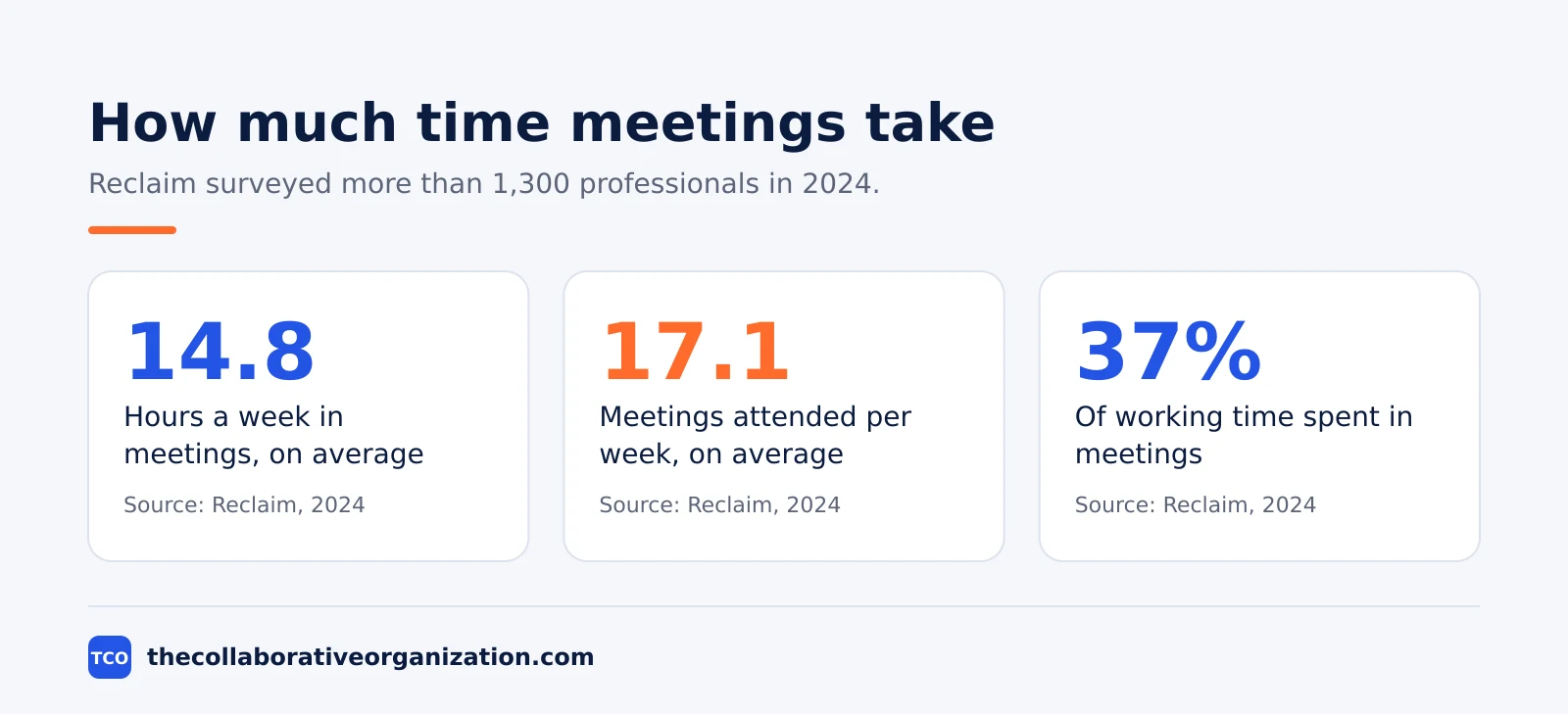
Professionals average 14.8 hours a week in meetings, Reclaim found in 2024 in a survey of more than 1,300 professionals. That is down 31.2% from 21.5 hours a week in 2021, but it is still 37% of their working time.
The count is high as well as the hours. Professionals attend 17.1 meetings a week on average, the same Reclaim report found, and the average meeting lasts 51.9 minutes. That length rose 2.6% from 50.6 minutes in 2021.
Some roles meet far more than others. Engineering averages 16.8 hours a week in meetings, the most of any department, while finance averages 23.7 meetings a week, the highest count, according to the same Reclaim survey. Product meetings average 62.7 minutes, and HR meetings average 66.5 minutes, the longest of any group.
Executives meet the most. On average, executives spend nearly 23 hours a week in meetings, up from less than 10 hours in the 1960s, Harvard Business Review found in 2017. That figure excludes impromptu gatherings that never make it onto the schedule.
Meeting volume has grown sharply since 2020. Employees attended 3 times more Teams meetings and calls per week than in February 2020, a 192% increase, Microsoft found in its 2023 Work Trend Index. The shift to remote and hybrid work drove much of that rise.
Unproductive meetings alone take 5 hours a week per knowledge worker, Asana’s 2024 survey found, double the figure from August 2019. Workers average 5 online or hybrid meetings a week, Owl Labs found in 2025, on top of the in-person ones.
What meetings cost
Meetings cost about $29,129 a year per employee, and the bill scales fast with headcount. The figures below are modelled estimates, so read them as the scale of the cost, not as a measured loss.
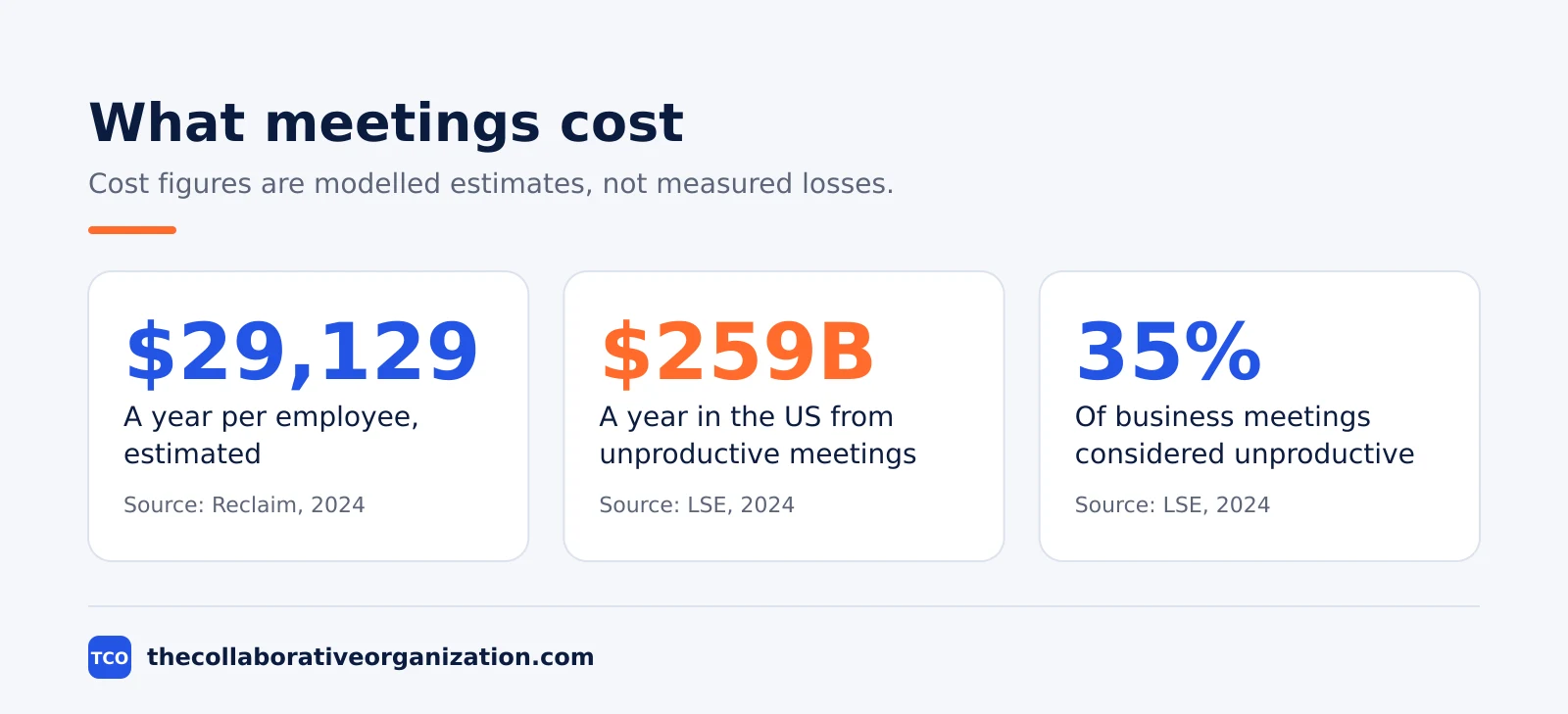
The average annual cost of meetings per employee is $29,129, Reclaim estimated in 2024. The estimate starts from an average salary of $59,384 in the fourth quarter of 2023, adds overhead at 1.325 times salary, and applies the 37% of time spent in meetings.
For a company of 100 employees, that is $2,912,900 a year, the same Reclaim report estimates. For 5,000 employees it is $145,643,200 a year, and for 25,000 employees it is $728,216,000 a year. The cost is linear, so every hire adds the same meeting bill.
One recurring meeting is easy to price. A single weekly team meeting for five employees costs the organization $9,836 a year in time, according to the same Reclaim estimate. Cutting one hour a week of unproductive meetings would save a 5,000-person company $9,835,500 a year.
Managing the calendar costs time too. On average, employees spend 3.0 hours a week managing their meetings, or 36 minutes a day, Reclaim found. That covers setting up meetings, coordinating calendars, and rescheduling.
The national bill is large. Unproductive meetings cost firms an estimated $259 billion a year in the United States and 50 billion pounds in the United Kingdom, the London School of Economics found in 2024. The estimate comes from a survey of more than 3,400 professional employees globally.
Better meetings would return much of it. Generational representation could cut unproductive meetings from 35% to 29%, saving $28 billion a year in the United States, the same LSE report found. Three inclusive behaviours could cut them from 35% to 15%, saving $144 billion a year.
Why meetings fail
Meetings fail for simple reasons: no goal, no agenda, too many people, and no next steps. Atlassian’s 2024 survey of 5,000 knowledge workers is the source for most of the figures in this section.
Meetings are ineffective 72% of the time, Atlassian found in March 2024. In the same survey, 78% of workers said they are expected to attend so many meetings it is hard to get their work done, and 51% work overtime at least a few days a week because of meeting overload.
The overload is physical. In the same Atlassian survey, 76% of workers said they feel drained on days when they have a lot of meetings. For 54% of knowledge workers, meetings dictate the structure of each day instead of time for real work.
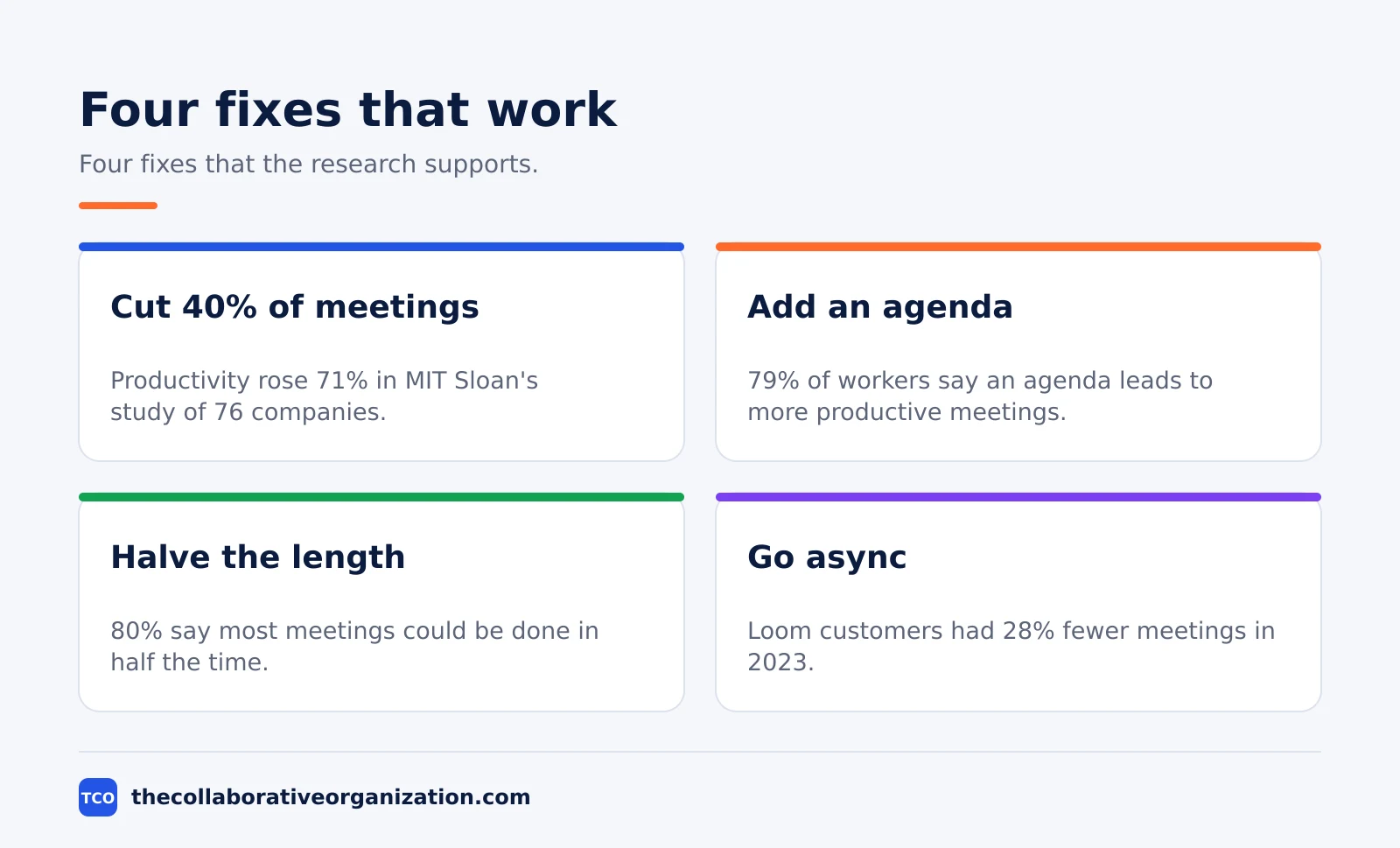
Most meetings could be shorter. In Atlassian’s survey, 80% of workers said most of their meetings could be done in half the time, and 79% said an agenda leads to more productive meetings. Yet 62% often attend meetings that did not state a goal in the invite, the same Atlassian research found.
Meetings also fail to end properly. In the same survey, 54% of workers frequently leave meetings without a clear idea of next steps or who owns which task. Worse, 77% are frequently in meetings that end in a decision to schedule a follow-up meeting, according to the same Atlassian findings.
A few voices dominate. In Atlassian’s survey, 43% of workers said a few people tend to dominate meetings, making it hard to participate. Meetings are also poor at connection: 55% of people say they feel lonely at work, even on days when they attend lots of meetings, the same Atlassian survey found.
One in three meetings should not happen. One-third of meetings are unnecessary, Otter.ai found in 2022, costing companies millions. The London School of Economics found more than one-third (35%) of business meetings are considered unproductive, in its 2024 report.
Diversity in the room helps. In the LSE survey, 71% of workplace meetings do not include representation from the Baby Boomer generation, and 57% do not include Gen Z. Gen X are reported to speak most in 59% of meetings, the same LSE research found.
Most meetings are not even planned. In Microsoft’s 2025 telemetry, 57% of meetings are ad hoc calls without a calendar invite, and 1 in 10 scheduled meetings is booked at the last minute. Half of all meetings fall between 9 and 11 am and 1 and 3 pm, the peak hours for focus work.
Meetings also pile into the evening. Meetings after 8 pm are up 16% year over year, the same Microsoft 2025 report found. Large meetings with 65 or more attendees are the fastest-growing type, and PowerPoint edits spike 122% in the final 10 minutes before a meeting.
What fixes meetings
Four fixes show up again and again: fewer meetings, a written goal, a shorter default, and async instead of live. The figures below come from MIT Sloan, Reclaim, Atlassian, and Owl Labs.
No-meeting days work, up to a point. MIT Sloan studied 76 companies with more than 1,000 employees each that introduced one to five no-meeting days a week. Nearly half (47%) reduced meetings by 40% with two no-meeting days a week, according to the 2022 study.
Cutting meetings by 40% raised productivity 71%, because employees felt more empowered and autonomous, the same MIT Sloan study found. Satisfaction rose 52% in the same comparison. Cutting meetings by 60% raised cooperation 55% and cut stress 57%.
The gains have a limit. With four meeting-free days a week, the potential for micromanaging fell 74% and communication was 65% clearer, the same MIT Sloan research found. But the benefits plateau after a 60% cut and wane when meetings are eliminated entirely, so three no-meeting days a week was the optimum.
People answer each other without meetings anyway. In the MIT Sloan study, 87% of questions get answered at the virtual watercooler, such as a message board or a direct-messaging platform. Our guide on how to run an effective meeting covers how to run the meetings that remain.
The calendar itself leaks meetings. While the average person attends 17.1 meetings a week, 3.5 meetings are declined, skipped, or canceled, and 4.2 are rescheduled, Reclaim found in 2024. That means 20.6 meetings sit on the calendar, but only 83% get attended.
Most of the calendar is on autopilot. In Reclaim’s survey, 52.9% of meetings are recurring and 47.1% are one-time, while 27.3% are spontaneous and unplanned. The most common reason people miss or move a meeting is over-scheduling with another meeting, named by 82.5% of respondents, the same Reclaim report found.
Async video replaces status meetings. Video views on Loom’s platform rose 37% in 2023, and 77 million Loom videos were recorded that year, Atlassian reported in 2024. Loom customers had 28% fewer meetings in 2023 than in 2022.
Shorter meetings have popular support. In Owl Labs’ 2025 survey, 82% of workers prefer meetings to end by 4 pm. Zoom is the default video tool for many teams that cut meeting time.
Our guide on how to reduce meetings at work covers how to audit a calendar and remove the recurring ones that no longer earn their slot.
Common meeting statistics mistakes to avoid
Most bad meeting numbers come from treating a modelled estimate as a measured loss, or from mixing executives with everyone else. Run through the list below before you quote a figure.
- Quoting Reclaim’s $29,129 as a measured loss. It is a modelled estimate built from an average salary of $59,384 and an overhead factor of 1.325. Say “estimated”, not “lost”.
- Mixing Reclaim’s 14.8 hours with HBR’s 23 hours. Reclaim’s figure covers all professionals in 2024, while HBR’s 23 hours covers executives in 2017. They measure different groups in different years.
- Presenting MIT Sloan’s 71% as an experiment. The study surveyed 76 companies that had already cut meetings, and the gains are self-reported. It shows an association, not proof that the cut caused the gain.
- Reading LSE’s 35% as “all meetings are useless”. The LSE survey asked whether meetings were unproductive, not whether they should be cancelled. A third were unproductive, which is not the same as a third being worthless.
- Adding the 3.5 skipped and 4.2 rescheduled meetings. Both come from the same 20.6 meetings on the calendar, and some meetings are both rescheduled and then skipped. Do not add them to get 7.7 lost meetings a week.
The full statistics table
The table below lists 30 statistics from the reports above, grouped by theme, with the source and the year for each one. Use it to check a figure before you quote it. Every number in the table also appears in the text above with a link to its original source.
| Statistic | Source | Year |
|---|---|---|
| 14.8 hours a week in meetings on average | Reclaim Smart Meetings Report | 2024 |
| 37% of working time spent in meetings | Reclaim Smart Meetings Report | 2024 |
| 17.1 meetings attended per week on average | Reclaim Smart Meetings Report | 2024 |
| 51.9 minutes average meeting length | Reclaim Smart Meetings Report | 2024 |
| 23.7 meetings a week for finance, the most | Reclaim Smart Meetings Report | 2024 |
| 16.8 hours a week in meetings for engineering | Reclaim Smart Meetings Report | 2024 |
| 23 hours a week in meetings for executives | Harvard Business Review | 2017 |
| 3 times more Teams meetings than February 2020 | Microsoft Work Trend Index | 2023 |
| 5 hours a week lost to unproductive meetings | Asana State of Work Innovation | 2024 |
| 5 online or hybrid meetings a week on average | Owl Labs State of Hybrid Work | 2025 |
| $29,129 a year per employee cost of meetings | Reclaim Smart Meetings Report | 2024 |
| $2,912,900 a year for 100 employees | Reclaim Smart Meetings Report | 2024 |
| $9,836 a year for one weekly 5-person meeting | Reclaim Smart Meetings Report | 2024 |
| 3.0 hours a week managing meetings | Reclaim Smart Meetings Report | 2024 |
| $259B a year US cost of unproductive meetings | LSE and Protiviti | 2024 |
| 35% of business meetings considered unproductive | LSE and Protiviti | 2024 |
| $144B a year savable with inclusive behaviours | LSE and Protiviti | 2024 |
| Meetings ineffective 72% of the time | Atlassian Workplace Woes | 2024 |
| 78% say too many meetings make work hard | Atlassian Workplace Woes | 2024 |
| 51% work overtime due to meeting overload | Atlassian Workplace Woes | 2024 |
| 80% say most meetings could take half the time | Atlassian Workplace Woes | 2024 |
| 62% often attend meetings with no stated goal | Atlassian Workplace Woes | 2024 |
| 54% leave meetings without clear next steps | Atlassian Workplace Woes | 2024 |
| 77% are in meetings that end in a follow-up | Atlassian Workplace Woes | 2024 |
| One-third of meetings are unnecessary | Otter.ai | 2022 |
| 57% of meetings are ad hoc, with no invite | Microsoft Work Trend Index | 2025 |
| 50% of meetings fall in peak hours (9-11 am, 1-3 pm) | Microsoft Work Trend Index | 2025 |
| Meetings after 8 pm up 16% year over year | Microsoft Work Trend Index | 2025 |
| 47% of companies cut meetings 40% with 2 no-meeting days | MIT Sloan Management Review | 2022 |
| 71% higher productivity after cutting meetings 40% | MIT Sloan Management Review | 2022 |
What the numbers mean
The numbers point at one problem: meetings are the default for every kind of coordination, and the default is wrong a third of the time. A goal, an agenda, and a shorter length fix most of it, and the rest belongs in writing or async video.
The cost makes the case for cutting. At $29,129 a year per employee, a 50-person team spends about $1.46 million a year on meeting time.
Cutting one hour a week of unproductive meetings would save that team about $98,000 a year, using Reclaim’s rate of $1,967 per employee per hour cut.
Our workplace collaboration statistics guide tracks how the same load shows up across email and chat.
Use the numbers to pick one fix, not ten. If the calendar is full of recurring meetings, audit them first. If meetings have no goal in the invite, add one line. Our guide on how to take meeting notes covers how to record decisions so the next meeting does not repeat the last one.
A worked example shows what the numbers mean for one team. Picture a 50-person team where each person spends 14.8 hours a week in meetings, Reclaim’s 2024 figure. That is 740 hours a week, or more than 18 full-time roles spent in meetings.
Cutting meetings by 40%, as 47% of the companies in MIT Sloan’s study did with two no-meeting days a week, would return about 7 roles’ worth of time. The numbers in this example are an illustration, built from Reclaim’s 14.8 hours and MIT Sloan’s 40% cut.
Sources
- Reclaim - Smart Meetings Trends Report (2024)
- Atlassian - Workplace Woes: Meetings Edition (2024)
- Microsoft - Breaking Down the Infinite Workday (2025)
- Microsoft - Will AI Fix Work? Work Trend Index (2023)
- Harvard Business Review - Stop the Meeting Madness (2017)
- London School of Economics - More Than a Third of Business Meetings Are Unproductive (2024)
- MIT Sloan Management Review - The Surprising Impact of Meeting-Free Days (2022)
- Otter.ai - The Cost of Unnecessary Meeting Attendance (2022)
- Asana - The State of Work Innovation 2024 (2024)
- Owl Labs - State of Hybrid Work 2025 (2025)
Frequently asked questions
How many hours a week do people spend in meetings?
Professionals average 14.8 hours a week in meetings, according to Reclaim's 2024 survey of more than 1,300 professionals. That is 37% of their working time. Executives spend more: Harvard Business Review found in 2017 that executives spend nearly 23 hours a week in meetings, up from less than 10 hours in the 1960s.
How much do meetings cost a company?
Reclaim estimated in 2024 that meetings cost about $29,129 a year per employee, based on average salary and an overhead factor. For a company of 100 employees that is $2,912,900 a year. One weekly team meeting for five employees costs $9,836 a year. These are modelled estimates, not measured losses.
What share of meetings are unnecessary?
Otter.ai found in 2022 that one-third of meetings are unnecessary. The London School of Economics found in 2024 that more than one-third, 35%, of business meetings are considered unproductive. The two surveys used different measures, but both put the waste at about a third of all meetings.
Do no-meeting days work?
Yes, up to a point. MIT Sloan studied 76 companies that introduced one to five no-meeting days a week. Cutting meetings by 40% raised productivity 71% and satisfaction 52%. Cutting by 60% raised cooperation 55% and cut stress 57%. The benefits faded when meetings were cut entirely, so three no-meeting days a week was the optimum.
Why are meetings ineffective?
Atlassian found in 2024 that meetings are ineffective 72% of the time. The same survey found 62% of workers often attend meetings that did not state a goal in the invite, 54% leave without a clear idea of next steps, and 43% say a few people tend to dominate. A written goal and an agenda fix most of it.
Related articles
guides
Free Project Management Templates: 7 to Copy (2026)
Seven free project management templates from monday, Wrike, Teamwork, Smartsheet, ClickUp, Asana and Trello, with what each one is for and what free really costs.
November 20, 2026 · 7 min read

guides
Project Proposal Template: Copy and Win Work (2026)
A project proposal template pitches the work before it is approved: problem, solution, scope, budget, timeline and terms. Copy the template and filled example.
November 20, 2026 · 10 min read

guides
Action Plan Template: Goal to Done in One Page (2026)
An action plan template turns one goal into owned steps with dates, dependencies and a success measure. Copy the table and see it filled for a support team.
November 20, 2026 · 11 min read