Too Many Meetings Statistics: 25+ Stats (2026) | The Collaborative Organization
By The Collaborative Organization Team · November 19, 2026 · Last verified November 19, 2026 · 16 min read
Too many meetings cost the average professional 14.8 hours a week, and meetings are rated ineffective 72% of the time. Those two numbers come from Reclaim in 2024 and Atlassian in 2024, and the rest of this article puts 25 more numbers beside them, each with its source and year.
Key takeaways
- Professionals average 14.8 hours a week in meetings, or 37% of the working week, according to Reclaim in 2024.
- Meetings are ineffective 72% of the time, Atlassian found in 2024 in a survey of 5,000 knowledge workers.
- Unnecessary meetings cost about $25,000 per employee per year, Rogelberg and Otter.ai found in 2022.
- More than two hours of meetings a day is the tipping point for feeling overburdened, Slack found in 2023.
- Two no-meeting days a week cut meetings by 40% and lifted productivity ratings by 71%, Laker and colleagues found in 2022.
How we chose these stats
We took every number in this article from the publisher’s own report, press release, or dataset, and we checked each one against that source on 19 November 2026. Vendor surveys are flagged as vendor surveys, and modelled estimates are flagged as estimates. Older studies appear only where no newer original exists for that finding.
We left out figures we could not trace to an original source. The popular claim that the United States wastes $37 billion a year on unproductive meetings traces to a 1989 magazine article with no source behind it, so it does not appear here as a fact.
The sources are Reclaim (2024), Otter.ai and Steven Rogelberg (2022), Atlassian (2024 and 2025), Microsoft (2023, 2024 and 2025), Slack (2023 and 2024), Asana (2023 and 2024), Calendly (2024), Fellow, the London School of Economics (2024), Doodle (2019), Harvard Business Review (2017), and MIT Sloan Management Review (2022).
How much time meetings take
Meetings take between 11 and 18 hours a week for the average professional, depending on the study and the year. The range matters more than any single number, because surveys and calendar data measure different things. Read the figures below as a range, not as one true average.
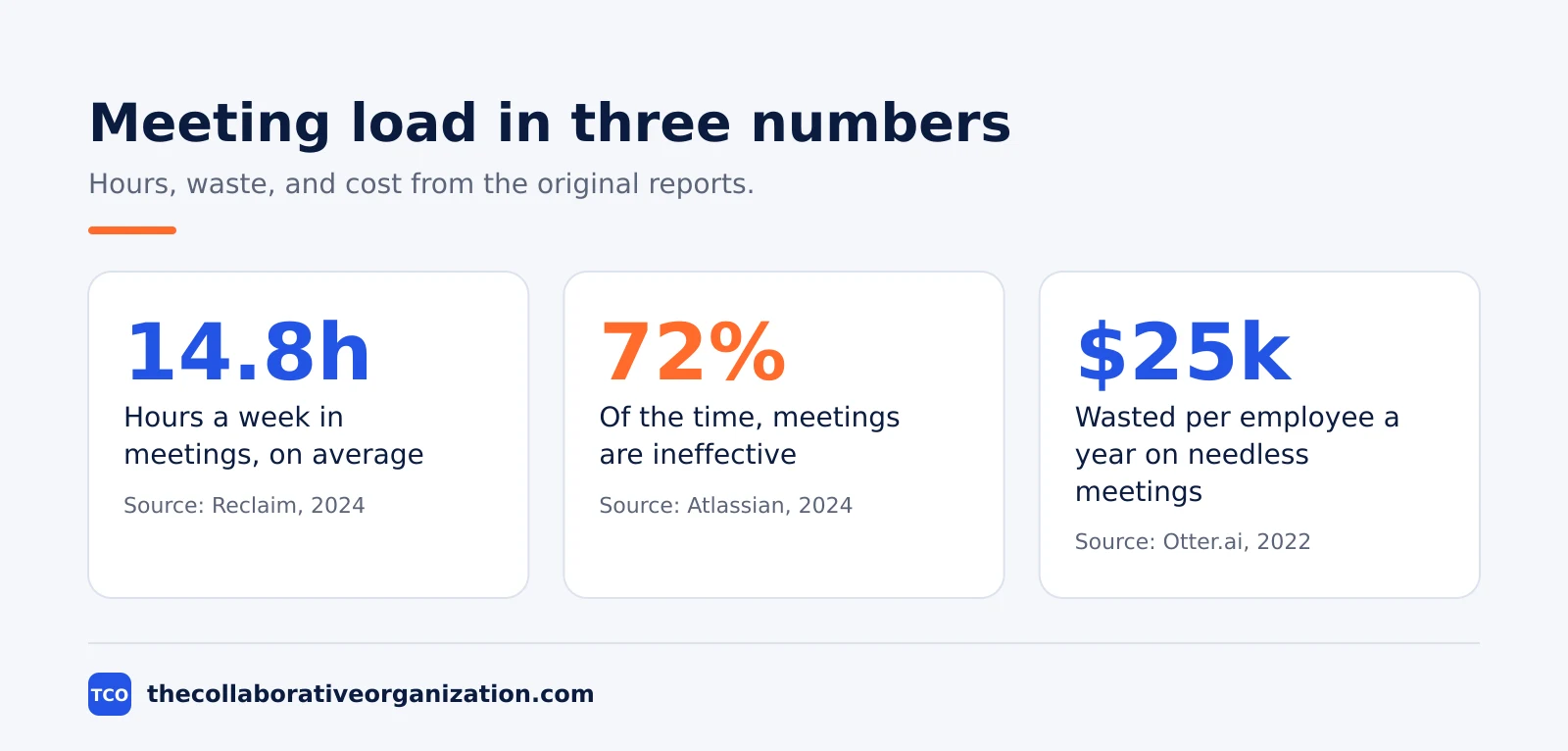
Professionals average 14.8 hours a week in meetings, down 31.2% from 21.5 hours a week in 2021, Reclaim found in 2024 in a survey of more than 1,300 professionals. Even after that fall, meetings still take 37.0% of the working week.
Calendar data tells a similar story at the low end of the range. The average employee spends 11.3 hours a week in meetings, Fellow found from calendar data across more than 30,000 companies. Individual contributors sit in about 9 hours a week, or 20.2% of their workweek.
The high end comes from a 2022 study of 632 employees. They attended 17.7 meetings a week totaling 18 hours, Otter.ai and Steven Rogelberg found in 2022. Managers with four or more direct reports attended 6.9 more meetings and 8.5 more hours a week than other staff.
Meetings also got longer. The average meeting runs 51.9 minutes, up from 50.6 minutes in 2021, Reclaim reported in 2024. Workers attend 17.1 meetings a week on average, and 52.9% of team meetings are recurring.
The calendar is fuller than the attendance figures suggest. Workers have 20.6 meetings a week on their calendars but attend only 83.0% of them, Reclaim found in 2024. On average, 3.5 meetings a week are declined, skipped, or canceled, and 4.2 are rescheduled.
How many meetings are unproductive
Most meetings fail on the basics: no goal, no next steps, and no clear outcome. The figures below come from large surveys, and they agree with each other even though the samples differ.
Meetings are ineffective 72% of the time, Atlassian found in 2024 in a survey of 5,000 knowledge workers across four continents. The same survey ranked meetings as the number one barrier to getting work done.
A third of meetings should not happen at all, in the view of the people in them. Employees said about a third of their meetings were unnecessary, Otter.ai and Rogelberg found in 2022. Nearly half said their calendar held too many unnecessary meetings.
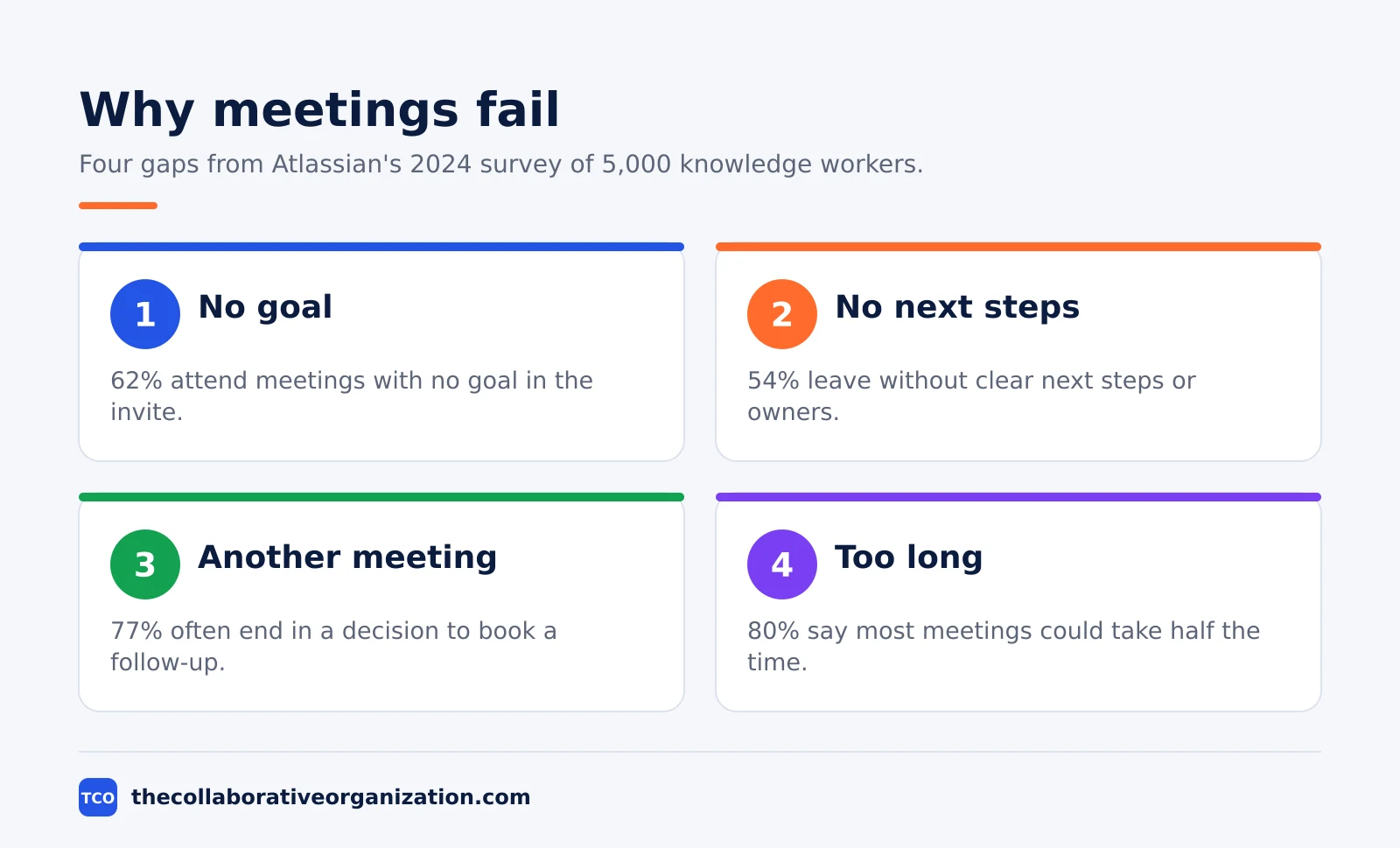
The goal is often missing before the meeting starts. In Atlassian’s 2024 survey, 62% of workers often attend meetings that did not state a goal in the invite. Without a goal, nobody can tell whether the meeting worked.
The ending is often missing too. In the same Atlassian 2024 survey, 54% of workers frequently leave meetings without a clear idea of next steps or who owns each task. A meeting that ends without owners has to be held again.
Many meetings end by booking another meeting. That happened frequently for 77% of workers in Atlassian’s 2024 survey. When the follow-up becomes the outcome, the meeting has failed at its own job.
Workers see the waste clearly. In the same Atlassian 2024 survey, 80% said most of their meetings could be done in half the time, and 79% said an agenda leads to more productive meetings. Shorter meetings with a written goal are the most direct fix.
Inefficient meetings top the list of productivity problems in Microsoft’s research too. People ranked inefficient meetings as their number one productivity disruptor, Microsoft found in its 2023 Work Trend Index, a survey of 31,000 people in 31 countries. Too many meetings ranked third, behind unclear goals.
What meetings cost
The cost of a meeting is the pay of everyone in the room, times the hours, plus the work that did not happen. The figures below price that cost three ways: per employee, per company, and per country.
Companies pay an average of $80,000 per professional employee a year for meeting attendance, and $25,000 of it goes to meetings the employee calls unnecessary, Otter.ai and Rogelberg found in 2022. For a company of 100 people, cutting unnecessary meetings could save over $2 million a year.
A second method reaches a similar total. Reclaim priced the average meeting load at $29,129 a year per employee in 2024, its report shows, using an average salary of $59,384 and a 1.325 multiplier for operational costs. For a company of 5,000 people, that is $145,643,200 a year.
One famous example makes the per-meeting cost concrete. Shopify’s internal calculator put a typical 30-minute meeting with three employees at $700 to $1,600 in 2023, and adding an executive pushed it above $2,000, Bloomberg reported at the time. The tool used fully loaded pay data, not base salary alone.
The economy-wide estimates are modelled, not measured, so read them as the scale of the problem. Unproductive meetings cost US firms an estimated $259 billion a year, the London School of Economics estimated in 2024, in a survey of more than 3,400 professional employees. In the same study, 35% of business meetings were rated unproductive.
An older estimate puts the number higher. Poorly organized meetings were projected to cost US companies $399 billion in 2019, Doodle estimated in its State of Meetings report, based on 19 million meetings and 6,528 professionals. Professionals spent two hours a week in pointless meetings, or 13 days a year.
A public benchmark helps price your own meetings. Private industry employers paid $46.89 per hour worked in June 2026, the US Bureau of Labor Statistics reported, with $32.82 in wages and $14.07 in benefits. Eight people in a one-hour meeting therefore cost about $375 at the national average, before any preparation time.
Who feels it most
The meeting load rises with seniority, and executives feel it most. The figures below split the average by role, because a single average hides the spread.
Executives spend an average of nearly 23 hours a week in meetings, up from under 10 hours in the 1960s, Harvard Business Review reported in 2017. The figure covers executives, not every office worker, so do not apply it to a whole company.
Senior managers rate their meetings badly. In a survey of 182 senior managers, 71% said meetings are unproductive and inefficient, Harvard Business Review found in 2017. In the same survey, 65% said meetings keep them from completing their own work, and 64% said meetings come at the expense of deep thinking.
The overload shows up as overtime. In Atlassian’s 2024 survey, 51% of workers have to work overtime at least a few days a week because of meeting overload, and the figure rises to 67% at director level and above. Three in four workers feel drained on days with lots of meetings.
The tipping point arrives early in the day. More than two hours of meetings a day is the point at which a majority of desk workers feel overburdened, Slack found in 2023 in a survey of 10,333 desk workers. In the same survey, 27% of desk workers and 55% of executives said they spend too much time in meetings.
Unnecessary meetings also eat more senior time. They take 2.8 hours a week for the average knowledge worker and 3.6 hours a week for senior leaders, Asana found in 2023 in a survey of 9,615 knowledge workers. The same survey put “work about work” at 58% of the workday.
The load has grown since 2019. Unproductive meetings now take 5 hours a week per knowledge worker, Asana found in 2024, double the figure from August 2019. In the same survey, 44% of workers said they dread meetings.
When meetings pile up
Meetings pile into the best hours of the day, and a large share are never planned at all. The timing figures below come from Microsoft’s telemetry, which measures what actually happened rather than what people remember.
Most meetings are ad hoc. In Microsoft’s 2025 telemetry, 57% of meetings are ad hoc calls without a calendar invite, and 1 in 10 scheduled meetings is booked at the last minute. A short daily check-in, like the standup in our daily standup meeting format guide, replaces many of these calls with one fixed slot.
Meetings take the peak hours. In the same Microsoft 2025 report, 50% of meetings fall between 9 and 11 am and 1 and 3 pm, and 30% span multiple time zones. Meetings after 8 pm are up 16% year over year.
The volume has grown sharply since 2020. People were in three times more Teams meetings and calls per week than in February 2020, a 192% increase, Microsoft found in 2023. Only 35% of workers said they would be missed in the majority of their meetings.
Scheduling itself is a second job. Workers spend 3 hours a week just scheduling meetings, Calendly found in 2024, and 43% spend at least three hours a week on scheduling, up from 36% the year before. Nearly half of workers, 46%, have three or more meetings a day.
Large companies meet more. In the same Calendly 2024 survey, 59% of enterprise employees spend five or more hours a week in meetings, against 32% at small and midsize businesses. Half of sales professionals spend five or more hours a day in meetings.
Workers still protect their own time where they can. In Owl Labs’ 2024 State of Hybrid Work, 63% of workers block time in their calendars to protect it from meetings. In the same survey, 92% said meetings after 4:30 pm are too late.
What fixes the load
The fixes that work are boring: fewer meetings, a written goal, and a no-meeting day. The evidence below comes from a 76-company study and from Atlassian’s own experiments.
Two no-meeting days a week cut meetings by 40% and lifted productivity ratings by 71%, Laker and colleagues found in 2022 in a study of 76 companies with more than 1,000 employees each. Three no-meeting days a week was the optimum in that study, and the gains fell when meetings were cut entirely.
Async video can replace the status meeting. Views on Loom’s platform were up 37% in 2023, with customers reporting 23% fewer meetings that year, Atlassian reported in 2024. A recorded update carries the same facts without taking everyone’s hour.
Writing the answer down removes the need to ask for it. In Atlassian’s State of Teams 2025, 56% of knowledge workers said they often have to ask someone or book a meeting to get the information they need.
A shared page with the answer on it ends that chain, and our meeting notes vs minutes guide shows what to record when a meeting does happen.
Poor meeting cultures cost more than good ones. In organizations with poor meeting cultures, people spend 50% more time in unnecessary meetings than on high-priority work, Atlassian found in 2024. In the same study, 93% of executives said teams could deliver similar outcomes in half the time with better collaboration.
Workers want better meetings, not zero meetings. In Calendly’s 2024 survey, 81% said more productive meetings could help them at work, and 54% said meetings enhance their productivity. The complaint is about bad meetings, and the fix is to make the ones that stay worth the hour.
A video tool helps only when the meeting itself is worth holding. Zoom Pro costs $14.16 per user per month billed annually, or $16.99 billed monthly, as of November 2026, with meetings up to 30 hours and 100 participants.
Compare the options on our video conferencing software shortlist before you buy a tool to fix a habit problem.
A worked example: one team’s meeting bill
A worked example shows what the numbers mean for one team of 20 people. Picture a 20-person team where each person averages 14.8 hours a week in meetings, the Reclaim 2024 figure. That is 296 hours a week, or about seven full-time roles spent in meetings.
If a third of those meetings are unnecessary, the Otter.ai and Rogelberg 2022 share, the team loses about 99 hours a week. At the Bureau of Labor Statistics rate of $46.89 per hour worked in June 2026, that is about $4,640 a week, or about $241,000 a year for 52 weeks.
Cutting those unnecessary meetings in half would return about 50 hours a week to the team. The numbers in this example are an illustration, built from the Reclaim, Otter.ai, and Bureau of Labor Statistics figures above, not a measurement of any real team.
A planning meeting, like the one in our sprint planning meeting guide, is the kind of meeting to keep, because it sets the work for the week.
Common too-many-meetings mistakes to avoid
Most teams try to fix meeting overload with a new tool, when the fix is a decision about which meetings exist. The mistakes below show up in almost every overloaded calendar.
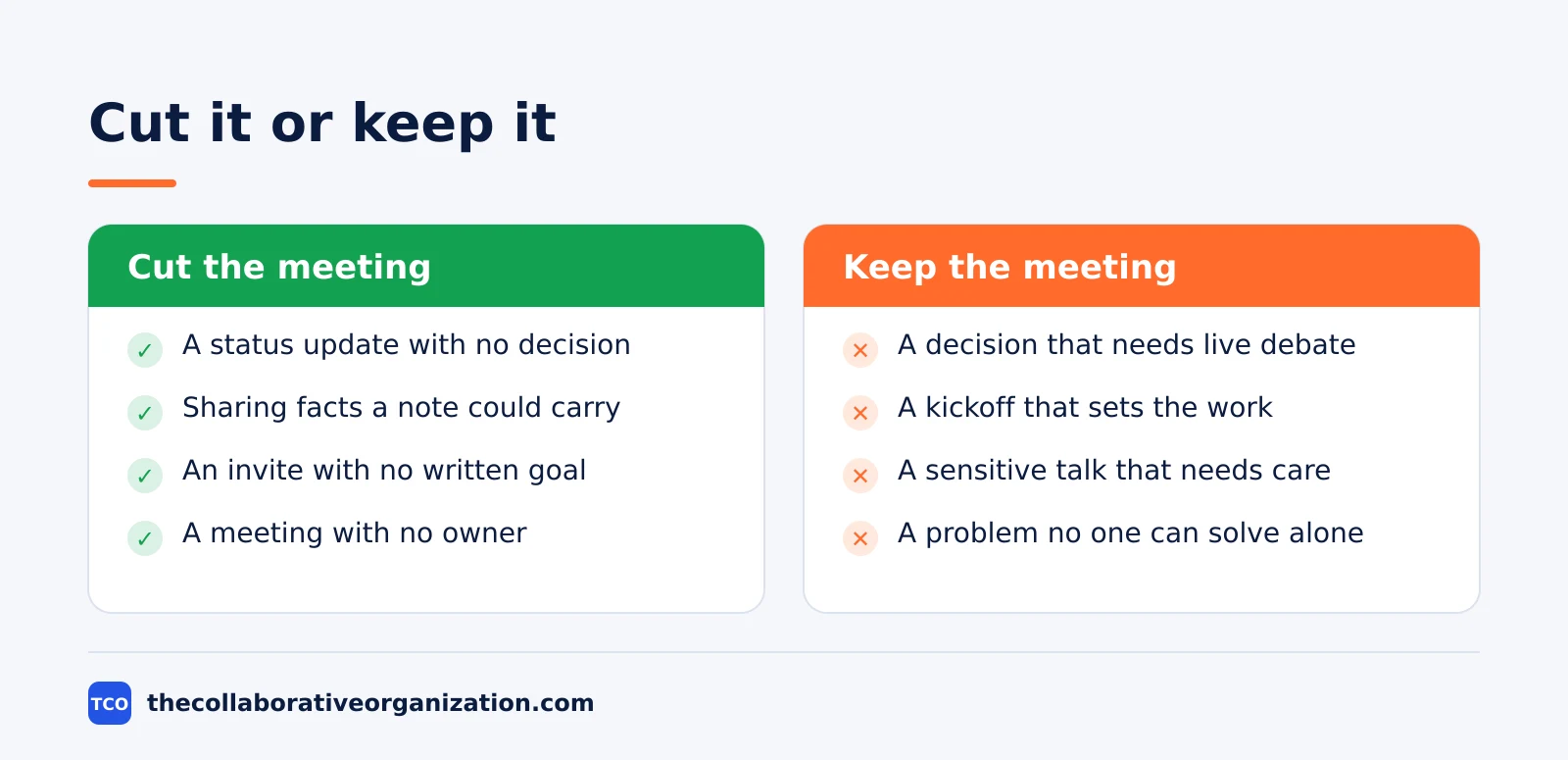
- Booking a meeting to share facts. A status update is a written note, not a meeting. Send the update and keep the hour.
- Inviting everyone “just in case”. Every extra attendee adds cost and adds nothing to the decision. Invite the people who must decide or act.
- Skipping the goal in the invite. If the invite does not say what the meeting must decide, people arrive unprepared and the meeting drifts.
- Ending without owners and dates. A meeting that ends with no named owner and no date has to be held again, which is how calendars fill up.
- Treating every meeting as 30 or 60 minutes. Most meetings could be done in half the time, Atlassian found in 2024, so set the length the decision needs.
- Cutting all meetings at once. Laker and colleagues found in 2022 that gains fell when meetings were removed entirely. Keep the meetings that decide, debate, or kick off work, and cut the rest. Our sprint review vs retrospective guide shows two meetings that earn their place.
The full statistics table
The table below lists 30 statistics from the reports above, grouped by theme, with the source and the year for each one. Every number in the table also appears in the text above with a link to its original source.
| Statistic | Source | Year |
|---|---|---|
| 14.8 hours a week in meetings on average | Reclaim Smart Meetings | 2024 |
| 21.5 hours a week in meetings in 2021 | Reclaim Smart Meetings | 2021 |
| 37.0% of work time spent in meetings | Reclaim Smart Meetings | 2024 |
| 17.1 meetings a week on average | Reclaim Smart Meetings | 2024 |
| 51.9 minutes, average meeting length | Reclaim Smart Meetings | 2024 |
| 52.9% of team meetings are recurring | Reclaim Smart Meetings | 2024 |
| 3.5 meetings a week declined, skipped, or canceled | Reclaim Smart Meetings | 2024 |
| 4.2 meetings a week rescheduled | Reclaim Smart Meetings | 2024 |
| 3.0 hours a week spent managing meetings | Reclaim Smart Meetings | 2024 |
| $29,129 a year cost of meetings per employee | Reclaim Smart Meetings | 2024 |
| 11.3 hours a week in meetings (calendar data) | Fellow State of Meetings | 2024 |
| 17.7 meetings a week, totaling 18 hours | Otter.ai and Rogelberg | 2022 |
| About a third of meetings are unnecessary | Otter.ai and Rogelberg | 2022 |
| $25,000 a year wasted per employee on unnecessary meetings | Otter.ai and Rogelberg | 2022 |
| $80,000 a year paid per employee for meeting attendance | Otter.ai and Rogelberg | 2022 |
| 72% of the time, meetings are ineffective | Atlassian Workplace Woes | 2024 |
| 78% say too many meetings make work hard | Atlassian Workplace Woes | 2024 |
| 51% work overtime due to meeting overload | Atlassian Workplace Woes | 2024 |
| 80% say most meetings could take half the time | Atlassian Workplace Woes | 2024 |
| 62% attend meetings with no goal in the invite | Atlassian Workplace Woes | 2024 |
| 54% leave meetings without clear next steps | Atlassian Workplace Woes | 2024 |
| 77% often in meetings that end by scheduling another | Atlassian Workplace Woes | 2024 |
| 57% of time in Microsoft 365 spent communicating | Microsoft Work Trend Index | 2023 |
| 192% increase in Teams meetings since February 2020 | Microsoft Work Trend Index | 2023 |
| 57% of meetings are ad hoc, with no invite | Microsoft Work Trend Index | 2025 |
| Meetings after 8 pm up 16% year over year | Microsoft Work Trend Index | 2025 |
| More than 2 hours of meetings a day is the tipping point | Slack Workforce Index | 2023 |
| 46% of workers have 3 or more meetings a day | Calendly State of Meetings | 2024 |
| 35% of business meetings are unproductive | London School of Economics | 2024 |
| $259 billion a year cost of unproductive meetings in the US | London School of Economics | 2024 |
What the numbers mean
The numbers point at one problem: meetings have become the default way to move information, and information moves badly in meetings. People book a meeting to ask a question, share a fact, or check a status, and each of those jobs is cheaper in writing. Our workplace collaboration statistics guide shows the same pattern across email and chat.
Three rules follow from the data. First, give every meeting a written goal and a named owner, because 62% of meetings have no goal and 54% end with no next steps. Second, cut the recurring meetings first, because they make up more than half of team meetings and nobody re-checks them.
Third, protect two days a week, because the 76-company study found that two no-meeting days cut meetings by 40% and lifted productivity ratings.
Do not quote a single average as if it were a law. The range runs from 11.3 hours a week in calendar data to 18 hours a week in a 2022 survey, and executives sit in nearly 23 hours a week.
Measure your own team’s hours for two weeks, then cut the meetings with no goal, no decision, and no owner. That is the fix the numbers support.
Sources
- Reclaim - Smart Meetings Trends Report (2024)
- Otter.ai - The Cost of Unnecessary Meeting Attendance (2022)
- Atlassian - Workplace Woes: Meetings Edition (2024)
- Microsoft - Will AI Fix Work? Work Trend Index (2023)
- Microsoft - Breaking Down the Infinite Workday (2025)
- London School of Economics - More Than a Third of Business Meetings Are Unproductive (2024)
- MIT Sloan Management Review - The Surprising Impact of Meeting-Free Days (2022)
- Harvard Business Review - Stop the Meeting Madness (2017)
- Asana - Anatomy of Work Global Index 2023 (2023)
- US Bureau of Labor Statistics - Employer Costs for Employee Compensation (2026)
Frequently asked questions
How many hours a week do people spend in meetings?
It depends on who you ask, but the range is 11 to 18 hours a week. Reclaim found 14.8 hours a week in 2024, Otter.ai and Rogelberg found 18 hours in 2022, and Fellow found 11.3 hours from calendar data. Managers and executives sit in more meetings than individual contributors, so a single average hides a wide spread by role.
What share of meetings are unnecessary?
About a third, according to the Otter.ai and Rogelberg study from 2022, in which employees said a third of their meetings were unnecessary. Atlassian found in 2024 that meetings are ineffective 72% of the time, which is a different measure: a meeting can be necessary and still run badly. Both numbers point to the same fix, which is fewer meetings with clearer goals.
How much do unnecessary meetings cost?
Rogelberg and Otter.ai put the cost at about $25,000 per employee per year in 2022, out of $80,000 a year spent on meeting attendance. Reclaim put the total cost of all meetings at $29,129 per employee per year in 2024. The London School of Economics estimated in 2024 that unproductive meetings cost US firms $259 billion a year, a modelled estimate rather than a measured loss.
How many meetings a day are too many?
Slack found in 2023 that more than two hours of meetings a day is the tipping point at which most desk workers feel overburdened. Calendly found in 2024 that 46% of workers have three or more meetings a day. The count matters less than the total hours and whether the meetings have a goal, an owner, and a decision at the end.
Do meeting-free days actually help?
Yes, up to a point. Laker and colleagues found in 2022 that 76 large companies with two no-meeting days a week cut meetings by 40% and saw productivity ratings 71% higher. Three no-meeting days a week was the optimum in that study, and the gains fell when meetings were cut entirely, because teams still need live time for decisions and connection.
Related articles

video conferencing
Loom vs Zoom Clips: Which Async Video Tool Wins? (2026)
Loom is the dedicated async video tool, while Zoom Clips is built into Zoom Workplace. Compare recording, editing, analytics and price to pick the right one.
November 19, 2026 · 9 min read
video conferencing
How to Reduce Meetings at Work: A 5-Week Plan (2026)
Cut meetings by a third without losing decisions: audit the calendar, cancel the weak ones, replace updates with writing, and protect focus days.
November 19, 2026 · 10 min read

video conferencing
How to Run an Effective Meeting in 7 Steps (2026)
An effective meeting starts with a clear purpose, a short agenda and named owners for every action. Follow 7 steps to run meetings people value.
November 19, 2026 · 12 min read