Zoom Fatigue Statistics: 30 Numbers That Explain It (2026) | The Collaborative Organization
By The Collaborative Organization Team · November 19, 2026 · Last verified November 19, 2026 · 11 min read
Zoom fatigue is real, and researchers have measured it in surveys, field experiments and brain scans. The numbers here come from the original studies, not from roundups. They cover who feels it most, what causes it, what it does to the brain, and how many meetings people sit through. Start with the table, then read what the numbers mean.
Key takeaways
- In Stanford’s 2021 survey of 10,322 people, 13.8% of women and 5.5% of men felt very or extremely fatigued after video calls.
- Camera-on days were more tiring than camera-off days across 1,408 daily reports from 103 employees in 2021.
- Ten-minute breaks kept stress-linked brain activity steady in Microsoft’s 2021 EEG study of 14 people.
- Workers average 5 online meetings a week, and 77% lost time to technical difficulties in Owl Labs’ 2025 survey.
- Meetings are ineffective 72% of the time, Atlassian found in a 2024 survey of 5,000 knowledge workers.
How big is Zoom fatigue, and who feels it most
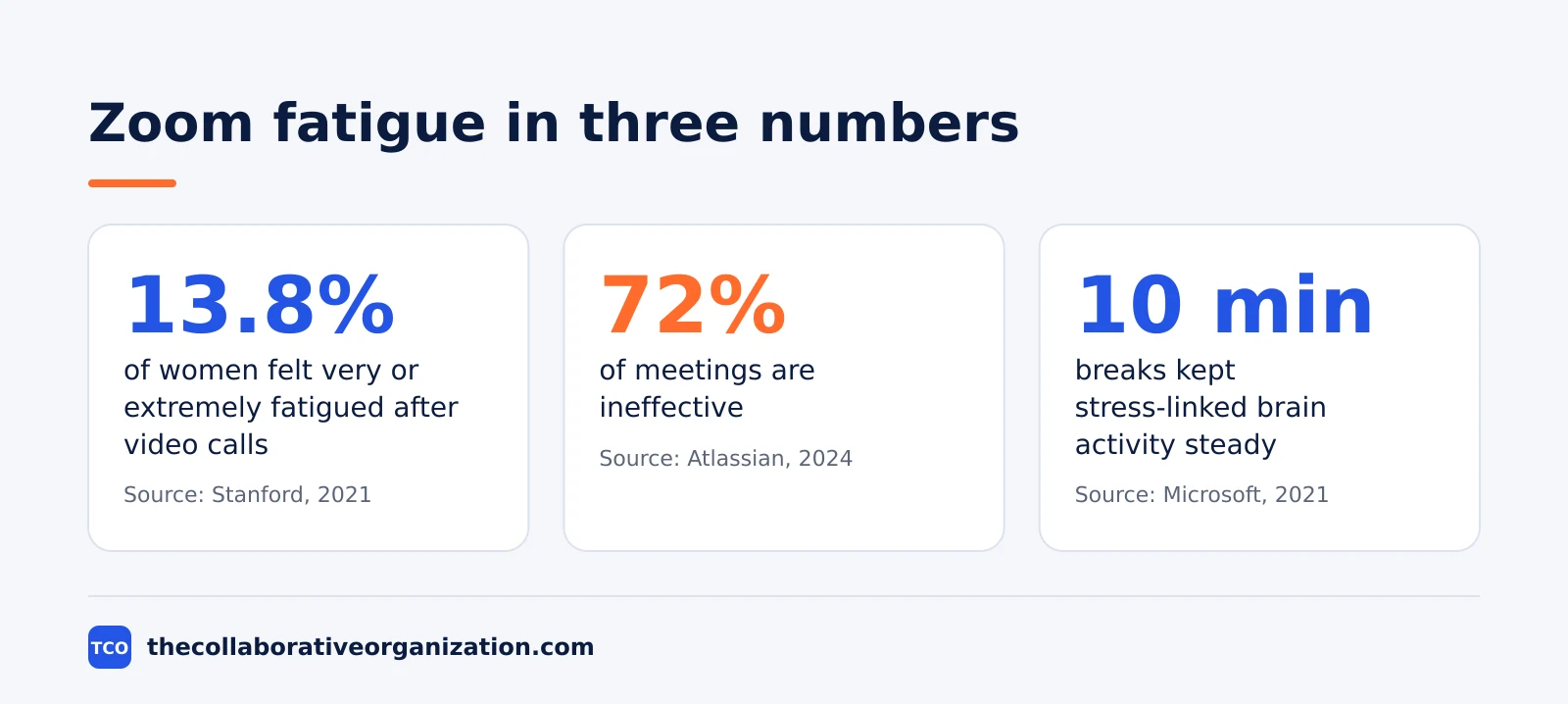
Zoom fatigue is common, and it hits some people much harder than others. In Stanford’s 2021 survey of 10,322 people, 13.8% of women and 5.5% of men said they felt very or extremely fatigued after video calls. That is about 1 in 7 women and 1 in 20 men.
The same survey found that the extra fatigue for women came mostly from self-view. Women had the same number of meetings per day as men, but their meetings ran longer and they took fewer breaks. Introverts reported more exhaustion than extraverts, younger people more than older people, and people of color slightly more than white participants in early data.
The scale shows in wider surveys too. In the UK, 55% of workers in a 2025 Kahoot survey of 2,000 professionals said they suffer video-call fatigue, and 87% said at least some of their video meetings are not needed.
Atlassian’s 2024 survey of 5,000 knowledge workers found the same drain: 76% said they feel drained on days with a lot of meetings, and 72% rated meetings ineffective. The numbers below come from the original reports, and the full table lists all 30.
What causes Zoom fatigue
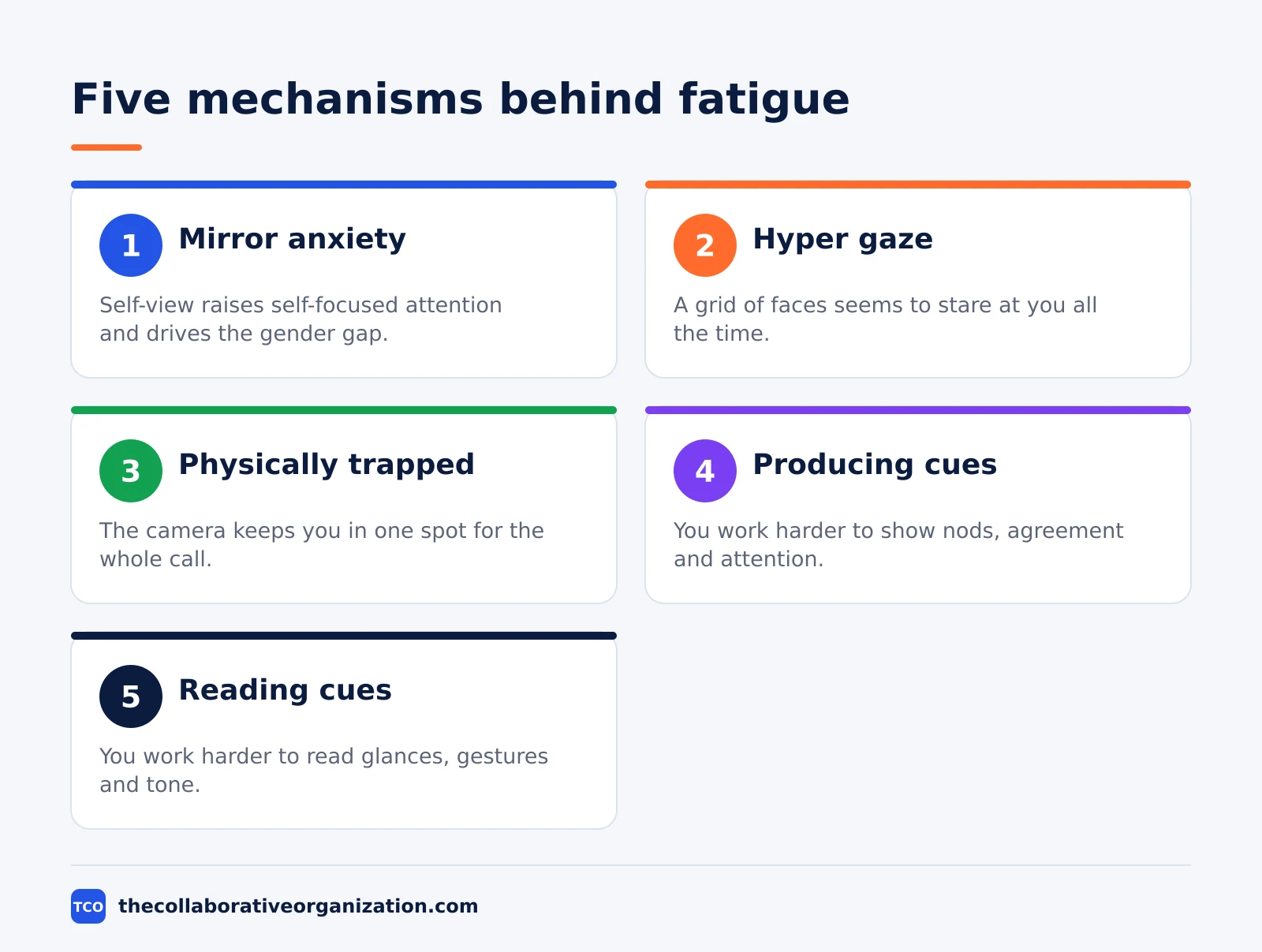
Five nonverbal mechanisms predict Zoom fatigue, and feeling physically trapped is the strongest of them. Stanford’s Jeremy Bailenson named four causes in 2021: close-up eye contact, constant self-view, reduced movement and higher mental load. A follow-up study of 9,787 people tested those ideas and found all five mechanisms predicted fatigue.
The five mechanisms together explained 29% of the variation in fatigue scores in the 2021 analysis. Mirror anxiety, the self-focused attention from seeing yourself on screen, explained the gender gap: it carried the difference between women’s and men’s fatigue scores. Women also had longer meetings and shorter breaks than men.
The camera adds its own cost on top of the five mechanisms. In a four-week experiment with 103 employees, days with cameras on were more tiring than days with cameras off, and the effect was stronger for women and newer employees. Tired people spoke up less and engaged less in meetings that day and the next.
What it does to the brain and body
Video calls tire the brain and body in ways that show up on scans, not only in surveys. Microsoft’s lab put EEG caps on 14 people for two days of video meetings. Without breaks, beta wave activity linked to stress kept rising across four 30-minute meetings. With 10-minute breaks, it held steady.
A 2023 study from Austria measured brain and heart signals during the same 50-minute lecture in person and over video. The video lecture left people significantly more fatigued, tired, drowsy and fed up, and the readings matched what people reported. It was the first study to show videoconference fatigue on a brain level.
Video also narrows thinking. In a 2022 study in Nature, pairs working over video generated fewer creative ideas than pairs in person, across a lab study of 602 people and a field study of 1,490 employees in five countries. The same pairs were no worse at choosing between ideas, so video suits decisions more than brainstorming.
The meeting load behind the fatigue
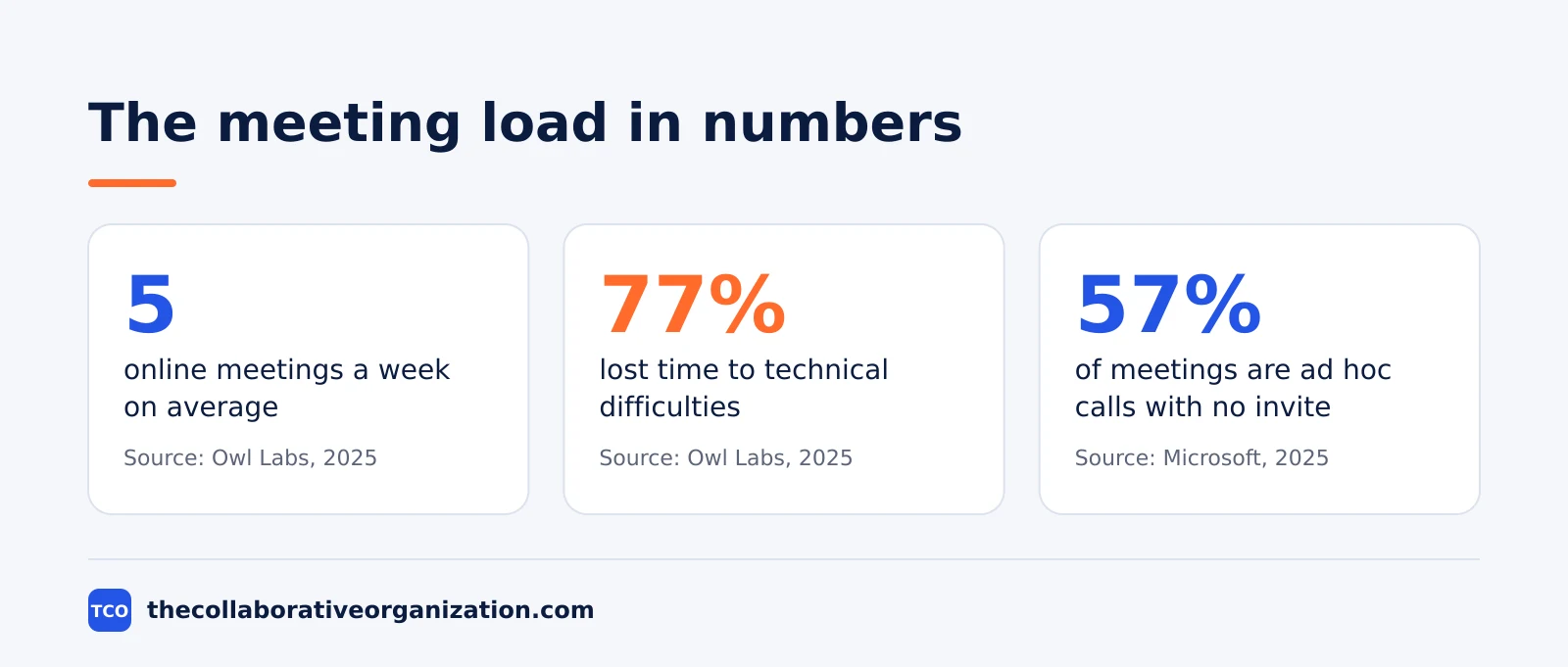
The fatigue sits on top of a heavy meeting load. Owl Labs’ 2025 survey of 2,000 US workers found an average of 5 online meetings and 5 face-to-face meetings a week. In the same survey, 77% said they had lost time to technical difficulties, and 67% had given up trying to set up video technology in a meeting space.
Microsoft’s 2025 telemetry shows the load is also unplanned. In its data, 57% of meetings are ad hoc calls without a calendar invite, and 1 in 10 scheduled meetings is booked at the last minute. The same report counts 117 emails a day and 153 Teams messages per weekday for the average worker.
Hybrid work spreads the load across home and office. Gallup’s 2025 survey found 51% of remote-capable US employees work hybrid, and those workers spend 46% of their week, or 2.3 days, on site. The hybrid share fell from 55% over two quarters, while fully remote and fully on-site work each rose two points.
Remote workers still want the flexibility behind the load. Buffer’s 2023 survey of 3,000 remote workers found 98% would like to work remotely at least some of the time for the rest of their careers, and 75% spend 1 to 10 hours a week in meetings.
Zoom fatigue statistics: the full table
The table below lists all 30 statistics in one place. Each row names the figure, links to the original source, and gives the year the data was published. Survey figures describe the people surveyed, telemetry figures describe Microsoft 365 users, and lab figures describe small groups, so read each row with its source in mind.
| Stat | Source | Year |
|---|---|---|
| 13.8% of women felt very or extremely fatigued after video calls | Stanford | 2021 |
| 5.5% of men felt very or extremely fatigued after video calls | Stanford | 2021 |
| 10,322 people surveyed in Stanford’s fatigue study | Stanford | 2021 |
| 29% of fatigue variation explained by five nonverbal mechanisms | SSRN | 2021 |
| 1,408 daily reports from 103 employees in the camera experiment | PubMed | 2021 |
| 14 people wore EEG caps in Microsoft’s break study | Microsoft | 2021 |
| 35 students took a 50-minute lecture in person and over video | Nature | 2023 |
| 1,490 employees in 5 countries generated fewer creative ideas over video | Nature | 2022 |
| 54% of workers said they feel overworked | Microsoft | 2021 |
| 39% of workers described themselves as outright exhausted | Microsoft | 2021 |
| 57% of meetings are ad hoc calls without a calendar invite | Microsoft | 2025 |
| 1 in 10 scheduled meetings is booked at the last minute | Microsoft | 2025 |
| 30% of meetings span multiple time zones | Microsoft | 2025 |
| 50% of meetings fall in peak hours, 9-11 am and 1-3 pm | Microsoft | 2025 |
| 117 emails received per worker per day | Microsoft | 2025 |
| 153 Teams messages received per weekday | Microsoft | 2025 |
| 275 interruptions a day, about one every 2 minutes (heaviest users) | Microsoft | 2025 |
| Meetings after 8 pm up 16% year over year | Microsoft | 2025 |
| 48% of employees say work feels chaotic and fragmented | Microsoft | 2025 |
| 5 online meetings a week on average | Owl Labs | 2025 |
| 77% of workers lost time to technical difficulties | Owl Labs | 2025 |
| 6 minutes lost on average getting a hybrid meeting started | Owl Labs | 2025 |
| 67% gave up trying to set up video technology in a meeting space | Owl Labs | 2025 |
| 51% of remote-capable US employees work hybrid | Gallup | 2025 |
| 2.3 days a week hybrid workers spend on site | Gallup | 2025 |
| 55% of UK workers suffer video-call fatigue | ITPro | 2025 |
| 87% say at least some video meetings are not needed | ITPro | 2025 |
| 72% of meetings are ineffective | Atlassian | 2024 |
| 76% feel drained on days with a lot of meetings | Atlassian | 2024 |
| 98% of remote workers want to keep working remotely at least some time | Buffer | 2023 |
What the numbers mean
The numbers point to three conclusions: the fatigue is real, the camera is the biggest lever, and fewer meetings beat better meetings. Brain scans and field experiments agree with the surveys, so this is not only a feeling people report. The camera experiment is the strongest evidence, because it changed one thing and watched fatigue follow.
Breaks are the cheapest fix the data supports. Ten minutes between meetings kept stress-linked brain activity steady in a 14-person lab study, while back-to-back meetings let it climb. Shorter meetings help too: 80% of workers in Atlassian’s 2024 survey said most meetings could be done in half the time.
Cutting meetings beats polishing them. In Owl Labs’ 2025 survey, 77% of workers lost time to tech trouble and 67% gave up on meeting-room video, so a shorter call list removes the worst calls first. A video call vs a phone call is one cut to make: the phone removes the visual load that video adds.
Read the numbers with their limits in mind. Most figures come from surveys, which show links, not causes. The lab studies are small: 14 people in the Microsoft EEG study and 35 in the Riedl study. Our workplace collaboration statistics guide applies the same checks to a wider set of team numbers.
How we chose these stats
Every number in this article comes from the original publisher, checked against that source on 19 November 2026. We used peer-reviewed papers where they exist, vendor telemetry for measured behaviour, and the survey owner’s own report for survey figures. Aggregator roundups were read and left out, and any figure we could not trace to a published study was dropped.
Two figures need a note. Microsoft’s report says 57% of meetings are ad hoc in its body text, while its methodology note gives 60% for the heaviest meeting users; this article uses the 57% figure. The 275 interruptions a day figure also covers the heaviest users, the top 20% by ping volume, not the average worker.
Hybrid and remote figures describe different groups, so do not mix them. Gallup’s 51% hybrid figure covers remote-capable US employees, while Owl Labs’ 5 meetings a week covers all full-time US workers in its survey. Our guide to remote and hybrid work explains the difference between the groups.
Tools that cut the meeting load
Tools help when they cut the number of meetings, not when they add features to them. A short async video can replace a status call, and a shared document can replace a read-out. The three tools below all support recordings, polls and breakout rooms, and each has a free plan. Pick the one your team already uses.
The prices below are as of November 2026. Zoom lists Pro at $14.16 per user per month billed annually, and Webex lists Meet at $12. Google Workspace Starter is $7 per user per month on an annual plan. Our video conferencing software shortlist compares these tools side by side.
| Tool | Best for | Free plan | Starting price (as of November 2026) | Notable limit |
|---|---|---|---|---|
| Zoom | Long meetings with polls and breakout rooms | Basic, free, 40-minute meetings, 100 participants | $14.16 per user per month (Pro), billed annually | Pro caps at 100 participants per meeting |
| Google Meet | Teams already on Google Workspace | Free with a Google account, 60-minute meetings, 100 participants | $7 per user per month (Business Starter), billed annually | Starter has no meeting recording |
| Webex | Long meetings with more people | Free, 40-minute meetings, 100 attendees | $12 per user per month (Meet), billed annually | Meet caps at 200 attendees per meeting |
Zoom’s own pricing page shows Pro at $16.99 per user per month billed monthly and $14.16 billed annually, with meetings up to 30 hours and 10 GB of cloud storage per user.
Webex lists Meet at $144 per user per year on the Webex pricing page, with 24-hour meetings and 200 attendees.
Google Workspace Starter is $7 per user per month on an annual plan, or $8.40 on the flexible plan, according to independent reads of the Google Workspace pricing page.
Sources
- Stanford News - Four causes for Zoom fatigue and their solutions (2021)
- Stanford News - Zoom fatigue worse for women (2021)
- Microsoft WorkLab - Research proves your brain needs breaks (2021)
- Microsoft WorkLab - Breaking down the infinite workday (2025)
- Nature - Videoconference fatigue from a neurophysiological perspective (2023)
- PubMed - The fatiguing effects of camera use in virtual meetings (2021)
- Owl Labs - State of Hybrid Work 2025 (2025)
- Gallup - Hybrid Work in Retreat? Barely (2025)
- Atlassian - Workplace Woes: Meetings (2024)
- Buffer - State of Remote Work 2023 (2023)
Frequently asked questions
How common is Zoom fatigue?
Very common. In Stanford's 2021 survey of 10,322 people, 13.8% of women and 5.5% of men felt very or extremely fatigued after video calls. In a 2025 UK survey of 2,000 workers, 55% said they suffer video-call fatigue. The figures come from different groups, so they describe different populations, not one single rate.
Is Zoom fatigue worse for women?
Yes, in the research so far. Stanford's 2021 survey found 13.8% of women and 5.5% of men felt very or extremely fatigued after video calls. The main driver was self-view: seeing yourself on screen raises self-focused attention, and women reported more of that strain. A 2023 follow-up with 9,787 people found the same pattern.
Does turning the camera off help?
Yes. In a four-week experiment with 103 employees, camera-on days were more tiring than camera-off days, and tired people spoke up less in meetings. The effect was stronger for women and newer employees. Turning the camera off for parts of a call, or hiding self-view, cuts the strain without ending the meeting.
How many meetings do people have each week?
Owl Labs' 2025 survey of 2,000 US workers found an average of 5 online meetings and 5 face-to-face meetings a week. Buffer's 2023 survey of 3,000 remote workers found 75% spend 1 to 10 hours a week in meetings. Both figures are survey averages, so individual weeks vary a lot.
What is the best fix for Zoom fatigue?
Cut the number of video calls first, then fix the ones that stay. Hide self-view, shrink the video window, add 10-minute gaps between meetings, and use audio-only spells for long calls. In Microsoft's lab study, 10-minute breaks kept stress-linked brain activity steady across four 30-minute meetings.
Related articles

video conferencing
Loom vs Zoom Clips: Which Async Video Tool Wins? (2026)
Loom is the dedicated async video tool, while Zoom Clips is built into Zoom Workplace. Compare recording, editing, analytics and price to pick the right one.
November 19, 2026 · 9 min read
video conferencing
How to Reduce Meetings at Work: A 5-Week Plan (2026)
Cut meetings by a third without losing decisions: audit the calendar, cancel the weak ones, replace updates with writing, and protect focus days.
November 19, 2026 · 10 min read
video conferencing
How to Run an Effective Meeting in 7 Steps (2026)
An effective meeting starts with a clear purpose, a short agenda and named owners for every action. Follow 7 steps to run meetings people value.
November 19, 2026 · 12 min read