How to Run a Hybrid Meeting That Works for Everyone (2026) | The Collaborative Organization
By The Collaborative Organization Team · November 19, 2026 · Last verified November 19, 2026 · 9 min read
A good hybrid meeting is one where the people on screen take part as much as the people in the room. The usual failure is not the tech: it is the room forgetting the remote people. This guide shows how to set up the room, plan the meeting, run it with a moderator, and close with decisions everyone can see.
Key takeaways
- Give the meeting a named moderator who watches the remote people, not only the room.
- Test the room tech 10 minutes early: 77% of workers lost time to technical difficulties.
- Put remote people first in every round: ask them before the room speaks.
- Keep it to 25 or 50 minutes with a gap, and end with decisions, owners and due dates.
- Send the notes and the recording to everyone within the hour, not only to the room.
What a good hybrid meeting looks like
A good hybrid meeting gives the remote people the same voice as the room, not a worse one. Everyone can see the shared note, hear every speaker, and join the discussion without shouting over the room. If a remote person has to ask twice to be heard, the meeting is already failing them.
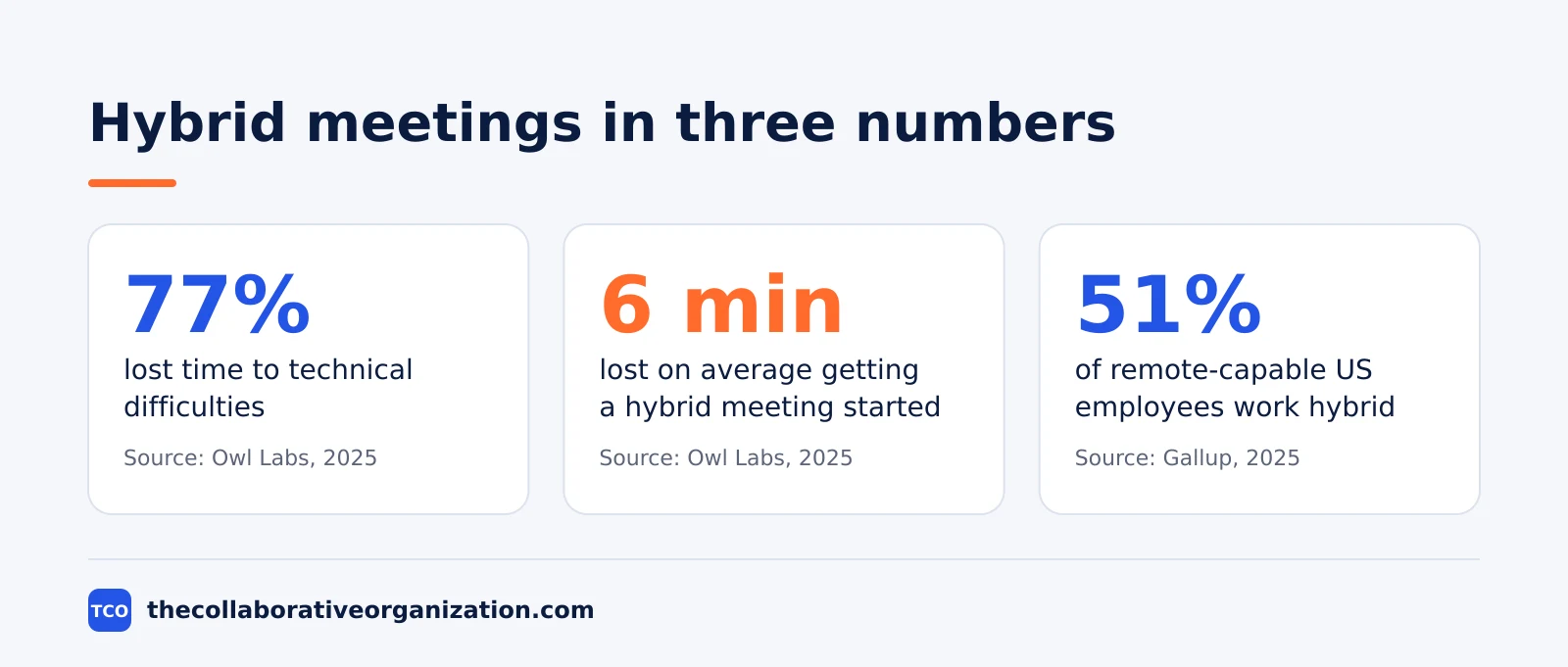
Hybrid work is now the norm for many teams. Gallup’s 2025 survey found 51% of remote-capable US employees work hybrid, and those workers spend 46% of their week, or 2.3 days, on site. A meeting that only works for the room no longer works for the team.
The tech is the first test, and many teams fail it. In Owl Labs’ 2025 survey, 77% of workers had lost time to technical difficulties, and 67% had given up trying to set up video technology in a meeting space. Good tech is not a nice extra: 85% of workers in the same survey called it a top factor.
How to set up the room and the tech
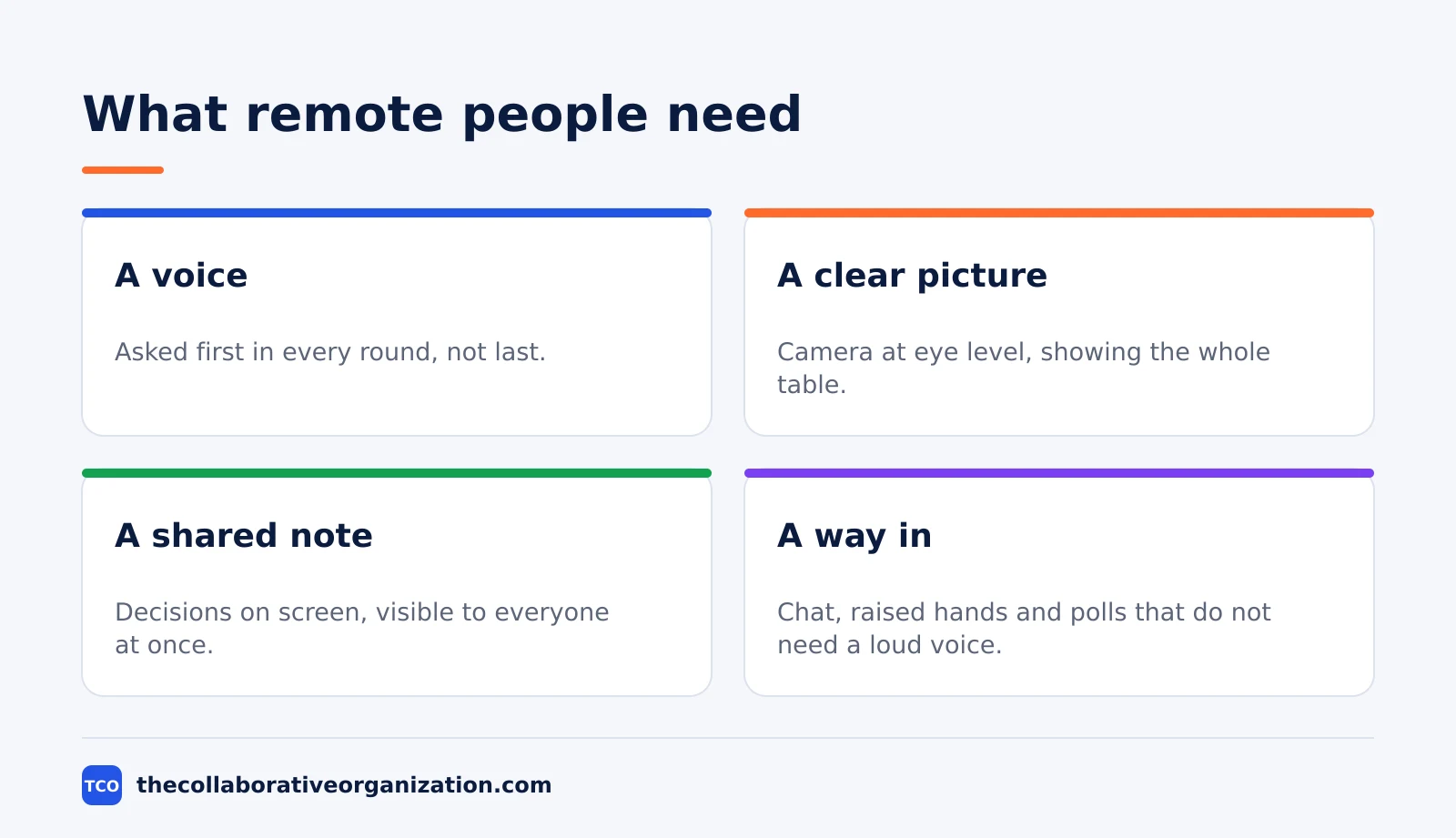
Set up the room so the remote people can see every face and hear every voice. Put the camera at eye level at the end of the table, not behind the room. Use a room mic that picks up the far end of the table, and put the shared screen where the room and the camera can both see it.
Open the room ten minutes early and test everything. Owl Labs’ 2025 survey found workers lose about 6 minutes on average getting a hybrid meeting started, and 27% lose 10 minutes or more per meeting. Test the camera, the mic, the screen share and the chat before the first person joins.
Give every remote person a way in that does not depend on shouting. Keep the chat open, use Raise your hand, and put the agenda and the shared note on screen from the start. If one person in the room is remote, run the whole meeting as if everyone is remote.
- Camera at eye level, showing the whole table, not the wall.
- Room mic that reaches the far end, tested before the call.
- Shared screen visible to the room and the camera at the same time.
- Chat open and a moderator watching it from the start.
How to plan a hybrid meeting
Plan a hybrid meeting around the remote people, not around the room. Write one decision in the invite, add an agenda with times, and name a moderator. If the meeting has no decision to make, cancel it or turn it into a written update.
An agenda matters more in a hybrid meeting than in a room-only one. In Atlassian’s 2024 survey, 79% of workers said an agenda leads to more productive meetings, and 62% said they often attend meetings with no goal in the invite. Send the agenda and the reading a day early, so remote people arrive with a view.
Pick a time that works across zones. Microsoft’s 2025 report found 30% of meetings span multiple time zones, up 35% since 2021, and half of all meetings fall in the peak hours of 9 to 11 am and 1 to 3 pm. Our guide to remote and hybrid work explains how teams split the week.
Keep the invite list small and the meeting short. Lattice’s guide to hybrid meetings cites Zoom data showing 64% of leaders say their workplace operates on a hybrid model. A short call with five people beats a long call with twenty, and a 25- or 50-minute slot leaves a gap for the next call.
How to run the meeting so remote people take part
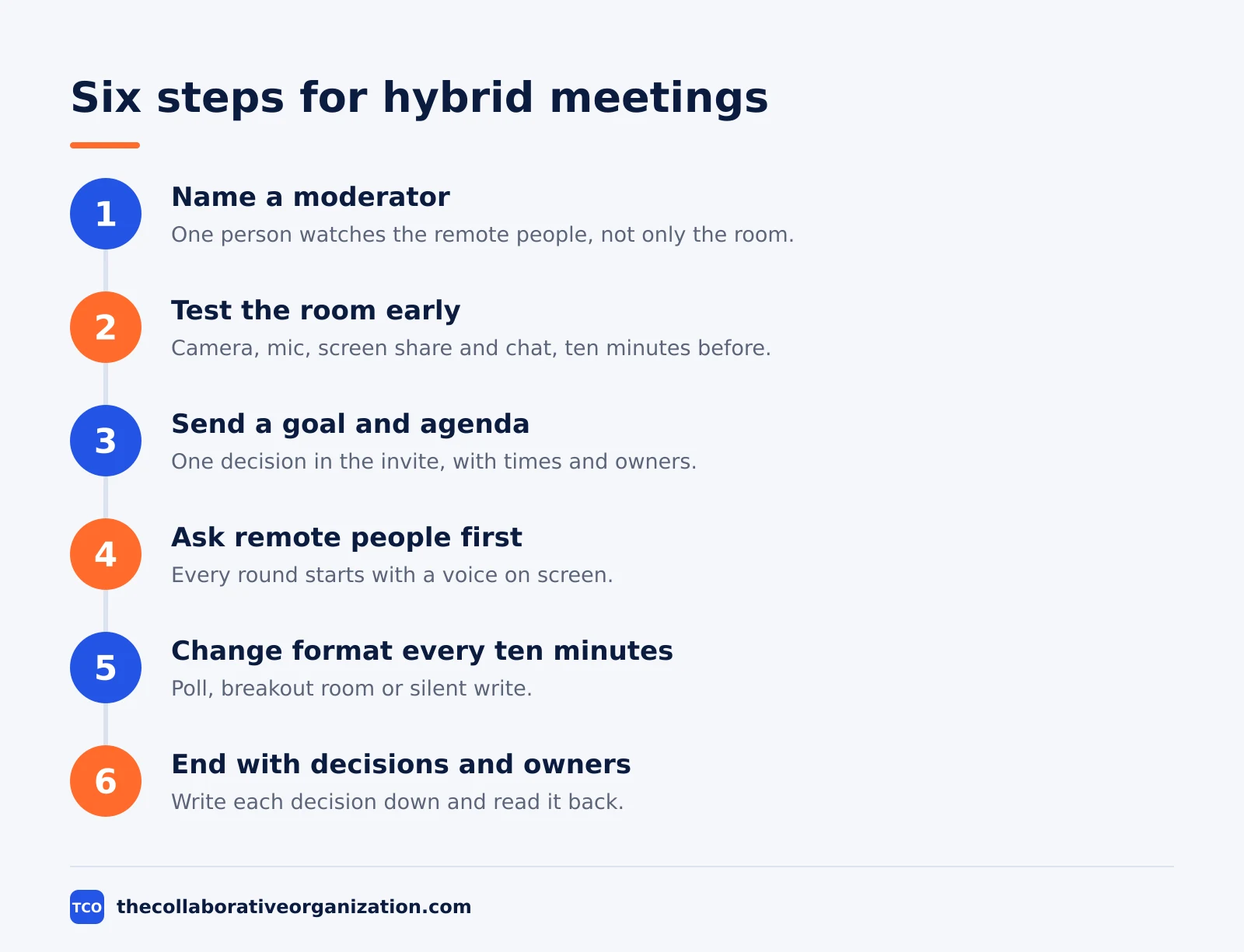
Name a moderator and give them one job: watch the remote people. The moderator opens the call, runs the rounds, watches the chat and the raised hands, and stops the room from talking over the remote people. The chair runs the content; the moderator runs the room.
Ask the remote people first, every time. Microsoft’s brain research says a moderator helps remote participants be included, and names Raise your hand, Whiteboard and Breakout Rooms as tools that help. Start each round with a remote voice, then go to the room.
Run the meeting in short blocks with a change every ten minutes. A poll, a question, a breakout or a silent write gives remote people a way in that does not need a loud voice. Buffer’s 2023 survey found 62% of remote workers work with teammates across time zones.
Keep cameras on for speakers and optional for listeners. A video call vs a phone call is worth weighing when one person is remote and the rest are in a room: the phone removes the visual load, but the video shows who is speaking. If the room has one camera, point it at the speaker, not at the table.
How to handle decisions and follow-up
Write every decision down in the shared note while the meeting runs, not after it. Each decision gets an owner and a due date, and the note is visible to everyone, remote and in the room. Read the decisions back in the last two minutes, and ask the remote people to confirm them.
A written close matters because hybrid meetings often end in fog. Atlassian’s 2024 survey found 54% of workers often leave meetings without a clear idea of next steps or who owns which task, and 77% often sit in meetings that end by scheduling a follow-up meeting. A decision list with owners breaks that loop.
Send the notes and the recording to everyone within the hour. Remote people who missed a word can catch up, and people who were not invited can read the decisions. Our meeting notes vs minutes guide shows what to write down and what to leave out.
Hybrid meeting example: one team, one week
This example is an illustration, not a real case. A ten-person team meets twice a week, with four people in the office and six remote.
On Tuesday, the team holds a 25-minute planning call. The moderator is remote, the agenda is in the invite, and the room camera shows the whole table. The moderator asks the six remote people first, then the room. A poll picks the priority, and the decisions go into the shared note with owners.
On Thursday, the same team holds a 50-minute review. The first ten minutes are a silent read of the update doc, so nobody has to listen to a read-out. Then the team splits into breakout rooms of three for ten minutes, with one remote person in each room. Each room brings back one point.
The notes and the recording reach everyone within the hour, and the next Tuesday call opens by checking the owners from last week. The team cut its meeting time from five hours a week to two, and the remote people speak first in every round. The change was the format, not the people.
Tools for hybrid meetings
The tool matters less than the format, but the right tool makes the hybrid format easy. Breakout rooms, polls, recordings and a good chat are built into the tools below, so you do not need a separate app for them. Pick the tool your team already opens every day, and learn its moderator and breakout features before your next call.
The prices below are as of November 2026. Zoom lists Pro at $14.16 per user per month billed annually, and Webex lists Meet at $12. Google Workspace Starter is $7 per user per month on an annual plan. Our video conferencing software shortlist compares these tools side by side.
| Tool | Best for | Free plan | Starting price (as of November 2026) | Notable limit |
|---|---|---|---|---|
| Zoom | Breakout rooms and polls for hybrid teams | Basic, free, 40-minute meetings, 100 participants | $14.16 per user per month (Pro), billed annually | Pro caps at 100 participants per meeting |
| Google Meet | Teams already on Google Workspace | Free with a Google account, 60-minute meetings, 100 participants | $7 per user per month (Business Starter), billed annually | Starter has no meeting recording |
| Webex | Hybrid rooms with more people | Free, 40-minute meetings, 100 attendees | $12 per user per month (Meet), billed annually | Meet caps at 200 attendees per meeting |
Zoom’s own pricing page shows Pro at $16.99 per user per month billed monthly and $14.16 billed annually, with meetings up to 30 hours and 10 GB of cloud storage per user.
Webex lists Meet at $144 per user per year on the Webex pricing page, with 24-hour meetings and 200 attendees.
Google Workspace Starter is $7 per user per month on an annual plan, or $8.40 on the flexible plan, according to independent reads of the Google Workspace pricing page.
Common mistakes that leave remote people out
The most common mistake is letting the room run the meeting. The people in the room talk to each other, the remote people watch, and the decisions are made in the room. A named moderator and a remote-first round fix this, because they give the remote people the first word, not the last.
The second mistake is bad room tech. Owl Labs’ 2025 survey found 67% of workers had given up trying to set up video technology in a meeting space, and 27% lose 10 minutes or more per meeting to setup. Test the room ten minutes early, and keep a spare mic and cable in the room.
The third mistake is ending without a written close. Atlassian’s 2024 survey found 54% of workers often leave meetings with no clear next steps, and 77% often sit in meetings that end by scheduling another meeting. Send the decisions, owners and dates to everyone within the hour.
The fourth mistake is scheduling across time zones without thinking. Microsoft’s 2025 report found meetings after 8 pm up 16% year over year, and 40% of people are back online at 6 am to check email. Pick a time in the overlap, and rotate it when the team spans many zones.
Sources
- Gallup - Hybrid Work in Retreat? Barely (2025)
- Owl Labs - State of Hybrid Work 2025 (2025)
- Microsoft WorkLab - Breaking down the infinite workday (2025)
- Microsoft WorkLab - Research proves your brain needs breaks (2021)
- Atlassian - Workplace Woes: Meetings (2024)
- Lattice - Best Practices for Hybrid Meetings (2025)
- Buffer - State of Remote Work 2023 (2023)
- Zoom - Pricing (2026)
- Webex - Pricing (2026)
- Google Workspace - Pricing (2026)
Frequently asked questions
How do you run a hybrid meeting?
Name a moderator, test the room ten minutes early, and run remote-first rounds: ask the people on screen before the room speaks. Keep the call to 25 or 50 minutes, use polls and breakout rooms, and end with decisions, owners and due dates in a shared note. Send the notes and the recording to everyone within the hour.
What equipment do you need for a hybrid meeting?
A camera at eye level that shows the whole table, a room mic that reaches the far end, and a shared screen the room and the camera can both see. Add a spare mic and cable in the room. Test the camera, mic, screen share and chat ten minutes before the call, not when people join.
How do you include remote people in a hybrid meeting?
Give the meeting a named moderator who watches the remote people, and ask them first in every round. Keep the chat open, use Raise your hand, and give remote people a way in that does not need a loud voice, such as a poll or a written round. Share the note on screen so everyone sees the same decisions.
How long should a hybrid meeting be?
Keep it to 25 or 50 minutes, with a 5- or 10-minute gap after it. Microsoft's lab study found stress-linked brain activity climbed across back-to-back 30-minute meetings, and held steady with 10-minute breaks. Shorter meetings also force a tighter agenda, and most of the work fits in half the time.
What is the biggest mistake in hybrid meetings?
Letting the room run the meeting. The people in the room talk to each other, the remote people watch, and the decisions are made in the room. A named moderator and a remote-first round fix this, because they give the remote people the first word. Bad room tech and no written close are the next two mistakes.
Related articles
video conferencing
Loom vs Zoom Clips: Which Async Video Tool Wins? (2026)
Loom is the dedicated async video tool, while Zoom Clips is built into Zoom Workplace. Compare recording, editing, analytics and price to pick the right one.
November 19, 2026 · 9 min read
video conferencing
How to Reduce Meetings at Work: A 5-Week Plan (2026)
Cut meetings by a third without losing decisions: audit the calendar, cancel the weak ones, replace updates with writing, and protect focus days.
November 19, 2026 · 10 min read
video conferencing
How to Run an Effective Meeting in 7 Steps (2026)
An effective meeting starts with a clear purpose, a short agenda and named owners for every action. Follow 7 steps to run meetings people value.
November 19, 2026 · 12 min read