Video Conferencing Statistics: 30+ Stats (2026) | The Collaborative Organization
By The Collaborative Organization Team · November 19, 2026 · Last verified November 19, 2026 · 11 min read

Video conferencing is now a $20.32 billion market in 2026, and the average worker sits in 5 online or hybrid meetings a week. This guide brings together more than 40 statistics on the market, hybrid work, meetings, and AI. Every figure below carries its source and year. The method note explains what was left out.
Key takeaways
- The global video conferencing market is $20.32 billion in 2026 and is forecast to reach $37.45 billion by 2034.
- Hybrid work has settled, not vanished: 51% of remote-capable US staff work hybrid, and 28% of all workers are hybrid.
- Workers average 5 online or hybrid meetings a week, and 77% have lost time to meetings starting late for tech reasons.
- 75% of knowledge workers use AI at work, and 66% of leaders would not hire someone without AI skills.
- Hybrid workers in a 6-month trial were just as productive as office staff, and resignations fell 33%.
How we chose these stats
We took every number from the original study or report, not from a roundup, and we dropped any figure we could not trace. Market figures come from the research firms’ own pages, hybrid figures from Owl Labs and Gallup, and AI figures from Microsoft’s own Work Trend Index report. Each stat in the tables below links to the page it came from.
A few figures are second-hand, and they are labelled as such. Buffer, Pew, the Flex Index, and Global Workplace Analytics appear here as quoted in Zoom’s 2025 roundup of remote work statistics, because their own report pages were not available to open. Treat those as reported by Zoom, not as read from the original.
We also dropped figures that could not be traced. Microsoft’s figure of 320 million Teams monthly users was not on a Microsoft page we could open, so it is out.
A Grand View Research market size of $11.65 billion for 2024 appeared only in search snippets, not in the report excerpt, so it is out. Cisco’s 2021 figures appear only in republications of a press release, so they are out too.
The market: how big video conferencing is
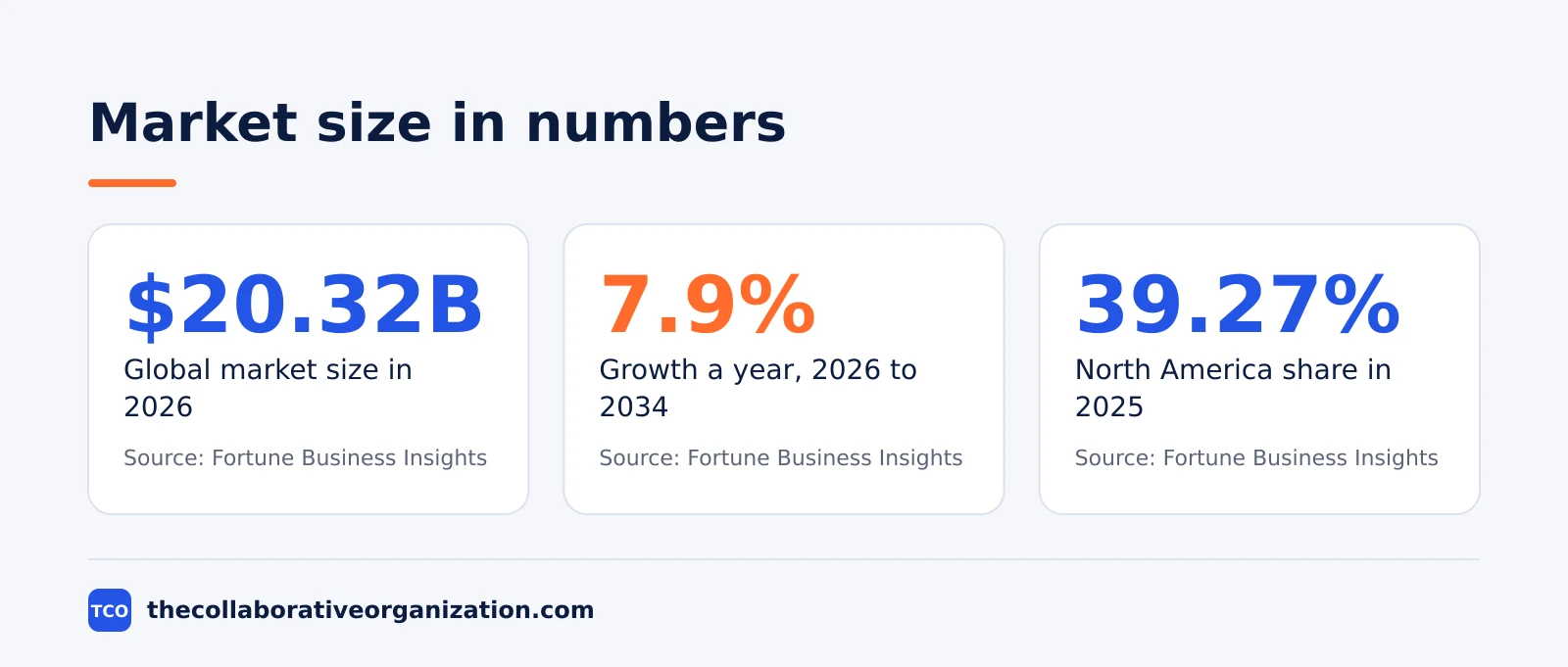
The market is growing steadily, at about 8% a year, and software is the largest part of it. Fortune Business Insights puts the global market at $18.64 billion in 2025 and $20.32 billion in 2026, on the way to $37.45 billion by 2034. Grand View Research gives a lower forecast of $24.46 billion by 2033, so the honest range is wide.
| Stat | Source | Year |
|---|---|---|
| Global video conferencing market of $18.64 billion | Fortune Business Insights | 2025 |
| Global video conferencing market of $20.32 billion | Fortune Business Insights | 2026 |
| Global video conferencing market of $37.45 billion by 2034 | Fortune Business Insights | 2034 |
| Market growth of 7.9% a year, 2026 to 2034 | Fortune Business Insights | 2026-2034 |
| North America holds 39.27% of the market | Fortune Business Insights | 2025 |
| Team collaboration is the largest segment, at 38.3% | Fortune Business Insights | 2025 |
| Software is the largest component, at 55.7% | Fortune Business Insights | 2025 |
| Telehealth is the fastest-growing segment, at 11.2% a year | Fortune Business Insights | 2026-2034 |
| Global market to reach $24.46 billion by 2033 | Grand View Research | 2033 |
| 64% of business leaders say their firms run a hybrid model (Archie, May 2026) | Fortune Business Insights | 2026 |
The two forecasts disagree by a third, which is normal for market research: the firms count different products and different regions. What they agree on is the direction. North America holds about 39% of the market in both reports, team collaboration is the largest use case, and software is the largest component.
For the wider collaboration market, see our collaboration tools statistics.
Hybrid work and the office
Hybrid work has settled at about half of remote-capable staff, and the office has not come back. Gallup puts hybrid work at 51% of remote-capable US employees in 2025, down from 55% two quarters earlier, with fully on-site and fully remote each up 2 points. Hybrid workers spend 46% of their week in the office, about 2.3 days.
| Stat | Source | Year |
|---|---|---|
| 47% of workers lack the flexibility they want | Owl Labs | 2025 |
| 37% would not take a job without flexible hours | Owl Labs | 2025 |
| Workers would give up 9% of pay for flexible hours | Owl Labs | 2025 |
| 82% prefer meetings to end by 4 pm | Owl Labs | 2025 |
| 28% of workers are hybrid, 9% fully remote | Owl Labs | 2025 |
| 63% of workers are fully in-office | Owl Labs | 2025 |
| 34% of hybrid workers go in 4 days a week | Owl Labs | 2025 |
| Hybrid share of remote-capable US staff is 51%, down from 55% | Gallup | 2025 |
| Hybrid workers spend 46% of the week in the office, about 2.3 days | Gallup | 2025 |
| 91% see the schedule as fair when their team decides it, vs 73% when the employer decides | Gallup | 2025 |
| In tech, 47% fully remote, 45% hybrid, 9% fully on-site | Gallup | 2025 |
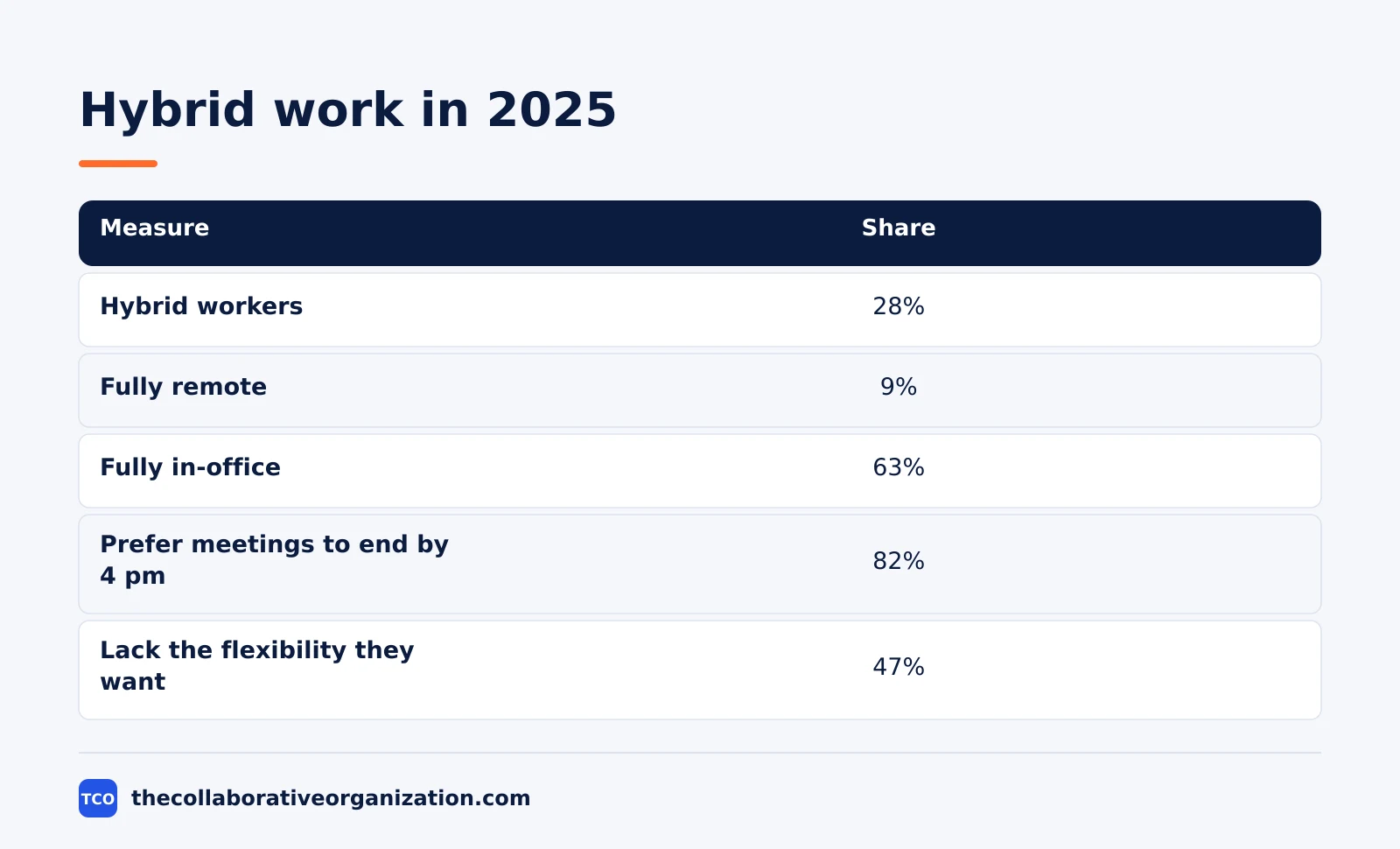
Flexibility is the point workers care about. Owl Labs found 47% of workers lack the flexibility they want in 2025, and 37% would not take a job without flexible hours, up from 35% in 2024. Workers would give up 9% of pay for flexible hours, and 8% for a 4-day week.
Who decides the schedule matters more than the schedule itself. Gallup found 91% of workers see the policy as fair when their team decides it, against 73% when the employer decides, in 2025.
The same report found the federal government an outlier: hybrid work there fell from 61% in late 2024 to 28% in the second quarter of 2025. Our guide to workplace collaboration statistics has more on how teams work across locations.
For the meeting load in detail, see too many meetings statistics.
Meetings: how many and how they feel
The average worker sits in 5 online or hybrid meetings a week, and the setup is the tax. Owl Labs found in-office workers spend 6 minutes setting up each meeting in 2025, and 27% spend 10 minutes or more. Worse, 77% lost time because meetings started late due to tech problems, and 67% tried to set up video tech and gave up.
| Stat | Source | Year |
|---|---|---|
| Workers average 5 online or hybrid meetings a week | Owl Labs | 2025 |
| In-office workers spend 6 minutes setting up each meeting | Owl Labs | 2025 |
| 27% spend 10 minutes or more setting up | Owl Labs | 2025 |
| 77% lost time because meetings started late for tech reasons | Owl Labs | 2025 |
| 67% tried to set up video tech and gave up | Owl Labs | 2025 |
| 98% of meetings include at least one remote participant | Cisco | 2024 |
| 83% of employers say collaboration tools help attract and keep talent | Cisco | 2024 |
| 46% of full-time office workers feel disengaged, vs 30% of remote staff | Owl Labs | 2025 |
| 300 million daily meeting participants in April 2020 | Zoom | 2020 |
Almost every meeting is now a hybrid meeting. Cisco says 98% of meetings include at least one remote participant, and 83% of employers say collaboration tools help attract and keep talent, in its 2024 Hybrid Work Study. The office worker is the one who pays the setup tax, while the remote worker joins in one click.
The Zoom figure needs a note. Zoom reported 300 million daily meeting participants in April 2020, up from about 10 million in December 2019, but a participant is counted once per meeting joined, not as a unique person.
Zoom corrected the wording from “daily users” to “daily meeting participants” in April 2020. Our guide to zoom fatigue statistics covers the strain of back-to-back calls.
For better calls, read how to make video calls more engaging.
AI in meetings and remote work
AI is now part of the meeting, and remote work keeps its edge on focus and stress. Microsoft found 75% of knowledge workers use AI at work in its 2024 Work Trend Index, and 78% of AI users bring their own AI tools. Two thirds of leaders, 66%, would not hire someone without AI skills.
| Stat | Source | Year |
|---|---|---|
| 75% of knowledge workers use AI at work | Microsoft | 2024 |
| 46% of AI users started less than 6 months before the survey | Microsoft | 2024 |
| 78% of AI users bring their own AI tools to work | Microsoft | 2024 |
| 90% of AI users say AI helps them save time | Microsoft | 2024 |
| 66% of leaders would not hire someone without AI skills | Microsoft | 2024 |
| 80% have tried AI, up 45% since March 2025 | Owl Labs | 2025 |
| 51% wish an AI avatar could attend a meeting for them | Owl Labs | 2025 |
| 64% say their company encourages AI use, up from 56% in March 2025 | Owl Labs | 2025 |
| Hybrid workers were as productive as office staff, and resignations fell 33% | Nature | 2024 |
| 70% say focused work is easier when remote | Buffer, quoted by Zoom | 2025 |
| 98% of remote workers would keep working remotely | Buffer, quoted by Zoom | 2025 |
| 46% would consider leaving rather than return to full-time office work | Pew, quoted by Zoom | 2025 |
| A hybrid worker can save up to $6,000 a year | Global Workplace Analytics, quoted by Zoom | 2025 |
The strongest evidence on hybrid work is a trial, not a survey. Bloom, Han, and Liang ran a 6-month trial of 1,612 Trip.com staff, published in Nature in 2024, and found hybrid workers were just as productive as full-time office staff on reviews, code, and promotions.
Resignations fell 33% among hybrid workers, with the largest falls among women, non-managers, and long commuters.
The Buffer and Pew figures in the table are second-hand: they come from Zoom’s 2025 roundup, which quotes Buffer and Pew, because the original report pages were not available to open.
Buffer says 70% find focused work easier when remote, and 98% would keep working remotely. Pew says 46% of people who work from home at least sometimes would consider leaving rather than return to full-time office work.
Our guide to video call vs phone call at work compares the two ways to talk when a meeting is not needed.
What the numbers mean
The market is growing because the meeting is now the office, and the meeting is where the time goes. A $20 billion market, 5 meetings a week per worker, and 98% of meetings with a remote participant all point the same way: video is not a tool for remote teams, it is how most teams meet. The cost is visible too, in 6 minutes of setup per meeting and 77% of workers losing time to late starts.
The second pattern is choice. Workers want flexibility, and they will give up pay for it, but they also want a say in the schedule: 91% call it fair when their team decides, against 73% when the employer decides.
Hybrid work that is imposed reads as a rule, while hybrid work that is agreed reads as a benefit. Compare the tools on our video conferencing software shortlist if the setup itself is part of the problem.
The third pattern is AI arriving before the training. Three quarters of knowledge workers use AI, most bring their own tools, and only 39% of AI users had training from their company, according to Microsoft in 2024.
Zoom reports the same gap from the other side: 51% of workers wish an AI avatar could attend a meeting for them. The meeting is where AI is used most, and where it is taught least.
Worked example: what the stats mean for a 50-person team
Imagine a 50-person team whose jobs can all be done remotely, with 5 online meetings a week per person. This is an illustration, not a real team, and the maths uses the stats above. The point is to show how small numbers add up across a team.
| Figure | Maths | Result |
|---|---|---|
| Meeting attendances a week | 50 people x 5 meetings | 250 attendances |
| Setup time a week | 250 attendances x 6 minutes | 25 hours |
| People who lost time to late starts | 77% of 50 people | About 39 people |
| Hybrid workers on the team | 51% of 50 people | About 26 people |
| People who want meetings to end by 4 pm | 82% of 50 people | About 41 people |
Twenty-five hours a week on setup is more than half a full-time job, spent on joining calls. The fix is not fewer meetings, it is a setup that works: one click to join, a room that is ready, and a start time that holds.
If the team moves its standing meetings to end by 4 pm, it meets the wish of about 41 of its 50 people, at no cost at all.
Sources
- Fortune Business Insights - Video Conferencing Market (2026)
- Grand View Research - Video Conferencing Market Size, Share and Trends (2025)
- Owl Labs - State of Hybrid Work 2025 (2025)
- Gallup - Hybrid Work in Retreat? Barely. (2025)
- Microsoft - Work Trend Index 2024 (2024)
- Cisco - Achieving Distance Zero: A New Frontier in Hybrid Working (2024)
- Zoom - Remote Work Statistics (2025)
- Nature - Bloom, Han and Liang: Hybrid Working From Home (2024)
- Zoom - A Message to Our Users (2020)
Frequently asked questions
How big is the video conferencing market in 2026?
The global video conferencing market is $20.32 billion in 2026, according to Fortune Business Insights, up from $18.64 billion in 2025. The same report forecasts $37.45 billion by 2034, a growth rate of 7.9% a year. Grand View Research gives a lower forecast of $24.46 billion by 2033, with growth of 8.2% a year, so treat the exact figure as a range, not a single number.
How many people work hybrid in 2025?
Gallup puts hybrid work at 51% of remote-capable US employees in 2025, down from 55% two quarters earlier. Owl Labs puts the whole workforce at 28% hybrid, 9% fully remote, and 63% fully in office. The two figures differ because Gallup counts only staff whose jobs can be done remotely, while Owl Labs counts all full-time knowledge workers.
How many meetings do workers have each week?
Workers average 5 online or hybrid meetings a week, according to Owl Labs in 2025. In-office workers spend about 6 minutes setting up each meeting, and 27% spend 10 minutes or more. Almost all meetings now include someone remote: Cisco says 98% of meetings include at least one remote participant.
Do hybrid workers get as much done as office workers?
Yes, in the best test we have. A 6-month trial of 1,612 Trip.com staff, published in Nature in 2024, found hybrid workers were just as productive as full-time office staff on reviews, code, and promotions. Resignations fell 33% among hybrid workers, with the largest falls among women, non-managers, and long commuters.
How many workers use AI in meetings?
Microsoft's 2024 Work Trend Index found 75% of knowledge workers use AI at work, and 78% of AI users bring their own AI tools. Owl Labs found 80% of workers had tried AI by 2025, and 51% wished an AI avatar could sit in on a meeting for them. Only 39% of AI users had received AI training from their company.
Related articles

video conferencing
Loom vs Zoom Clips: Which Async Video Tool Wins? (2026)
Loom is the dedicated async video tool, while Zoom Clips is built into Zoom Workplace. Compare recording, editing, analytics and price to pick the right one.
November 19, 2026 · 9 min read
video conferencing
How to Reduce Meetings at Work: A 5-Week Plan (2026)
Cut meetings by a third without losing decisions: audit the calendar, cancel the weak ones, replace updates with writing, and protect focus days.
November 19, 2026 · 10 min read

video conferencing
How to Run an Effective Meeting in 7 Steps (2026)
An effective meeting starts with a clear purpose, a short agenda and named owners for every action. Follow 7 steps to run meetings people value.
November 19, 2026 · 12 min read