What Is Team Collaboration? Definition and Benefits (2026) | The Collaborative Organization
By The Collaborative Organization Team · November 19, 2026 · Last verified November 19, 2026 · 9 min read
Team collaboration is people pooling their skills, information and judgment to produce a shared result that none of them could reach alone. The work itself is shared: people build on each other’s ideas, make decisions together and take joint credit for the outcome.
Key takeaways
- Team collaboration means shared work and shared ownership of the result, not just working side by side.
- It differs from teamwork, where tasks are divided and each person owns one piece alone.
- The five parts are a shared goal, clear roles, open communication, trust and shared knowledge.
- McKinsey found trust, communication, innovative thinking and decision making explain 69% to 76% of the gap between low- and high-performing teams.
- Gallup links at least one collaborative relationship at work to a 42% higher intent to stay with an employer.
What team collaboration means
Team collaboration means a group works on one shared result together, with each person adding skills the others lack. Slack defines it as a process that brings people together to reach a common goal, built on communication, shared responsibility and pooled expertise.
The test is simple: does the work change because people shaped it together? If one person writes the plan and the rest only approve it, that is a review, not collaboration. When a designer, an engineer and a support agent each change the plan in the same session, the result belongs to the group.
Collaboration also needs “shared ownership” of the result. Credit and blame sit with the team, not with one hero. That shared stake is what makes people raise risks early instead of staying quiet.
What team collaboration is not
Team collaboration is not the same as teamwork, coordination or holding more meetings. Teamwork divides work into pieces that each person owns alone, like runners in a relay race. Collaboration is the jazz band: nobody owns the final sound alone.
Coordination is also different. It lines up timing and handoffs between people who still work apart, such as a designer finishing mockups before a developer starts. Collaboration happens at the same time, on the same problem, with shared decisions.
Meetings are not proof of collaboration either. A status meeting where each person reports progress is coordination. A working session where the group changes the plan together is collaboration, and it often needs fewer meetings, not more.
The five parts of good team collaboration
Good team collaboration rests on five parts: a shared goal, clear roles, open communication, trust and shared knowledge. Miss one part and the rest wobble. Slack names the same building blocks in its guide to team collaboration: shared goals and clear roles, open communication and feedback, knowledge sharing, and diverse views.
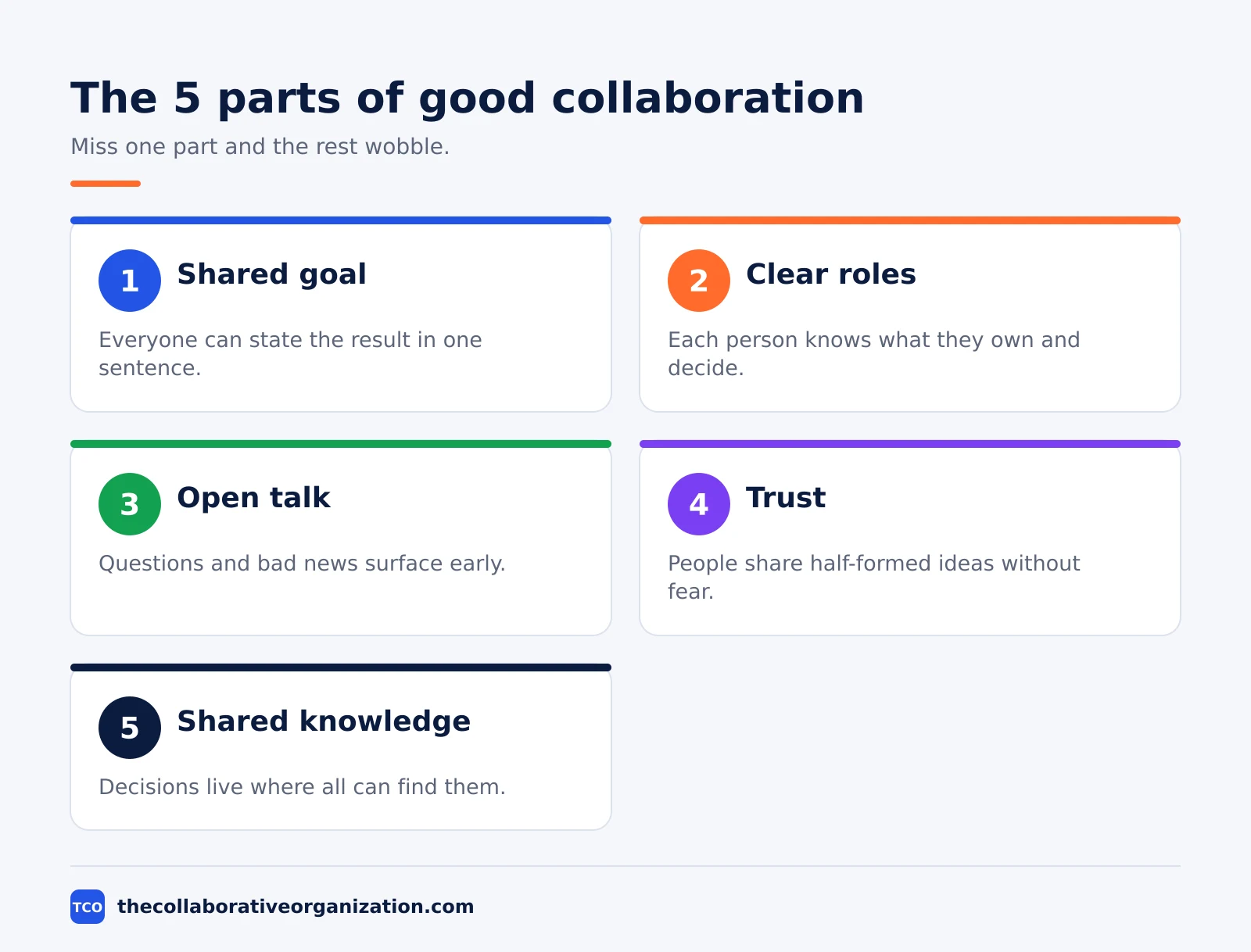
| Part | What it looks like in practice | Sign it is missing |
|---|---|---|
| Shared goal | Everyone can state the result in one sentence | People work hard on different targets |
| Clear roles | Each person knows what they own and what they decide | Two people do the same task, or nobody does it |
| Open communication | Questions and bad news surface early | Surprises appear at the deadline |
| Trust | People share half-formed ideas without fear | Only polished ideas reach the room |
| Shared knowledge | Decisions and files live where all can find them | Answers hide in private chats |
A shared goal matters most, because it turns disagreements into trade-offs. When the goal is clear, a debate about scope becomes a question about what serves the goal. Our guide on how to choose project management software shows how a shared board keeps that goal visible.
Clear roles protect the goal. A RACI matrix names who does the work, who approves it, who gives input and who gets told. Without that map, shared work drifts into shared confusion.
Why team collaboration matters
Team collaboration matters because most work that drives results now crosses roles, so no single person holds all the facts. Vantage Circle puts it plainly: collaboration matters because the work that drives results crosses roles, and diverse knowledge shortens the time from problem to solution.
Better decisions follow from more views in the room. An engineer spots a build risk, a support agent spots a confusing message, and a finance lead spots a cost risk, all before the plan ships. Each view alone is partial, and together they catch blind spots early.
The research backs the claim. McKinsey identified 17 team behaviors, called health drivers, and found four with the greatest impact: trust, communication, innovative thinking and decision making. Those drivers explain 69% to 76% of the difference between low- and high-performing teams on efficiency, results and innovation, according to McKinsey.
Retention is a second payoff. Employees with at least one collaborative relationship are 42% more likely to intend to stay with their current employer for their whole career, Gallup found, as reported by Slack. People stay where their work is seen and where they belong to a group.
Team collaboration example: a product launch
A small product launch shows how the five parts work on real work. Imagine a team of six people launching a new pricing page in four weeks: a product manager, a designer, a developer, a writer, a marketer and a support lead.
Week one is a shared working session, not a handoff chain. The group agrees on one goal: a pricing page that cuts support questions about plans by a third. The product manager owns the decision, the designer owns the layout, and the developer owns the build.
In week two, the support lead brings the five questions customers ask most, and the writer rewrites the page around those answers. The developer flags that one plan comparison needs data the team does not have, so the group drops that section instead of guessing.
Week three is a review in the shared document, with comments resolved in the open. Week four ships the page, and the support lead tracks questions for two weeks. The example is an illustration, not a case study, but it shows the pattern: one goal, named owners, early input and a shared record.
When to use team collaboration, and when not to
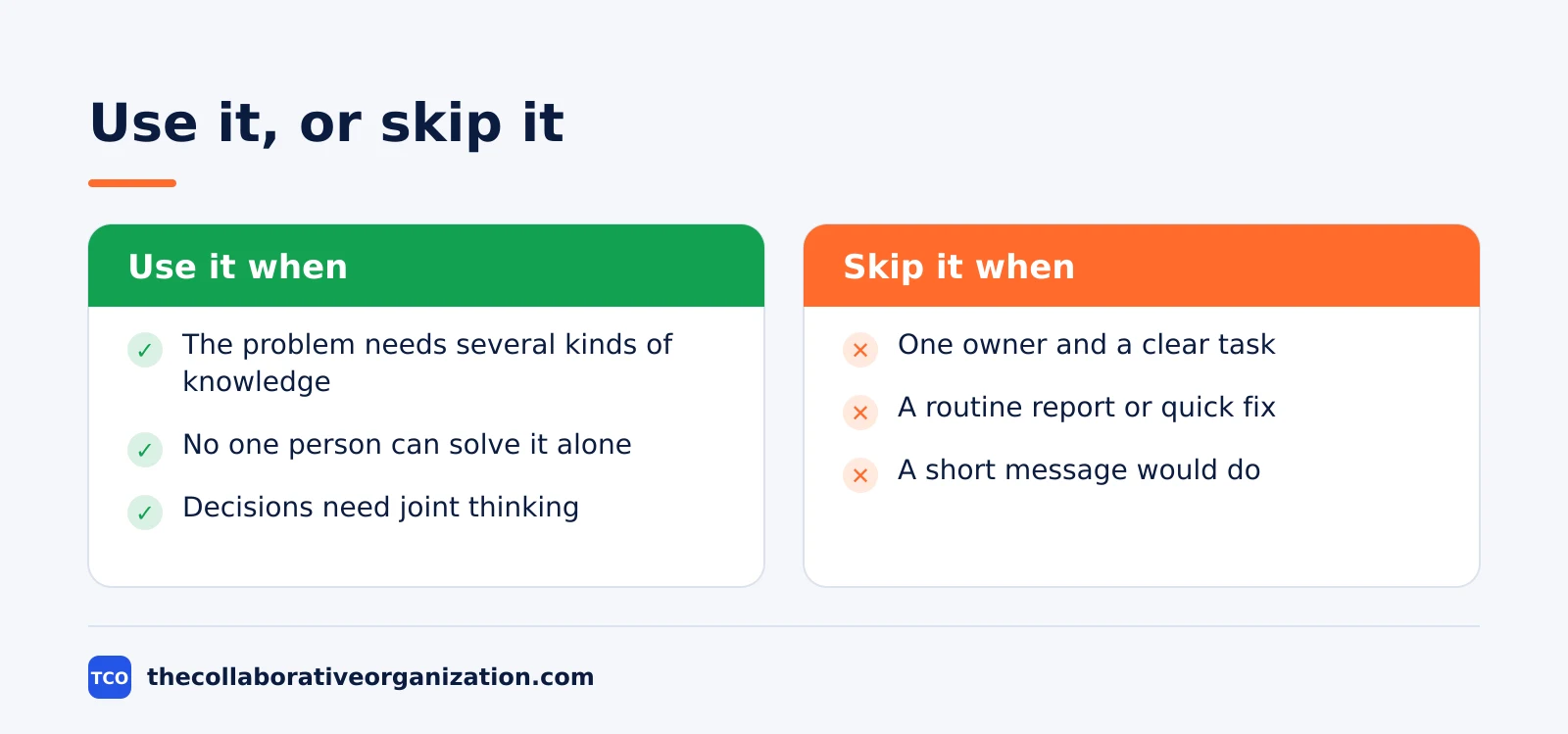
Use team collaboration when the problem needs several kinds of knowledge and no one person can solve it alone. Product launches, process changes and hard customer problems fit that shape. The work needs joint thinking, not just joint effort.
Skip it for simple tasks with one clear owner. A two-person task, a routine report or a quick fix needs a due date and a short message, not a working group. Collaboration adds cost in time and attention, so spend it where the problem is hard enough to repay it.
Zoom makes the same point in its guide: successful collaboration depends on clear shared goals, defined roles, open communication, high trust and sustained alignment. If those are absent, a meeting will not create them.
Also watch for collaboration drag. Gartner surveyed 329 marketing leaders and 78 leaders from other functions in 2023 and found 84% report high levels of collaboration drag. Organizations with high drag were 37% less likely to achieve their revenue goals, according to Gartner. More meetings are not the fix; better design is.
Tools that support team collaboration
A chat tool, a task board and a shared document store cover most collaboration needs, and one tool per job beats six half-used tools. Slack is the chat layer for many teams, while a task tool holds the work and its owners.
Our project management software shortlist compares the main task tools side by side. The right pick is the one the team opens every day, not the one with the longest feature list.
| Tool | Best for | Free plan | Starting price (as of November 2026) | Notable limit |
|---|---|---|---|---|
| Asana | Teams that want every task to have a named owner | Free for 2 people | $10.99 per user per month, billed annually | Free plan covers 2 people |
| monday.com | Teams that want a visual board with phases and status | Free plan for up to 2 seats | $9 per seat per month (Basic), billed annually | Paid plans need at least 3 seats |
| ClickUp | Teams that want one place for docs, tasks and chat | Free Forever plan | $9 per user per month (Core), billed annually | Yearly billing needed for that price |
The Asana price comes from Asana pricing: Starter is $10.99 per user per month when billed annually. On the monday.com pricing page, Basic is $9 per seat per month billed annually. The ClickUp pricing page lists Core at $9 per user per month billed yearly.
A tool cannot fix a missing goal or missing trust. Google studied 180 teams in Project Aristotle and found “psychological safety” was the most important of five dynamics, ahead of dependability, structure, meaning and impact, as LeaderFactor reports. People speak up first; tools only carry the conversation.
Common team collaboration mistakes to avoid
Most collaboration fails in five ways, and all five are easy to spot in a review. Vantage Circle names the same five failure modes: unclear ownership, low psychological safety, silos, tool overload and individual-only rewards.
- No named owner for the result. When everyone owns the outcome, nobody does, and decisions wait for someone else to make them.
- Safety only in words. If people are punished for bad news, they stop sharing it, and the team learns about problems at the deadline.
- Silos with separate goals. Teams that only serve their own targets stop sharing facts across the boundary, and handoffs break.
- Too many tools. Six tools with no agreed home for decisions means the latest version is always somewhere else.
- Rewards for solo work only. When only individual output earns credit, helping a teammate costs the helper, so people stop helping.
Fix ownership first with a RACI chart, then fix safety by having the lead share an unfinished idea first. Tools come last, after the habits are in place. A team that works in Scrum already has a useful rhythm for this: short cycles, a shared board and a regular review of how the team works.
Sources
- Slack - What Is Team Collaboration? 10 Benefits and Best Practices (2026)
- Vantage Circle - Team Collaboration: What It Is, 6 Types and How to Build It (2026)
- McKinsey - Go, Teams: When Teams Get Healthier, the Whole Organization Benefits (2024)
- Gartner - Gartner Survey Reveals 84% of Marketers Report Experiencing High Collaboration Drag (2024)
- LeaderFactor - Google Project Aristotle: Findings, 5 Keys, and Limits (2026)
- Zoom - What Is Team Collaboration? (2026)
- Slack - Why Is Collaboration Important in the Workplace? (2026)
- Asana - Pricing (2026)
- monday.com - Pricing (2026)
- ClickUp - Pricing (2026)
Frequently asked questions
What is team collaboration in simple words?
Team collaboration is people working on the same shared result together, not just side by side. Each person adds skills, ideas and judgment, and the group makes decisions together and shares credit for the outcome. It differs from splitting tasks, where each person owns only their own piece.
How is team collaboration different from teamwork?
Teamwork divides the work so each person owns one piece, like runners in a relay race. Collaboration shares the work itself, so people build on each other's ideas and decide together. Most teams need both: collaboration to shape the plan, and teamwork to carry out the agreed tasks.
What are the benefits of team collaboration?
Good collaboration brings faster problem solving, better decisions, more ideas and stronger engagement. Different views catch risks early, so less work needs rework. People also stay longer when their part in a shared result is visible, and Gallup links collaborative relationships to a higher intent to stay.
When does team collaboration not work?
It fails when ownership is unclear, when people feel unsafe speaking up, when teams work in silos, or when too many tools split the conversation. It also fails for simple tasks with one clear owner, where a short message beats a meeting. Fix ownership and safety first, before adding new tools.
Which tools help team collaboration?
A shared chat tool, a shared task board and a shared document store cover most needs. Slack, Asana, monday.com and ClickUp each fill one of those jobs, and the best choice is the tool your team will open every day. Pick one tool per job, so nobody has to guess where the latest version lives.
Related articles

project management
How to Choose Project Management Software (2026)
Pick project management software in seven steps: define the work, count seats, price the real cost, and run a two-week pilot before you pay.
November 19, 2026 · 10 min read
project management
What Is a RACI Matrix? Definition, Roles and Examples (2026)
A RACI matrix maps who is Responsible, Accountable, Consulted and Informed for each task. Learn the four roles, how to build one, and see a worked example.
November 19, 2026 · 9 min read
project management
Daily Standup Meeting Format That Works (2026)
A daily standup is a 15-minute meeting where Developers inspect progress toward the Sprint Goal and plan the next day. Use this format to run one that ends on time.
November 19, 2026 · 10 min read