Remote Work Productivity Statistics: 30 Stats (2026) | The Collaborative Organization
By The Collaborative Organization Team · November 19, 2026 · Last verified November 19, 2026 · 12 min read
Remote workers are as productive as office workers in the best trials, and more productive in some surveys, but the workday is more broken up than ever. A 2015 trial found home workers performed 13% better, and a 2024 trial found hybrid workers matched office workers exactly. The 30 statistics below come from the original studies and surveys.
Key takeaways
- In 2025, 22.4% of US workers teleworked, and about 25% of paid workdays were worked from home.
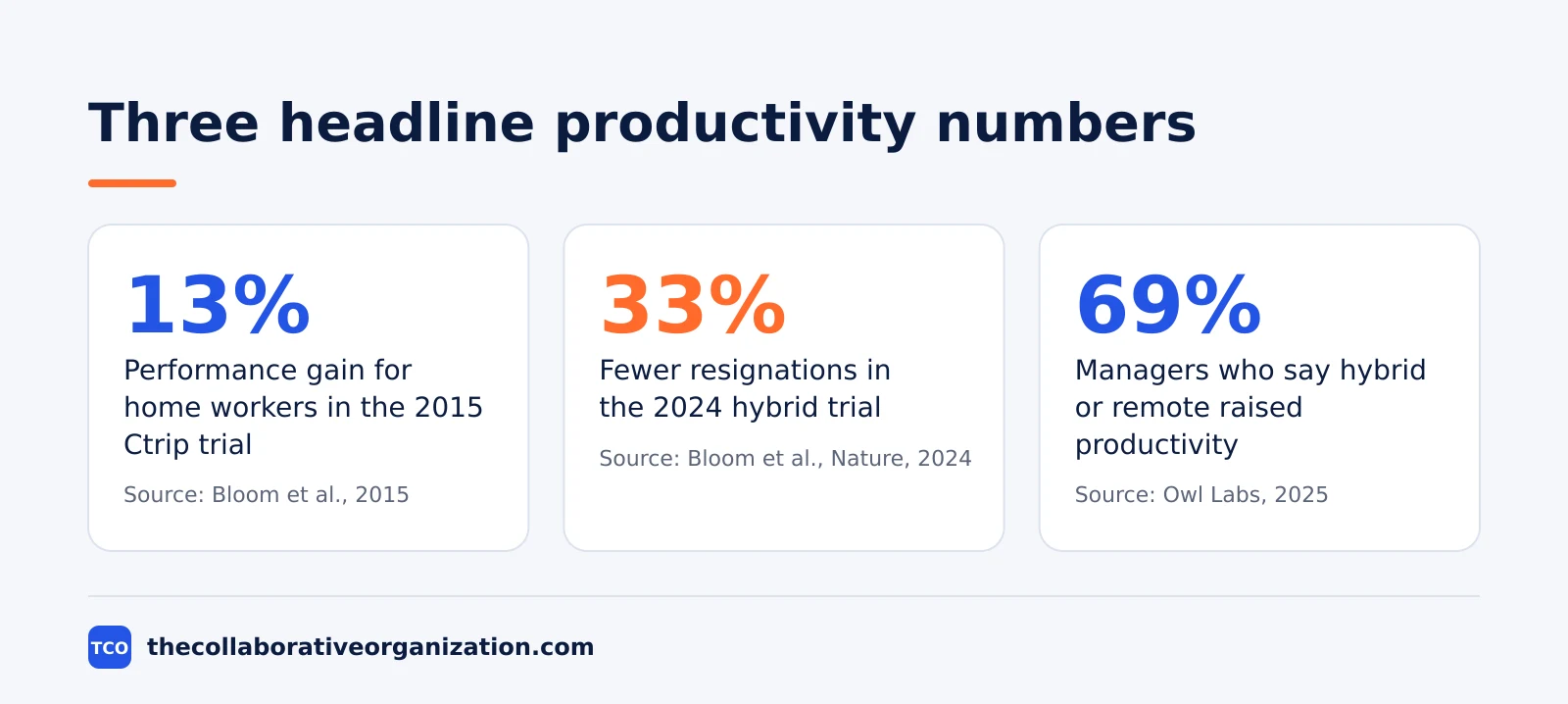
- A 2015 trial found home workers performed 13% better, while a 2024 trial found hybrid work cut resignations by 33% with no performance loss.
- Owl Labs found in 2025 that 69% of managers say hybrid or remote work made their team more productive.
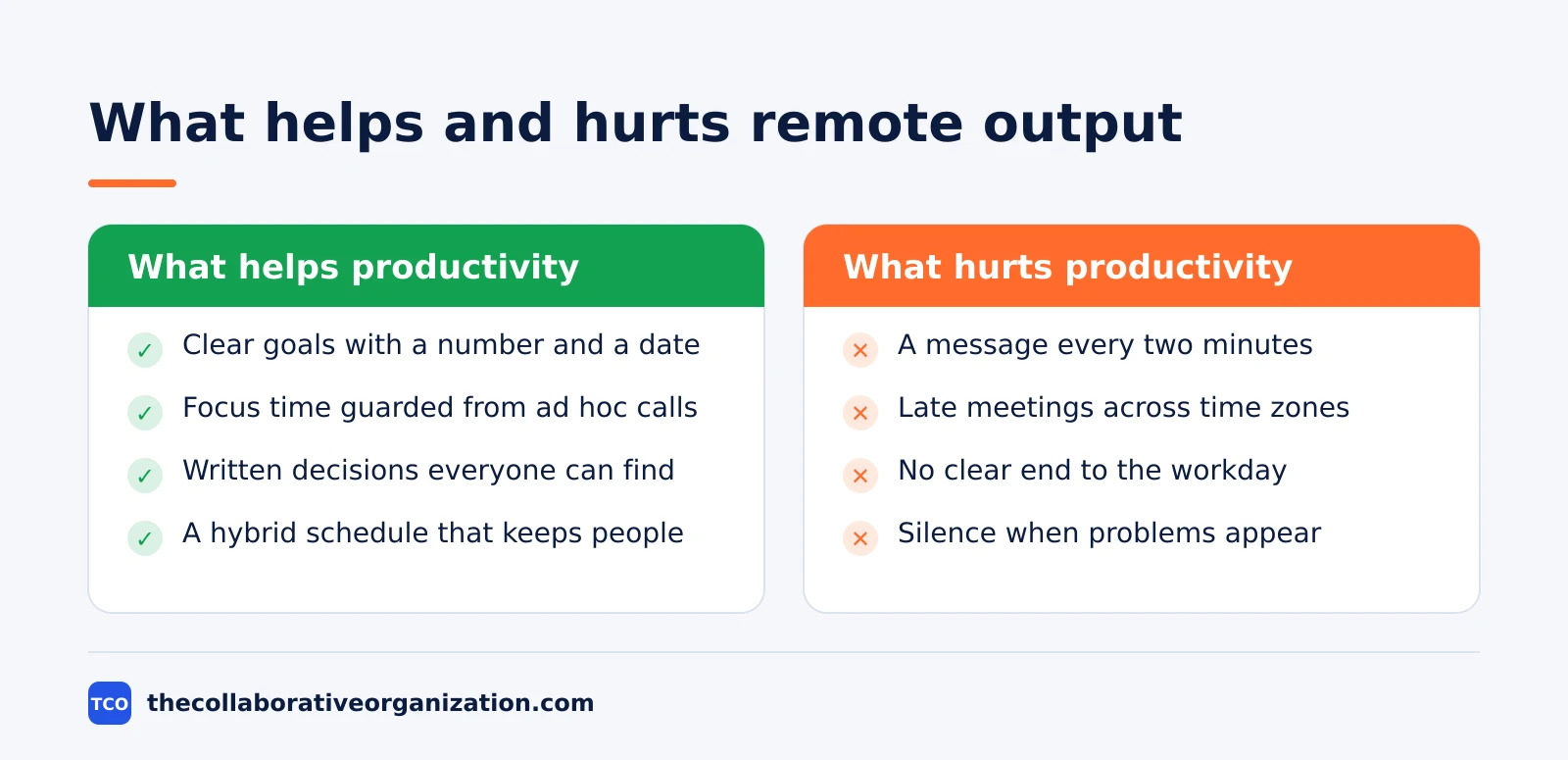
- Microsoft found in 2025 that workers are interrupted every two minutes, about 275 times a day.
- Gallup found in 2025 that fully remote workers are the most engaged group at 31%, but only 36% are thriving.
How we chose these 30 statistics
We kept only figures that trace to a named survey, dataset, or trial with a date, and we dropped any figure that appears only in roundups. Each statistic below names its source and year in the sentence, and the table at the end lists all 30 in one place. Figures from different surveys measure different people, so read each one with its source attached.
We favoured originals: government data from the Bureau of Labor Statistics, peer-reviewed trials from Nature and the Quarterly Journal of Economics, and large surveys from Gallup, Pew, Owl Labs, Buffer, Microsoft, and Eagle Hill.
Survey figures are self-reported, and trial figures cover the roles tested, so neither type proves what will happen in your team. The remote vs hybrid vs office work guide covers how the three patterns differ in practice.
How common is remote work
About one in five US workers teleworked in 2025, and about a quarter of paid workdays were worked from home. The figures below use the same measures across years, so they can be compared.
BLS data for 2025 show that 22.4% of US workers teleworked or worked at home for pay, or 35.4 million of 157.7 million people at work. Of those, 11.9% teleworked some hours and 10.5% teleworked all hours.
Working from home took 26.5 hours a week on average for teleworkers in 2025, the BLS tables show. People who teleworked all hours averaged 37.0 hours, against 17.3 hours for those who teleworked some hours.
WFH Research found that about 25% of paid days in the US in October 2025 were work-from-home days. Its survey covers US residents aged 20 to 64 who earned at least $10,000 in the prior year.
In the same survey, 61% of workers were full-time on site in late 2025, and 27% were in a hybrid arrangement, WFH Research reports. The share of paid days worked from home has held near a quarter since 2023.
Pew Research Center found in 2023 that 35% of workers with jobs that can be done remotely work from home all the time, and 41% follow a hybrid schedule. That is down from 43% fully remote in January 2022, but up from 7% before the pandemic.
Owl Labs found in 2025 that 28% of US full-time workers are hybrid, 9% are fully remote, and 63% are fully in office. Hybrid is now the largest form of remote work in the US.
What the research says about productivity
The trials say location does not cut output, and the surveys say managers see a gain. The two randomised trials below are the strongest evidence, because they compare like with like.
In a 2015 trial at Ctrip, home workers performed 13% better than office workers over nine months. The paper is Bloom, Liang, Roberts and Ying, Quarterly Journal of Economics, 2015, based on 249 call-centre volunteers. The gain came from more minutes worked and more calls per minute.
In a 2024 trial at Trip.com, hybrid workers matched office workers on performance grades and promotions over two years. Bloom, Han and Liang, Nature, 2024 ran the trial with 1,612 employees working from home two days a week. Resignations fell 33% in the hybrid group, from 7.20% to 4.80%.
Owl Labs found in 2025 that 69% of managers say hybrid or remote work made their team more productive. Only 12% of managers said it made their team less productive.
Workers agree: 51% say they are more productive in their current arrangement, Owl Labs found in 2025. Only 6% of workers said they are less productive.
Pew Research Center found in 2023 that 56% of teleworkers say working from home helps them get work done and meet deadlines. Only 7% say it hurts, and 37% say it neither helps nor hurts.
Microsoft found in 2025 that employees are interrupted every two minutes during core hours, about 275 times a day. The finding comes from Microsoft 365 telemetry and a survey of 31,000 knowledge workers in 31 markets.
Email adds to the load: the average worker receives 117 emails a day, most skimmed in under 60 seconds, Microsoft found in 2025. Mass emails to 20 or more people rose 7% year over year.
Microsoft also found in 2025 that the average worker receives 153 Teams messages per weekday. Message volumes rose more than 20% in parts of Europe, the Middle East, and Africa.
Four in five workers lack time or energy: 80% of the global workforce said so in the Microsoft survey of 2025. At the same time, 53% of leaders said productivity must increase.
Owl Labs found in 2025 that the average hybrid meeting loses 6 minutes to technical setup. More than a quarter of workers, 27%, lose 10 or more minutes per meeting to technical problems.
Engagement and wellbeing
Fully remote workers are the most engaged group, but the least likely to say they are thriving. The gap between engagement and wellbeing is the most important pattern in the data.
Gallup found in its 2025 report that 31% of fully remote workers are engaged, against 23% of hybrid workers and 23% of on-site workers whose jobs could be done remotely. On-site workers whose jobs could not be done remotely sit at 19%.
Global engagement fell to 21% in 2024, down from 23% the year before, according to Gallup. The two-point drop cost the world economy about $438 billion in lost productivity, driven by a fall in manager engagement.
Thriving tells the other side: only 36% of fully remote workers are thriving in life overall, Gallup found, against 42% of hybrid workers and 42% of on-site remote-capable workers. Global thriving fell to 33%.
Loneliness follows the same split. Gallup found in its 2025 report that 27% of fully remote workers felt lonely a lot of the previous day, against 23% of hybrid workers.
Stress is high in every arrangement. Gallup found that 45% of fully remote workers felt stressed the previous day, against 46% of hybrid workers and 39% of on-site remote-capable workers.
Buffer found in 2023 that 98% of remote workers want to work remotely at least some of the time for the rest of their careers. The survey covered 3,000 remote workers around the world.
Most remote workers like the arrangement: 91% report a positive experience, Buffer found in 2023. Only 1% described their experience as negative.
Pew Research Center found in 2023 that 71% of teleworkers say working from home helps them balance work and personal life. Of those, 52% say it helps them a lot.
Boundaries, retention, and burnout
Flexibility keeps people, but weak boundaries burn them out. The figures below show both sides of the same deal.
Pew Research Center found in 2023 that 53% of people who work from home at least some of the time say it hurts their ability to feel connected with co-workers. Only 10% say it helps them feel connected.
Buffer found in 2023 that 81% of remote workers check email outside work hours, including 63% on weekends and 34% on vacation. Nearly half, 48%, often work outside their scheduled hours.
Owl Labs found in 2025 that 40% of workers would start job hunting if flexibility were removed, and 5% would quit outright. A further 22% would expect a raise to make up for the lost flexibility.
Office days are creeping up: 39% of hybrid workers go into the office three days a week, and 34% go in four days, Owl Labs found in 2025. Both shares rose from 2024.
Burnout runs highest among fully remote staff. Eagle Hill Consulting found in its 2025 survey that 61% of fully remote US employees report burnout, against 57% of hybrid workers and 55% of all workers.
Owl Labs found in 2025 that 73% of workers say their company has not changed its remote or hybrid policy in the past year. Stability is the norm, even as office days rise.
What the numbers mean
The numbers point to hybrid as the middle path, with boundaries as the deciding factor. Trials show hybrid work keeps output steady and cuts quits by a third, while surveys show managers and workers both report gains. Fully remote work scores best on engagement and worst on thriving, loneliness, and burnout, so the gain depends on how the team is run.
Fragmentation is the hidden cost. Microsoft’s 275 interruptions a day and 117 emails explain why output feels lower even when trials show it is not.
A team that protects focus time will get more from remote work than a team that fills the day with ad hoc calls. Our guide on how to reduce meetings at work covers the cuts that free up that time.
Retention is the clearest win. The Trip.com trial put a price on it: each quit cost about $20,000 in hiring and training, and hybrid cut quits by a third. Owl Labs found in 2025 that 40% of workers would job hunt without flexibility, so the schedule is part of the offer, not a perk.
The employee burnout statistics roundup covers the wellbeing side in full.
Our guide on video call fatigue covers one of the main drains on remote energy.
The 30 statistics in one table
All 30 statistics, with source and year, in one place for reference. The sentences above carry the detail behind each row.
| Stat | Source | Year |
|---|---|---|
| 22.4% of US workers teleworked or worked at home for pay | BLS, Current Population Survey | 2025 |
| Teleworkers averaged 26.5 hours a week working from home | BLS, Current Population Survey | 2025 |
| About 25% of paid days were work-from-home days in October | WFH Research, SWAA | 2025 |
| 61% of workers full-time on site, 27% in a hybrid arrangement | WFH Research, SWAA | 2025 |
| 35% of remote-capable workers fully remote, 41% hybrid | Pew Research Center | 2023 |
| 28% hybrid, 9% fully remote, 63% fully in office | Owl Labs, State of Hybrid Work | 2025 |
| Home workers performed 13% better than office workers | Bloom et al., Quarterly Journal of Economics | 2015 |
| Hybrid work cut resignations 33% with no performance loss | Bloom et al., Nature | 2024 |
| 69% of managers say hybrid or remote made their team more productive | Owl Labs, State of Hybrid Work | 2025 |
| 51% of workers say they are more productive | Owl Labs, State of Hybrid Work | 2025 |
| 56% of teleworkers say home helps them meet deadlines | Pew Research Center | 2023 |
| Workers interrupted every 2 minutes, about 275 times a day | Microsoft, Work Trend Index | 2025 |
| Average worker receives 117 emails a day | Microsoft, Work Trend Index | 2025 |
| Average worker receives 153 Teams messages per weekday | Microsoft, Work Trend Index | 2025 |
| 80% of the global workforce lack time or energy for their work | Microsoft, Work Trend Index | 2025 |
| Average hybrid meeting loses 6 minutes to technical setup | Owl Labs, State of Hybrid Work | 2025 |
| Fully remote workers engaged at 31%, hybrid at 23% | Gallup, State of the Global Workplace | 2025 |
| Global engagement 21%, down from 23% the year before | Gallup, State of the Global Workplace | 2025 |
| Fully remote thriving at 36%, hybrid at 42% | Gallup, State of the Global Workplace | 2025 |
| Fully remote lonely at 27%, hybrid at 23% | Gallup, State of the Global Workplace | 2025 |
| Fully remote stressed at 45%, hybrid at 46% | Gallup, State of the Global Workplace | 2025 |
| 98% of remote workers want to stay remote at least some of the time | Buffer, State of Remote Work | 2023 |
| 91% of remote workers report a positive experience | Buffer, State of Remote Work | 2023 |
| 71% of teleworkers say home helps work-life balance | Pew Research Center | 2023 |
| 53% say home hurts feeling connected with co-workers | Pew Research Center | 2023 |
| 81% of remote workers check email outside work hours | Buffer, State of Remote Work | 2023 |
| 40% would job hunt if flexibility were removed, 5% would quit | Owl Labs, State of Hybrid Work | 2025 |
| 39% of hybrid workers in the office 3 days a week | Owl Labs, State of Hybrid Work | 2025 |
| Fully remote burnout at 61%, hybrid at 57%, all workers 55% | Eagle Hill Consulting, Workforce Burnout Survey | 2025 |
| 73% say their company has not changed remote or hybrid policy | Owl Labs, State of Hybrid Work | 2025 |
Our AI productivity statistics roundup covers the other big shift in how output is measured.
The team communication software shortlist compares the tools teams use to stay in touch.
Sources
- BLS - People at Work by Telework Status, 2025 Annual Averages (2025)
- BLS - People Who Teleworked by Average Weekly Hours, 2025 Annual Averages (2025)
- WFH Research - SWAA November 2025 Updates (2025)
- Pew Research Center - About a Third of US Workers Who Can Work From Home Do So All the Time (2023)
- Owl Labs - State of Hybrid Work 2025 (2025)
- Bloom et al. - Does Working from Home Work, Quarterly Journal of Economics (2015)
- Bloom et al. - Hybrid Working from Home Improves Retention, Nature (2024)
- Microsoft - Breaking Down the Infinite Workday (2025)
- Gallup - State of the Global Workplace 2025 Report (2025)
- Buffer - Key Insights from the 2023 State of Remote Work (2023)
Frequently asked questions
Are remote workers more productive than office workers?
The best trials say yes for some roles and no different for others. A 2015 trial at Ctrip found home workers performed 13% better, while a 2024 trial at Trip.com found hybrid workers performed the same as office workers but quit a third less often. Surveys are more positive: 69% of managers in Owl Labs 2025 research say hybrid or remote work made their team more productive.
What percentage of workers work remotely in 2025?
In the United States, 22.4% of workers teleworked or worked at home for pay in 2025, according to the Bureau of Labor Statistics. About 25% of paid workdays were worked from home in October 2025, according to WFH Research. Among workers whose jobs can be done remotely, Pew found 35% work from home all the time and 41% follow a hybrid schedule.
Does working from home hurt productivity?
The trials say no for the jobs tested. Hybrid workers in the 2024 Trip.com trial matched office workers on performance grades and promotions over two years. The risk is not location but fragmentation: Microsoft found in 2025 that workers are interrupted about every two minutes, which breaks the focus that remote work is meant to protect.
Why do remote workers quit less often?
Flexibility is the main reason. In the Trip.com trial, resignations fell 33% when workers moved to a hybrid schedule, with the largest drops among women, non-managers, and long commuters. Owl Labs found in 2025 that 40% of workers would start job hunting if flexibility were removed, so the schedule itself is part of the pay.
Is remote work bad for wellbeing?
The picture is mixed. Gallup found in 2025 that fully remote workers are the most engaged group at 31%, but only 36% say they are thriving in life, against 42% of hybrid workers. Remote workers also report more loneliness and more daily stress, so wellbeing depends on boundaries and contact, not on location alone.
Related articles

team communication
Communication Plan for a Project: Template (2026)
A communication plan for a project names who gets which update, in which channel, how often, and from whom. Copy the template and the filled example below.
November 20, 2026 · 10 min read
team communication
How Often Should Managers Communicate With Teams? (2026)
Managers should hold one meaningful conversation with each person every week, plus a weekly team update. See the cadence table for meetings, updates and feedback.
November 20, 2026 · 9 min read
team communication
Upward Communication Examples: 10 That Work (2026)
Upward communication is a message that travels from an employee to a manager or leader. See 10 concrete examples, each with why it works and when to use it.
November 20, 2026 · 9 min read