How Often Should Managers Communicate With Teams? (2026) | The Collaborative Organization
By The Collaborative Organization Team · November 20, 2026 · Last verified November 20, 2026 · 9 min read
Managers should hold one meaningful conversation with each team member every week, run one team meeting a week, and send one written team update a week. That is the whole cadence for a steady team. More contact helps only when it is meaningful, and less contact costs engagement fast.
Key takeaways
- Gallup’s guidance is one meaningful conversation per week with each person, lasting 15 to 30 minutes.
- 80% of employees who got meaningful feedback in the past week were fully engaged, Gallup found.
- Only 16% of nearly 15,000 employees said their last conversation with their manager was extremely meaningful.
- The default cadence is weekly one-on-ones, one weekly team meeting, and one written update a week.
- New starters and people in a difficult stretch need weekly contact; steady, experienced people can go to every two weeks.
How often managers should communicate: the short answer
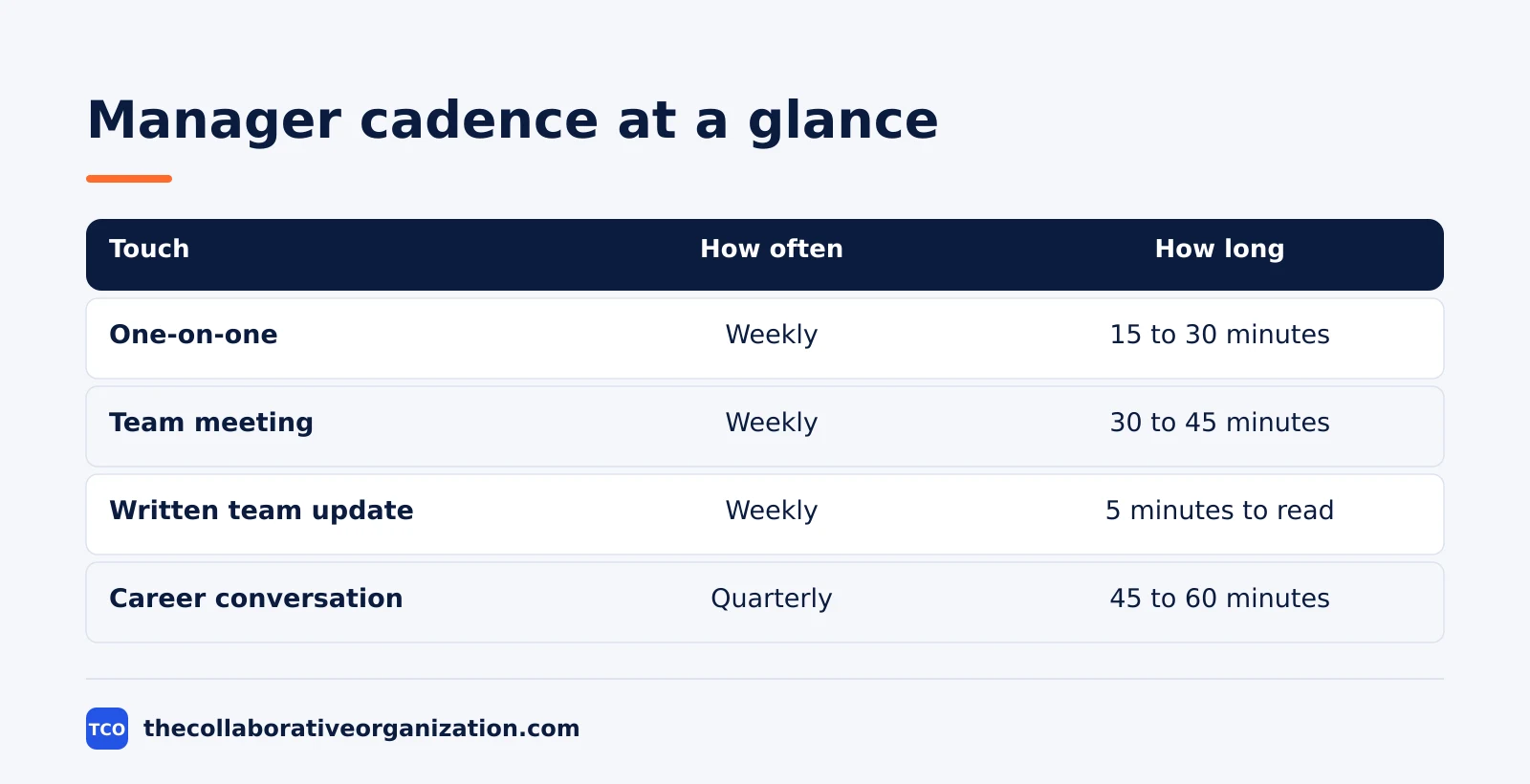
The short answer is weekly for the three touches that matter: one conversation with each person, one team meeting, and one written update. Daily contact happens in writing, through task updates and short notes, not in extra meetings. Monthly contact is the floor, not the target.
| Touch | How often | How long | Channel |
|---|---|---|---|
| One-on-one with each person | Weekly | 15 to 30 minutes | Video, phone or in person |
| Team meeting | Weekly | 30 to 45 minutes | Video or in person |
| Written team update | Weekly | One screen, 5 minutes to read | Task tool or team channel |
| Daily check-in | Only when work is fast-moving | 10 minutes | Chat or stand-up |
| Feedback on recent work | Weekly, inside the one-on-one | 5 minutes | In the conversation |
| Career conversation | Quarterly | 45 to 60 minutes | Video or in person |
| Company news from the manager | As news happens | 5 minutes to read | Team channel or email |
The table is a default, not a rule for every person. A new starter needs weekly contact and more of it, while a steady expert may prefer every two weeks. The manager’s job is to set the default, then adjust it per person and say so out loud.
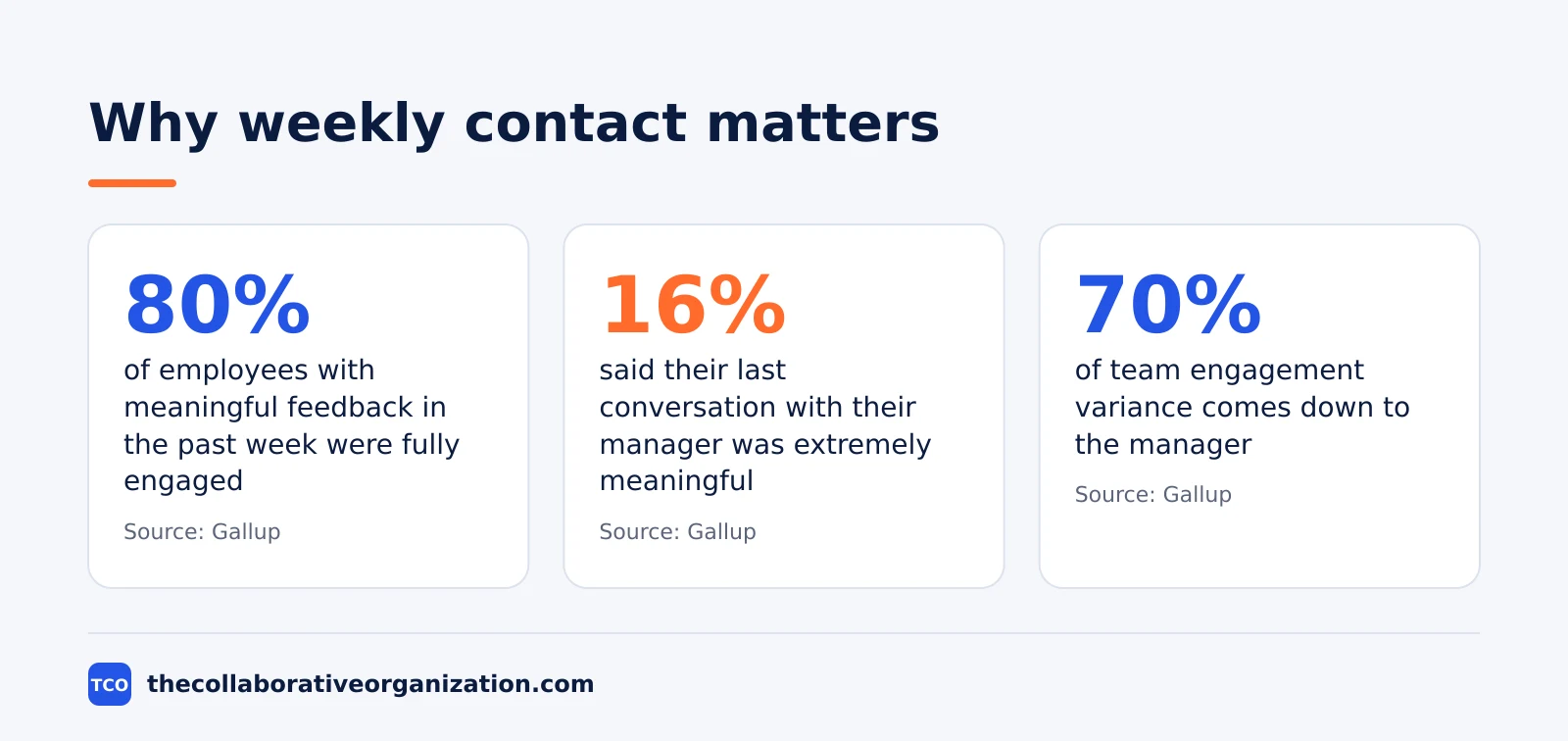
Gallup’s research gives the reason the weekly rhythm matters. In a study of nearly 15,000 employees, only 16% said their last conversation with their manager was extremely meaningful, yet 80% of employees who had received meaningful feedback in the past week were fully engaged.
One meaningful conversation a week with each person
One meaningful conversation a week with each team member is the single highest-value habit a manager has, and Gallup calls it the core of great managing. The conversation can be in person, on the phone, by video, by email, at coffee or standing in a hallway. The format matters less than the frequency and the content.
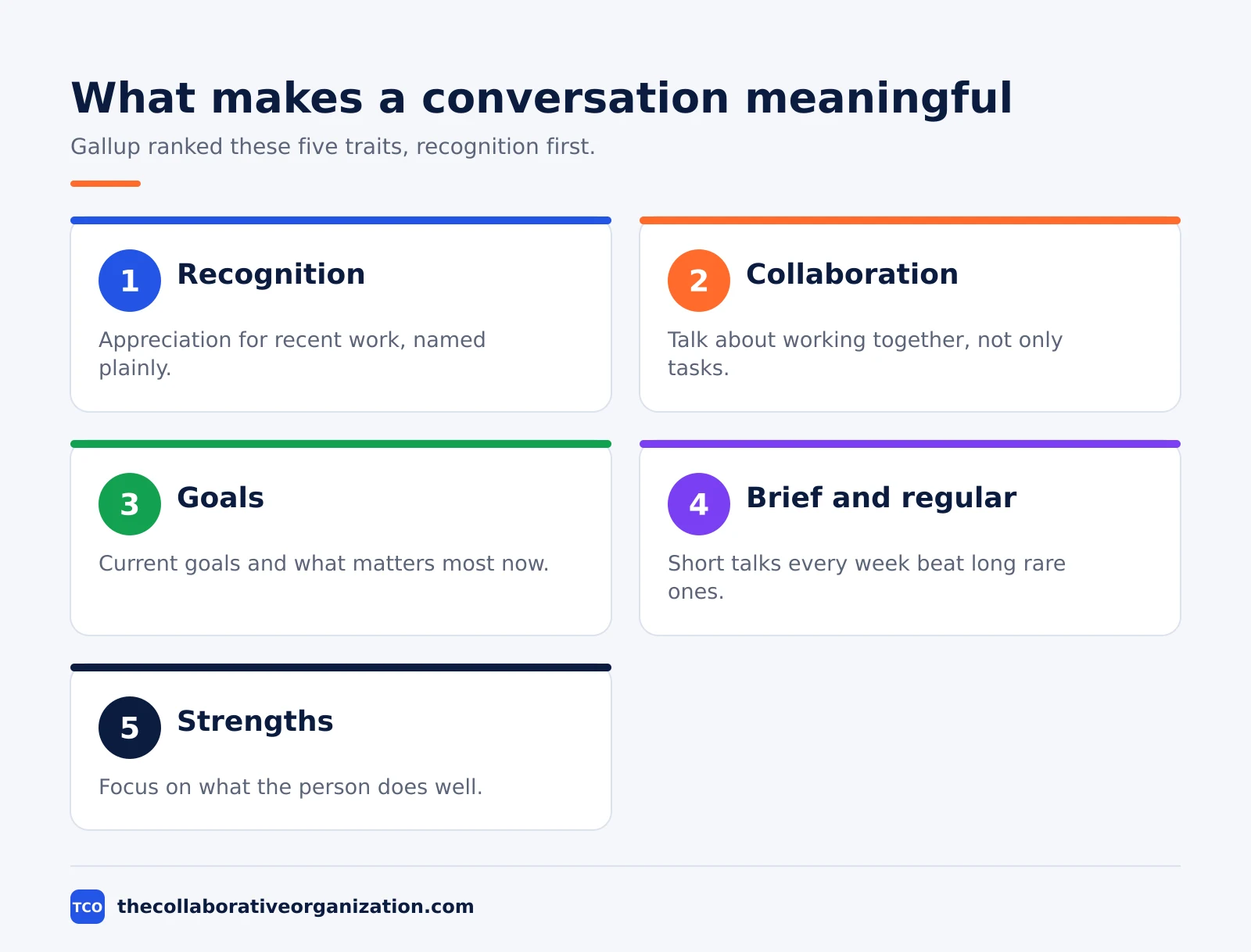
Gallup’s researchers studied the most common traits of extremely meaningful conversations and ranked five of them: recognition or appreciation for recent work, collaboration and relationships, current goals and prioritisation, regular and brief sessions, and emphasis on strengths. Recognition came first, and conversations focused on weaknesses ranked as the least meaningful.
The length follows the frequency. Gallup found that 15 to 30 minute conversations have a greater impact than 30 to 60 minute ones, but only when they happen regularly. When managers skip weeks, they need longer conversations to catch up, and the catch-up meeting feels like an interrogation.
Use our one-on-one meeting template to run the conversation. The template keeps the agenda in the employee’s hands, with the manager asking about goals, blockers and recognition before adding their own items.
The weekly team meeting and the daily check-in
One team meeting a week covers decisions, priorities and blockers, and a daily check-in is only needed when the work is fast-moving or blocked. The weekly meeting is where the team agrees what matters this week, who owns each item, and what needs a decision. It runs 30 to 45 minutes, with an agenda sent the day before.
The daily check-in covers only what changed since yesterday: what each person finished, what they plan next, and what blocks them. Keep it to 10 minutes and standing up, in person or on video. When nothing is blocked and nothing changed, the check-in can be a written note instead of a call.
A team meeting with no decision to make can usually become a written update. Gallup puts the point bluntly: great managing is an act of coaching, not one of directing and administrating, and coaching happens in conversation, not in status rounds.
The weekly written update
One written update a week keeps the whole team aligned without another meeting, and it should fit on one screen. The update covers four lines: what shipped, the numbers that matter, what is blocked, and what needs a decision. The manager writes it on the same day each week, and the team reads it in about five minutes.
The update is also the record. When a decision is made in a meeting, the summary goes in writing the same day, with the owner and the date. Remote staff and people in other time zones miss the hallway version of every decision, so the written version must be the real version.
Our guide to team communication strategies covers the wider system this update sits inside, with seven strategies and a worked example of a team that cut its meetings by a third.
Feedback every week, not only at review time
Feedback belongs inside the weekly conversation, while it is still fresh, not saved for a quarterly review. Gallup found that 80% of employees who received meaningful feedback in the past week were fully engaged, and the lift from meaningful feedback was four times the lift from having the right number of days in the office.
Good weekly feedback names recent work, says what was good about it, and ties it to the person’s goals. It takes about five minutes inside the one-on-one. The manager should also ask for feedback in return, because a conversation that only flows down is a briefing, not a conversation.
The gap is wide. Only 16% of nearly 15,000 employees in Gallup’s study said their last conversation with their manager was extremely meaningful. The fix is not longer meetings. It is weekly meetings that cover recognition, goals and strengths instead of status alone.
When to talk more, and when to talk less
Talk more when a person is new, stuck, or remote, and talk less when a person is steady, experienced, and delivering. A new starter needs weekly contact and fast answers, because a two-week gap lets small confusions harden into real mistakes. A person going through a difficult stretch needs the same.
An experienced person doing steady work may prefer a one-on-one every two weeks, with a weekly written update in between. Research by organisational psychologist Steven Rogelberg, reported in Harvard Business Review and summarised here, found employees rate a weekly 30-minute one-on-one as most desirable, with a biweekly 45 to 60 minute meeting second and a monthly meeting least preferred.
Crises change the rhythm in the other direction. When a deadline slips or a system fails, the manager should talk to the team daily until the problem is contained, then return to the weekly rhythm. The team should hear bad news from the manager first, live, with questions taken at once.
Axios HQ surveyed 813 employees and 457 leaders in 2025, and found that 37% of employees wanted a more consistent cadence from leaders. A steady rhythm beats a flood of messages followed by weeks of silence, because the team learns when to expect news.
Worked example: a manager with 8 reports sets the cadence
Picture a manager with 8 direct reports, a mix of 2 new starters, 5 steady staff and 1 remote worker in another time zone. She sets the cadence in one week, and it costs her about 5 hours a week. The example below is an illustration, not a case study.
She holds a 30-minute one-on-one with each person every week: Tuesday and Thursday mornings, four each day. The 2 new starters get the first slots, so their questions are answered before the week fills up. The remote worker gets a video call in the overlap window, and the summary goes in writing the same day.
She runs one 45-minute team meeting on Monday, with the agenda sent on Friday. She writes a one-screen team update every Friday, covering what shipped, the numbers, the blockers and the decisions needed. The daily check-in is written, not a meeting, unless something is blocked.
After a month, she counts three numbers: meetings per week, repeat questions per week, and time to first reply on routine messages. If all three fall, the cadence works. Our guide to internal communication best practices explains how to measure what lands with a two-question survey.
Tools that carry the cadence
A tool helps only when it matches a rhythm the manager already agreed, so pick the tool after the cadence, not before. Compare the options on our team communication software shortlist before you pay for anything.
| Tool | Best for | Free plan | Starting price (as of November 2026) | Notable limit |
|---|---|---|---|---|
| Slack | Daily notes and quick questions in channels | Free plan, 90-day message history | $7.25 per user per month (Pro), billed annually | Free plan keeps 90 days of history |
| Microsoft Teams | Teams already on Microsoft 365 | Free plan | $4.00 per user per month (Teams Essentials), paid yearly | Essentials has no Office apps |
| Zoom | Weekly one-on-ones and team meetings by video | Free plan, 40-minute group meetings | $14.16 per user per month (Pro), billed annually | Free plan caps group meetings at 40 minutes |
The Slack pricing page lists Pro at $7.25 per user per month billed annually.
The Microsoft Teams pricing page lists Essentials at $4.00 per user per month, paid yearly, with one source noting $4.50 after a July 2026 increase, so check the vendor page before you buy.
The Zoom pricing page lists Pro at $14.16 per user per month billed annually, or $16.99 billed monthly.
Common manager communication cadence mistakes to avoid
Most managers get the cadence wrong in the same five ways, and each one has a simple fix. Check the list at the next quarterly review.
- Skipping one-on-ones when busy. A one-on-one that is regularly skipped tells the employee they are not a priority. Protect the slot, and move it rather than cancelling it.
- Status updates as meetings. A meeting that only reports status wastes the hour. Move status to writing, and keep meetings for debate and decisions.
- One rhythm for everyone. A new starter and a ten-year veteran need different contact. Set the default, then adjust it per person and say so.
- Feedback saved for review time. Feedback that arrives three months late is history, not help. Give it weekly, inside the conversation, while the work is fresh.
- Talking more than listening. The biggest predictor of a bad one-on-one is the manager doing most of the talking. The report should speak most of the time, and the manager should ask, not tell.
Sources
- Gallup - A Great Manager’s Most Important Habit (2026)
- Gallup - Gallup Finds a Silver Bullet: Coach Me Once Per Week (2026)
- Gallup - State of the Global Workplace 2025 (2025)
- Axios HQ - Internal Communications Statistics, State of Internal Communication 2025 (2025)
- Newman Human Resources - One-on-One Meetings, Check-in Cadence and Manager Presence (2026)
- Slack - Pricing (2026)
- Microsoft - Microsoft Teams Pricing (2026)
- Zoom - Pricing (2026)
Frequently asked questions
How often should a manager talk to each team member?
Once a week, in a meaningful conversation of 15 to 30 minutes. Gallup's research puts it plainly: one meaningful conversation per week with each team member builds high-performance relationships more than any other leadership activity. The conversation can be in person, by phone, by video, or even in a hallway, and it should cover goals, recognition and strengths.
How often should a manager hold team meetings?
One team meeting a week is the default for most teams, plus a short daily check-in only when the work is fast-moving or blocked. A weekly meeting covers decisions, priorities and blockers, while the daily check-in covers only what changed since yesterday. If the weekly meeting has no decision to make, it can usually become a written update.
How long should a one-on-one with a team member last?
15 to 30 minutes is enough when the meeting happens every week. Gallup found that regular 15 to 30 minute conversations have a bigger effect than 30 to 60 minute ones. Save 45 to 60 minutes for the conversations that need room, such as a quarterly career check-in, a return from leave, or a catch-up after weeks of thin contact.
Should managers communicate with their team every day?
Not in a meeting, but yes in writing. A short daily note or task update keeps the team moving without another call. Reserve live contact for debate, hard news and conflict, and let status updates, document reviews and routine questions travel in writing. Daily contact that is all meetings burns the time it is meant to save.
How often should managers give feedback?
Every week, inside the regular conversation, not only at review time. Gallup found that 80% of employees who received meaningful feedback in the past week were fully engaged. The feedback should name recent work, say what was good about it, and tie it to the person's goals. Waiting for a quarterly review makes the feedback stale.
Do remote teams need more frequent communication from managers?
Yes, at first, and in writing more than in meetings. Remote staff miss the hallway version of every decision, so the written version must be the real version. Keep the weekly one-on-one, add a short written team update each week, and send the summary after every live decision so nobody has to have been in the room.
Related articles
team communication
Communication Plan for a Project: Template (2026)
A communication plan for a project names who gets which update, in which channel, how often, and from whom. Copy the template and the filled example below.
November 20, 2026 · 10 min read
team communication
Upward Communication Examples: 10 That Work (2026)
Upward communication is a message that travels from an employee to a manager or leader. See 10 concrete examples, each with why it works and when to use it.
November 20, 2026 · 9 min read
team communication
Onboarding Statistics: 33 Numbers That Decide Retention (2026)
Onboarding statistics from Gallup, SHRM, BambooHR and more: 33 verified numbers on retention, cost, training and first-90-day turnover for 2026.
November 19, 2026 · 11 min read