Remote vs Hybrid vs Office Work: Which Wins? (2026) | The Collaborative Organization
By The Collaborative Organization Team · November 19, 2026 · Last verified November 19, 2026 · 11 min read
Remote work puts the employee at home full time, hybrid splits the week between home and office, and office work keeps everyone on site. No model wins on its own. Hybrid is the most common and the most wanted, remote wins on focus and hiring reach, and the office wins on fast, unplanned contact.
Key takeaways
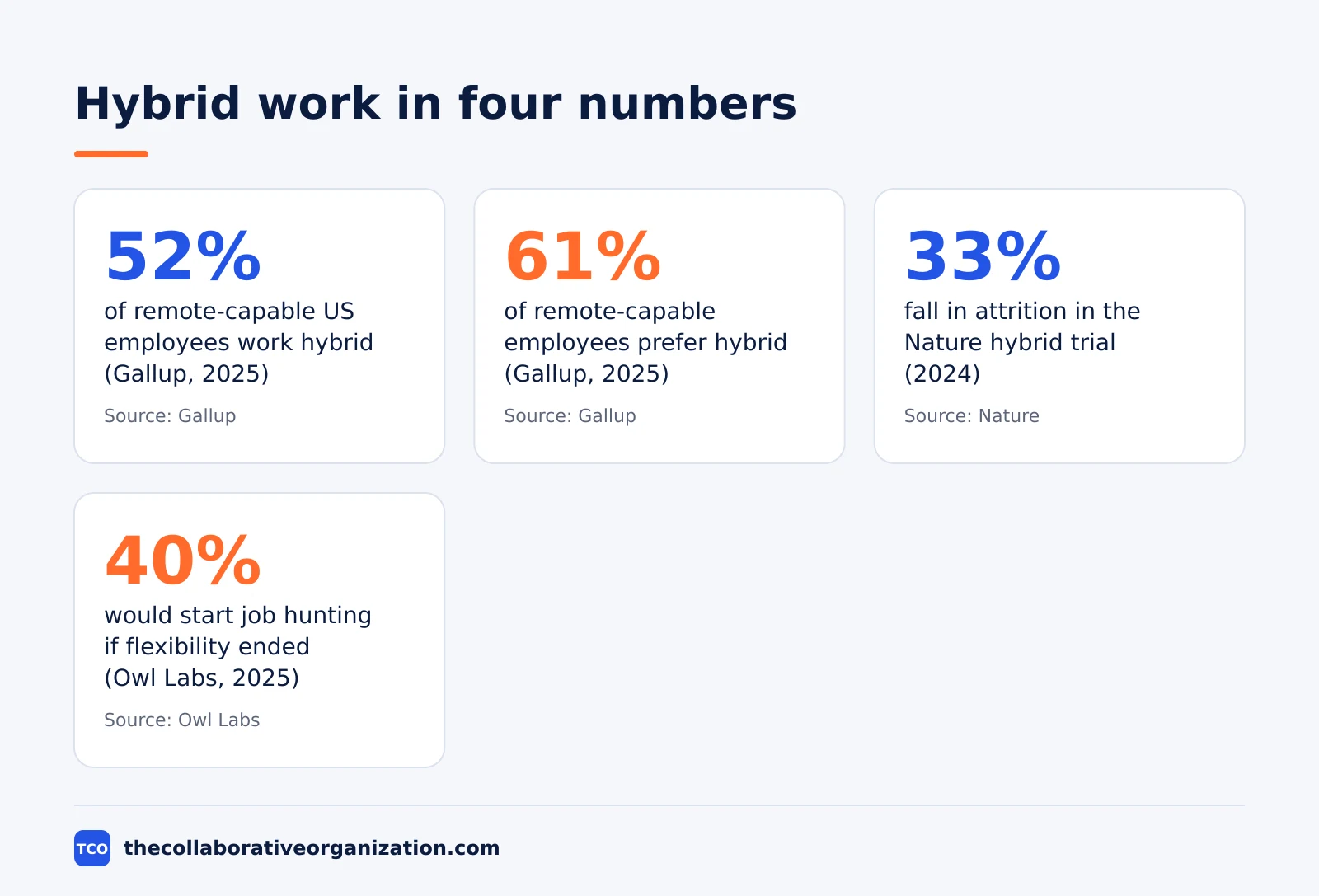
- About 52% of remote-capable US employees work hybrid, 27% fully remote and 21% fully on-site, in Gallup data from 2025.
- When asked where they would prefer to work, 61% of remote-capable employees chose hybrid and only 6% chose the office.
- A Nature trial in 2024 found hybrid work matched office output and cut attrition by about one-third.
- Owl Labs found 39% of hybrid workers go to the office three days a week and 34% go four days.
- Microsoft found the average worker gets 117 emails and 153 Teams messages a day in its 2025 index.
- If flexibility were taken away, 40% of workers would start job hunting, in the Owl Labs 2025 survey.
The core difference between remote, hybrid and office work
The difference is where the work happens, and who decides. Remote work fixes the location at home or elsewhere, and the team meets online. Hybrid fixes a split, usually two or three office days, and the team plans around the days everyone is in. Office work fixes the location at the office, and the team meets in person by default.
The choice shapes everything else: hiring reach, office costs, meeting habits and how new staff learn the job. A remote team can hire anywhere, while an office team hires near the building. A hybrid team gets both benefits in part, and both costs in part. Our guide to workplace collaboration statistics puts the numbers behind these trade-offs in one place.
The three models also differ in what they demand from managers. Remote work demands written decisions and clear goals. Office work demands a good room and a reason to be there. Hybrid demands both, plus a calendar that says which days are for together work and which are for focus work.
Remote vs hybrid vs office at a glance
The table below compares the three models on the questions a manager actually asks. Use it when the team debates a policy change, since it keeps the argument on facts instead of habits.
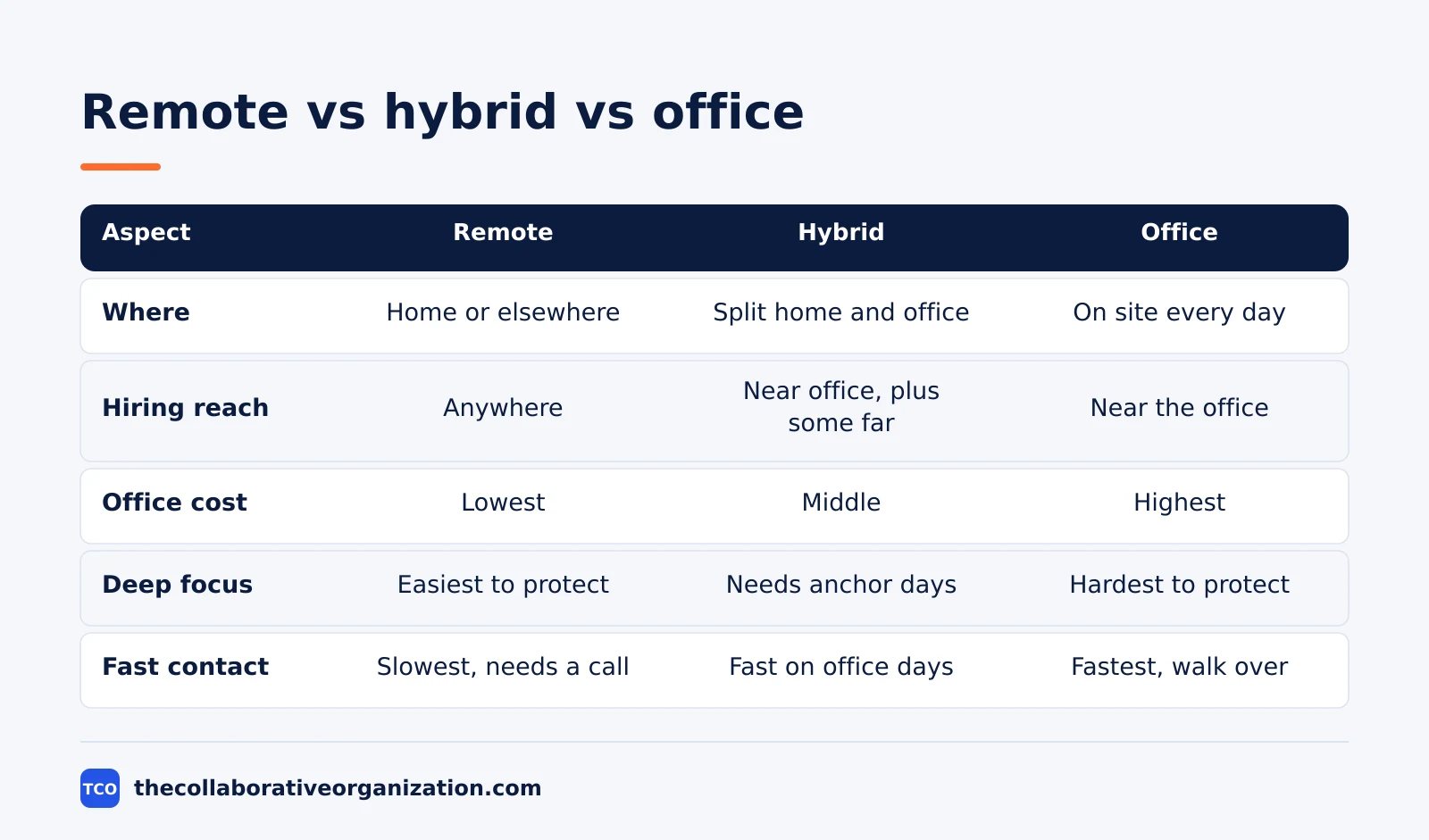
| Aspect | Remote | Hybrid | Office |
|---|---|---|---|
| Where work happens | Home or elsewhere | Split home and office | On site every day |
| Hiring reach | Anywhere | Near the office, plus some far | Near the office |
| Office cost | Lowest | Middle | Highest |
| Deep focus | Easiest to protect | Needs anchor days | Hardest to protect |
| Fast contact | Slowest, needs a call | Fast on office days | Fastest, walk over |
| New staff learning | Slowest, needs a plan | Mixed, office days help | Fastest, by watching |
One row matters more than the rest: new staff learning. A new hire learns fastest by watching others, and remote work removes that channel. Hybrid keeps it on office days, but only if those days are planned for together work rather than solo work done in a louder room.
How remote work works
Remote work runs on written decisions, clear goals and online meetings. The team agrees what “done” means in writing, since nobody can walk over and ask. Meetings happen on video, and the work itself lives in shared docs and boards that anyone can open at any time.
The model suits deep focus work and hiring beyond one city. A writer, a developer or an analyst can do a full day of focused work at home without the interruptions of an open office. The cost is the loss of unplanned contact: ideas that used to surface at lunch now need a scheduled call or a written note.
Remote work also needs a plan for loneliness and visibility. Gallup found fully remote workers reported feeling lonely at higher rates than hybrid or on-site workers in its 2025 surveys, so managers must check in on purpose rather than by chance.
Deskbird’s summary of Gallup data puts the 2025 split at 52% hybrid, 27% fully remote and 21% on-site among remote-capable US employees.
How hybrid work works
Hybrid work splits the week, and the split only works when the team agrees which days are for what. The usual pattern is three office days and two home days, with office days used for planning, reviews and hard conversations, and home days used for focus work. Owl Labs found 39% of hybrid workers go in three days a week and 34% go in four days in its 2025 survey.
The model is the most wanted one. Gallup asked remote-capable employees in November 2025 where they would prefer to work: 61% chose hybrid, 33% chose fully remote, and 6% chose the office. The Owl Labs report adds that 40% of workers would start job hunting if flexibility were taken away, and 5% would quit outright.
Hybrid fails when the office days are not coordinated. If each person picks different days, the team pays for an office that nobody uses together. Anchor days, when the whole team is in, fix that. The policy should name the days and the purpose of each day.
How office work works
Office work runs on presence: the team is in the same place, and contact is fast and unplanned. A question gets an answer in seconds, a new hire learns by watching, and a hard conversation happens face to face. The office also makes some work possible that remote work cannot: hands-on tasks, secure systems and customer-facing roles.
The cost is the commute and the interruption. Owl Labs found the average commute is 31 minutes for in-office and hybrid workers, and Microsoft found the average worker is interrupted about every two minutes by a message or a meeting. Microsoft’s 2025 index also found 80% of employees say they lack the time or energy to do their job.
Office work suits teams that need fast, unplanned contact or hands-on work, and it suits new hires who learn by watching. It fits poorly for deep focus work, since the open office is the hardest place to protect focus time.
What the evidence says about productivity
The best evidence says hybrid work matches office output, while remote work depends on the task. A randomized trial at Trip.com, published in Nature in June 2024, covered 1,612 employees on a hybrid schedule of three office days and two home days. Output, performance reviews and promotion rates showed no measurable difference from full-time office work, while attrition fell by about one-third.
Surveys point the same way but prove less. Owl Labs found 69% of managers believe hybrid or remote work made their team more productive, which is a belief rather than a measurement. Stanford survey data shows hybrid workers report being about 9% more productive on remote days than on office days, by their own account.
The honest reading is that the model matters less than the setup. A hybrid team with anchor days and protected focus time beats an office team that meets all day. Measure output and retention on your own team instead of copying a headline number.
Choose remote if the work is focused and the talent is far away
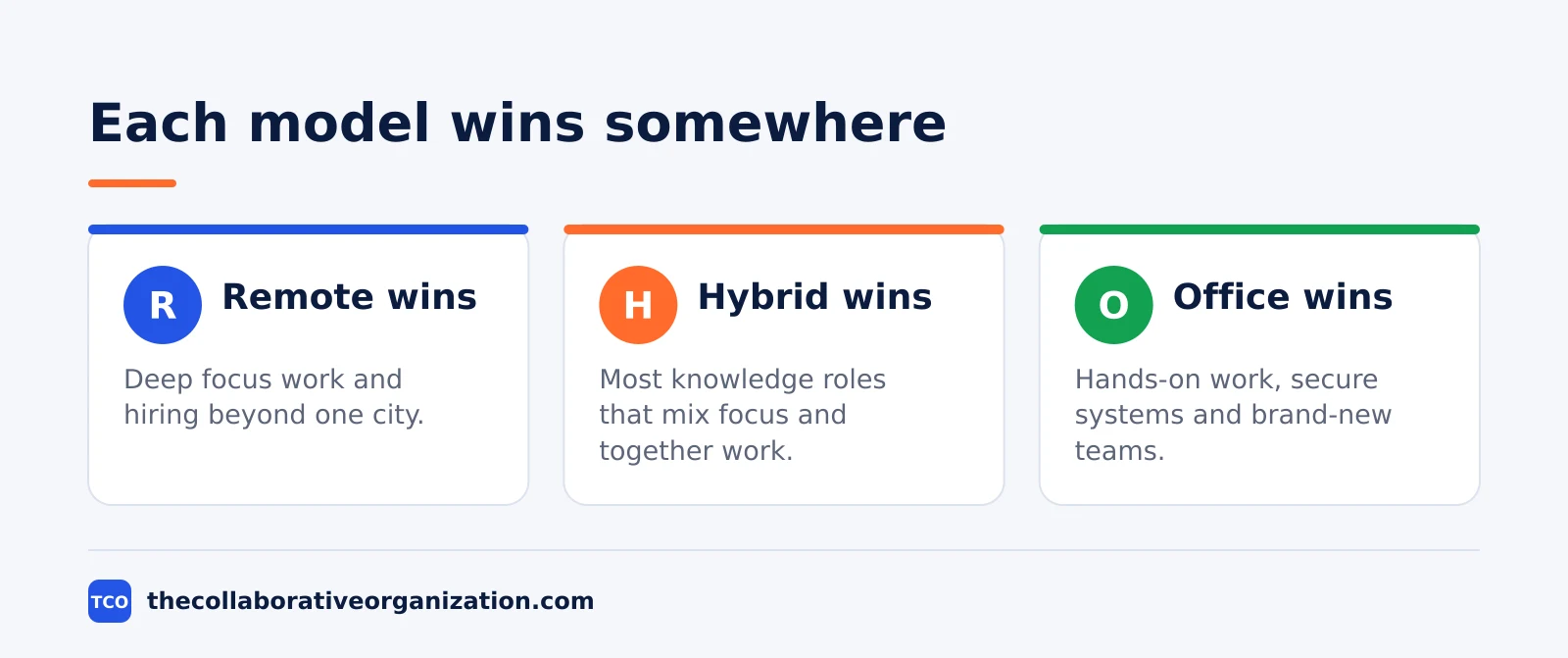
Choose remote when the work needs deep focus and the best people do not live near the office. Writing, coding, analysis and design all fit, since the work is done on a screen and the output is easy to judge. Remote also fits a team that wants to hire across time zones.
Remote needs three things to work: written goals, a home setup that supports focus, and a plan for new hires. Without those, the team drifts into long meetings and slow answers. Our guide on how to improve team collaboration covers the habits that keep a distributed team in step.
- The work is judged by output, not by hours seen. A finished design or a shipped fix speaks for itself.
- The best hires live far away. Remote hiring opens the whole country, not one city.
- The team is small and the tools are shared. Docs, boards and chat carry the work.
- Office costs would eat the budget. A remote team spends the money on tools and pay instead.
Choose hybrid if most roles can flex
Choose hybrid when most roles can flex and the team still needs regular face time. Hybrid is the default for knowledge work now, and it is the model employees want most. It keeps the office for planning and learning, and it keeps home for focus work.
Hybrid needs anchor days and a clear purpose for each day. Office days are for together work: planning, reviews, onboarding and hard talks. Home days are for focus work. A team that goes to the office to sit on video calls has the worst of both models.
- Roles mix focus work and together work. Most knowledge roles fit this shape.
- New hires need office days. Watching others is the fastest way to learn.
- The office exists and is paid for. Hybrid uses it on purpose instead of leaving it empty.
- The team wants flexibility without losing contact. Hybrid is the middle ground employees ask for.
Choose office if the work is hands-on or the team is new
Choose the office when the work needs hands, secure systems or constant contact. Customer-facing roles, lab work and hardware all need a place. A brand-new team also learns faster in person, since trust builds quickest face to face.
Office work also fits a team that struggles with written habits. If decisions are never written down and goals are vague, remote work will expose those gaps fast. The office papers over them with fast talk, which is a reason to fix the habits rather than a reason to stay.
- The work needs hands or secure on-site systems. No video call replaces the bench or the vault.
- The team is brand new. Trust and shared habits form fastest in person.
- Customers come to you. A shop, a clinic or a front desk is the workplace.
- Decisions are never written down yet. Fix the writing habit first, then flex the location.
Worked example: a 40-person team sets its anchor days
A 40-person product team shows how a hybrid policy works in practice. The team went hybrid with three office days, but each person picked different days, so the office sat half empty and planning meetings still happened on video. The policy had a split but no shared purpose.
The team fixed it with two anchor days, Tuesday and Thursday, when everyone is in. Those days hold planning, reviews and onboarding. Monday, Wednesday and Friday are focus days at home, with no recurring meetings before noon. The office days are for together work, and the home days are for deep work.
Six months later, the team kept the split and the office felt busy on anchor days. The lesson is simple: hybrid is a calendar decision before it is a location decision. Name the days, name the purpose of each day, and review the split every quarter.
Tools that hold a remote, hybrid or office team together
A team spread across locations needs one chat tool, one meeting tool and one place for decisions. The chat tool carries daily talk, the meeting tool carries video, and the decision log carries the choices that remote workers cannot overhear. Our team communication software shortlist compares the options side by side.
| Tool | Best for | Free plan | Starting price (as of November 2026) | Notable limit |
|---|---|---|---|---|
| Slack | Fast team chat with channels | Free, 90 days of history | $7.25 per user per month (Pro), billed annually | Free plan hides messages older than 90 days |
| Microsoft Teams | Teams already on Microsoft 365 | Free version for small groups | $4 per user per month (Essentials), billed annually | Essentials has no business email |
| Zoom | Video meetings that just work | Free, 40-minute meetings | $14.16 per user per month (Pro), billed annually | Free meetings cap at 40 minutes |
Pricing checks from October and November 2026 put Slack Pro at $7.25 per user per month billed annually, and Business+ at $15. Slack’s own help pages confirm the free plan keeps messages searchable for 90 days.
Pricing checks from November 2026 list Teams Essentials at $4 per user per month billed annually, in the Teams pricing check.
The Google Workspace pricing check lists Business Starter at $7 per user per month billed annually for teams that want Gmail on their own domain with Meet included.
Common remote vs hybrid vs office mistakes to avoid
Most location policies fail in the same five ways, and all five are easy to spot. Run through the list before the next policy change.
- Letting each person pick different office days. The team pays for an office nobody uses together.
- Using office days for solo video calls. Office days are for together work, not for louder solo work.
- Measuring presence instead of output. Hours in a seat say nothing about work shipped.
- Forgetting new hires. Remote onboarding needs a written plan, a buddy and regular check-ins.
- Changing the policy without asking the team. A mandate that ignores the 61% who prefer hybrid will cost hires.
Sources
- Owl Labs - State of Hybrid Work 2025 (2025)
- Microsoft - Work Trend Index 2025 Executive Summary (2025)
- Deskbird - Hybrid Work Statistics: What Data Says in 2026 (2026)
- Gloroots - Remote Work Statistics 2026: Data for Global Hiring (2026)
- Microsoft News - Work Trend Index 2025 Report (2025)
- Rock - Slack Pricing 2026: Plans, Real Costs and Free Limits (2026)
- The 64th - Zoom vs Microsoft Teams (2026)
- Axel SEO - Gmail for Business: Free vs Your Own Domain (2026)
Frequently asked questions
What is the difference between remote, hybrid and office work?
Remote work means the employee works away from the office full time, usually from home. Hybrid work splits the week between home and office, most often three days in the office. Office work means the employee is on site every working day. Gallup counts someone as hybrid when they work remotely from 10% to less than 100% of the time.
Do employees prefer hybrid work over remote or office work?
Yes, hybrid is the most wanted option. Gallup asked remote-capable US employees in November 2025 where they would prefer to work, and 61% chose hybrid, 33% chose fully remote, and only 6% chose fully on-site work. Hybrid is also the most common arrangement, at about half of remote-capable employees.
Is hybrid work as productive as office work?
The strongest evidence says yes. A randomized trial at Trip.com, published in Nature in June 2024, found that a hybrid schedule of three office days and two home days produced no measurable difference in output, performance reviews or promotion rates compared with full-time office work. Attrition fell by about one-third in the same trial.
How many days a week do hybrid workers go to the office?
Most hybrid workers go in three or four days a week. Owl Labs found in its 2025 survey that 39% of hybrid workers go in three days and 34% go in four days, both up from 2024. Gallup found hybrid workers spent 46% of their workweek in the office in September 2025, the equal of 2.3 days.
Can a company mix remote, hybrid and office roles?
Yes, and most do. The mix usually follows the job, not the person: roles that need hands-on work or secure on-site systems stay in the office, while roles that need deep focus go remote or hybrid. The policy should name which roles fit which model and how the team stays in step, instead of leaving each manager to decide alone.
Related articles
guides
Free Project Management Templates: 7 to Copy (2026)
Seven free project management templates from monday, Wrike, Teamwork, Smartsheet, ClickUp, Asana and Trello, with what each one is for and what free really costs.
November 20, 2026 · 7 min read
guides
Project Proposal Template: Copy and Win Work (2026)
A project proposal template pitches the work before it is approved: problem, solution, scope, budget, timeline and terms. Copy the template and filled example.
November 20, 2026 · 10 min read

guides
Action Plan Template: Goal to Done in One Page (2026)
An action plan template turns one goal into owned steps with dates, dependencies and a success measure. Copy the table and see it filled for a support team.
November 20, 2026 · 11 min read