Upward Communication Examples: 10 That Work (2026) | The Collaborative Organization
By The Collaborative Organization Team · November 20, 2026 · Last verified November 20, 2026 · 9 min read
Upward communication is any message that travels from an employee to a manager or a senior leader: feedback, a suggestion, a question, a status update, or a concern raised early. It is the opposite of downward communication, where leaders pass instructions down. Employees see problems first, so the upward route is how a company learns what is actually happening.
Key takeaways
- Upward communication flows from employees to leaders, and carries feedback, suggestions, questions and concerns.
- The best example is a regular one-on-one with your manager, because it is private, regular and two-way.
- 10 examples below cover everyday talks, written messages and formal company channels.
- Every example works for the same reason: it gives the manager a fact, an effect, and something they can act on.
- Anonymous routes suit sensitive topics, while named messages suit ideas, because the manager can follow up.
Upward communication at a glance
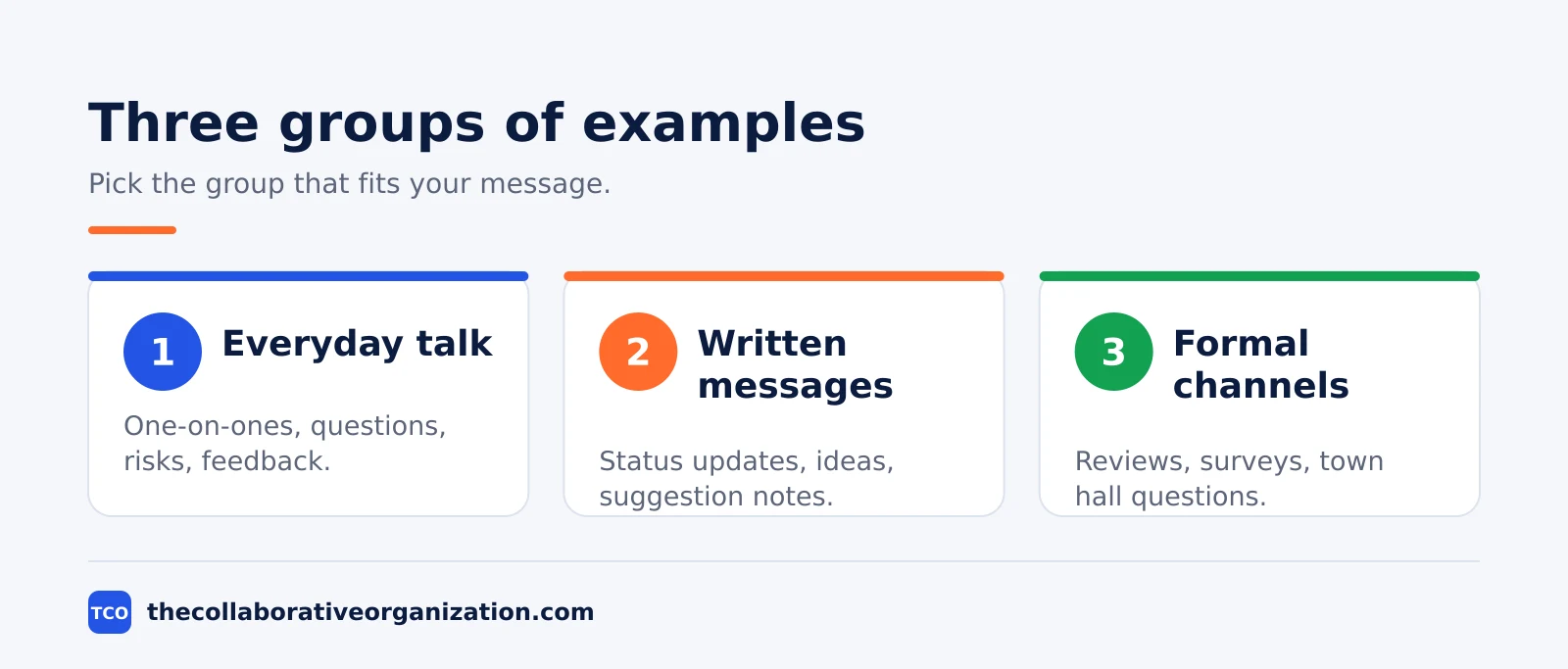
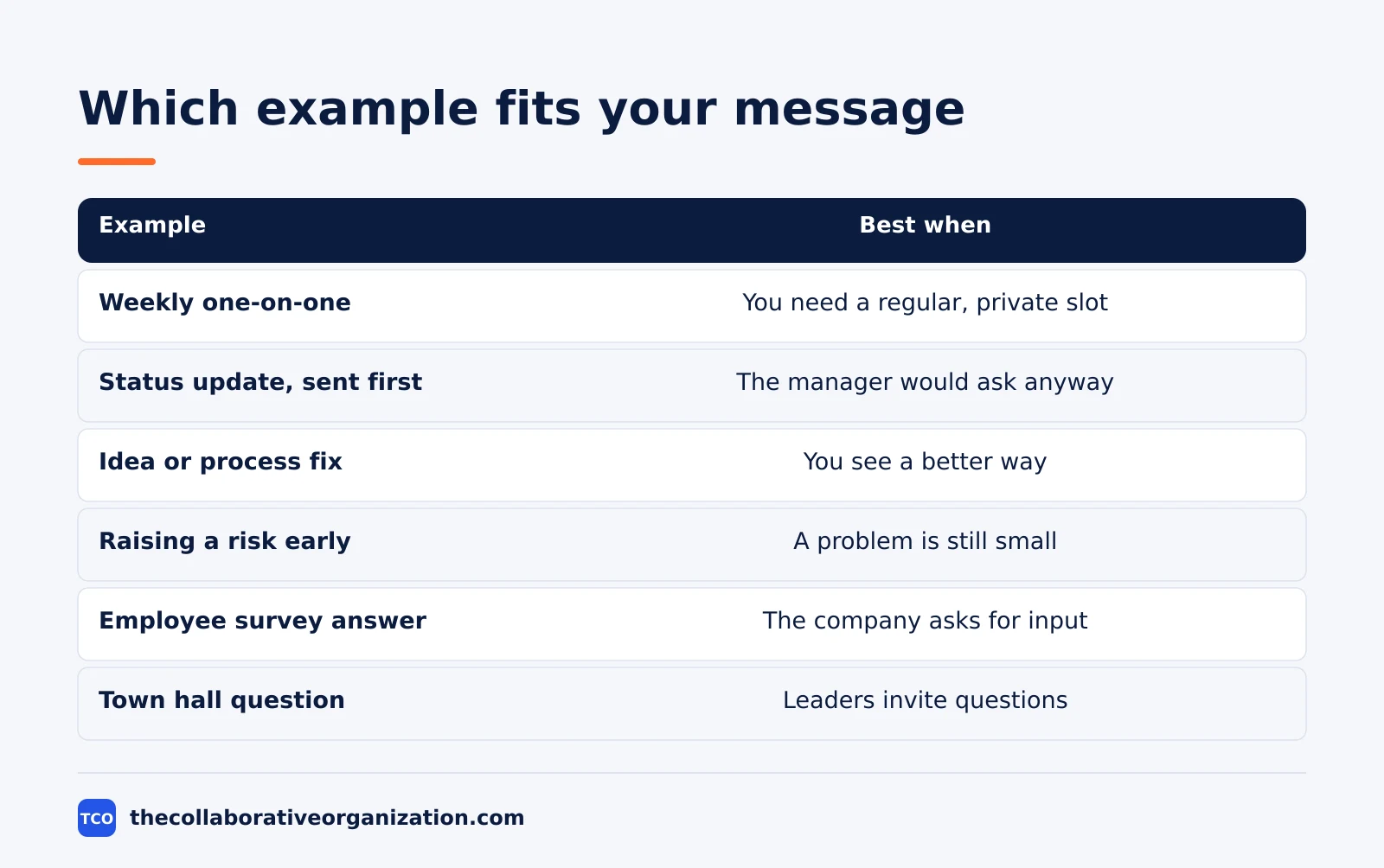
The 10 examples below fall into three groups: everyday conversations, written messages, and formal company channels. Use the table to pick the right one for your message, then read the example for the exact shape. The groups overlap, and that is fine: a good upward message often starts as a chat and ends as a written note.
Our guide on what team communication is explains the channels these messages travel on, from chat and email to meetings and surveys.
| Example | Group | Best when |
|---|---|---|
| Weekly one-on-one | Everyday talk | You need a regular, private slot |
| Clarifying question | Everyday talk | The task is unclear |
| Raising a risk early | Everyday talk | A problem is still small |
| Feedback for your manager | Everyday talk | Something helps or hinders you |
| Status update, sent first | Written | The manager would ask anyway |
| Idea or process fix | Written | You see a better way to do a task |
| Suggestion box note | Written | The topic is sensitive |
| Self-assessment in a review | Formal channel | Review season arrives |
| Employee survey answer | Formal channel | The company asks for input |
| Town hall or skip-level question | Formal channel | Leaders invite questions |
Indeed lists five of these as the classic set: performance reports, focus groups, employee satisfaction surveys, company meetings and suggestion boxes. The examples below add the everyday ones, because most upward communication happens outside formal channels.
Everyday examples: in conversation with your manager
Everyday upward communication happens in short talks, and it works because it is fast, specific and easy to act on. These four examples need no form and no meeting invite beyond the one you already have.
1. The weekly one-on-one with your manager
You bring three items to your regular one-on-one: one thing that went well, one blocker, and one question. Your manager hears the blocker while it is still small, and you hear the answer in the same meeting. Use our one-on-one meeting template to run it. Why it works: it is private, regular and two-way, so hard topics do not wait for review season.
2. A question that clarifies what is expected
You ask your manager which of two tasks matters more this week, and what “done” looks like for each. The answer takes two minutes and saves a day of work on the wrong priority. Why it works: it turns a guess into a fact, and managers would rather answer a short question than fix a finished task.
3. Raising a risk or blocker early
You tell your manager on Tuesday that a supplier delivery will be two days late, and that the launch date is at risk unless the team reorders the work. The manager moves one task and the date holds. Why it works: early news gives the manager options, while late news gives them only apologies.
4. Feedback for your manager, given directly
You tell your manager that the new Monday meeting clashes with the team’s busiest hour, and suggest moving it to Tuesday. Your manager moves it, and the team stops missing it. Why it works: it names a fact, an effect and a fix, so the manager can act without guessing what you want.
Written examples: sent on your own initiative
Written upward messages work because they arrive with the facts attached and can be forwarded to whoever decides. These three examples need no meeting at all, and each one answers a question before it is asked.
5. A status update, sent before you are asked
You send a three-line update on Friday: what you finished, what is next, and one blocker with a date. Your manager reads it in a minute and does not need to chase you on Monday. Why it works: it proves progress without a meeting, and it surfaces the blocker while there is still time to fix it.
6. An idea or process fix, sent in writing
You notice the monthly report takes 3 days because the data arrives in 4 different formats, and you send your manager a one-page note proposing a single template. The manager tries it for one month. BetterUp lists ideas and suggestions as a core upward channel, because staff who do the work see the waste first. Why it works: it pairs a cost with a fix, so the manager can say yes without doing the research.
7. A suggestion box note, signed or anonymous
You drop a note in the suggestion box, or the digital equivalent, saying the shift handover misses the same two checks each week, and suggesting a one-line checklist. A signed note lets the manager follow up with you; an anonymous note suits a topic that names a person. Why it works: it gives a safe route for messages that would never survive a meeting, and the best ones are short and specific.
Formal examples: through company channels
Formal upward channels work because they reach people you would never meet, and they create a record the company must answer. These three examples run on the company’s schedule, so use them when they appear.
8. A self-assessment in a performance review
In your self-assessment you write two lines: the work you are proud of, and the one thing that slowed you down, with a suggestion for fixing it. Your manager reads it before the review, so the meeting starts from facts. Why it works: it puts your view on the record next to your manager’s view, and it frames the problem as a fix, not a complaint.
9. An employee survey answer with a concrete suggestion
The annual survey asks what would improve your work, and instead of writing “better communication” you write one sentence: a 10-minute handover note between shifts would stop the same two checks being missed. Coursera lists employee surveys as a key upward channel, because they reach senior leaders directly. Why it works: a specific suggestion can be acted on, while a vague complaint can only be counted.
10. A question in a town hall or skip-level meeting
At the quarterly town hall you ask the director when the team will hear the result of the pay review, and what the timeline is. Leaders hear the question in public, so the answer is public too. Why it works: it asks one clear question with a date attached, and a public answer is harder to forget than a private promise.
Worked example: a junior analyst fixes a 3-day report
Picture a junior analyst, 4 months into the job, who notices the monthly sales report takes 3 days to build because the data arrives in 4 different formats. She does not complain about the workload. She writes a one-page note to her manager with the fact, the effect and a fix. The example below is an illustration, not a case study.
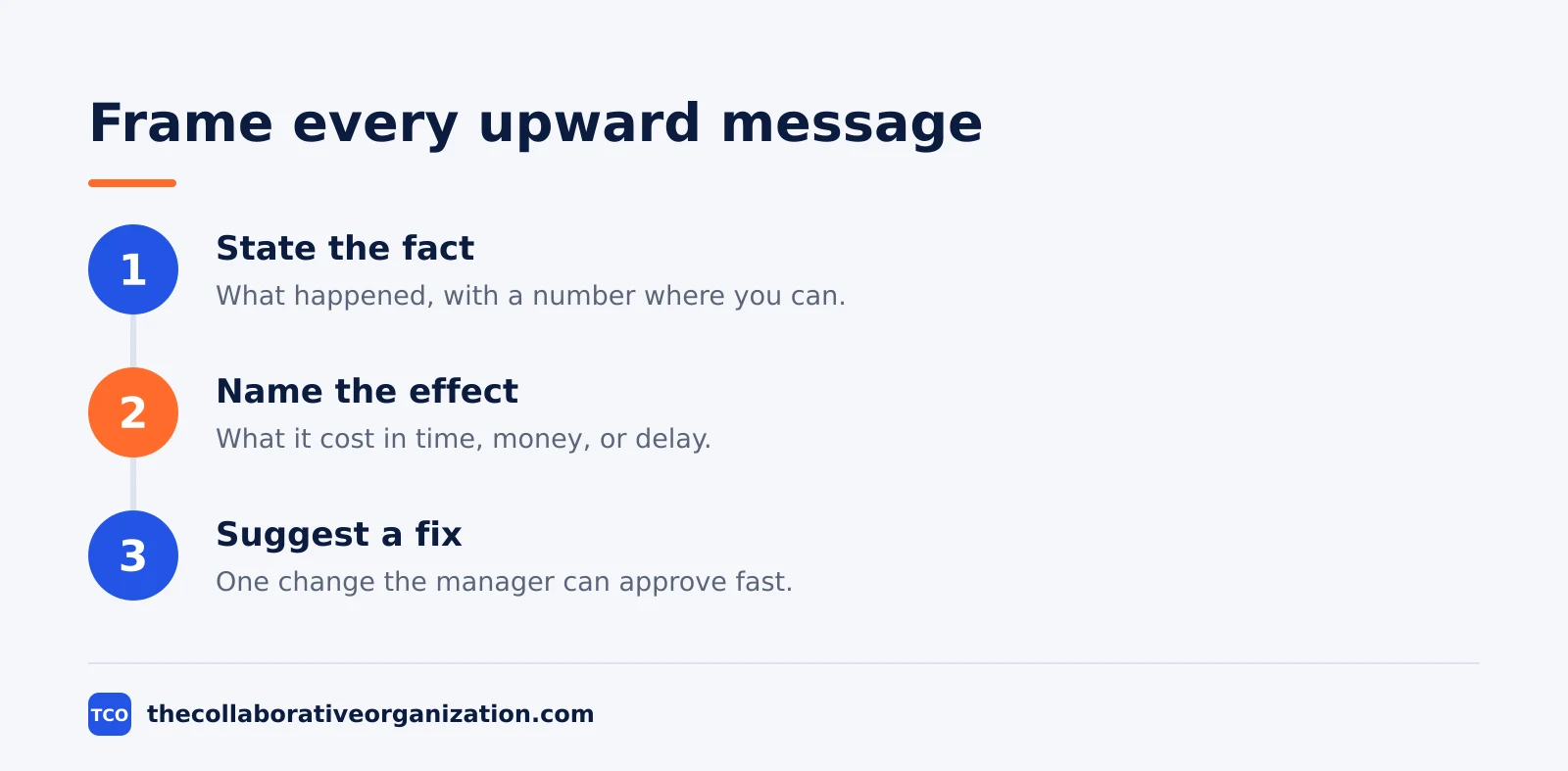
The note says the report took 3 days last month, that 2 of those days went on reformatting, and that a single template sent to the 4 data owners would cut the job to 1 day. She offers to draft the template herself and test it for one month. Her manager agrees, and the next report takes 1 day.
Three things make this example work. The message leads with a fact and a number, not a feeling. It names a fix the manager can approve in one reply. And it offers the analyst’s own time to test it, so the manager risks nothing by saying yes.
How to make upward communication safe
Upward communication works only when people believe it is safe, and safety is built by what happens after the first message. A manager who thanks the person, acts on the message, and reports back will hear the second message. A manager who ignores it or punishes it will hear nothing again.
Managers can build the habit in three moves. First, ask for input in the one-on-one by asking what is slowing you down this week. Second, act on one suggestion in public, and name the person who made it. Third, keep an anonymous route open for sensitive topics, such as a suggestion box or a feedback email address.
Our guide to team communication strategies covers seven habits that make these messages normal, including written decisions and one home per message.
Our guide on how to improve team communication covers the same habits at team scale, with seven steps and a worked example for a 12-person team.
Our guide to internal communication best practices explains how leaders close the loop after they hear something, with a two-question survey that checks what landed.
Common upward communication mistakes to avoid
Most upward messages fail in the same five ways, and each one is easy to fix before you send. Run through the list before your next one-on-one.
- Vague complaints with no fix. “Communication is bad” cannot be acted on. Name the fact, the effect and one suggestion instead.
- Raising it too late. A problem raised the day before the deadline leaves the manager no options. Raise it while it is still small.
- Saving it for review season. A concern saved for 6 months is stale and feels like an ambush. Raise it in the next one-on-one.
- Gossip dressed as feedback. A message about a person, told to a third party, is not upward communication. Raise it with the person or their manager, in private.
- Asking a question with no date attached. “When will we hear about the pay review?” is easy to dodge. “When will we hear, and by which date?” is not.
Sources
- Indeed - Understanding Upward Communication: Examples and Benefits (2026)
- BetterUp - Upward Communication Explained: Meaning, Examples, and Tips (2026)
- Coursera - The Importance of Upward Communication and How to Implement It (2026)
- Pumble - Upward Communication: Meaning, Examples, and Tips (2025)
- Gallup - A Great Manager’s Most Important Habit (2026)
- Headway Skills - Upward Communication Examples: 7 That Actually Work (2026)
Frequently asked questions
What is upward communication?
Upward communication is any message that travels from a lower-level employee to a manager or a senior leader. It includes feedback, suggestions, questions, status updates and concerns. It is the opposite of downward communication, where leaders pass instructions down. Both directions matter, but upward messages are the ones that usually go missing.
What is the best example of upward communication?
A regular one-on-one with your manager is the best example, because it is private, regular and two-way. You can raise a blocker, share an idea, ask a question and give feedback in one short meeting. A status update sent before you are asked is a close second, because it answers the manager's next question before they ask it.
How do you communicate upward without sounding critical?
Lead with the fact, then the effect, then a suggestion. Say what happened, what it cost in time or money, and what you suggest instead. That shape turns a complaint into a proposal. Keep the tone plain and the message short, and raise it in private first when it concerns one person rather than a process.
Can upward communication be anonymous?
Yes. Anonymous routes include suggestion boxes, anonymous survey questions and a dedicated feedback email address. Anonymous messages suit sensitive topics, such as a concern about a manager. Named messages suit ideas and updates, because the manager can follow up with you. Use the anonymous route when naming yourself would carry a real risk.
Why do managers need upward communication?
Employees see problems first, whether that is a confusing policy, a safety issue, a broken process or a customer complaint pattern. Managers cannot fix what they never hear about. Upward messages also build trust: when staff see their input change something, they keep speaking up, and the next problem surfaces earlier.
What is the difference between upward and downward communication?
Upward communication flows from employees to leaders, and carries feedback, suggestions and concerns. Downward communication flows from leaders to employees, and carries instructions, goals and policy. Upward messages are participative, because they invite staff to shape decisions. Downward messages are directive, because they tell staff what to do.
Related articles
team communication
Communication Plan for a Project: Template (2026)
A communication plan for a project names who gets which update, in which channel, how often, and from whom. Copy the template and the filled example below.
November 20, 2026 · 10 min read
team communication
How Often Should Managers Communicate With Teams? (2026)
Managers should hold one meaningful conversation with each person every week, plus a weekly team update. See the cadence table for meetings, updates and feedback.
November 20, 2026 · 9 min read
team communication
Onboarding Statistics: 33 Numbers That Decide Retention (2026)
Onboarding statistics from Gallup, SHRM, BambooHR and more: 33 verified numbers on retention, cost, training and first-90-day turnover for 2026.
November 19, 2026 · 11 min read