Microsoft Teams Statistics: 29 Stats for 2026 | The Collaborative Organization
By The Collaborative Organization Team · November 19, 2026 · Last verified November 19, 2026 · 10 min read
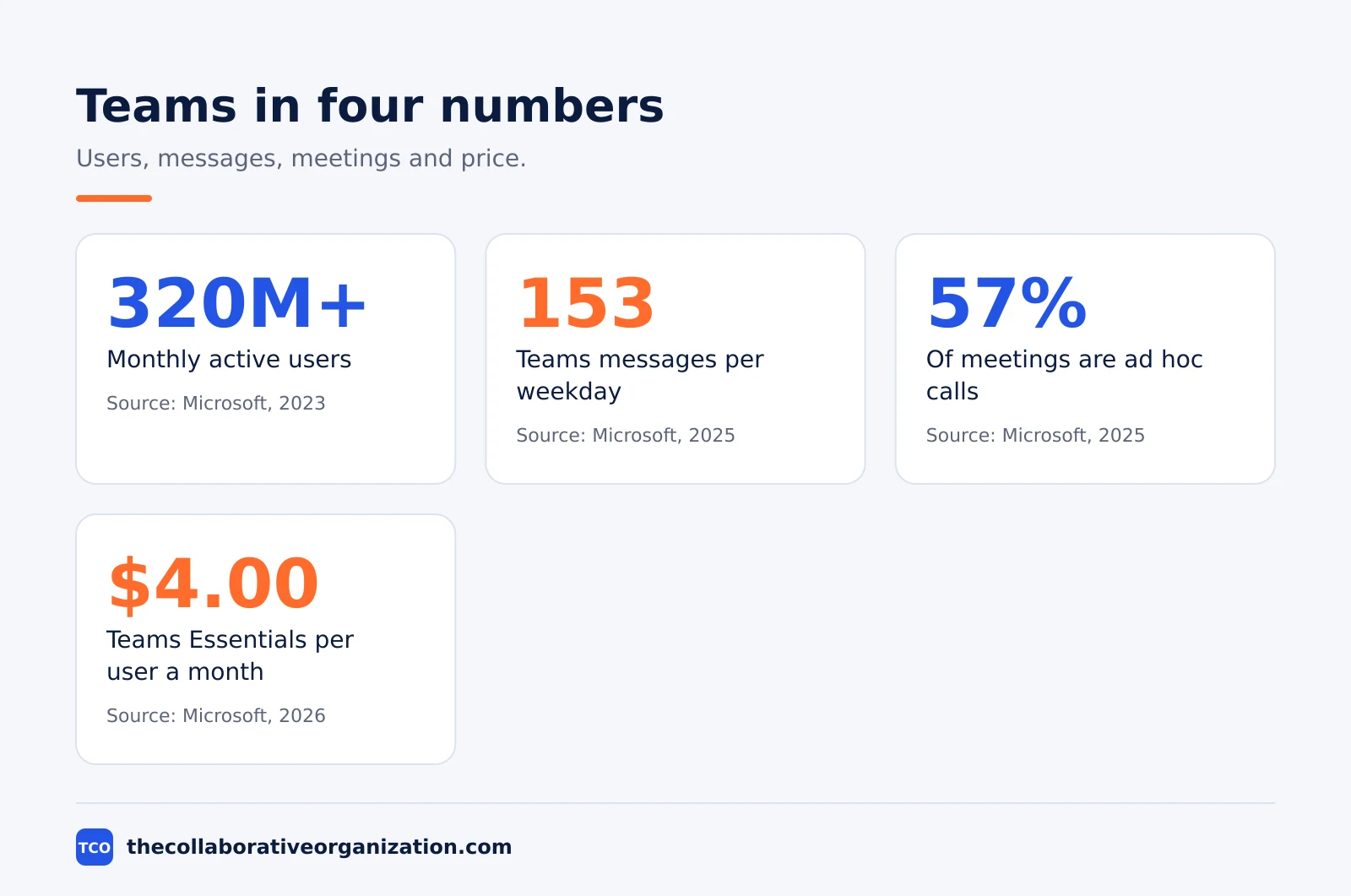
Microsoft Teams serves more than 320 million monthly users, and the average worker gets 153 Teams messages every weekday. Microsoft reported the user count in October 2023, restated in March 2024, and counted the messages in its June 2025 Work Trend Index. The 29 statistics below cover users, messages, meetings, pricing and hybrid work, each with its source and year.
Key takeaways
- Microsoft Teams has 320 million or more monthly active users, per Microsoft in October 2023.
- The average worker receives 153 Teams messages and 117 emails per weekday, per Microsoft in 2025.
- 57% of meetings are ad hoc calls with no calendar invite, per Microsoft in 2025.
- Teams Essentials costs $4.00 per user per month, and Teams Premium is a $10.00 add-on, as of November 2026.
- Skype retired on 5 May 2025, and its users moved to Teams.
How we chose these 29 statistics
We picked statistics from Microsoft’s own reports, earnings statements and pricing page, plus named surveys from Owl Labs, Gallup and Buffer. Each number below names its study and year, and the table at the end repeats all 29 with links. Where Microsoft’s own figure is old, we say so and give the newer third-party read beside it.
One honesty note: Microsoft stopped publishing regular Teams user counts after October 2023, so the 320 million figure from that date is the last regular disclosure. Microsoft restated the same figure in March 2024, and later totals are estimates, not Microsoft figures.
How big Teams is
Microsoft Teams serves more than 320 million monthly active users. Microsoft Teams passed that mark by October 2023. Microsoft has not published a newer regular Teams user count since, so the October 2023 disclosure is the newest official figure.
Microsoft restated the same figure in March 2024, when it also put Teams in 181 markets and 44 languages. The March 2024 update restates the user count and the reach.
Growth was fastest in the pandemic years. Teams went from 44 million daily users in March 2020 to 75 million a month later, then to 145 million daily users by April 2021.
The count then switched to monthly users. Teams passed 270 million monthly users in January 2022 and 300 million in April 2023, before reaching 320 million in October 2023.
Teams is now the default for Skype’s old users. Microsoft retired Skype on 5 May 2025 after 22 years, and moved its users to Teams Free. The retirement announcement came in February 2025, when Microsoft said hundreds of millions of people already used Teams.
The wider Microsoft 365 base is large too. Microsoft ended its 2025 fiscal year with 89.0 million Microsoft 365 Consumer subscribers on 30 June 2025, a figure that includes the personal and family plans that bundle Teams. The FY25 Q4 results put subscriber growth at 8% year over year.
Teams Phone, the cloud calling add-on, passed 20 million PSTN users in April 2024. Microsoft announced the milestone on 29 April 2024, and has not published a newer PSTN user count since.
Messages, meetings and the working day
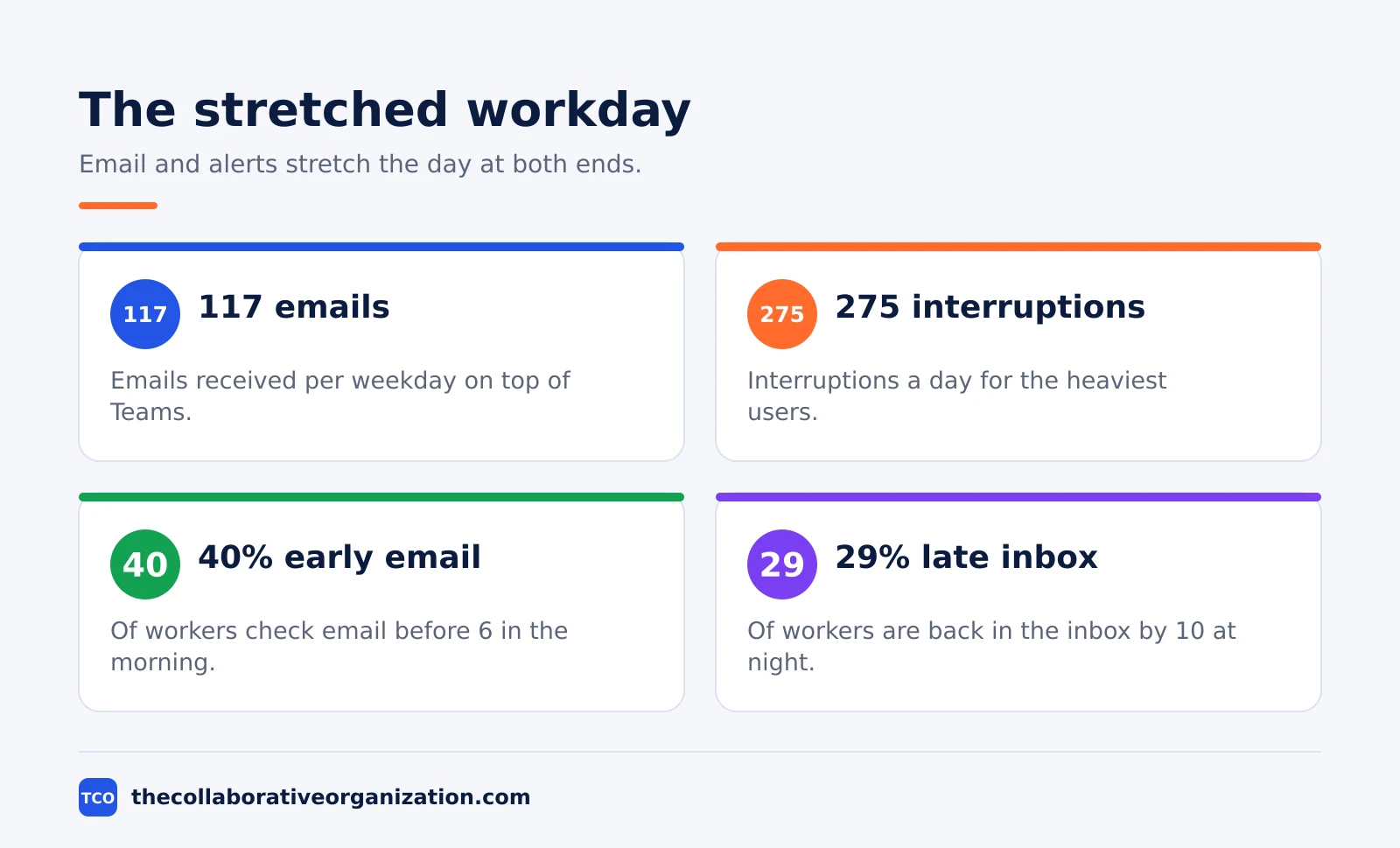
The average worker receives 153 Teams messages and 117 emails every weekday. Microsoft counted both in its Work Trend Index special report of June 2025, using anonymised Microsoft 365 telemetry plus a survey of 31,000 knowledge workers in 31 markets. Together they add up to 270 messages a day.
Interruptions pile up fast. Workers in the most heavily pinged fifth are interrupted every two minutes during core hours, or 275 times across a full day, by meetings, emails and chat alerts. The same Microsoft report found 57% of meetings are ad hoc calls with no calendar invite, so much of the load arrives unplanned.
Chats and channels need different rules. Microsoft found half of all meetings land in peak hours, 9 to 11 in the morning and 1 to 3 in the afternoon, leaving little room for deep work. Our guide to Teams channels vs chats explains which conversations belong in each place.
The day stretches at both ends. Microsoft found 40% of employees check email before 6 in the morning and 29% return to their inbox by 10 at night, while 20% work on weekends. Meetings after 8 in the evening rose 16% year over year, and nearly a third of meetings now span multiple time zones, up 35% since 2021.
Meetings and hybrid work
Meetings are the main cost of Teams for most teams. Owl Labs found the average worker has 5 online meetings and 5 face-to-face meetings each week in 2025, and 77% lost time to technical difficulties in meetings. Our video conferencing statistics guide puts Teams beside Zoom and Google Meet.
Setup time is the hidden tax. Owl Labs found workers lose about 6 minutes getting each hybrid meeting started, and 27% lose 10 minutes or more per meeting to setup alone. Two in three workers (67%) have given up trying to get video technology working in a meeting space at all.
Timing matters as much as count. Owl Labs found 70% of workers say 8 in the morning or earlier is too early for a meeting, and 82% prefer meetings to end by 4 in the afternoon. The comparison with Zoom is covered in our Microsoft Teams vs Zoom for meetings guide.
Hybrid workers still prefer remote days. Buffer’s 2025 figures show 98% of remote workers would keep working remotely for the rest of their careers, and 70% say focused work is easier remotely.
Engagement is low across the board. Gallup found only 20% of employees worldwide were engaged in 2025, and managers account for at least 70% of the variance in team engagement. Teams cannot fix that alone, but clearer channels help.
What Teams costs in 2026
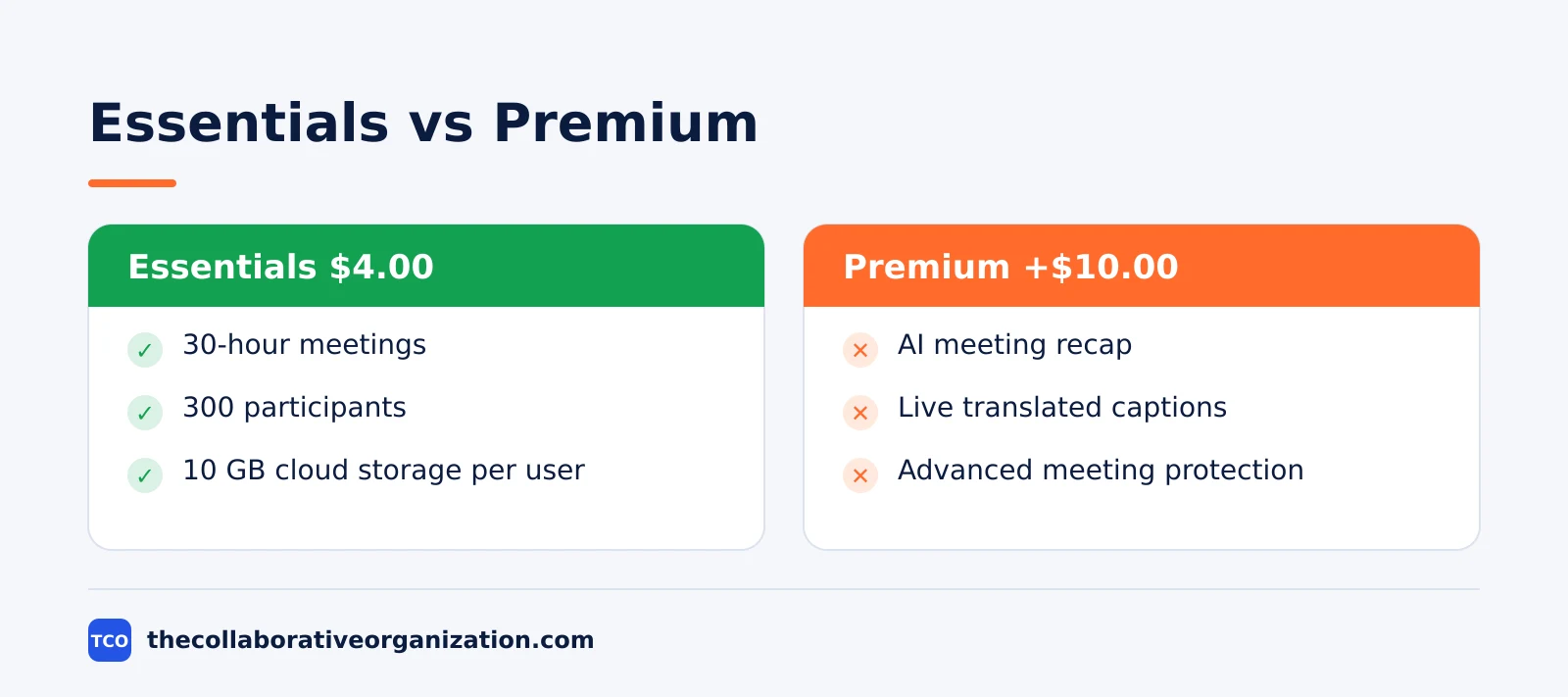
Teams Essentials costs $4.00 per user per month, paid yearly, and Teams Premium is a $10.00 add-on. Microsoft’s pricing page lists both rates, with Essentials covering 30-hour meetings for up to 300 participants and 10 GB of cloud storage per user. The rates below are as of November 2026.
Most teams get Teams inside Microsoft 365. Business Basic costs $7.00 per user per month with Teams, Business Standard $14.00 and Business Premium $22.00, all billed annually after the 1 July 2026 rise, per an independent read of Microsoft’s comparison page in September 2026. Our Teams free vs paid guide compares the free plan with these paid tiers.
Premium adds AI recaps and protection. Teams Premium costs $10.00 per user per month on top of a paid licence, and adds intelligent meeting recap, live translated captions and advanced meeting protection. Since September 2025, Microsoft sells Microsoft 365 suites both with and without Teams worldwide, so check whether your bundle already includes it.
The 29 Microsoft Teams statistics in one table
The table below lists all 29 statistics with their source and year. Figures that describe a subgroup say so in the statistic itself.
| Statistic | Source | Year |
|---|---|---|
| 320 million monthly active users (Oct 2023) | Microsoft | 2023 |
| 75 million daily users (Apr 2020) | Microsoft | 2020 |
| 145 million daily users (Apr 2021) | Microsoft | 2021 |
| 270 million monthly users (Jan 2022) | Microsoft | 2022 |
| 300 million monthly users (Apr 2023) | Microsoft | 2023 |
| 89.0 million Microsoft 365 Consumer subscribers (30 Jun 2025) | Microsoft | 2025 |
| 20 million Teams Phone PSTN users (Apr 2024) | Microsoft | 2024 |
| Teams serves 181 markets and 44 languages (Mar 2024) | Microsoft | 2024 |
| 153 Teams messages per weekday | Microsoft | 2025 |
| 117 emails per day | Microsoft | 2025 |
| 275 interruptions per day (most heavily pinged fifth) | Microsoft | 2025 |
| 57% of meetings are ad hoc calls with no invite | Microsoft | 2025 |
| 40% check email before 6 in the morning | Microsoft | 2025 |
| 29% back in inbox by 10 at night | Microsoft | 2025 |
| 20% work on weekends | Microsoft | 2025 |
| Meetings after 8 in the evening up 16% year over year | Microsoft | 2025 |
| 48% of employees say work feels chaotic and fragmented | Microsoft | 2025 |
| 52% of leaders say work feels chaotic and fragmented | Microsoft | 2025 |
| 80% lack time or energy to do their work | Microsoft | 2025 |
| A third of meetings span time zones, up 35% since 2021 | Microsoft | 2025 |
| 50% of meetings fall in peak hours | Microsoft | 2025 |
| PowerPoint edits spike 122% in final 10 minutes | Microsoft | 2025 |
| 46% globally use agents to automate business processes | Microsoft | 2025 |
| Tuesday is busiest day (23% of meetings) | Microsoft | 2025 |
| 5 online and 5 face-to-face meetings per week | Owl Labs | 2025 |
| 77% lost time to technical difficulties in meetings | Owl Labs | 2025 |
| 70% say 8 in the morning or earlier is too early | Owl Labs | 2025 |
| 82% prefer meetings to end by 4 in the afternoon | Owl Labs | 2025 |
| 98% of remote workers would keep working remotely | Buffer | 2025 |
What the numbers mean for your team
The numbers tell one story: Teams is huge, chatty and meeting-heavy, and the cost of entry is low. The risk is not the price, it is the volume: 153 messages a day plus 117 emails leaves little room for deep work. The fix is fewer channels, written decisions and protected focus time.
Worked example: a 100-person team on Teams Essentials
Take a 100-person team as an illustration. At $4.00 per user per month paid yearly, Teams Essentials costs $400 a month, or $4,800 a year. Add Teams Premium at $10.00 per user per month and the bill rises to $1,400 a month, or $16,800 a year. The arithmetic is an illustration from the published prices, not a quote.
Pick the plan after the workflow, not before it. Our how to choose team communication software guide covers seat counts, free-plan caps and the questions to ask in a trial.
Common Microsoft Teams statistics mistakes to avoid
Most bad takes on these numbers come from the same five errors, and all five are easy to avoid.
- Quoting 350 million or 360 million users as a Microsoft figure. Both are third-party estimates; Microsoft’s newest disclosure is more than 320 million monthly users from October 2023.
- Treating the 275 interruptions as an average. It describes the most heavily pinged fifth of users across a full day.
- Comparing Teams’ monthly users with Slack’s messages. One counts people and the other counts messages, so they answer different questions.
- Buying Premium for everyone by default. At $10.00 on top of a paid licence, it costs more than Essentials itself, so trial it with heavy meeting users first.
- Forgetting the unbundling. Since September 2025, Microsoft 365 suites can come with or without Teams, so check your bundle before you pay twice.
Sources
- Microsoft - Breaking down the infinite workday (2025)
- Microsoft - Microsoft Teams at 3: Everything you need to connect with your teammates and be more productive (2020)
- Microsoft - FY20 Q3 earnings results (2020)
- Microsoft - FY21 Q3 earnings results (2021)
- Microsoft - FY22 Q2 earnings results (2022)
- Microsoft - Fiscal Year 2023 Third Quarter Earnings Conference Call (2023)
- Microsoft - Fiscal Year 2024 First Quarter Earnings Conference Call (2023)
- Microsoft - FY25 Q4 Productivity and Business Processes Performance (2025)
- Microsoft - Discover why over 20 million PSTN users trust Microsoft Teams Phone (2024)
- Microsoft - Microsoft Teams: Building a Foundation for the Future (2024)
Frequently asked questions
How many people use Microsoft Teams?
Microsoft last disclosed Teams at more than 320 million monthly active users in October 2023, and restated that figure in March 2024. Microsoft stopped publishing regular Teams user counts after October 2023, so higher totals you see elsewhere are estimates, not Microsoft figures.
How many messages do Teams users get each day?
The average worker receives 153 Teams messages and 117 emails on a weekday, according to Microsoft's June 2025 Work Trend Index. Together that is about 270 messages a day, before meetings and notifications are counted.
How much does Microsoft Teams cost?
Teams Essentials costs $4.00 per user per month paid yearly, and Teams Premium is a $10.00 add-on, as of November 2026. Microsoft 365 Business Basic costs $7.00, Standard $14.00 and Premium $22.00 per user per month billed annually.
Did Skype shut down?
Yes. Microsoft retired Skype on 5 May 2025 after 22 years, and moved its users to Teams Free. Microsoft announced the retirement in February 2025, saying hundreds of millions of people already used Teams, whose last disclosed count was more than 320 million monthly users in October 2023.
What is Teams Phone?
Teams Phone is Microsoft's cloud calling add-on for Teams, replacing a desk phone with calls inside the app. Microsoft said it passed 20 million PSTN users in April 2024, and has not published a newer PSTN user count since.
Related articles
guides
Free Project Management Templates: 7 to Copy (2026)
Seven free project management templates from monday, Wrike, Teamwork, Smartsheet, ClickUp, Asana and Trello, with what each one is for and what free really costs.
November 20, 2026 · 7 min read
guides
Project Proposal Template: Copy and Win Work (2026)
A project proposal template pitches the work before it is approved: problem, solution, scope, budget, timeline and terms. Copy the template and filled example.
November 20, 2026 · 10 min read

guides
Action Plan Template: Goal to Done in One Page (2026)
An action plan template turns one goal into owned steps with dates, dependencies and a success measure. Copy the table and see it filled for a support team.
November 20, 2026 · 11 min read