Workplace Communication Statistics: 30 Key Stats (2026) | The Collaborative Organization
By The Collaborative Organization Team · November 19, 2026 · Last verified November 19, 2026 · 12 min read
Poor communication costs US businesses about $1.2 trillion a year, and the average worker spends 57% of the working day communicating rather than creating. The 30 statistics below cover message volume, cost, meetings, alignment and AI, each with its source and year, so you can see which numbers hold up and which describe only part of the workforce.
Key takeaways
- Workers get 153 Teams messages and 117 emails on a typical weekday, per Microsoft in 2025.
- Poor communication cost US businesses $1.2 trillion in 2022, per Grammarly, or $9,284 per worker in 2025.
- Only 7% of US workers strongly agree communication at work is accurate, timely and open, per Gallup in 2021.
- Employees say 43% of meetings could be cut with no real harm, per Slack in 2023.
- Daily AI users are 64% more likely to report very good productivity than non-users, per Slack in 2025.
How we chose these 30 statistics
We picked statistics from named studies published from 2012 to 2026, and we dropped any figure we could not trace to its source. Each number below names its study and year, and the table near the end repeats all 30 with links.
The spine of this article is the older, original editions: McKinsey’s 2012 social economy study, Grammarly’s 2022 report and Gallup’s 2021 survey. A companion article on team communication statistics covers the same period from the team chat angle, with more weight on 2025 surveys.
Two scope notes matter. Microsoft’s 275 daily interruptions describe the most heavily pinged fifth of users across a full 24 hours, not the average worker. Gallup’s 20% engagement figure is a global average, and country results differ widely.
Every figure below comes from the original study, report or vendor page. We dropped figures we could not trace to a published study, including two often-quoted numbers with no solid source behind them.
How much teams communicate each day
The average knowledge worker now receives 153 Microsoft Teams messages and 117 emails on a weekday, which adds up to 270 messages a day. Microsoft counted both in its Work Trend Index special report of June 2025, using Microsoft 365 telemetry plus a survey of 31,000 knowledge workers in 31 markets.
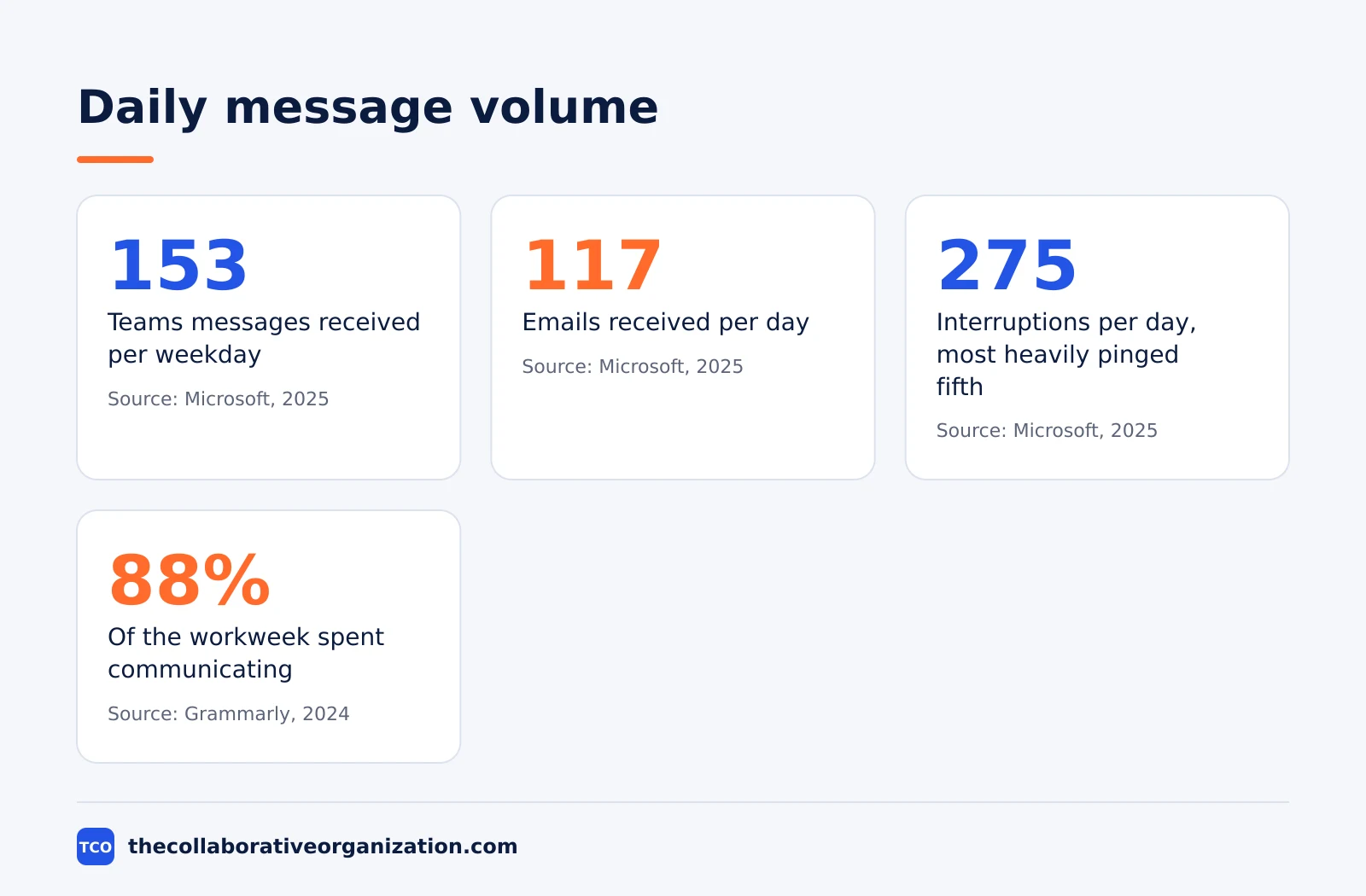
Interruptions pile up fast. Workers in the most heavily pinged fifth are interrupted every two minutes during core hours, or 275 times across a full day, by meetings, emails and chat alerts. The same Microsoft report found 57% of meetings are ad hoc calls with no calendar invite, so much of the load is unplanned.
Writing takes most of the week. Grammarly found professionals spend more than 28 hours a week on written and tool-based communication in 2025, up 13.2% on the year before. The 2024 edition of the same report put writing time at 19 hours a week, and said people spend 88% of the workweek communicating.
The load does not stop at 5 in the evening. Microsoft found 40% of employees check email before 6 in the morning and 29% return to their inbox by 10 at night, while 20% work on weekends. Chats outside the nine-to-five day rose 15% year over year, and meetings after 8 in the evening rose 16%.
Older studies show the same shape. McKinsey found in 2012 that the average interaction worker spent 28% of the workweek managing email and nearly 20% looking for internal information or tracking down colleagues. The tools changed; the share of the week spent on messages did not.
The split between talking and making has barely moved. Microsoft’s 2023 Work Trend Index found workers spend 57% of their time communicating and 43% creating, and the 2024 edition put the split at 60% communication and 40% creation. Both editions drew on 31,000-person surveys plus Microsoft 365 telemetry.
What poor communication costs
Poor communication has a price tag: Grammarly put the cost at $1.2 trillion a year across US businesses in its 2022 report. Grammarly also put the cost at $12,506 per employee per year, and estimated teams lose 7.47 hours a week to poor communication.
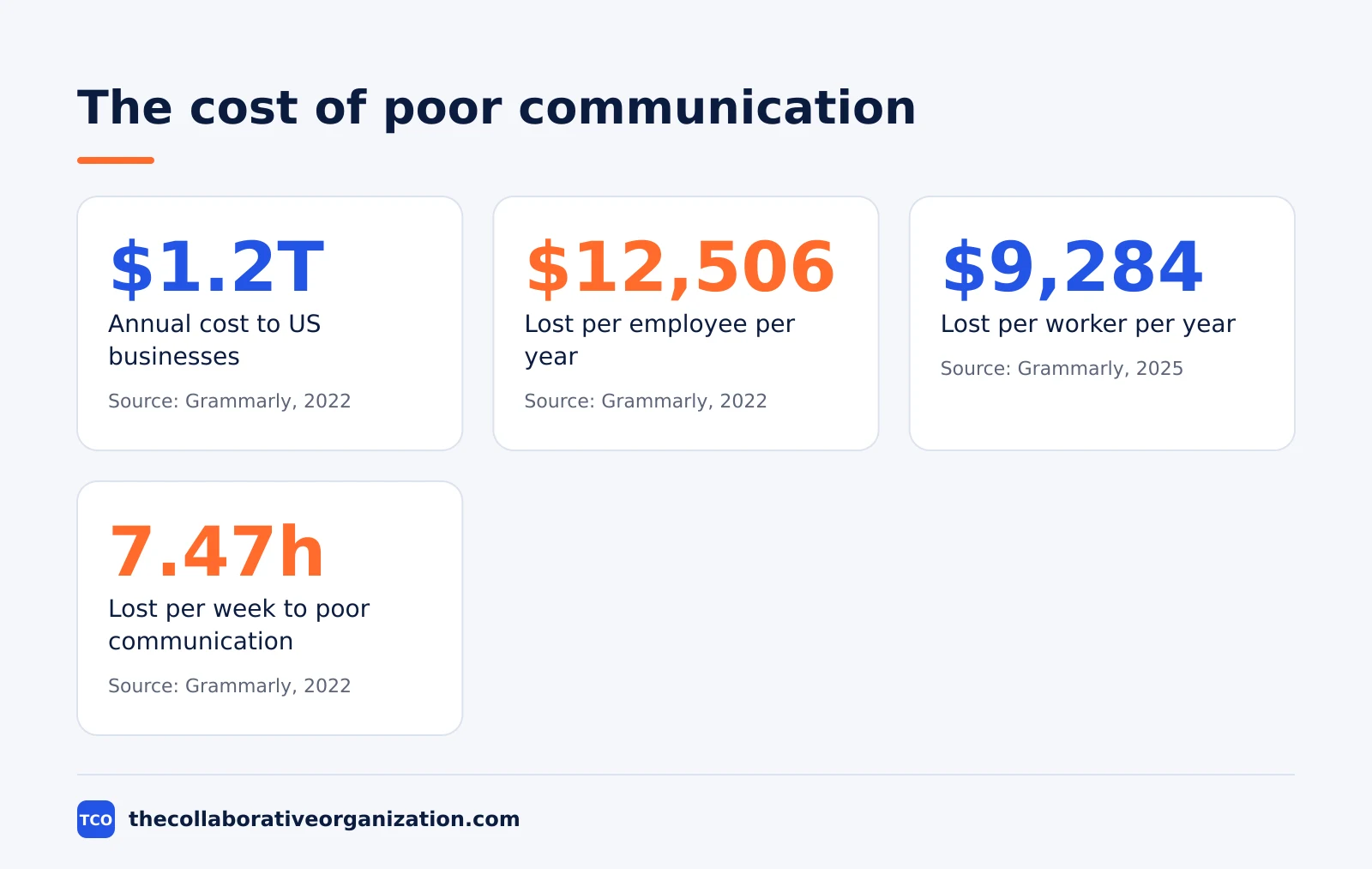
The 2025 numbers are smaller per worker but point the same way. Grammarly’s 2025 report put the cost at $9,284 per worker per year, while Axios HQ found an employee earning $50,000 to $100,000 loses 35 or more working days a year, worth $10,140 in salary.
Senior staff lose more. Axios HQ found senior employees lose 63 work days a year to ineffective communication, at a cost of $54,860 per senior employee earning over $200,000. A third of leaders said they had to set aside their own tasks to fight fires caused by poor communication.
The cost shows up in time as well as money. Asana found knowledge workers spend 60% of their time on “work about work”, and counted 103 hours a year in unnecessary meetings and 209 hours on duplicative work, per its Anatomy of Work Index. Only 43% of workers said they were clear on their organization’s objectives for the year.
Bad collaboration also bills leaders directly. Zoom and Morning Consult found over a third of leaders spend an hour or more a day resolving issues tied to bad collaboration, at a cost of about $16,491 per leader per year. Teams using more than 10 apps are twice as likely to spend that hour.
Meetings: time, frequency and focus
Employees say 43% of their meetings could be eliminated with no real adverse consequences, per Slack in 2023. The same survey found 35% of workers name too much time in meetings as a top productivity challenge, and only 19% of executives encourage asynchronous work.
The same survey found desk workers spend 32% of their time on performative work, done to appear productive rather than to move work forward. Workers who use automations estimate they save 3.6 hours a week, about one working month a year.
Hybrid meetings add their own tax. Owl Labs found an average of 5 online meetings and 5 face-to-face meetings a week in 2025. More than a quarter of workers lose 10 or more minutes to setup at least once per meeting, and 67% have given up trying to get video technology working in a meeting space.
Focus time is the casualty. Microsoft’s 2023 index found 68% of people say they do not have enough uninterrupted focus time. A related guide on too many meetings looks at the same problem from the meeting count side.
Alignment and trust
Only 7% of US workers strongly agree that communication at their organization is accurate, timely and open, per Gallup in 2021. The same survey found only 26% strongly agree the feedback they receive helps them do better work.
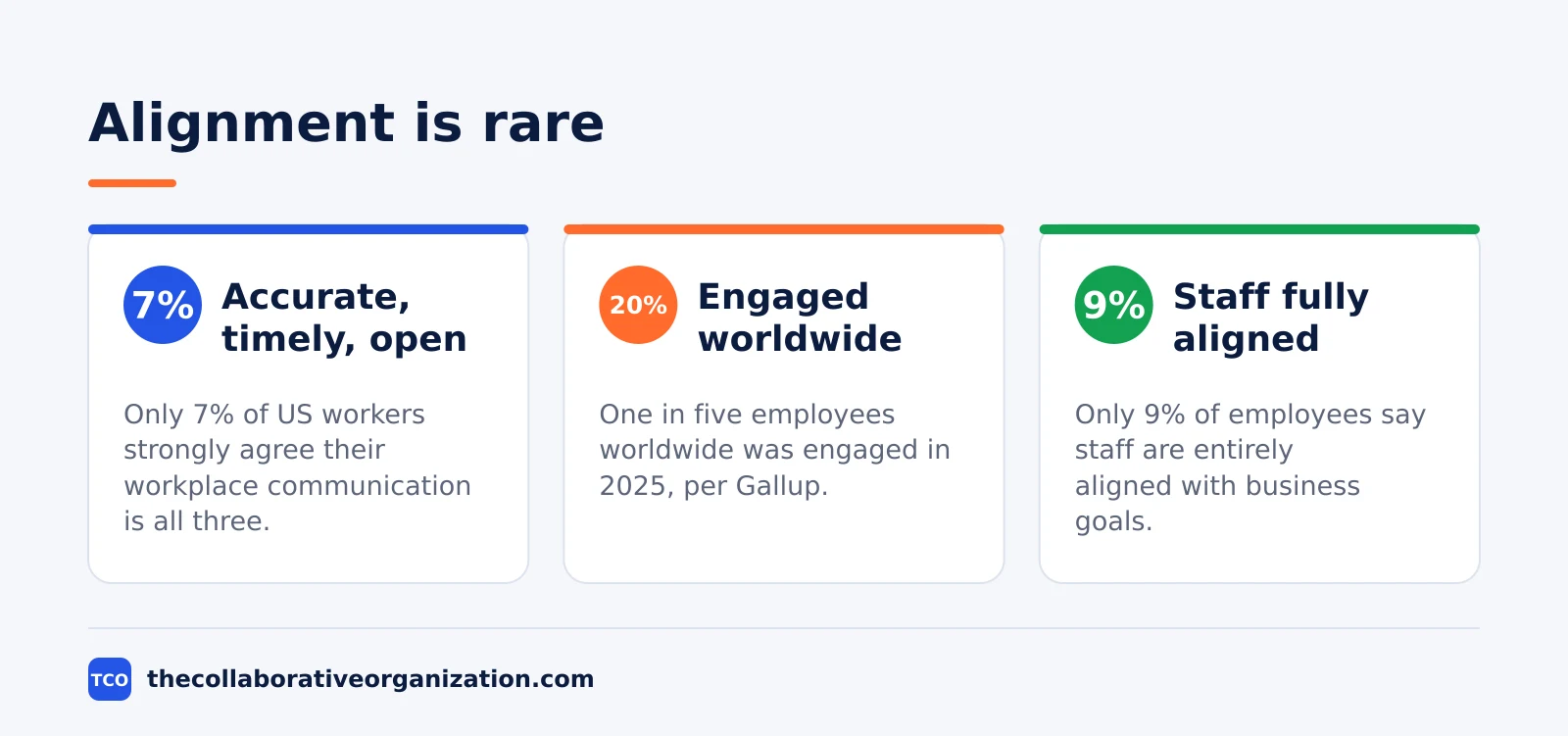
Leaders and staff see different pictures. Axios HQ found 27% of leaders think staff are entirely aligned with business goals, while only 9% of employees agree. The gap repeats on clarity: 80% of leaders think internal communication is helpful and relevant, against 53% of employees.
Engagement follows the same pattern. Gallup found 20% of employees worldwide were engaged in 2025, and managers explain at least 70% of the variance in team engagement. In the United States, 31% of employees were engaged in 2025.
Messages often miss their mark. ContactMonkey found 86% of internal communicators say employees miss key updates at least sometimes, and its 2026 benchmark put the average internal email open rate at 76%. The click rate on those emails averages 9%.
Remote and hybrid communication
Remote work is popular, and it runs on written messages: 98% of remote workers say they would like to work remotely at least some of the time for the rest of their careers, per Buffer in 2023. The same survey found 91% report a positive remote work experience, and 62% work with teammates across different time zones.
Time zones make async habits matter more. Buffer found 22% of remote workers name flexibility in how they spend their time as the biggest benefit of remote work. A team spread across zones cannot rely on a quick chat at a desk, so written updates carry more weight.
Hybrid work mixes both worlds. Owl Labs found 28% of US workers are hybrid, 9% fully remote and 63% fully in office in 2025. The most common hybrid pattern is three days in the office a week, reported by 39% of hybrid workers.
AI in workplace communication
Daily AI users are 64% more likely to report very good productivity than colleagues who do not use AI, per Slack in 2025. The same index found daily users are also 58% more likely to report very good focus and 81% more likely to report very good job satisfaction.
Use is growing fast, but guidance lags. Daily AI use rose 233% in the six months to April 2025, and 60% of desk workers now use AI at work. Yet 29% of workers said their company had issued no formal AI guidance, and half said AI use is not explicitly encouraged.
Workers have tried the tools even where rules are missing. Owl Labs found 80% of workers have tried AI at work in 2025, and 51% wish an AI avatar could attend a meeting for them. The wish is a joke with a serious point: many meetings do not need a live person in the room.
All 30 workplace communication statistics
The table below repeats the 30 headline statistics with their source and year. Each source links to the original study or report.
| Statistic | Source | Year |
|---|---|---|
| 153 Teams messages received per weekday | Microsoft | 2025 |
| 117 emails received per day | Microsoft | 2025 |
| 275 interruptions per day (most heavily pinged fifth of users) | Microsoft | 2025 |
| 28+ hours per week on written and tool-based communication | Grammarly | 2025 |
| 88% of the workweek spent communicating | Grammarly | 2024 |
| 19 hours per week on writing tasks | Grammarly | 2024 |
| 57% of time spent communicating, 43% creating | Microsoft | 2023 |
| 28% of the workweek spent managing email | McKinsey | 2012 |
| Nearly 20% of the workweek looking for internal information | McKinsey | 2012 |
| 68% say they lack enough uninterrupted focus time | Microsoft | 2023 |
| $1.2 trillion annual cost of poor communication to US businesses | Grammarly | 2022 |
| $12,506 lost per employee per year to poor communication | Grammarly | 2022 |
| 7.47 hours lost per week to poor communication | Grammarly | 2022 |
| $9,284 lost per worker per year to poor communication | Grammarly | 2025 |
| $10,140 salary lost per employee per year ($50k-$100k earners) | Axios HQ | 2025 |
| 35+ working days lost per employee per year | Axios HQ | 2025 |
| $16,491 per leader per year resolving bad-collaboration issues | Zoom | 2024 |
| 60% of knowledge-worker time goes to “work about work” | Asana | 2026 |
| 103 hours per year in unnecessary meetings | Asana | 2026 |
| 43% of meetings could be eliminated with no real harm | Slack | 2023 |
| 32% of time spent on performative work | Slack | 2023 |
| 5 online and 5 face-to-face meetings per week | Owl Labs | 2025 |
| 57% of meetings are ad hoc calls with no invite | Microsoft | 2025 |
| 7% strongly agree workplace communication is accurate, timely and open | Gallup | 2021 |
| 20% of employees worldwide engaged | Gallup | 2025 |
| 9% of employees vs 27% of leaders say staff are fully aligned | Axios HQ | 2025 |
| 86% say employees miss key updates at least sometimes | ContactMonkey | 2026 |
| 76% average internal email open rate | ContactMonkey | 2026 |
| 98% of remote workers would keep working remotely at least some of the time | Buffer | 2023 |
| Daily AI users 64% more likely to report very good productivity | Slack | 2025 |
What the numbers mean
Read the numbers as a time problem first and a money problem second. The time figures repeat across every study: more than half the week goes to messages, meetings and searching, and few workers call the result good.
Take a 100-person company as an illustration. Grammarly’s 2025 report puts the cost of poor communication at $9,284 per worker per year, which is $928,400 a year for 100 people.
At 7.47 hours lost per worker per week, the same company loses 747 hours a week, or about 37,350 hours over a 50-week year. The arithmetic is simple; the fix is not, because the hours sit in habits, not in one tool.
A chat tool sets the pace of the day. Slack is one of the main chat tools behind the message counts above, and moving status talk into threads cuts the ping load without buying anything new.
Picking a tool is a separate job from fixing the habits. A guide to the best team communication software compares the main options side by side, so a team can match the tool to the way it already works.
The habit fix starts with one change at a time. A guide on how to improve team collaboration covers the practices that sit behind the numbers, from written updates to shared priorities.
Mistakes to avoid when using workplace communication statistics
Three mistakes turn good statistics into bad decisions, and all three are easy to avoid. The fixes are simple: name the scope, name the year, and name the original source.
- Quote the scope, not just the number. A figure about the most heavily pinged fifth of users is not a figure about the average worker, and a global engagement average is not a US figure.
- Keep the year with the number. The $1.2 trillion cost comes from 2022, while the $9,284 per-worker cost comes from 2025, and the two do not describe the same year or the same survey.
- Use the original study, not a roundup. Statistics sites repeat numbers without checking them, and errors travel fast. Drop a figure you cannot trace to a published study.
Sources
- Grammarly - The State of Business Communication (2022)
- Grammarly - The 2024 State of Business Communication Report (2024)
- Grammarly - The Productivity Shift (2025)
- Microsoft - Work Trend Index 2023 (2023)
- Microsoft - Work Trend Index 2024 (2024)
- Microsoft - Breaking down the infinite workday (2025)
- McKinsey Global Institute - The Social Economy (2012)
- Gallup - Communicate Better With Employees (2021)
- Asana - Anatomy of Work Index (2026)
- Axios HQ - State of Internal Communications 2025 (2025)
Frequently asked questions
How much time do workers spend communicating each day?
Microsoft counted 153 Teams messages and 117 emails per weekday in 2025, and its 2023 index found workers spend 57% of their time communicating and 43% creating. Grammarly found professionals spend more than 28 hours a week on written and tool-based communication. The exact split depends on the job, but communication now takes more than half the week in most office roles.
What does poor communication cost a business each year?
Grammarly estimated the cost at $1.2 trillion a year across US businesses in 2022, or $12,506 per employee. Its 2025 report put the cost at $9,284 per worker per year. Axios HQ found an employee earning $50,000 to $100,000 loses 35 or more working days a year to ineffective communication, worth $10,140 in salary.
How many meetings could a team cut without harm?
Slack found employees believe 43% of their meetings could be eliminated with no real adverse consequences in 2023. The same survey found 35% of workers name too much time in meetings as a top productivity challenge. A team that cancels one recurring meeting a week and replaces it with a written update usually finds out fast which meetings mattered.
What share of employees are engaged at work?
Gallup found 20% of employees worldwide were engaged in 2025, and 31% of US employees were engaged that year. Managers explain at least 70% of the variance in team engagement, so a team's communication habits and its manager's habits are hard to separate. Only 7% of US workers call their workplace communication accurate, timely and open.
Does AI help workplace communication?
Early signs point yes for users, with limits. Slack found daily AI users in 2025 were 64% more likely to report very good productivity and 81% more likely to report very good job satisfaction than non-users. But 29% of workers said their company had issued no formal AI guidance, so most teams are still working out the rules.
Related articles
team communication
Communication Plan for a Project: Template (2026)
A communication plan for a project names who gets which update, in which channel, how often, and from whom. Copy the template and the filled example below.
November 20, 2026 · 10 min read
team communication
How Often Should Managers Communicate With Teams? (2026)
Managers should hold one meaningful conversation with each person every week, plus a weekly team update. See the cadence table for meetings, updates and feedback.
November 20, 2026 · 9 min read
team communication
Upward Communication Examples: 10 That Work (2026)
Upward communication is a message that travels from an employee to a manager or leader. See 10 concrete examples, each with why it works and when to use it.
November 20, 2026 · 9 min read