Team Communication Statistics: 30 Key Stats (2026) | The Collaborative Organization
By The Collaborative Organization Team · November 19, 2026 · Last verified November 19, 2026 · 11 min read
Team communication in 2026 runs at about 270 messages a day per worker, and poor communication costs about $9,284 per worker each year. The 270 is the sum of 153 Teams messages and 117 emails counted by Microsoft in 2025. The 30 statistics below cover volume, cost, alignment, meetings and AI, each with its source and year.
Key takeaways
- Workers receive 153 Teams messages and 117 emails on a typical weekday, per Microsoft in 2025.
- Poor communication costs about $9,284 per worker per year, per Grammarly in 2025.
- Only 20% of employees worldwide were engaged in 2025, per Gallup, and manager engagement fell to 22%.
- The average worker has 5 online and 5 face-to-face meetings a week, per Owl Labs in 2025.
- Daily AI users report 64% higher productivity than colleagues who do not use AI, per Slack in 2025.
How we chose these 30 statistics
We picked statistics from named studies published in 2025 and 2026, and we dropped any figure we could not trace to its source. Each number below names its study and year, and the table at the end repeats all 30 with links. Where a study counts only part of the workforce, we say so in the text.
Two scope notes matter. The 275 daily interruptions counted by Microsoft describe the most heavily pinged fifth of users, not the average worker, and the figure spans a full 24 hours. The 20% engagement figure is a global average from Gallup, and country results differ widely.
How much teams communicate each day
The average knowledge worker now receives 153 Microsoft Teams messages and 117 emails on a weekday, which adds up to 270 messages a day. Microsoft counted both in its Work Trend Index special report of June 2025, using anonymised Microsoft 365 telemetry plus a survey of 31,000 knowledge workers in 31 markets.
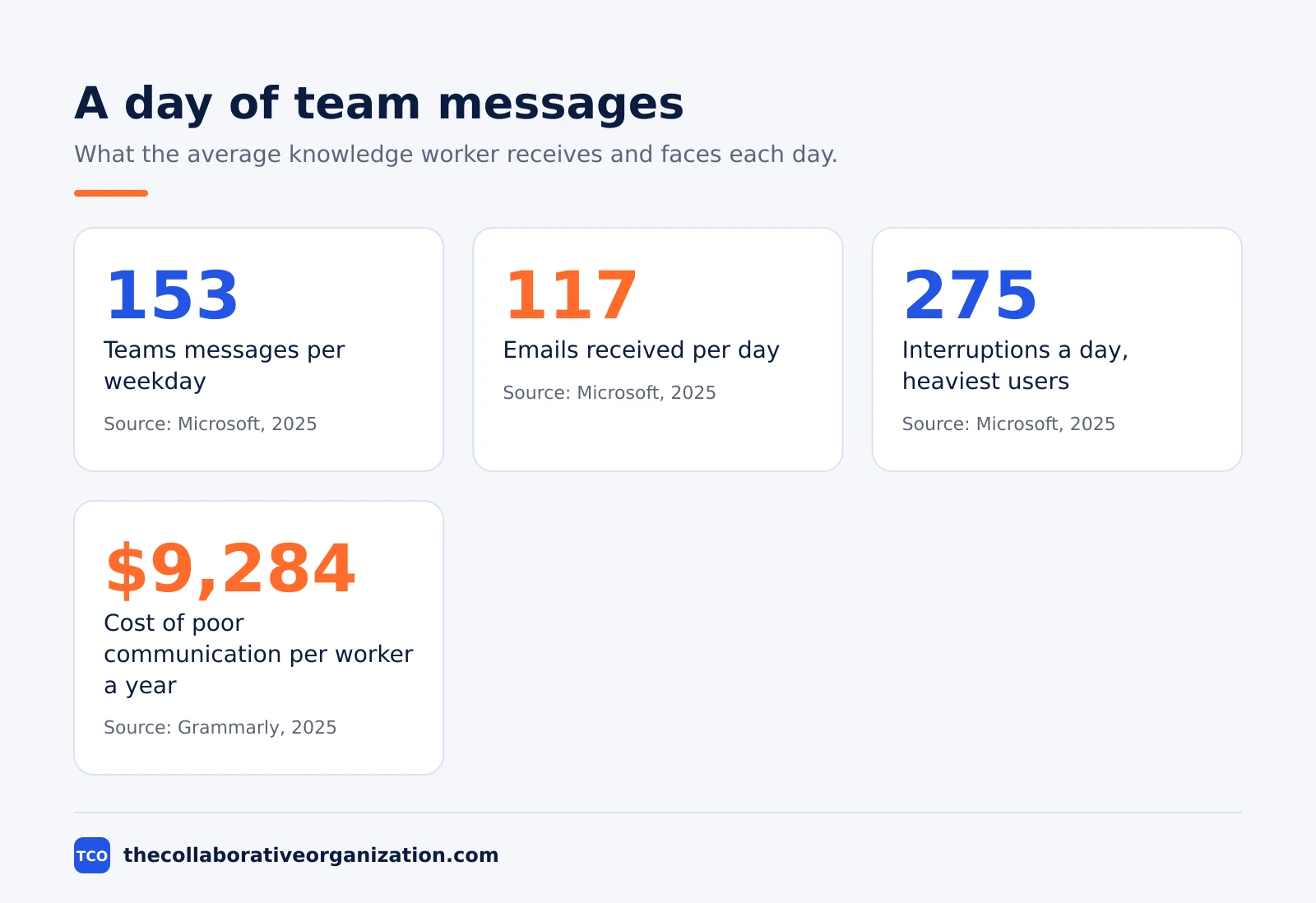
Interruptions pile up fast. Workers in the most heavily pinged fifth are interrupted every two minutes during core hours, or 275 times across a full day, by meetings, emails and chat alerts. The same Microsoft report found 57% of meetings are ad hoc calls with no calendar invite, so much of the load is unplanned.
Writing takes most of the week. Grammarly found professionals spend more than 28 hours a week on written and tool-based communication in 2025, up 13.2% on the year before, while in-tool messages rose 14%. Grammarly surveyed 1,032 knowledge workers and 254 business leaders for the report.
The load does not stop at 5 in the evening. Microsoft found 40% of employees check email before 6 in the morning and 29% return to their inbox by 10 at night, while 20% work on weekends. Chats outside the nine-to-five day rose 15% year over year, and meetings after 8 in the evening rose 16%.
What poor communication costs
Poor communication has a price tag: Grammarly put the cost at $9,284 per worker per year in its 2025 report. Axios HQ found a similar scale: an employee earning $50,000 to $100,000 loses 35 or more working days a year, worth $10,140 in salary.
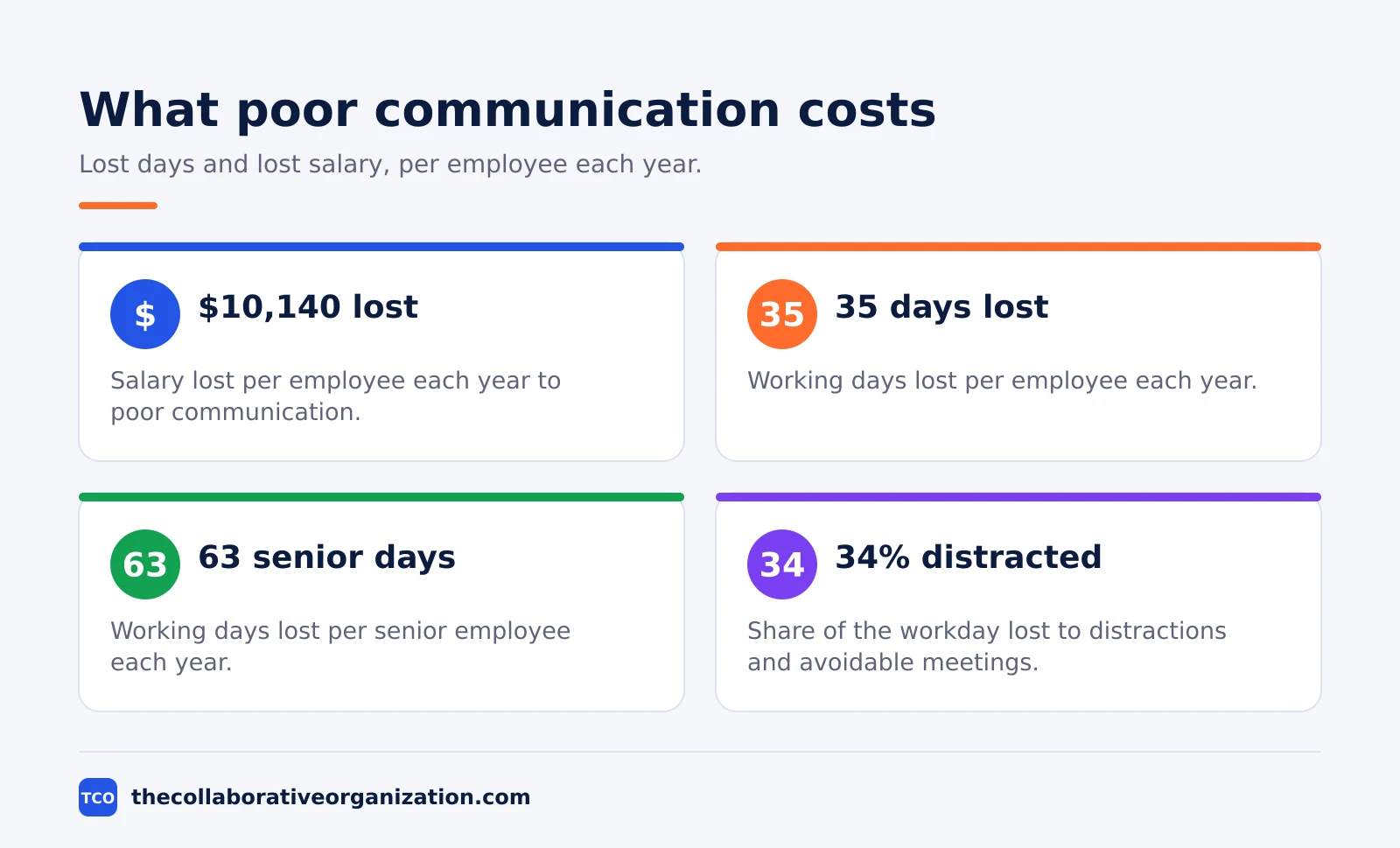
Senior staff lose more. Axios HQ found senior employees lose 63 work days a year to ineffective communication, at a cost of $54,860 per senior employee earning over $200,000. A third of leaders said they had to set aside their own tasks to fight fires caused by poor communication.
Time leaks in smaller ways too. Axios HQ found employees spend only 63% of their workday on core responsibilities, while 34% goes to distractions and avoidable meetings. Nearly half of C-level leaders said they get more involved in projects than they should because communication failed.
The bill is not only money. Grammarly found 66% of professionals say the expectation to always be connected adds to their burnout or stress, and 60% say constant connectivity makes it hard to focus on important tasks. The same report found 88% of workers waste time on unproductive tasks.
Alignment, engagement and the manager gap
Leaders and staff see the same communication very differently. In the Axios HQ 2025 survey, 27% of leaders thought staff were entirely aligned with business goals, but only 9% of employees agreed. The gap is just as wide on clarity: 80% of leaders called their communication clear and engaging, against 50% of employees.
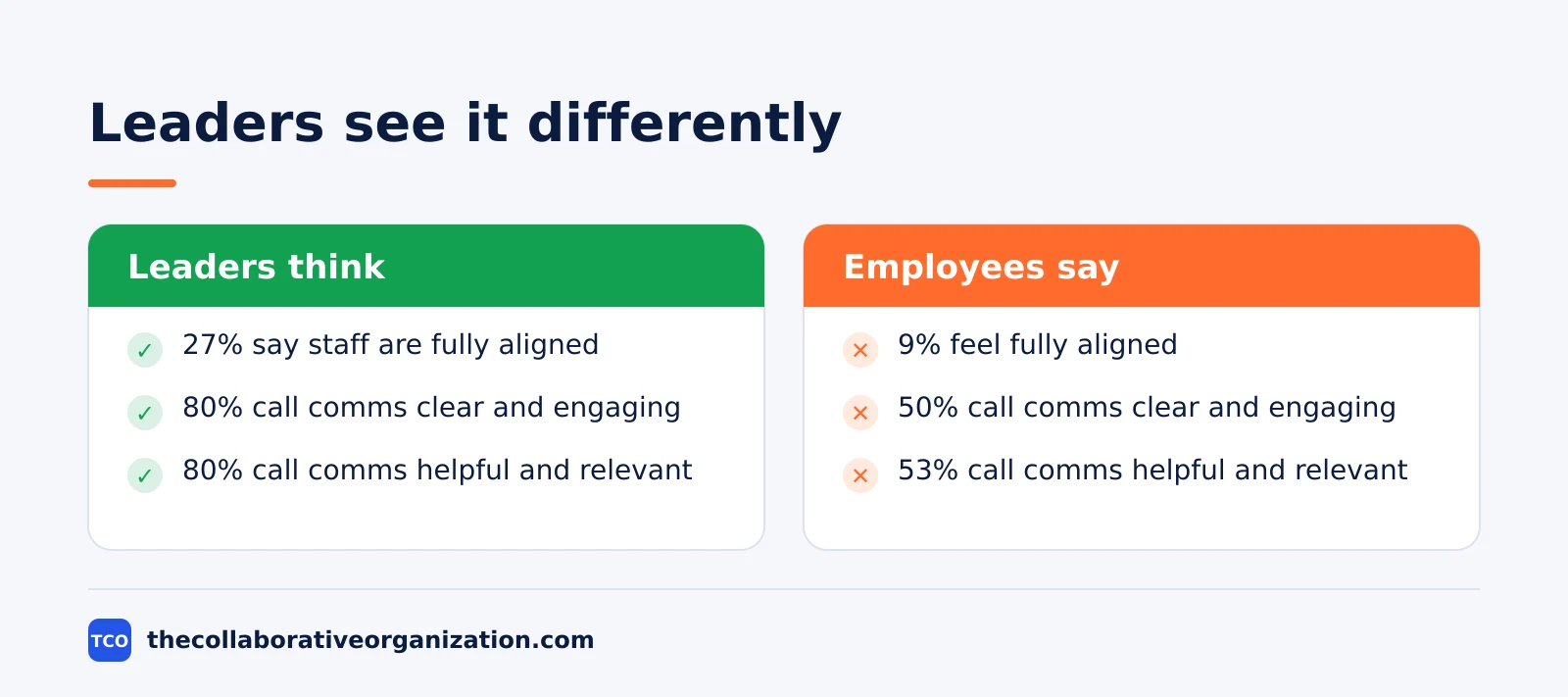
The same split shows in helpfulness. Axios HQ found 80% of leaders think their internal communication is helpful and relevant, but only 53% of employees agree, and just 12 to 16% of employees rate the critical updates they receive as very effective. Our guide to workplace collaboration statistics puts these gaps beside wider collaboration data.
Engagement is low and falling. Gallup found only 20% of employees worldwide were engaged in 2025, the lowest since 2020, at an estimated cost of $10 trillion, or 9% of global GDP. Manager engagement fell further, from 31% in 2022 to 22% in 2025, and Gallup attributes at least 70% of the variance in team engagement to the manager.
Clarity is the missing piece. In the first half of 2026, only 49% of US employees strongly agreed they knew what was expected of them at work, up from 47% in the second quarter of 2025, according to Gallup’s US surveys. Workers who know what is expected are far easier to align than workers who have to guess.
Meetings, hybrid work and the working day
Meetings now fill the week in two formats: the average worker has 5 online meetings and 5 face-to-face meetings each week. Owl Labs found that split in its 2025 survey of 2,000 US full-time workers, and the same survey found 77% of workers lost time to technical difficulties in meetings.
Setup time is the hidden tax. Owl Labs found workers lose about 6 minutes getting each hybrid meeting started, and 27% lose 10 minutes or more per meeting to setup alone. Two in three workers (67%) have given up trying to get video technology working in a meeting space at all. Our too many meetings statistics guide covers the load.
Timing matters as much as count. Owl Labs found 70% of workers say 8 a.m. or earlier is too early for a meeting, and 82% prefer meetings to end by 4 p.m. The fix is not another tool: our how to choose team communication software guide covers how to pick one channel per job.
Hybrid is now common, but office days still dominate. Owl Labs found 28% of workers are hybrid, 9% fully remote and 63% fully in office, while 47% say they lack the flexibility they want. Buffer found 98% of remote workers would keep working remotely for the rest of their careers. Remote work figures are in our remote work statistics guide.
What AI is doing to team communication
AI is now part of daily communication: 60% of desk workers use AI and 42% use it at least weekly. Slack’s 2025 Workforce Index found daily AI use rose 233% in six months, and daily users report 64% higher productivity and 81% greater job satisfaction than colleagues who do not use AI.
The gains are uneven. Slack found daily AI users report 58% better focus and 62% higher belonging. Yet 29% of desk workers say their company has issued no formal AI guidance, and half say AI use is not explicitly encouraged. Workers at companies that promote AI are nearly three times more likely to become daily users.
Organisations are adopting AI faster than they are seeing value from it. McKinsey found 88% of organisations regularly use AI in at least one function in 2025, up from 78% a year earlier, but only 39% report any enterprise-level effect on profit. The gap between use and value is now the main AI story at work.
The 30 team communication statistics in one table
The table below lists all 30 statistics with their source and year. Figures that describe a subgroup say so in the statistic itself.
| Statistic | Source | Year |
|---|---|---|
| 153 Teams messages received per weekday | Microsoft | 2025 |
| 117 emails received per day | Microsoft | 2025 |
| 275 interruptions per day (most heavily pinged fifth of users) | Microsoft | 2025 |
| 57% of meetings are ad hoc calls with no invite | Microsoft | 2025 |
| 28+ hours per week on written and tool-based communication | Grammarly | 2025 |
| In-tool communication up 14% year over year | Grammarly | 2025 |
| $9,284 lost per worker per year to poor communication | Grammarly | 2025 |
| $10,140 salary lost per employee per year ($50k-$100k earners) | Axios HQ | 2025 |
| 35+ working days lost per employee per year | Axios HQ | 2025 |
| 63 working days lost per senior employee per year | Axios HQ | 2025 |
| $54,860 annual cost per senior employee earning $200k+ | Axios HQ | 2025 |
| 34% of the workday spent on distractions and avoidable meetings | Axios HQ | 2025 |
| 27% of leaders vs 9% of employees say staff are fully aligned | Axios HQ | 2025 |
| 80% of leaders vs 53% of employees find internal comms helpful | Axios HQ | 2025 |
| 80% of leaders vs 50% of employees call comms clear and engaging | Axios HQ | 2025 |
| 79% say communication quality affects understanding of goals | Axios HQ | 2025 |
| 20% of employees worldwide engaged | Gallup | 2025 |
| 22% of managers engaged, down from 31% in 2022 | Gallup | 2025 |
| 49% of US employees strongly agree they know what is expected | Gallup | 2026 |
| 70% of variance in team engagement tied to the manager | Gallup | 2025 |
| 5 online and 5 face-to-face meetings per week | Owl Labs | 2025 |
| 77% lost time to technical difficulties in meetings | Owl Labs | 2025 |
| 27% lose 10+ minutes per meeting to setup | Owl Labs | 2025 |
| 70% say 8 a.m. or earlier is too early for a meeting | Owl Labs | 2025 |
| 82% prefer meetings to end by 4 p.m. | Owl Labs | 2025 |
| 98% of remote workers would keep working remotely | Buffer | 2025 |
| 60% of desk workers use AI; 42% use it weekly | Slack | 2025 |
| Daily AI users report 64% higher productivity | Slack | 2025 |
| 88% of organisations regularly use AI in at least one function | McKinsey | 2025 |
| 60% of knowledge-worker time goes to “work about work” | Asana | 2026 |
What the numbers mean for your team
The pattern is clear: message volume is up, clarity is down, and the bill lands on managers and senior staff. The fix is fewer channels, written decisions and clearer ownership, not more messages or more meetings. Start by naming one channel for each kind of message, and by writing down decisions instead of holding a call about them.
Worked example: a 40-person team loses a month a year
Take a 40-person team as an illustration. At $10,140 lost per employee per year (Axios HQ, 2025), poor communication costs this team about $405,600 a year. At 35 lost days per employee, the team loses 1,400 working days a year. The numbers are an illustration from the published figures, not a measurement of a real team.
If the team runs on three chat tools, pick one. Compare the options on our team communication software shortlist before you spend anything, and move status updates out of live meetings into written channels.
Video meetings deserve the same treatment. Zoom is the default for external calls on many teams, so keep internal updates in chat and save live calls for decisions and debate.
Common team communication statistics mistakes to avoid
Most bad takes on these numbers come from the same five errors, and all five are easy to avoid.
- Reading the 275 interruptions as an average. It describes the most heavily pinged fifth of users across a full day, not the typical worker.
- Quoting the 20% engagement figure without its scope. It is a global average for 2025; US engagement was 31% in the first half of 2026.
- Adding up costs from different studies. Grammarly’s $9,284 and Axios HQ’s $10,140 measure different things and cannot be combined.
- Treating AI use as AI value. McKinsey found 88% of organisations use AI but only 39% report any effect on profit.
- Comparing user counts across tools. Slack and Teams count users differently, and Slack no longer publishes a daily user count, so compare messages and customers instead.
Sources
- Microsoft - Breaking down the infinite workday (2025)
- Grammarly - The Productivity Shift (2025)
- Axios HQ - Internal communications statistics (2025)
- Gallup - Quiet Quitting Is on the Rise in India (2026)
- Business Communication Network - Better Communication: Boost Today at Work (2026)
- Asana - How Work About Work Gets in the Way of Real Work (2026)
- Owl Labs - State of Hybrid Work 2025 (2025)
- Slack - The New AI Advantage (2025)
- McKinsey - The State of AI in 2025 (2025)
- Zoom - 25 must-know remote work statistics for 2025 (2025)
Frequently asked questions
How many messages does the average worker get each day?
About 270 a day, by Microsoft's 2025 count: 153 Teams messages plus 117 emails on a typical weekday. The figure describes knowledge workers on Microsoft 365, so teams on other tools will differ, but the order of size holds across most office jobs.
What does poor communication cost a business each year?
Grammarly put the cost at $9,284 per worker per year in 2025. Axios HQ found a similar scale: an employee earning $50,000 to $100,000 loses 35 or more working days a year to ineffective communication, worth $10,140 in salary.
What share of employees are engaged at work?
Gallup found 20% of employees worldwide were engaged in 2025, the lowest since 2020. In the United States, 31% were engaged in the first half of 2026. Manager engagement fell further, from 31% in 2022 to 22% in 2025.
How many meetings does the average worker attend each week?
Owl Labs found an average of 5 online meetings and 5 face-to-face meetings per week in its 2025 survey of 2,000 US full-time workers. Over half of meetings are ad hoc calls with no calendar invite, according to Microsoft.
Does AI help or hurt team communication?
Both, so far. Slack found daily AI users report 64% higher productivity and 81% greater job satisfaction in 2025, but McKinsey found only 39% of organisations report any effect of AI on profit. Use is widespread; proven value is not.
Related articles
guides
Free Project Management Templates: 7 to Copy (2026)
Seven free project management templates from monday, Wrike, Teamwork, Smartsheet, ClickUp, Asana and Trello, with what each one is for and what free really costs.
November 20, 2026 · 7 min read
guides
Project Proposal Template: Copy and Win Work (2026)
A project proposal template pitches the work before it is approved: problem, solution, scope, budget, timeline and terms. Copy the template and filled example.
November 20, 2026 · 10 min read
guides
Action Plan Template: Goal to Done in One Page (2026)
An action plan template turns one goal into owned steps with dates, dependencies and a success measure. Copy the table and see it filled for a support team.
November 20, 2026 · 11 min read