How to Improve Team Collaboration (2026) | The Collaborative Organization
By The Collaborative Organization Team · November 19, 2026 · Last verified November 19, 2026 · 9 min read
To improve team collaboration, name one shared goal, give every task one owner, make it safe to disagree, and keep decisions in one place the whole team can see. Those four moves fix the failures that stall most teams, and the steps below turn them into habits.
Key takeaways
- Start with one shared goal that every team member can state in one sentence.
- Give every task exactly one owner, and record who decides, who does the work and who gives input.
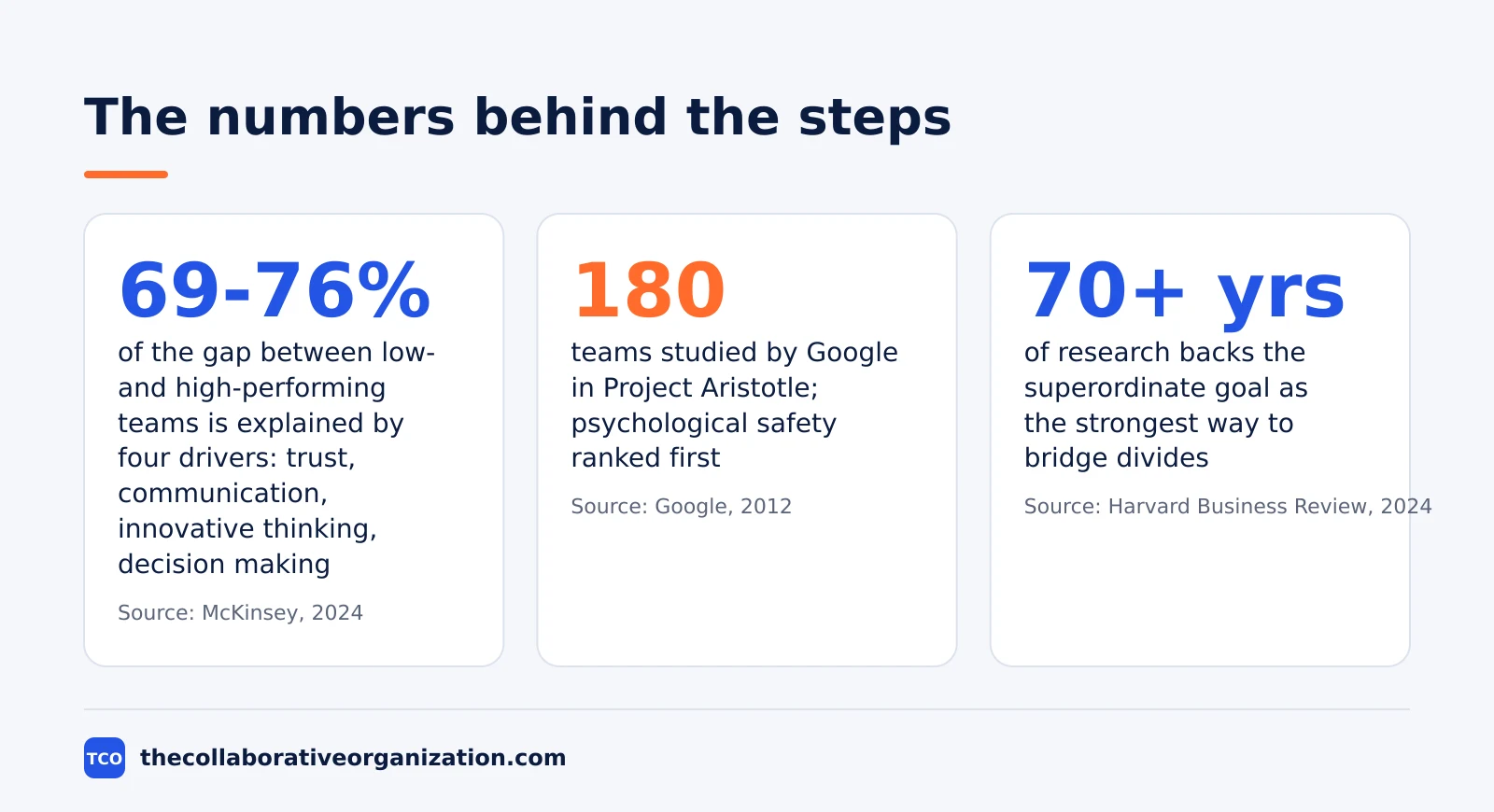
- Psychological safety matters most: Google found it was the top factor in its study of 180 teams.
- McKinsey found trust, communication, innovative thinking and decision making explain 69% to 76% of the gap between low- and high-performing teams.
- Measure four signs each month: on-time decisions, clean handoffs, broad speaking time and fast fixes.
What you need before you start
Before you change any habit, you need a shared goal, a list of owners, one home for decisions and one hour a week to review how the team works. Without those four, new tools only move the mess to a new place.
First, write the goal in one sentence and test it: can every member repeat it without looking? If not, the goal is too vague. Second, list the people and their roles, so each task has one owner. A RACI matrix is the simplest map for that job.
Third, pick one home for decisions: a shared doc, a task board or a channel where outcomes are recorded. Fourth, book a weekly 30-minute check-in to review the goal, the blockers and the decisions made. The review is where collaboration becomes a habit instead of a one-off push.
How to improve team collaboration in 7 steps
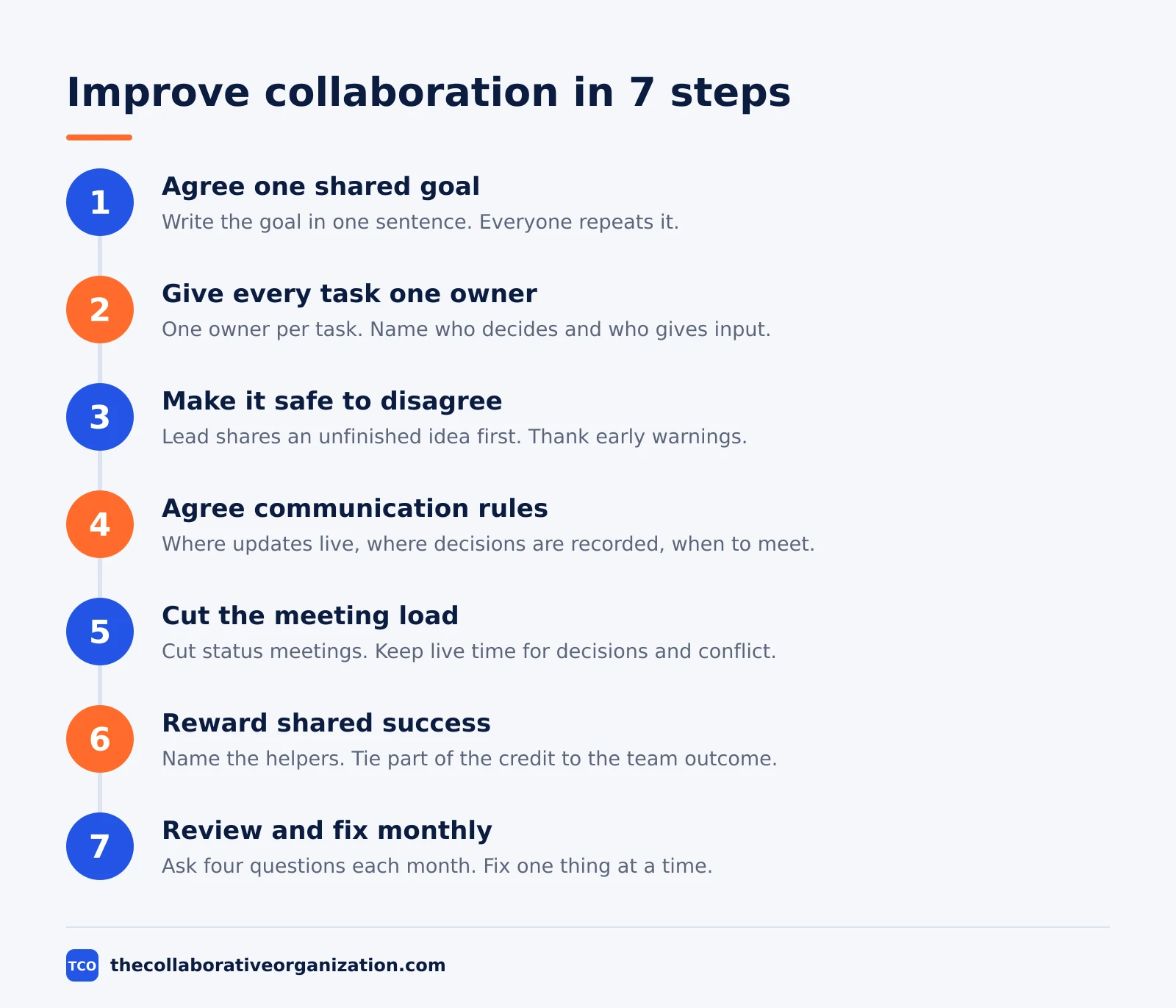
The seven steps below run in order, and each one takes a week or less to start. Do not skip step one: a team with no shared goal cannot collaborate, it can only coordinate.
Step 1: Agree one shared goal
Write the goal in one sentence and ask each member to repeat it. The goal must name the result and the date, such as shipping the new pricing page by 15 December. Harvard Business Review calls this a superordinate goal: a shared objective that needs cooperation across silos to reach, and more than 70 years of research backs it as the strongest way to bridge divides, according to HBR.
Outcome: everyone can state the goal, and debates become trade-offs about what serves it. If two members state different goals, stop and fix the goal before doing anything else.
Step 2: Give every task one owner
List every task and name one owner for each, plus who decides and who gives input. Shared ownership of a task means nobody owns it, so the owner is a single name, not a team. Use a RACI chart for the project, and review it when the scope changes.
Outcome: no task waits for someone else to start it, and no decision waits for a missing approver. Our guide on how to choose project management software shows how a shared board makes owners visible to the whole team.
Step 3: Make it safe to disagree
Psychological safety means people can speak up, ask questions and admit mistakes without fear of punishment. Google studied 180 teams over two years in Project Aristotle and found it was the most important of five dynamics, ahead of dependability, structure, meaning and impact, as LeaderFactor reports.
Start by having the lead share an unfinished idea first, and thank people who raise bad news early. Outcome: risks surface in week one instead of at the deadline, and the team fixes problems while they are still small.
Step 4: Agree communication rules
Write down where updates live, where decisions are recorded, and when a meeting is needed versus a written update. Use live calls for decisions and hard talks, and shared docs for review and status. Every thread should close with a decision, a named owner and a next-action date.
Outcome: nobody has to guess where the latest version lives, and new joiners can catch up by reading the record. Business.com notes the same point: schedule time for collaboration, and use technology to support it rather than to add noise.
Step 5: Cut the meeting load
Count the recurring meetings and cut any that only share status, since a written update does the same job faster. Keep live time for decisions, brainstorms and conflict, where back-and-forth adds value. A daily standup of 15 minutes replaces three status meetings for most teams.
Outcome: the team gains hours each week, and the meetings that remain have a decision to make. If a meeting ends with no decision and no owner, it should have been a written update.
Step 6: Reward shared success
When only individual output earns credit, helping a teammate costs the helper, so people stop helping. Reward the shared result as well as the individual part: name the helpers in the review, and tie part of the recognition to the team outcome. HBR advises offering rewards for collective success and showing how each part feeds the bigger picture, in the same HBR guide.
Outcome: people ask for help earlier and offer help without being asked. The change is visible within a month: more cross-team messages, and fewer tasks stuck waiting for one person.
Step 7: Review and fix one thing each month
Book a monthly review of how the team works, not just what it shipped. Ask four questions: did we know the goal, did we know our roles, did decisions land on time, and did everyone get heard? Pick one fix, try it for a month, and keep it only if it helps.
Outcome: collaboration keeps improving instead of fading after the first push. The review also catches new problems early, such as a tool that nobody opens or a handoff that keeps breaking.
Worked example: a support team in six weeks
A support team of eight people used the seven steps to cut handoff delays in six weeks. The team handled billing questions, and tickets bounced between support, billing and product because nobody owned the handoff. This example is an illustration, not a case study.
Week one, the team agreed one goal: answer questions in one reply, with no bounce to another team. Week two, they named one owner per ticket type and wrote the handoff rule in a shared doc. Week three, the lead shared a mistake in the weekly review, and two agents raised a billing edge case they had hidden for months.
Week four, they cut three status meetings and moved updates to a shared thread. Week five, they added a team shout-out for the best handoff of the week. Week six, the review showed tickets resolved in one reply rose, and the team kept the new habits. The pattern is the point: goal, owner, safety, rules, fewer meetings, shared credit, review.
How to measure team collaboration
Measure four signs each month, and trust the trend over three months, not one week. The four signs are on-time decisions, clean handoffs, broad speaking time and fast fixes.
Count decisions that landed by their agreed date, and handoffs that arrived with all the facts attached. In meetings, note who speaks and who stays silent: a meeting where two people do all the talking is not collaboration. Track the time from a problem surfacing to a fix, since faster fixes mean earlier warnings.
Predictive Index makes the same point: collaboration is measurable, and teams should track specific signs rather than assume things are working. A short monthly survey helps too: ask if people know the goal, their role and where decisions live, on a scale of one to five.
McKinsey gives a reason to care about the numbers. Its research found 17 team behaviors, and four drivers matter most: trust, communication, innovative thinking and decision making. Those drivers explain 69% to 76% of the difference between low- and high-performing teams, according to McKinsey.
Tools that support better collaboration
One chat tool, one task board and one document store cover the seven steps, and the best pick is the tool the team will open every day. Our project management software shortlist compares the task boards side by side.
| Tool | Best for | Free plan | Starting price (as of November 2026) | Notable limit |
|---|---|---|---|---|
| Asana | Tasks with a named owner and a due date | Free for 2 people | $10.99 per user per month, billed annually | Free plan covers 2 people |
| monday.com | Visual boards for shared goals and status | Free plan for up to 2 seats | $9 per seat per month (Basic), billed annually | Paid plans need at least 3 seats |
| ClickUp | Docs, tasks and chat in one place | Free Forever plan | $9 per user per month (Core), billed annually | Yearly billing needed for that price |
The Asana price comes from Asana pricing: Starter is $10.99 per user per month when billed annually. On the monday.com pricing page, Basic is $9 per seat per month billed annually. The ClickUp pricing page lists Core at $9 per user per month billed yearly.
Slack covers the chat layer, with channels per project and threads for async discussion. A tool cannot create safety or a shared goal, so fix the habits first and let the tool carry them.
Common team collaboration mistakes to avoid
Most attempts to improve collaboration fail in five ways, and all five are easy to spot. Fix them before buying new software.
- Adding tools before fixing ownership. Six tools with no agreed owner for a task means the work is lost in six places at once.
- More meetings as the fix. Meetings are the most expensive way to share status, and they hide the real problem: no written record.
- Asking for honesty, then punishing bad news. One punished warning teaches the team to stay quiet, and the next problem arrives at the deadline.
- Rewarding solo heroes only. When only individual output earns credit, shared work becomes invisible and people stop helping.
- A one-off workshop with no review. Habits fade without a monthly check, so book the review before the workshop ends.
A team that works in Scrum already has a useful rhythm for the review: short cycles, a shared board and a regular look at how the team works. Use that rhythm, and change one thing at a time.
Sources
- Harvard Business Review - 4 Research-Backed Ways to Help Your Team Collaborate Better (2024)
- Business.com - Teamwork Strategies: How to Improve Teamwork and Collaboration (2026)
- Predictive Index - How to Improve Team Collaboration: 7 Strategies That Actually Work (2026)
- McKinsey - Go, Teams: When Teams Get Healthier, the Whole Organization Benefits (2024)
- LeaderFactor - Google Project Aristotle: Findings, 5 Keys, and Limits (2026)
- Slack - What Is Team Collaboration? 10 Benefits and Best Practices (2026)
- Asana - Pricing (2026)
- monday.com - Pricing (2026)
- ClickUp - Pricing (2026)
Frequently asked questions
What is the fastest way to improve team collaboration?
Name one shared goal, give every task one owner, and agree where decisions will be recorded. Those three moves fix the most common failures: unclear ownership, scattered facts and decisions nobody can find. Add a weekly check-in and a rule that every thread closes with a decision and a date.
How do you improve collaboration on a remote team?
Use live calls for decisions and hard talks, and shared docs and threads for updates and review. Collect remote input before a decision closes, so people in other time zones shape the outcome instead of hearing about it later. Keep one shared place for plans and decisions, and record every outcome there.
How do you measure team collaboration?
Track four signs: decisions made on time, handoffs with no missing facts, the share of people who speak in meetings, and the time from a problem surfacing to a fix. Ask the team each month whether they know the goal, their role and where decisions live. Rising scores on those four signs mean collaboration is improving.
What kills team collaboration most often?
Unclear ownership kills it first, because when everyone owns the result, nobody does. Low psychological safety comes next, since people hide bad news when speaking up feels risky. Silos, too many tools and rewards for solo work only add to the damage, so fix ownership and safety before buying new software.
How long does it take to improve team collaboration?
A team can agree a goal, roles and decision rules in one week, and see faster decisions within a month. Trust and new habits take longer, usually two to three months of steady practice. Review progress each month, keep the habits that work, and drop the ones that add meetings without adding clarity.
Related articles

project management
How to Choose Project Management Software (2026)
Pick project management software in seven steps: define the work, count seats, price the real cost, and run a two-week pilot before you pay.
November 19, 2026 · 10 min read
project management
What Is a RACI Matrix? Definition, Roles and Examples (2026)
A RACI matrix maps who is Responsible, Accountable, Consulted and Informed for each task. Learn the four roles, how to build one, and see a worked example.
November 19, 2026 · 9 min read
project management
Daily Standup Meeting Format That Works (2026)
A daily standup is a 15-minute meeting where Developers inspect progress toward the Sprint Goal and plan the next day. Use this format to run one that ends on time.
November 19, 2026 · 10 min read