Team Communication Strategies: 7 That Actually Work (2026) | The Collaborative Organization
By The Collaborative Organization Team · November 19, 2026 · Last verified November 19, 2026 · 9 min read
The team communication strategy that works is simple: make written, async messages the default, put every decision in writing, give every message one home, and have managers share news first. Teams do not need more tools. They need a few rules that everyone follows, and a way to check whether the rules work.
Key takeaways
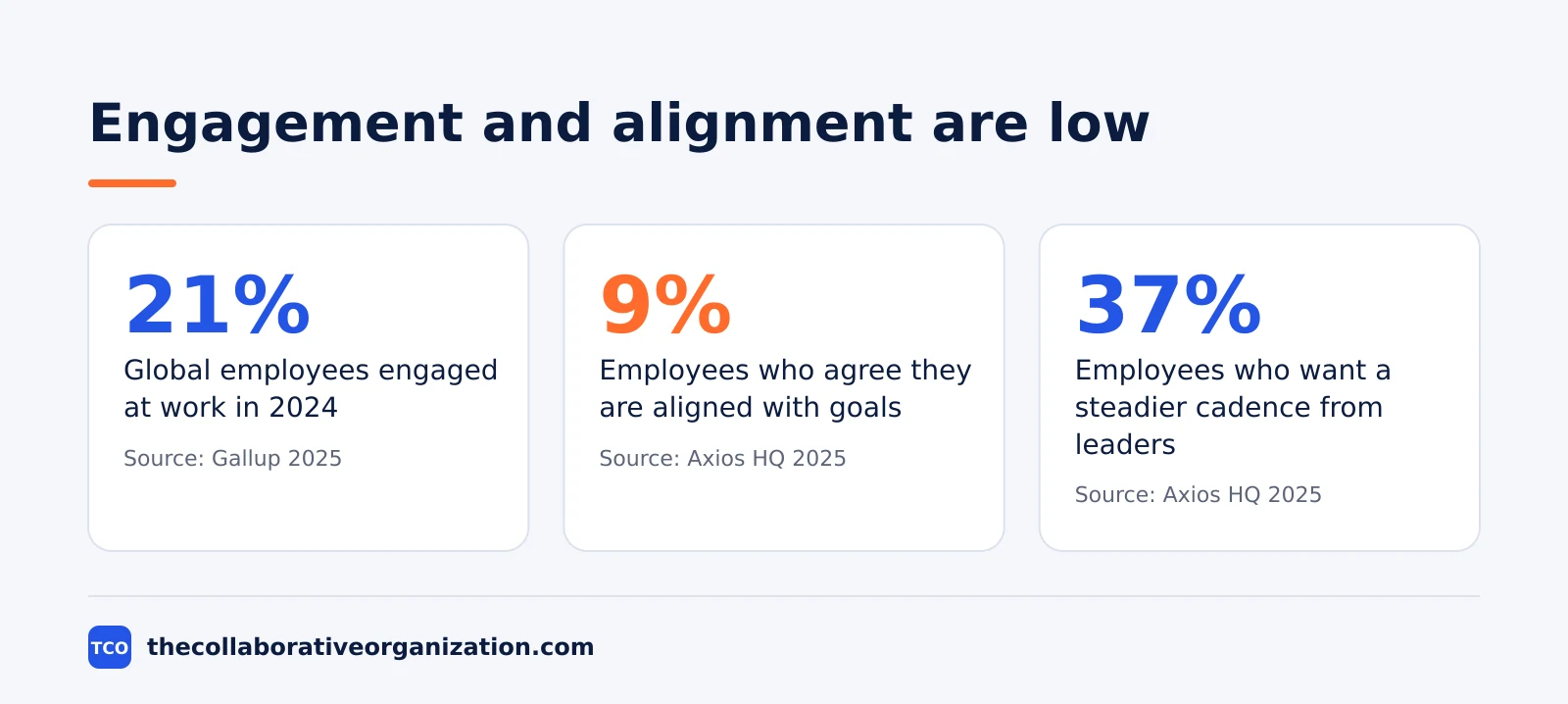
- Global employee engagement fell to 21% in 2024, and Gallup ties 70% of team engagement to the manager.
- Only 9% of employees agree they are aligned with business goals, against 27% of leaders, in the Axios HQ 2025 report.
- Make async the default: status updates and reviews in writing, live meetings only for debate, hard news and conflict.
- Write every decision down with an owner and a deadline for objections, or the team will decide it twice.
- Measure three numbers: meetings per week, repeat questions per week, and time to first reply.
Why strategy beats more tools
Most teams already have the tools, and the tools are part of the problem. Asana interviewed more than 13,000 knowledge workers and found the average worker switches between 10 and 25 apps a day, hunting for the message, the file, or the decision.
The same research puts a number on the waste: knowledge workers spend 60% of their time on busywork, and 13% of their time, 236 hours a year, on work that was already completed. A new chat app does not fix that. A rule about where decisions live does.
The cost of getting it wrong is measured too. Axios HQ surveyed 813 employees and 457 leaders in 2025, and found that an employee earning $50,000 to $100,000 loses more than 35 working days a year to ineffective communication, worth $10,140 in salary.
Gallup found global engagement fell from 23% to 21% in 2024, costing the world economy $438 billion in lost productivity, with the drop driven by manager engagement falling from 30% to 27%. Team communication is the layer where that damage shows up first, in missed messages and remade decisions.
7 team communication strategies
Seven strategies cover most teams, and each one has a test you can run in a month. Pick three to start, and add the rest one at a time.
1. Make async the default, live the exception
Async means a message that does not need everyone present at once: a written update, a doc comment, a recorded video. Set it as the default, and make live meetings the exception with a clear purpose.
Atlassian’s Loop framework draws the line this way: async suits summaries of information and feedback that is not urgent, while live suits input from two or more people, high complexity, and divergent thinking. Write the line down for your team, so the choice is a rule, not a mood.
2. Write every decision down, with an objection deadline
A decision that lives only in a call will be remade next week by different people. Write each one as a short record: the question, the options, the choice, the owner, and a deadline for objections. If nobody objects by the deadline, the owner proceeds.
Put the record where the work happens, not in a private chat. A decision log takes minutes to keep and saves hours of re-debate. Test it by asking a new joiner to find the last three decisions in under five minutes.
3. Give every message one home
Every type of message gets exactly one channel, and the channel list is written down. Announcements go in one place, project talk in the project channel, help questions in the help channel. A message posted in two places teaches people to watch everything.
When a message lands in the wrong home, move it kindly and say where it belongs. The redirect is the rule working, not a reprimand. After a month, the team should be able to guess the right channel without thinking.
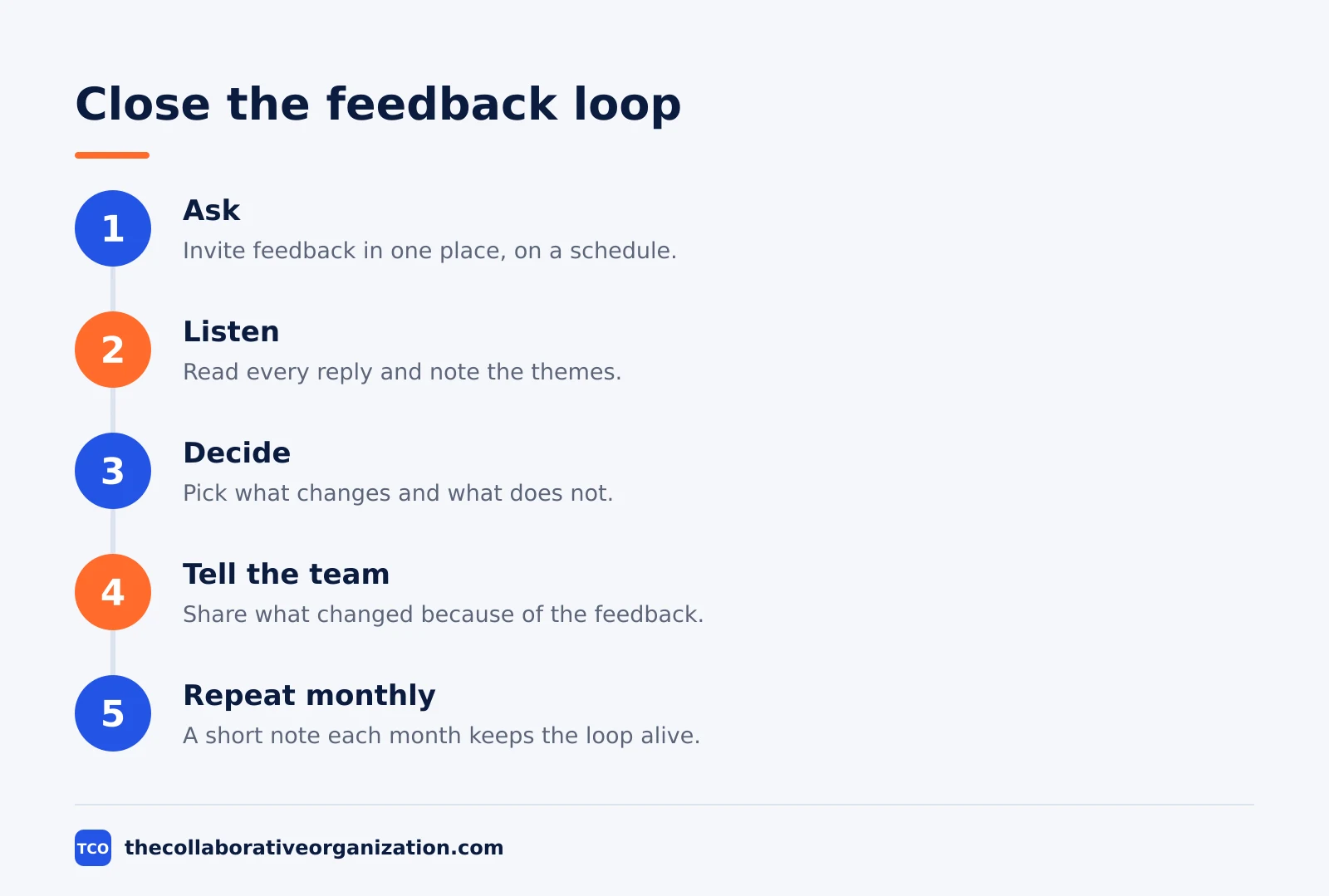
4. Close every feedback loop
Asking for feedback and ignoring it is worse than never asking. Axios HQ found that 36% of employees want the chance to provide feedback, and 37% want a more consistent cadence from leaders. The ask is cheap, and the silence after it is expensive.
Close each loop in public: what you heard, what changed because of it, and what did not change and why. A monthly note of three lines does the job. Teams that close loops get more feedback, because people learn that speaking up does something.
5. Put managers first, not last
Managers carry the strategy, because they carry the engagement. Gallup found that 70% of team engagement comes down to the manager, and only 27% of managers felt engaged in 2024, down from 30% the year before.
When managers share news early, answer in the open instead of in private messages, and follow the same reply rules as everyone else, the team copies the habit within weeks. When managers skip the rules, the team learns the rules are optional. Start every change with the managers, and make their behavior the example.
6. Measure three numbers, not feelings
Feelings about communication are hard to argue with, and numbers are not. Count three things before and after a change: meetings per week, repeat questions per week, and time to first reply on routine messages.
Count meetings from the calendar, and count repeat questions by asking the help channel owner to tally them for two weeks. Time to first reply comes from a sample of 20 messages, not a new tracking tool. If all three fall, the strategy works. If they do not, change the strategy, not the people.
7. Design for the quietest person in the room
A strategy that works only for the loudest people fails the rest of the team. Remote staff, new joiners, and people in other time zones miss the hallway version of every decision, so the written version must be the real version.
Ask quiet voices first in meetings, and rotate who speaks first. Record key calls so people in other time zones can catch up. And send the written summary after every live decision, so nobody has to have been in the room to know what happened.
Async or live: pick by the message
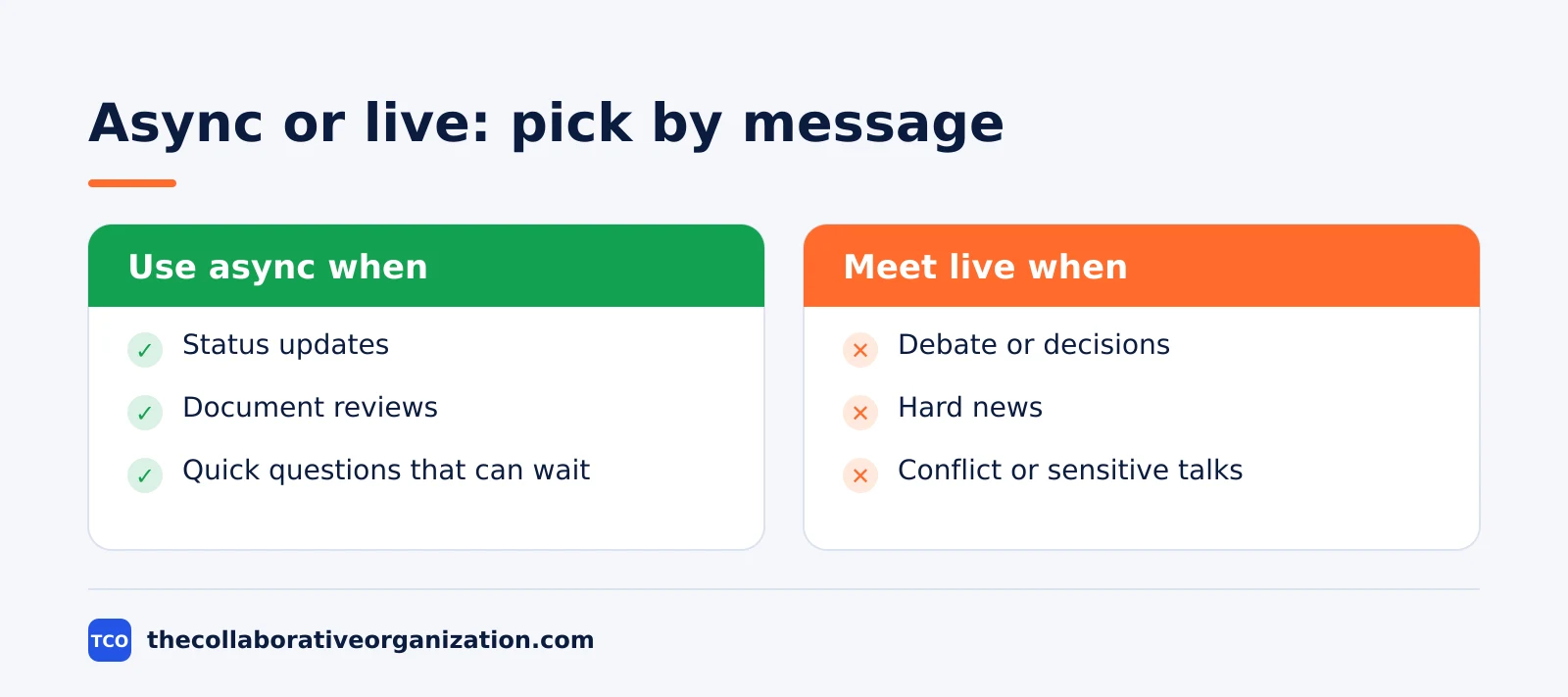
The choice between async and live is a decision about the message, not about the tool. The table below gives the rule in one glance, and the figure repeats it.
| Message | Use | Why |
|---|---|---|
| Status update | Async, written | Nobody needs to be present |
| Document review | Async, comments | Reviewers need time to think |
| Quick question | Async, chat | The answer can wait a few hours |
| Debate or decision | Live, meeting | The answer changes the next step |
| Hard news | Live, call or meeting | Tone matters, and questions follow |
| Conflict | Live, video or in person | Chat hides tone and makes it worse |
Atlassian’s Loop framework uses the same split: async for summaries and feedback that is not urgent, live for work that needs input from two or more people, high complexity, or divergent thinking. When a message fits both columns, pick live, because a 20-minute call beats a three-day thread.
Tools that carry the strategies
A tool helps only when it matches a rule the team already agreed, so pick the tool after the rules, not before. Compare the options on our team communication software shortlist before you pay for anything.
| Tool | Best for | Free plan | Starting price (as of November 2026) | Notable limit |
|---|---|---|---|---|
| Slack | Chat-first teams with threads and search | Free plan, 90-day message history | $7.25 per active user per month (Pro), billed annually | Free plan keeps 90 days of history |
| Microsoft Teams | Teams already on Microsoft 365 | Free plan | $4.00 per user per month (Teams Essentials), paid yearly | Essentials has no Office apps |
| Zoom | Teams whose work is mostly live meetings | Free plan, 40-minute group meetings | $14.16 per user per month (Pro), billed annually | Free plan caps group meetings at 40 minutes |
The Slack price comes from Slack pricing: Pro is $7.25 per active user per month billed annually. Slack’s own page returns a script shell to our reader, so the figure rests on three independent November 2026 checks.
The Teams price comes from Microsoft Teams pricing: Essentials is $4.00 per user per month, paid yearly. One source notes $4.50 after a July 2026 increase, so check the vendor page before you buy.
The Zoom price comes from Zoom pricing: Pro is $14.16 per user per month billed annually, after a price rise in March 2026.
Worked example: a 20-person team cuts meetings by a third
A 20-person product team had 25 hours of meetings a week, the same three questions asked daily, and decisions that lived in chat threads. The manager ran three strategies first: async by default, written decisions, and one home per message.
Week 1, the team replaced the two weekly status meetings with a written update posted every Monday, in a fixed format: what shipped, the numbers, what is blocked, and what needs a decision. Week 2, every decision went into a shared log with an owner and an objection deadline.
Week 3, the team archived 6 of its 18 channels and wrote the channel list on one page. Questions that used to arrive in three places now arrived in one, and the help channel owner could tally them.
After four weeks, meetings fell from 25 hours to 16 hours a week, and repeat questions fell from 15 a week to 6. The team did not buy a tool. It wrote down how it would talk, and then followed the page.
This is an illustration, not a case study. The pattern is what matters: three strategies, four weeks, and three numbers counted before and after.
Common team communication strategy mistakes to avoid
Most strategies fail in the same five ways, and each one has a simple fix. Check the list at the quarterly review.
- Async for everything. A conflict handled in chat gets worse, not better. Use live for debate, hard news and conflict.
- Decisions with no owner. A decision record without an owner is a note, not a decision. Name one person and a date.
- Feedback with no reply. Asking for input and going silent teaches the team not to bother. Close every loop in public.
- Managers exempt from the rules. If the manager ignores the reply times, the team copies the habit within a week. Leaders follow first.
- Measuring feelings instead of numbers. “Communication feels better” cannot be tested. Count meetings, repeat questions, and reply times.
Sources
- Gallup - State of the Global Workplace 2025 (2025)
- Axios HQ - Internal Communications Statistics, State of Internal Communication 2025 (2025)
- Asana - How to Write a Communication Plan (2026)
- Atlassian - The Loop: A Project Communication Framework (2021)
- Slack - Pricing (2026)
- Microsoft - Microsoft Teams Pricing (2026)
- Zoom - Pricing (2026)
- Atlassian - State of Teams 2025 (2025)
Frequently asked questions
What is the best team communication strategy?
Make written, async communication the default and live meetings the exception. Decisions go in writing with an owner and a deadline for objections, every message has one home, and managers share news first instead of last. Teams that run this way cut meetings without losing speed, because fewer people wait on a call to move.
How do you reduce meetings without losing alignment?
Replace each status meeting with a short written update in the same format every week: what shipped, the numbers that matter, what is blocked, and what needs a decision. Keep live meetings for debate, hard news and conflict. If a meeting has no decision to make, it can usually be a message.
Should all team communication be async?
No. Async suits status updates, document reviews and questions that can wait a few hours. Live suits debate, hard news, conflict and work where the answer changes the next step. The strategy is to choose by the message, not by habit, and to write the choice down so the team follows it.
How do you know if a communication strategy is working?
Measure three numbers before and after the change: meetings per week, repeat questions per week, and time to first reply on routine messages. If all three fall, the strategy works. Also ask the team one question each month: can you find the last decision in under a minute?
What role do managers play in team communication?
Managers carry most of it. Gallup found that 70% of team engagement comes down to the manager, and manager engagement fell from 30% to 27% in 2024. When managers share news early, write decisions down and answer in the open, the team copies the habit. When they do not, no tool fixes it.
How often should a team review its communication strategy?
Review it every quarter, and sooner when the team grows, adds a time zone or adopts a new tool. Ask what still works, which channel is noisy, and which meeting should have been a message. Change one rule at a time, and tell the team what changed and why.
Related articles
team communication
Communication Plan for a Project: Template (2026)
A communication plan for a project names who gets which update, in which channel, how often, and from whom. Copy the template and the filled example below.
November 20, 2026 · 10 min read
team communication
How Often Should Managers Communicate With Teams? (2026)
Managers should hold one meaningful conversation with each person every week, plus a weekly team update. See the cadence table for meetings, updates and feedback.
November 20, 2026 · 9 min read
team communication
Upward Communication Examples: 10 That Work (2026)
Upward communication is a message that travels from an employee to a manager or leader. See 10 concrete examples, each with why it works and when to use it.
November 20, 2026 · 9 min read