Internal Communication Best Practices (2026) | The Collaborative Organization
By The Collaborative Organization Team · November 19, 2026 · Last verified November 19, 2026 · 12 min read
Internal communication works when leaders explain the reason behind a decision, give every message one home, and check that people understood it. The rest is detail. Most companies do not have a tool problem. They have a habit problem: too many channels, messages with no clear reason, and no check that anything landed.
Key takeaways
- An employee earning 50,000 to 100,000 dollars loses 35 or more working days a year to ineffective communication, worth 10,140 dollars in salary, Axios HQ found in 2025.
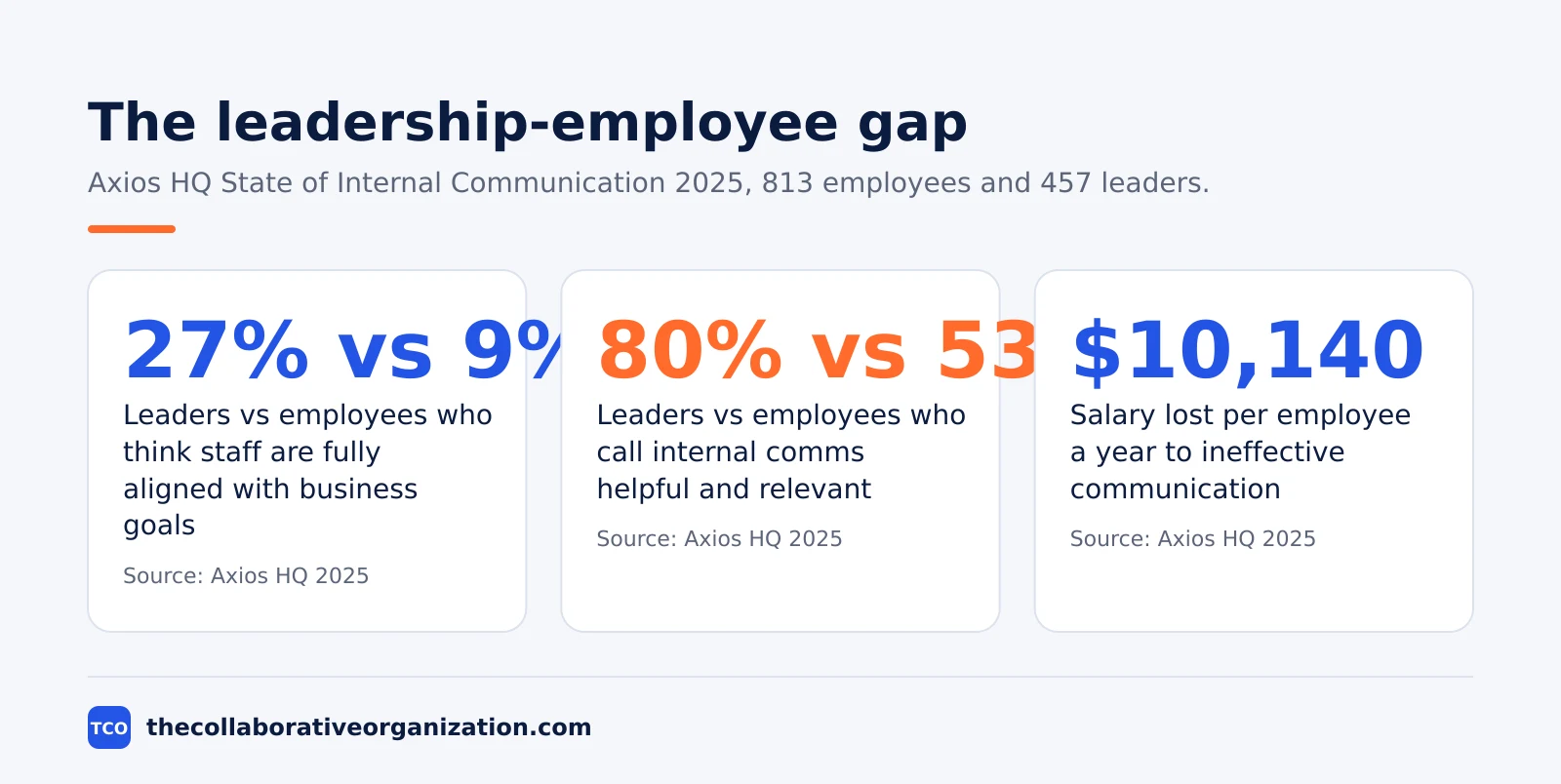
- Only 9% of employees think staff are fully aligned with business goals, while 27% of leaders think so.
- Only 16% of US employees said in August 2025 that their leadership communicated effectively, Gallup data shows.
- Managers account for 70% of the variance in team engagement, so they are the main channel, not an afterthought.
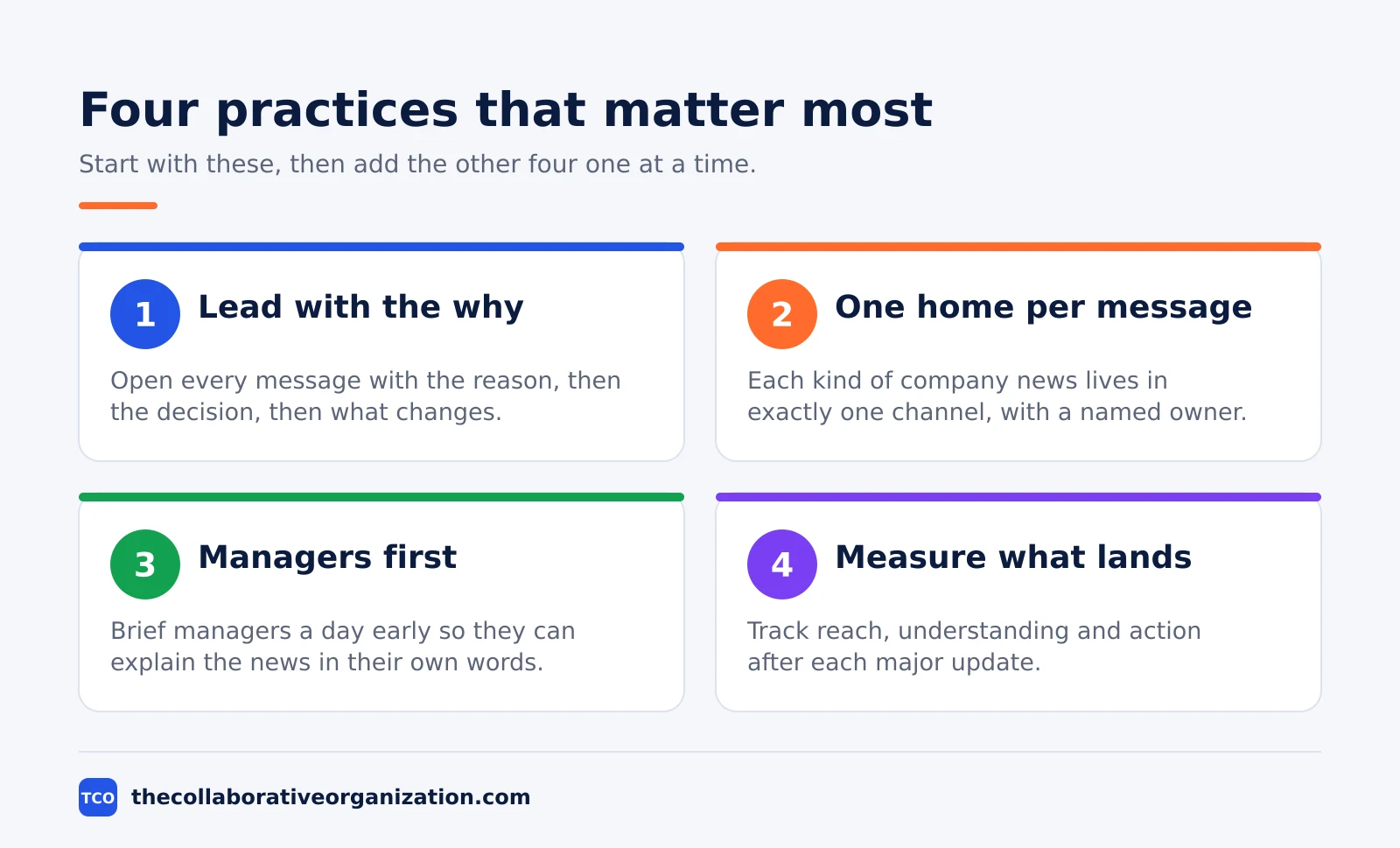
- Eight practices cover the job: lead with the why, one home per message, managers first, short updates, feedback, cadence, one urgent protocol and measurement.
Why internal communication breaks down
Internal communication breaks down because leaders overrate their own messages while employees quietly miss the point. The gap shows up in every number Axios HQ published in its 2025 State of Internal Communication report, which surveyed 813 employees and 457 leaders.
The alignment gap is the sharpest. Only 27% of leaders think their staff are entirely aligned with the organization’s business goals, but only 9% of employees agree. The clarity gap is just as wide: 80% of leaders think their internal communications are clear and engaging, but only 50% of employees agree.
The cost is measured in days, not feelings. An employee earning between 50,000 and 100,000 dollars loses 35 or more working days a year to ineffective communication, equal to 10,140 dollars in salary per employee per year.
Senior employees lose 63 working days a year, at a cost of 54,860 dollars a year for each senior employee earning over 200,000 dollars.
Leaders also pay the price in their own calendars. A third of leaders in the 2025 survey, 33%, were forced to set aside their tasks to put out fires caused by ineffective communication. Another 30% were drawn deeper into projects than they should have been.
The practices below close that gap. Each one is a habit a team can start this week, and each one has a number behind it so you can argue for it in a budget meeting.
8 internal communication best practices
Eight practices cover the whole job, from the first sentence of a message to the survey that checks whether it landed. Start with the first three, then add the rest one at a time. A team that tries all eight at once will drop most of them by month two.
1. Lead with the why, not the what
Every message should open with the reason behind the decision, then the decision itself, then what changes for the reader. People act on reasons, not announcements. A message that says “we are moving to a new expense tool on 1 December” leaves the reader guessing. A message that says “expense claims take 9 days to approve today, so we are moving to a tool that approves them in 2” gives the reader a reason to care.
The data backs the habit. In the Axios HQ 2025 survey, 79% of employees said the quality of communication they receive affects how well they understand leaders’ goals. When employees clearly understood company goals and were engaged, their productivity rose by 63% and their motivation by 59%.
Write the reason in one sentence, in plain words, at the top. If the reason cannot fit in one sentence, the decision is not ready to announce.
2. Give every message one home
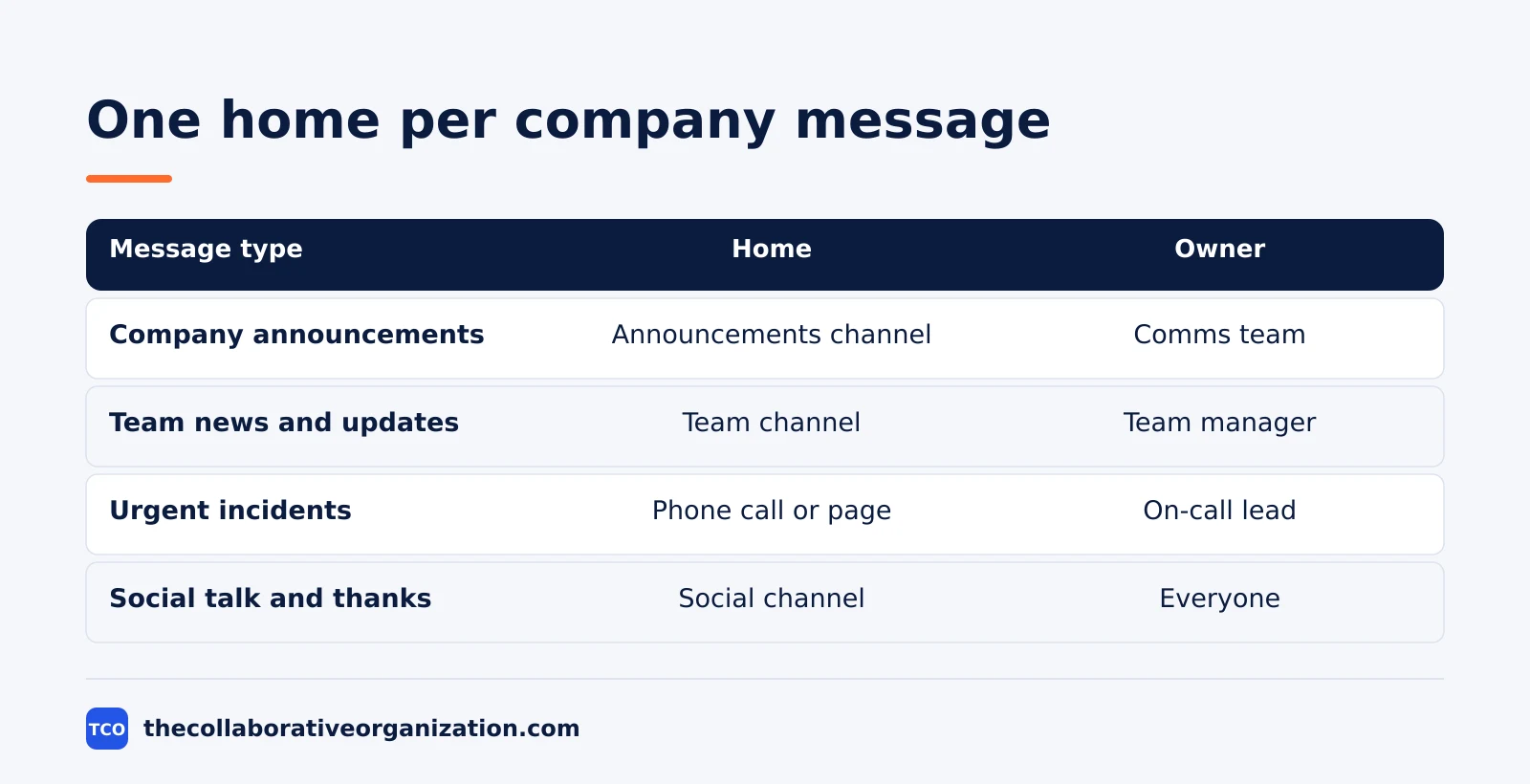
Pick one channel for each kind of company message and publish the map where everyone can find it. Announcements go in one place, team news in another, and social talk in a third. When the same news travels through email, chat and a meeting, staff must watch all three, and most of them watch none of them well.
Team communication works the same way at company scale: one home per message type, with a named owner for each home. The owner posts the news, answers the first questions, and keeps the record current. Without an owner, a channel fills with duplicates and goes quiet.
Audit the channels first. Most companies find three places doing the same job and one message type with no home at all. Close the duplicates, name the homes, and tell the whole company where to look.
3. Make managers the main channel
Company-wide messages land through managers, not around them. A manager who can explain a decision in their own words, answer questions and say what changes for their team is worth more than a polished video from the top floor. Gallup estimates that managers account for 70% of the variance in team engagement across business units.
That makes the manager briefing the most important document in internal communication. Send it to managers a day before the company-wide message, with the decision, the reason, the likely questions and the answers. Then give managers 15 minutes in their team meeting to talk it through.
The feedback gap shows why this matters. In Gallup’s US data, 50% of managers strongly agreed they gave direct reports feedback every week, but only 20% of individual contributors strongly agreed their manager did so. A briefing that names the feedback managers owe closes that gap.
4. Keep updates short and scannable
Long updates do not get read. They get saved for later, and later never comes. A good company update fits on one screen: a headline, three or four short points, and one clear action. Put the decision and the deadline first, and move background detail to a linked document.
Only 12 to 16% of employees in the Axios HQ 2025 survey called the critical updates they receive from leaders “very effective”. And 60% of employees said the internal updates they get are not engaging. The problem is rarely the news itself. It is the length and the format.
Test every update with one question: can a reader get the point in 30 seconds? If not, cut a paragraph. Short updates also respect the working day: employees already spend only 63% of their workday on core job responsibilities, with 34% going to distractions and avoidable meetings.
5. Ask for feedback, and act on it
Communication that runs one way is a broadcast, not a conversation. Give staff a fast way to answer back: a short pulse survey after big news, a question box in the update channel, or a monthly open session with a leader. Then publish what you heard and what changed because of it.
Employees are asking for this directly. In the Axios HQ 2025 survey, 36% of employees wanted the chance to provide feedback, and 35% wanted more thoughtful and insightful details in the communications they receive. A feedback loop that never closes teaches staff that answering is a waste of time.
Keep the loop small and visible. One question per update, one change per month, announced in the next update. Staff who see their feedback change something will keep giving it.
6. Set a cadence, then stop duplicating
Fix the rhythm of company news and hold it: a short weekly update, a longer monthly one, and breaking news only when it truly breaks. A steady cadence is what staff asked for most in the Axios HQ 2025 survey, with 37% wanting communications on a more consistent cadence and 34% wanting more frequent updates from leadership.
The rule that makes cadence work is no duplication. Post the news once, in its home, and link to it from elsewhere instead of copying it. Duplication teaches staff that every channel might hold anything, so they must watch them all, and then they watch none of them.
A shared calendar of planned announcements helps too. It stops three teams from sending three company-wide messages on the same day, and it gives the communications team time to write well instead of rushing.
7. Write one urgent protocol
Urgent news needs a separate route, or everything starts to look urgent. Name the three situations that count as urgent for your company, such as a service outage, a security incident or a safety issue. Then name the channel that carries them, such as a phone call or a paging alert, and state plainly that chat and email are never the urgent route.
The protocol protects the normal channels. When staff know that real urgency arrives by phone, they can read chat and email in batches without fear of missing a crisis. When urgency has no defined route, every message feels like it might be one, and focus time disappears.
Test the protocol twice a year with a short drill. A rule nobody has used in a real situation is a guess, not a plan.
8. Measure what lands, then change it
A message you do not measure is a message you hope worked. Track three numbers after each major update: reach, understanding and action. Reach is the share of staff who opened or saw the message. Understanding is the share who can state the decision and the reason, checked with a two-question survey. Action is the share who did what the message asked.
The measurement gap is common. In the Axios HQ 2025 survey, 22% of leaders said the lack of data and feedback to measure success was a challenge, and 20% said writing in a concise, engaging way was a key difficulty.
Start with the smallest survey that answers the question: two questions, one open comment box, sent to a sample of 50 staff.
Publish the results inside the company. When staff see that read rates changed a format, they trust the next survey. And when leaders see that a short update beat a long one, the next update gets shorter on its own.
Worked example: a 400-person company fixes its updates in 6 weeks
Picture a 400-person company with 6 offices, where the weekly all-staff email runs to 2,000 words and nobody reads past the first paragraph. The head of people runs the eight practices above as a six-week fix. The example below is an illustration, not a case study.
Week 1, she audits the channels: 4 places carry company news, and 2 of them duplicate each other. She closes one duplicate and publishes a one-page channel map. Week 2, she rewrites the weekly update to one screen, with the reason first and one action at the end.
Week 3, she sends managers a one-page briefing a day before each company message, with the likely questions and the answers. Week 4, she adds a two-question survey to the update: what did we decide, and what confused you.
Week 5, she publishes the survey results and the two changes they caused: shorter updates and a fixed Friday send time. Week 6, she counts the result: the update’s open rate rises from 41% to 68%, and the share of staff who can state the week’s decision rises from 1 in 3 to 2 in 3 in the survey sample.
The fix cost no new tool. It cost a channel map, a shorter format, a manager briefing and a two-question survey.
Tools that carry internal communication
A tool helps internal communication only when it matches a rule the team already agreed, so pick the tool after the practices, not before. Compare the options on our team communication software shortlist before you pay for anything, and start with the free plan to test the fit.
Slack fits companies that live in chat and want announcements, threads and apps in one place. Microsoft Teams fits companies already on Microsoft 365. Zoom fits companies whose internal news travels by live video, and Google Chat fits companies already on Google Workspace.
| Tool | Best for | Free plan | Starting price (as of November 2026) | Notable limit |
|---|---|---|---|---|
| Slack | Chat-first companies with many channels | Free plan with 90 days of history | $7.25 per active user per month (Pro), billed annually | Full history needs a paid plan |
| Microsoft Teams | Companies already on Microsoft 365 | Free plan | $4.00 per user per month (Essentials), billed annually | Essentials has no Office apps |
| Zoom | Live video updates and all-hands calls | Free plan, 40-minute group meetings | $14.16 per user per month (Pro), billed annually | Free plan caps group meetings at 40 minutes |
| Google Chat | Companies already on Google Workspace | Included with Workspace trial | $7 per user per month (Business Starter), billed annually | Business plans cap at 300 users |
Slack lists Pro at $7.25 per active user per month billed annually, or $8.75 billed monthly, and Business+ at $15 billed annually. Microsoft lists Teams Essentials at $4.00 per user per month, paid yearly, with a note in one source that the price rose to $4.50 after a July 2026 increase, so check the vendor page before you buy.
Zoom lists Pro at $14.16 per user per month billed annually, or $16.99 billed monthly. Google lists Workspace Business Starter at $7 per user per month on the annual plan.
Common internal communication mistakes to avoid
Most internal communication fails in the same six ways, and each one has a simple fix. Run through the list at the next quarterly review.
- Sending without checking. The message went out, so the job feels done. Fix it with a two-question survey after each major update.
- One channel for everything. A single channel mixes urgent news with casual talk, and urgent items get buried. Fix it with one home per message type.
- Hiding the reason. The announcement states what changed and never says why. Fix it by leading with the reason in one sentence.
- Skipping the managers. Leaders announce directly to staff and managers hear the news at the same time. Fix it with a manager briefing sent a day early.
- Duplicating the news. The same message goes out by email, chat and meeting, so staff stop trusting any of them. Fix it by posting once and linking elsewhere.
- Measuring nothing. No one knows the open rate, the understanding rate or the action rate. Fix it by tracking all three after each major update.
Our guide on how to improve team communication covers the same habits at team scale, with seven steps and a worked example for a 12-person team.
Sources
- Axios HQ - Internal Communications Statistics from Axios HQ 2025 Annual Report (2025)
- Axios HQ - Internal Communication Trends: 8 for 2025 (2025)
- GetApplause - Leadership Communication Statistics: Trust, Feedback, and Employee Voice (2026)
- Slack - The New AI Advantage (2025)
- Slack - Pricing (2026)
- Microsoft - Microsoft Teams Pricing (2026)
- Zoom - Pricing (2026)
- Google - Google Workspace Pricing (2026)
Frequently asked questions
What are internal communication best practices?
They are the habits that make company-wide messages land: lead with the reason behind a decision, give every message one home, use managers as the main channel, keep updates short, ask for feedback, and measure what people actually read. The practices work together. One clear channel cannot fix a message that hides its reason, and a good message cannot fix a channel nobody opens.
How do you measure internal communication?
Track three numbers: reach, understanding and action. Reach is the share of staff who opened or saw the message. Understanding is the share who can state the decision and the reason behind it, checked with a short survey. Action is the share who did what the message asked. Add one open question so staff can say what confused them, then fix the next message based on the answers.
Who owns internal communication in a company?
The chief executive owns the message, the communications team owns the system, and managers own the last mile. Leaders decide what to say and why it matters. The communications team picks the channel, the timing and the format. Managers translate the message for their own teams and answer questions. When no one owns the last mile, the message stops at the inbox.
How often should leaders update employees?
Set a fixed cadence and keep it, such as a short weekly update and a longer monthly one, plus news when it happens. In the Axios HQ 2025 survey, 37% of employees asked for a more consistent cadence and 34% asked for more frequent updates from leadership. A steady rhythm beats a flood of messages followed by weeks of silence, because staff learn when to expect news.
What is the biggest internal communication mistake?
Assuming the message landed because it was sent. Only 12 to 16% of employees in the Axios HQ 2025 survey called the critical updates they receive from leaders very effective, while 80% of leaders thought their communications were clear and engaging. Sending is not communicating. Check that people understood the message, then change the format, the channel or the timing until they do.
Related articles
team communication
Communication Plan for a Project: Template (2026)
A communication plan for a project names who gets which update, in which channel, how often, and from whom. Copy the template and the filled example below.
November 20, 2026 · 10 min read
team communication
How Often Should Managers Communicate With Teams? (2026)
Managers should hold one meaningful conversation with each person every week, plus a weekly team update. See the cadence table for meetings, updates and feedback.
November 20, 2026 · 9 min read
team communication
Upward Communication Examples: 10 That Work (2026)
Upward communication is a message that travels from an employee to a manager or leader. See 10 concrete examples, each with why it works and when to use it.
November 20, 2026 · 9 min read