Onboarding Statistics: 33 Numbers That Decide Retention (2026) | The Collaborative Organization
By The Collaborative Organization Team · November 19, 2026 · Last verified November 19, 2026 · 11 min read
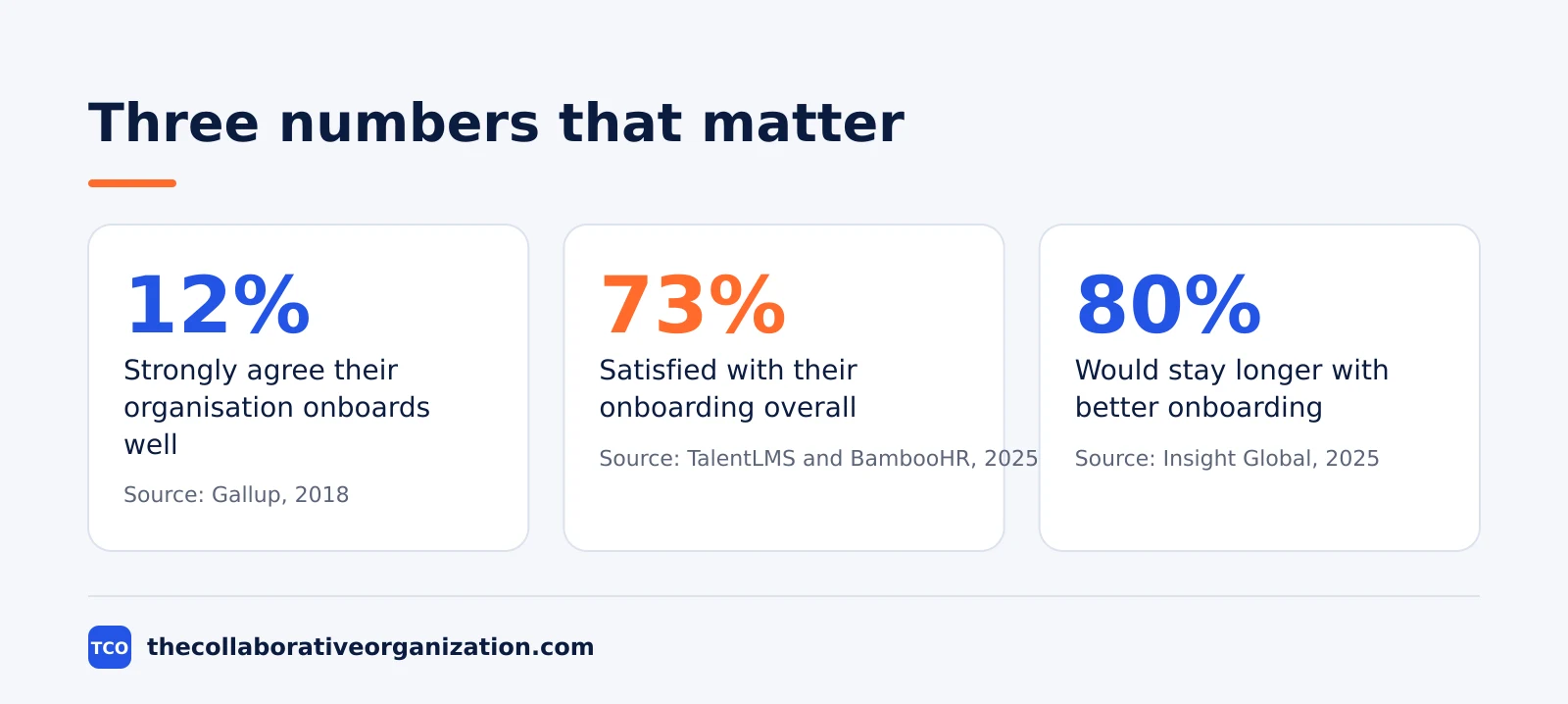
Only 12% of employees strongly agree their organisation does a great job onboarding new employees, and that single number explains why the first 90 days decide retention. Gallup published the figure in 2018 and updated it in August 2026. The rest of this page gathers 33 numbers from the original studies behind that headline.
Key takeaways
- Only 12% of employees strongly agree their organisation onboards well (Gallup, 2018, updated 2026).
- 70% of new hires decide within the first month whether the job is right, and 44% have regrets within the first week (BambooHR, 2023).
- 22% of workers have left a job within the first 90 days (Insight Global, 2025).
- 80% of workers say they would stay longer with better onboarding (Insight Global, 2025).
- Replacing an employee costs six to nine months of salary (SHRM, cited by Gallup).
How we chose these stats
Every number on this page comes from the original study, survey or report, with its sample and year stated. We read the Gallup article, the BambooHR surveys, the TalentLMS and BambooHR 2025 report, the Enboarder 2025 HR leader survey, the Insight Global 2025 report, the Paychex 2022 survey, the Work Institute 2025 retention report and the SHRM 2025 benchmarking release. Where the original sits behind a member wall, we link the closest reputable summary and say so.
Three widely quoted figures did not make the cut. The claim that 69% of employees stay three years after a great onboarding experience cannot be traced to a published study. The claim that 20% of turnover happens in the first 45 days has no named source.
The Brandon Hall Group figures on retention and productivity are included with a warning, because the original study is not publicly available. A stat without a source is a rumour, not evidence.
Onboarding statistics: the full table
The table below holds all 33 statistics, grouped by theme, each with its source and year. Read the theme you need, then check the section below it for what the numbers mean.
| Statistic | Figure | Source | Year |
|---|---|---|---|
| Employees who strongly agree their organisation onboards well | 12% | Gallup | 2018 |
| New hires who feel fully prepared and supported after onboarding | 29% | Gallup | 2018 |
| New hires satisfied with their onboarding overall | 73% | TalentLMS and BambooHR | 2025 |
| New hires who had second thoughts during onboarding | 39% | TalentLMS and BambooHR | 2025 |
| Gen Z new hires who had second thoughts during onboarding | 49% | TalentLMS and BambooHR | 2025 |
| New hires satisfied with their onboarding | 52% | Paychex | 2022 |
| Employees who felt fully informed, engaged and confident | 26% | Enboarder | 2024 |
| New hires who finished onboarding disappointed | 32% | TalentLMS and BambooHR | 2025 |
| New hires with regrets or second thoughts in the first week | 44% | BambooHR | 2023 |
| New hires who decide within the first month if the job is right | 70% | BambooHR | 2023 |
| New hires who know within the first week if the job is right | 29% | BambooHR | 2023 |
| Average days companies have to influence long-term retention | 44 days | BambooHR | 2023 |
| Workers who have left a job within the first 90 days | 22% | Insight Global | 2025 |
| HR leaders who say up to half of new hires leave within 90 days | 20.5% | Enboarder | 2025 |
| HR leaders who say 90-day turnover rose in the past year | 60.8% | Enboarder | 2025 |
| HR leaders who rank high 90-day attrition as the top challenge | 29% | Enboarder | 2025 |
| Share of all employee turnover that happens in the first year | Up to 40% | Work Institute | 2025 |
| New hires who decide how long to stay within six months | 86% | Enboarder | 2025 |
| Early leavers citing mismatched expectations | 30.3% | Enboarder | 2025 |
| Early leavers citing lack of connection to team or culture | 19.5% | Enboarder | 2025 |
| Early leavers citing a poor onboarding experience | 17.4% | Enboarder | 2025 |
| Early leavers citing disorganised or missing training | 60% | Insight Global | 2025 |
| New hires with no clear point of contact for questions | 65% | BambooHR | 2023 |
| Undertrained new hires who plan to quit soon, vs 7% of well-trained | 80% | Paychex | 2022 |
| Remote new hires who felt undertrained after onboarding | 63% | Paychex | 2022 |
| Higher new-hire retention with a strong onboarding process | 82% | Brandon Hall Group | Undated |
| Higher productivity with a strong onboarding process | 70% | Brandon Hall Group | Undated |
| More likely to call onboarding exceptional with an active manager | 3.4x | Gallup | 2018 |
| More likely to be extremely satisfied after exceptional onboarding | 2.6x | Gallup | 2018 |
| Exceptional-onboarding employees who say they have the best job | 70% | Gallup | 2018 |
| Satisfaction: hybrid vs in-person vs remote onboarding | 75% / 73% / 71% | TalentLMS and BambooHR | 2025 |
| New hires who met a buddy once in 90 days and got productive faster | 56% | Microsoft WorkLab | 2021 |
| New hires who met a buddy 8+ times and got productive faster | 97% | Microsoft WorkLab | 2021 |
How good is onboarding today?
Onboarding is common, but good onboarding is rare. Only 12% of employees strongly agree their organisation does a great job onboarding new employees, according to Gallup’s 2018 article, updated in August 2026. Only 29% of new hires feel fully prepared and supported to excel in their role after onboarding, in the same Gallup research.
Satisfaction scores look better than quality scores. In the TalentLMS and BambooHR 2025 survey of 1,156 US employees hired in the past year, 73% were satisfied with onboarding overall. Yet 39% had second thoughts during onboarding, rising to 49% of Gen Z, and 32% finished disappointed.
The older Paychex 2022 survey of 1,002 recent hires found 52% satisfied with onboarding, and Enboarder’s 2024 survey found only 26% of employees felt fully informed, engaged and confident. Read together, the numbers say new hires tolerate onboarding more than they praise it.
The first 90 days decide retention
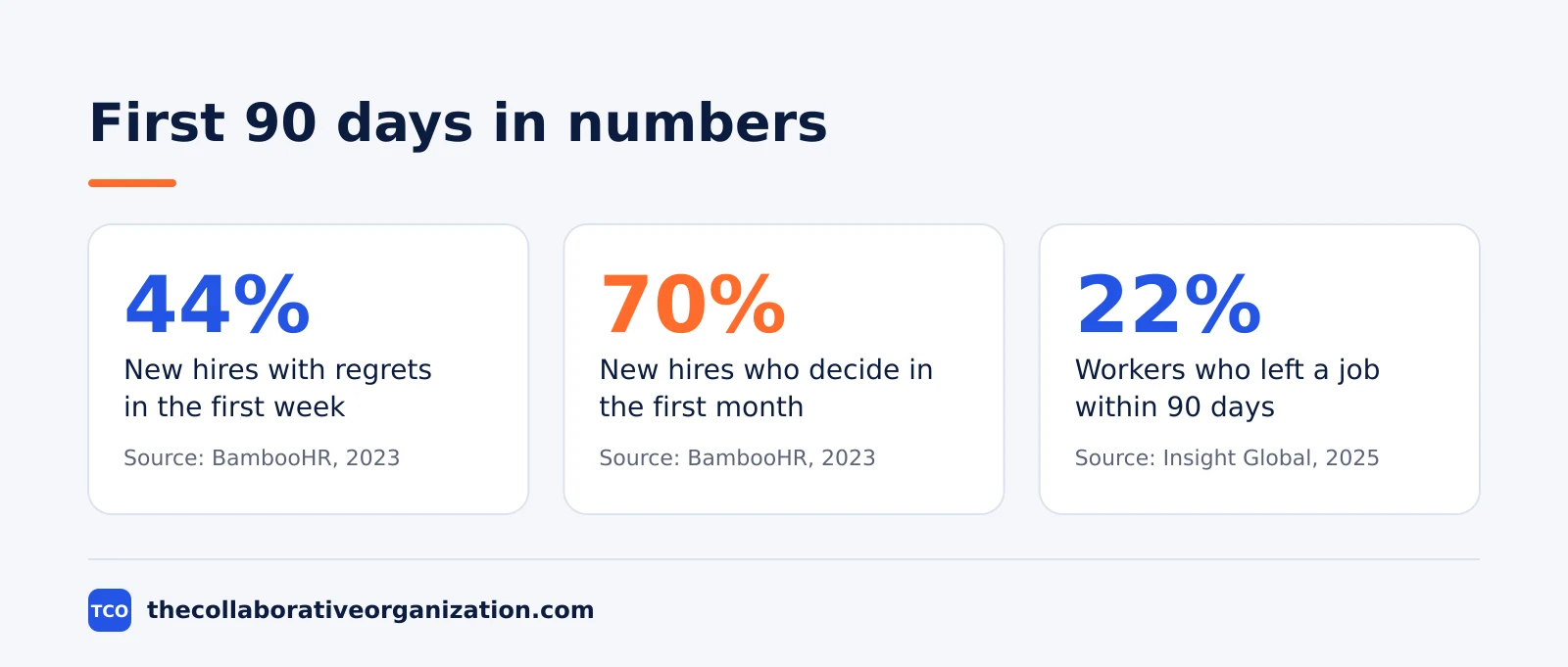
New hires judge the job fast, and the window to change their mind is about six weeks. In BambooHR’s 2023 survey of 1,565 US employees, 44% had regrets or second thoughts within the first week, 70% decided within the first month whether the job was right, and 29% knew within the first week. On average, companies have 44 days to influence long-term retention.
The exits follow the same clock. Insight Global’s 2025 survey of 905 US workers found 22% had left a job within the first 90 days.
In Enboarder’s 2025 survey of 1,000 HR leaders, 20.5% said up to half of their new hires leave within 90 days. Of those leaders, 60.8% said 90-day turnover had risen in the past year, and 29% ranked high 90-day attrition as their top onboarding challenge.
The first year carries the rest of the risk. The Work Institute’s 2025 Retention Report, built on 123,297 exit interviews from 2019 to 2024, places as much as 40% of all employee turnover in the first year. Enboarder’s 2025 survey adds that 86% of new hires decide how long they will stay within their first six months.
Why new hires leave early
The top reason is not the onboarding agenda: it is the gap between the job as sold and the job as lived. In Enboarder’s 2025 survey, HR leaders named mismatched expectations as the top reason new hires leave early, at 30.3%, ahead of lack of connection at 19.5% and a poor onboarding experience at 17.4%. The fix starts in hiring, not in week one.
Training is the second fault line. Of the workers who left a job within 90 days in Insight Global’s 2025 survey, 60% cited disorganised or missing training.
In BambooHR’s 2023 survey, 65% of new hires named having no clear point of contact for questions as their top frustration, ahead of inadequate training at 62% and no access to the tools they needed at 58%.
The training gap shows up in intent to quit. In the Paychex 2022 survey, 80% of new hires who felt undertrained said they planned to quit soon, against 7% of those who felt well trained. Remote hires had it worst: 63% felt undertrained. Train before you judge performance, or the first month manufactures the exits you measure in month three.
What good onboarding is worth
The manager is the largest single lever in the research. Gallup found new hires are 3.4 times as likely to call their onboarding exceptional when the manager takes an active role, and employees with an exceptional onboarding experience are 2.6 times as likely to be extremely satisfied at work. In the same research, 70% of employees who had an exceptional onboarding experience say they have the best possible job.
The headline return figures need a warning. Brandon Hall Group’s research is widely cited as showing 82% higher new-hire retention and 70% higher productivity from a strong onboarding process. The original study is not publicly available, so treat the figures as a direction, not a promise.
The number compares organisations with strong programmes against those without, and it is not a controlled trial.
Small habits pay off in the newer data. In the TalentLMS and BambooHR 2025 survey, hybrid onboarding scored highest on satisfaction at 75%, ahead of in-person at 73% and remote at 71%.
Microsoft’s 2021 WorkLab research found 56% of new hires who met their onboarding buddy at least once in the first 90 days said it helped them get productive quickly, rising to 97% for those who met their buddy more than eight times.
What bad onboarding costs
A failed hire costs far more than the recruiter’s invoice. SHRM’s 2025 benchmarking puts the average direct cost per hire at $5,475 for a nonexecutive role and $35,879 for an executive role, from a survey of 2,371 members in early 2025. The older $4,700 figure comes from 2021 data and should not be quoted as current.
Replacement costs run higher still. SHRM estimates it costs six to nine months of an employee’s salary to identify and onboard a replacement, as cited in Gallup’s onboarding article. The Work Institute’s 2025 report puts replacement at about 33% of base pay, and Enboarder’s 2025 survey puts a failed hire at $25,000 to $50,000.
The churn is visible in hiring data too. BambooHR’s July 2025 Hiring Edition reports 44% of HR managers saw new hires quit within the first month in the past year, and 37% experienced offer no-shows. Every early exit restarts the $5,475 hiring bill, plus the months of ramp time that follow.
Worked example: a 50-person company hires 10 people
Imagine a 50-person company that hires 10 people in one year, and run the table’s numbers through that cohort. The figures below are an illustration built from the statistics above, not a case study of a real company. Four or five of the 10 will have regrets in the first week, using BambooHR’s 44% figure from 2023, and 7 will decide within the first month whether the job is right.
Two of the 10 will leave within 90 days, using Insight Global’s 22% figure from 2025, and each exit restarts the hiring bill. At SHRM’s 2025 average of $5,475 per nonexecutive hire, two early exits cost about $10,950 in direct hiring spend alone, before ramp time and manager hours.
Our guide on how to run a team kickoff shows how the first week can be planned instead of improvised.
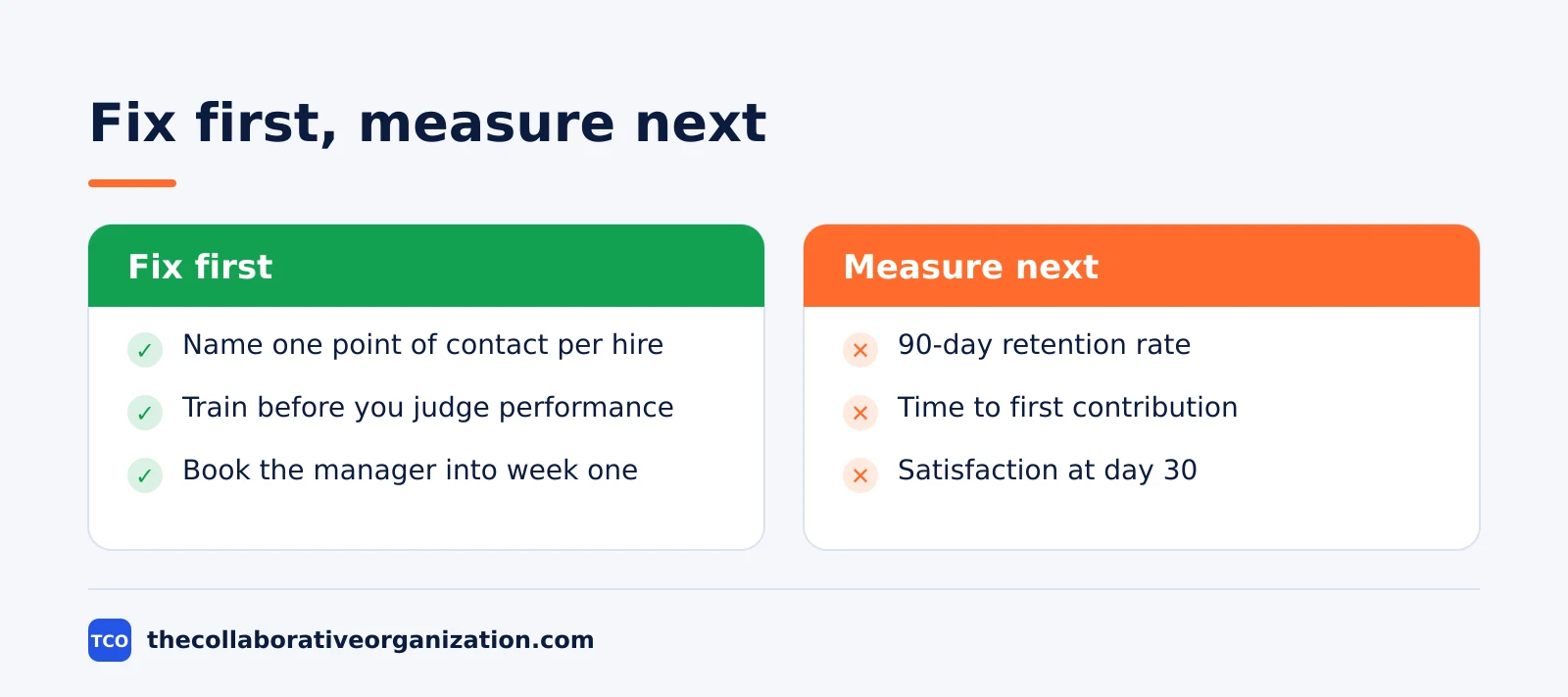
The fix costs less than the exits. Name one point of contact for each hire, book the manager into week one, and train before judging performance. A buddy who meets the new hire 8 times or more is the cheapest retention tool in the table. Measure 90-day retention before and after.
Common onboarding statistics mistakes to avoid
Most onboarding statistics pages mislead in the same five ways, and each one is easy to spot.
- Quoting the 82% retention figure as a fact. Brandon Hall Group’s 82% compares organisations, and the original study is not publicly available. Use it with the warning attached.
- Mixing samples without saying so. Gallup’s 12% comes from a national panel, while vendor surveys cover 905 to 1,565 self-selected workers. The numbers are not directly comparable.
- Using the old cost-per-hire figure. SHRM’s current average is $5,475 from 2025, not $4,700 from 2021 data.
- Reading satisfaction as success. In the 2025 TalentLMS and BambooHR survey, 73% were satisfied and 39% still had second thoughts. Both numbers are true at once.
- Treating the first 90 days as paperwork. The data puts the decision in the first month and the exits in the first quarter, so a one-week orientation cannot carry the whole job.
Our guide on how to build psychological safety in a team covers the belonging side of the same problem.
Our guide on high-performing team characteristics shows what good teams do once the hire stays.
For the team around the new hire, see our guide to Tuckman stages of team development.
And compare tools for keeping the new hire connected on our team communication software shortlist.
Sources
- Gallup - Why the Onboarding Experience Is Key for Retention (2018)
- BambooHR - 2023 Onboarding Statistics (2023)
- BambooHR - First Day Fog: Onboarding Benchmarking Report for 2025 (2025)
- Enboarder - Onboarding and Retention: New Hire Turnover Statistics (2025)
- Insight Global - How to Effectively Use Onboarding to Improve Engagement (2025)
- ATD - Onboarding: Getting It Right (2023)
- WorldatWork - Maximize the Potential of New Hires (2025)
- WorkInsiders - Cost Per Hire 2026 (2026)
- Doitify - Onboarding Statistics 2026 (2026)
- Archie - Employee Onboarding Statistics and Best Practices for 2026 (2026)
Frequently asked questions
What percentage of employees think onboarding is good?
Only 12% of employees strongly agree their organisation does a great job onboarding new employees, according to Gallup. The figure comes from Gallup's onboarding research, published in 2018 and updated in August 2026, and it has stayed low for years. Most companies run an onboarding process, but few new hires experience it as good.
How long does it take a new hire to become productive?
Gallup estimates it takes about 12 months for a new hire to reach full performance potential. Insight Global's 2025 survey found workers need 6 to 7 months on average just to feel settled in a role. Structured onboarding shortens the ramp: SHRM data puts time to full productivity at 4 to 6 months with a structured programme, against 8 to 12 months without one.
How many new hires leave in the first 90 days?
Insight Global's 2025 survey of 905 US workers found 22% had left a job within the first 90 days. Enboarder's 2025 survey of 1,000 HR leaders found 20.5% saying up to half of their new hires leave within 90 days, and 60.8% saying early attrition had risen in the past year. The first quarter is the highest-risk window.
How much does a bad hire cost?
SHRM's 2025 benchmarking puts the average direct cost per hire at $5,475 for a nonexecutive role and $35,879 for an executive role. That covers recruiting only. SHRM also estimates that replacing an employee costs six to nine months of that employee's salary once ramp time and lost output are counted. Enboarder's 2025 survey puts a failed hire at $25,000 to $50,000.
Does onboarding really affect retention?
Yes, and workers say so themselves. Insight Global's 2025 survey found 80% of workers would stay longer in a role with better onboarding. Gallup found employees with an exceptional onboarding experience are 2.6 times as likely to be extremely satisfied at work. The link runs through the manager, training and belonging in the first 90 days.
Related articles
team communication
Communication Plan for a Project: Template (2026)
A communication plan for a project names who gets which update, in which channel, how often, and from whom. Copy the template and the filled example below.
November 20, 2026 · 10 min read
team communication
How Often Should Managers Communicate With Teams? (2026)
Managers should hold one meaningful conversation with each person every week, plus a weekly team update. See the cadence table for meetings, updates and feedback.
November 20, 2026 · 9 min read
team communication
Upward Communication Examples: 10 That Work (2026)
Upward communication is a message that travels from an employee to a manager or leader. See 10 concrete examples, each with why it works and when to use it.
November 20, 2026 · 9 min read