Slack Statistics: 30 Stats on Usage and Users (2026) | The Collaborative Organization
By The Collaborative Organization Team · November 19, 2026 · Last verified November 19, 2026 · 9 min read
Slack users send 1 billion messages a day, and half of those messages now come from apps and agents rather than people. The figures come from Salesforce’s Slack statistics release of November 2026. The 30 statistics below cover scale, AI agents, daily AI use, tool sprawl and pricing, each with its source and year.
Key takeaways
- Slack users send 1 billion messages a day, per Salesforce in November 2026.
- Half of Slack messages now come from apps and agents, per Salesforce in 2026.
- Slack processes 127 million automated MCP tool calls a week, doubling each quarter.
- Daily AI users report 64% higher productivity, per Slack’s 2025 Workforce Index.
- Slack Pro costs $7.25 per user per month billed annually, as of November 2026.
How we chose these 30 statistics
We picked statistics from Slack’s own pages, Salesforce’s November 2026 statistics release, Slack’s 2025 Workforce Index and a Forrester study Slack commissioned in 2025. Each number below names its study and year, and the table at the end repeats all 30 with links. Vendor figures are self-reported, and we say so where it matters.
One gap to name up front: Slack no longer publishes a current daily user count. The last widely cited figure, 12 million daily users from 2019, is out of date, so this article uses messages per day and customer counts from Salesforce instead. Third-party daily-user estimates were left out.
Slack at scale: messages and customers
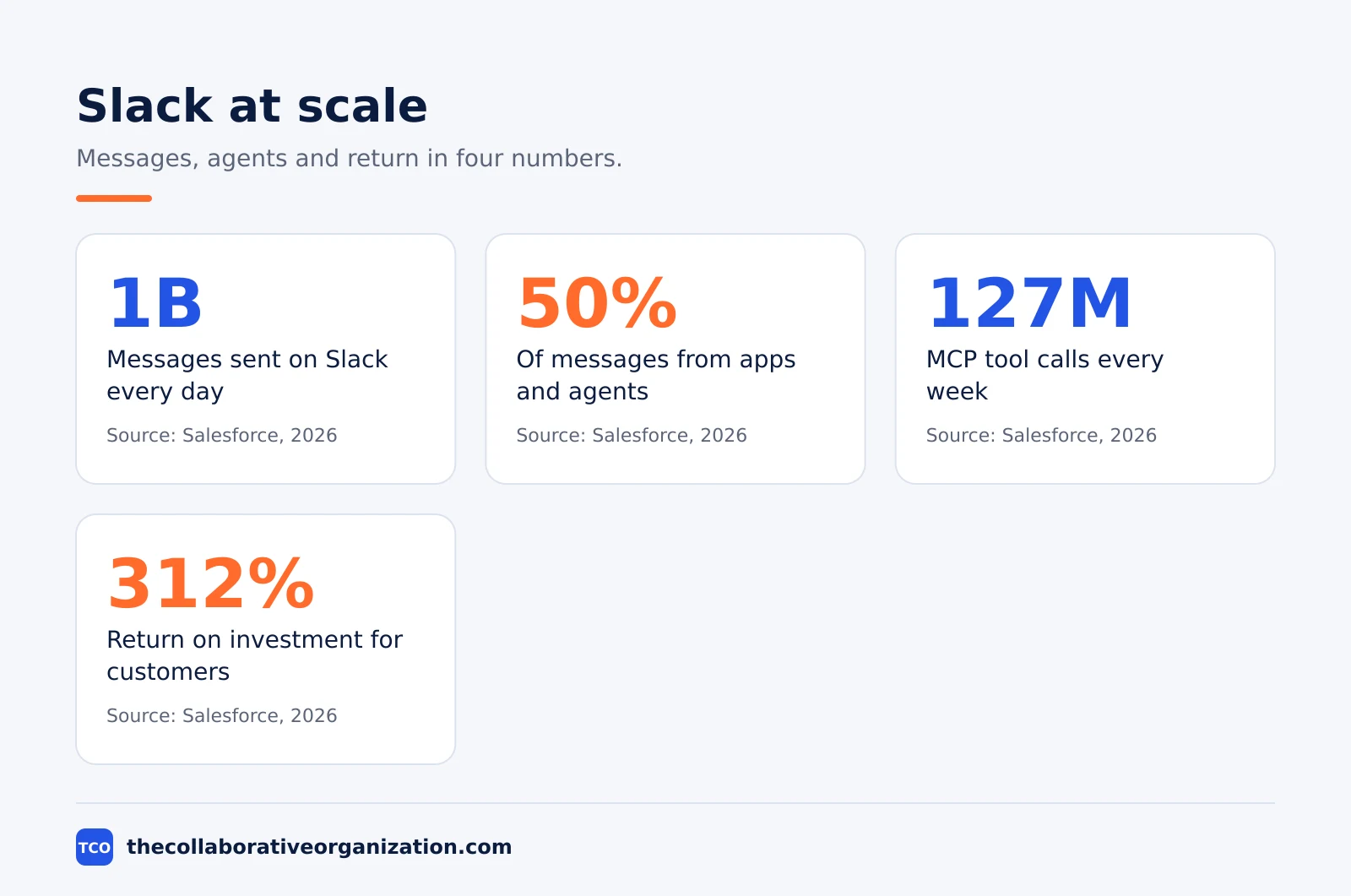
Slack users send 1 billion messages every day. Slack reported the figure in Salesforce’s November 2026 statistics release, six years after Slack joined Salesforce. The same release says more than 100,000 customers joined Slack so far in 2026, and Slack customers see 312% return on investment.
The scale shows inside Salesforce itself. Salesforce has 694,000 active Slack channels, and 83% of its employees are weekly active users of Slackbot. Nine in ten Salesforce sellers (90%) use Slackbot to update Salesforce, which is the kind of internal proof buyers ask for.
For scale, Microsoft counts 153 Teams messages per weekday for the average worker, against Slack’s 1 billion messages a day across the whole platform. The two figures count different things, so compare them as platform totals, not per-person use. Microsoft’s 2025 report gives the Teams figure, and our Slack vs email for teams guide covers when chat beats the inbox.
AI agents are now half the conversation
Half of all Slack messages now come from apps and agents, not people. Salesforce reported the 50% figure in November 2026, alongside 127 million MCP tool calls a week, a figure that doubles quarter over quarter. MCP is the open standard agents use to pull context from Slack and act on it.
People are meeting agents in Slack every week. Salesforce says 1.9 million users interact with third-party agents in Slack each week, and Slackbot is the fastest-adopted AI product in Salesforce history. Nine of 10 top frontier AI companies run their operations on Slack.
The AI world builds in Slack. At Anthropic, 65% of all code changes ship through Slack every day, and frontier AI company spending across Salesforce products grew 435% year over year. Vercel runs its entire company in Slack, and its staff search Slack more than 250,000 times a month.
AI at work: the Workforce Index
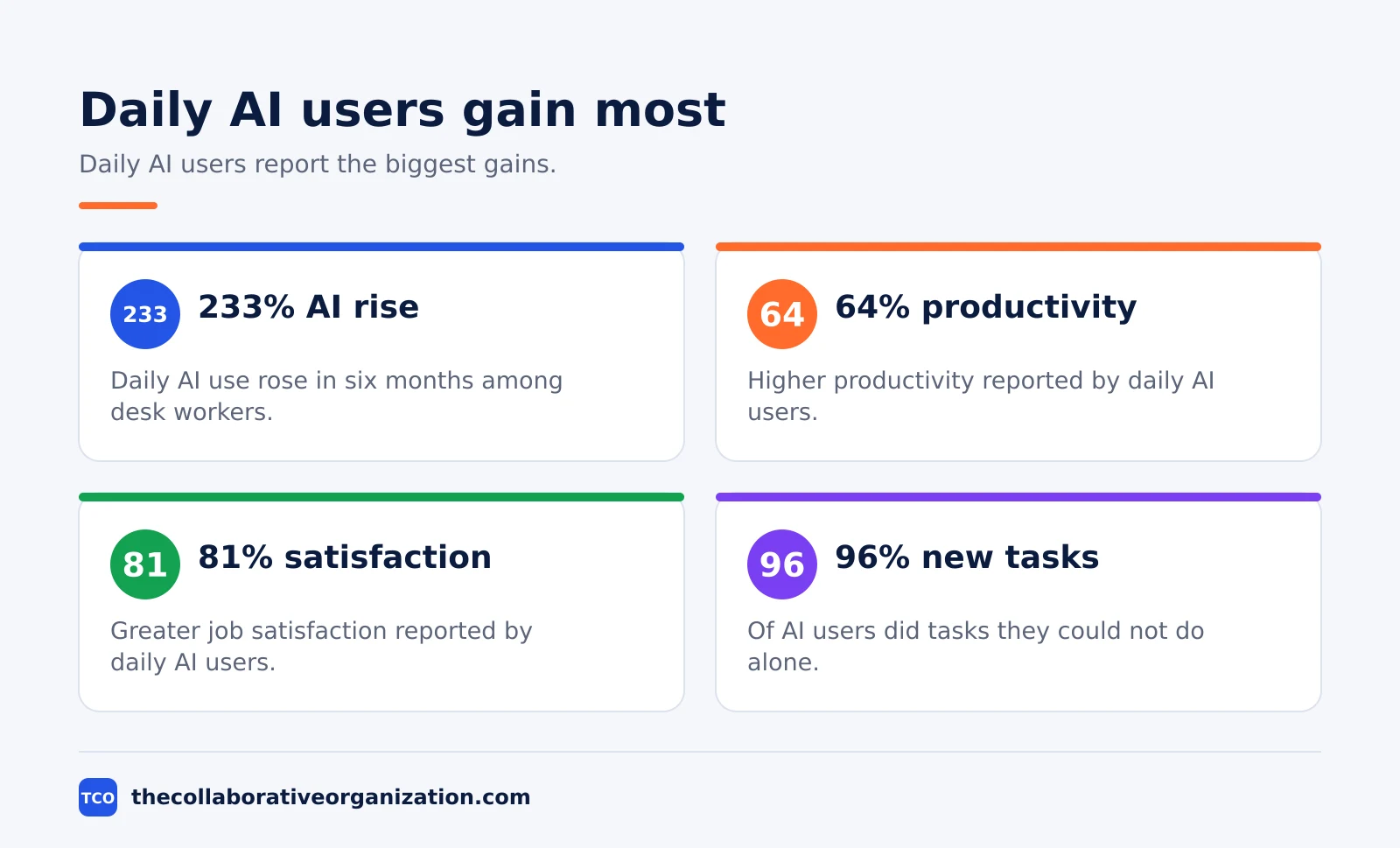
Daily AI use among desk workers rose 233% in six months. Slack’s 2025 Workforce Index surveyed 5,156 desk workers in April and May 2025, and found 60% now use AI, with 42% using it at least weekly. Daily users report 64% higher productivity, 58% better focus and 81% greater job satisfaction than colleagues who do not use AI.
The gains reach beyond output. Daily AI users also report a 62% higher sense of belonging at work, and they are more than twice as likely as less frequent users to say AI helps them feel connected to colleagues. The pattern is covered in our AI in the workplace statistics guide.
Access is uneven. Slack found 29% of desk workers say their company has issued no formal AI guidance, and 50% say AI use is not explicitly encouraged. Workers at companies that actively promote AI are nearly three times more likely to become daily users, and 40% of desk workers have already used an AI agent chatbot.
Most AI users stretch beyond their own skills. Slack found 96% of AI users have used AI for tasks they could not have done themselves, and 30% cite that as a top reason for higher productivity. Millennials lead daily use at 33%, ahead of Gen Z at 28%, while 43% of executives use AI daily against 10% of individual contributors.
Too many tools, not enough payoff
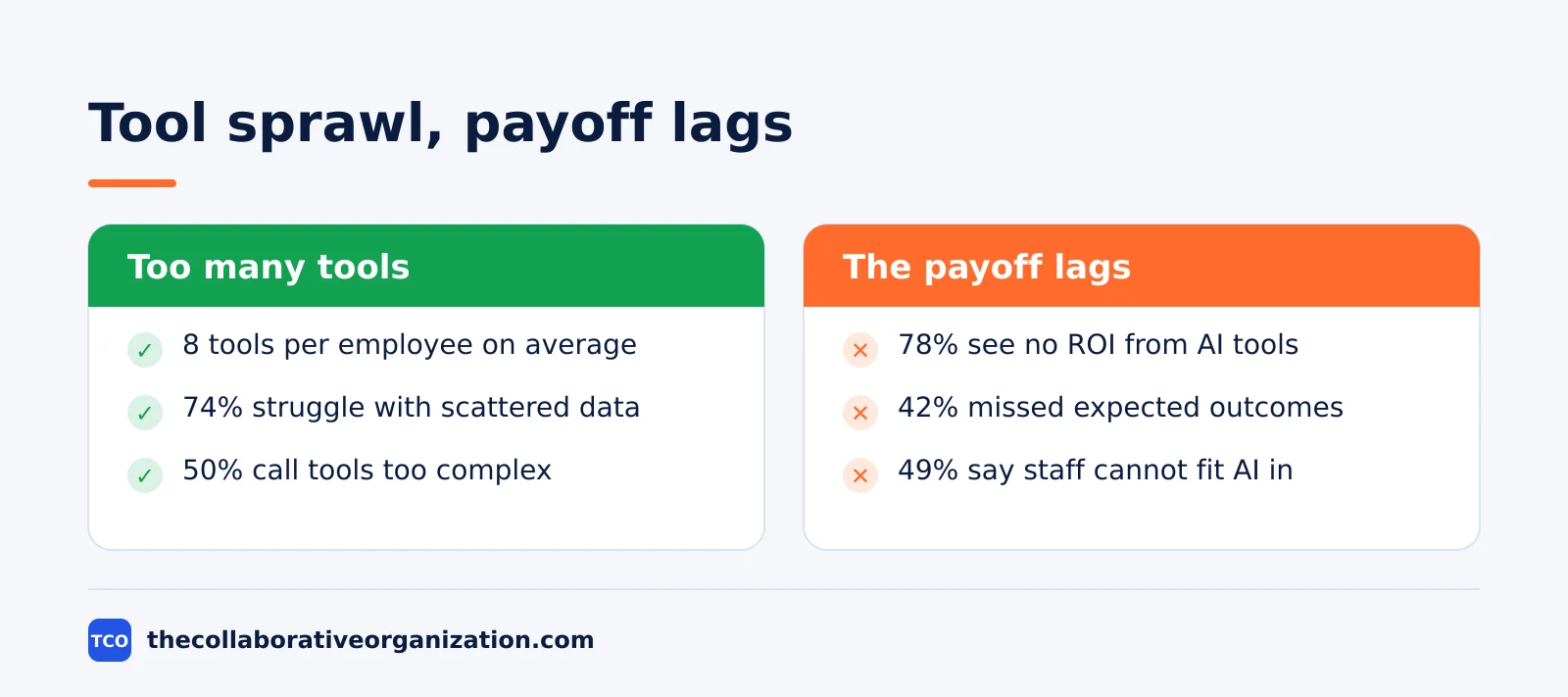
The average employee uses 8 different tools to do their job. A Forrester study commissioned by Slack surveyed 611 IT and technology decision-makers in March 2025, and found 74% struggle with decentralised data, 63% with inconsistent processes and 54% with repetitive work.
Half say the tools themselves are too complex. The same Forrester study found 50% of decision-makers call their tools too complex, and 78% struggle to see a real return on investment from generative AI tools. Our how to choose team communication software guide covers how to cut the stack before adding to it.
Demand for agents is high anyway. Forrester found 62% of decision-makers want AI agents in their tools, yet 42% have not fully achieved the outcomes they expected from generative AI tools so far. The gap between wanting agents and getting value from them is the story of this section.
What Slack costs in 2026
Slack Pro costs $7.25 per user per month billed annually, and Business+ costs $15. Slack’s own pricing page lists those rates, with $8.75 and $18 on monthly billing. Slack bills per active user, so you pay only for members who use the workspace. The rates below are as of November 2026.
The prices check out against independent reads. The Pricer confirmed Pro at $7.25 and Business+ at $15 in October 2026, and other November 2026 checks of Slack’s pricing page agree. Business+ rose from $12.50 to $15 in June 2025, when Slack AI was folded into the plan.
Compare before you buy. Our Slack vs Microsoft Teams comparison puts Slack’s price beside Teams Essentials at $4.00 per user per month. Enterprise+ is custom-quoted, so larger teams should ask sales for a price.
Moving is a project of its own. The migration guide covers moving a workspace from Slack to Teams, including what to do with channels and history.
The 30 Slack statistics in one table
The table below lists all 30 statistics with their source and year. Figures that describe a subgroup say so in the statistic itself.
| Statistic | Source | Year |
|---|---|---|
| 1 billion messages sent per day | Salesforce | 2026 |
| 100,000+ customers joined in 2026 | Salesforce | 2026 |
| 312% return on investment for customers | Salesforce | 2026 |
| 127 million MCP tool calls per week | Salesforce | 2026 |
| 50% of messages from apps and agents | Salesforce | 2026 |
| 1.9 million users use third-party agents weekly | Salesforce | 2026 |
| 9 of 10 top frontier AI companies run on Slack | Salesforce | 2026 |
| 65% of code changes at Anthropic ship through Slack | Salesforce | 2026 |
| 694,000 active Slack channels at Salesforce | Salesforce | 2026 |
| 83% of Salesforce employees weekly Slackbot users | Salesforce | 2026 |
| 90% of Salesforce sellers use Slackbot to update Salesforce | Salesforce | 2026 |
| 435% year-over-year spending growth by frontier AI companies | Salesforce | 2026 |
| Daily AI use up 233% in six months | Slack | 2025 |
| 60% of desk workers use AI; 42% weekly | Slack | 2025 |
| Daily AI users report 64% higher productivity | Slack | 2025 |
| Daily AI users report 81% greater job satisfaction | Slack | 2025 |
| Daily AI users report 58% better focus | Slack | 2025 |
| 40% have used an AI agent chatbot | Slack | 2025 |
| 23% have directed an agent to complete work | Slack | 2025 |
| 96% of AI users did tasks they could not do alone | Slack | 2025 |
| 61% of executives say companies implemented generative AI | Slack | 2025 |
| 52% of executives say companies implemented AI agents | Slack | 2025 |
| 33% of millennials use AI daily vs 28% of Gen Z | Slack | 2025 |
| 29% say company issued no formal AI guidance | Slack | 2025 |
| 50% say AI use is not explicitly encouraged | Slack | 2025 |
| Daily AI users report 62% higher sense of belonging | Slack | 2025 |
| 8 tools used by the average employee | Forrester | 2025 |
| 74% struggle with decentralised data | Forrester | 2025 |
| 78% struggle to see ROI from generative AI tools | Forrester | 2025 |
| 62% of decision-makers want AI agents in their tools | Forrester | 2025 |
What the numbers mean for your team
The numbers tell one story: Slack is no longer only a chat app, it is where agents do work beside people. Half the messages are automated, daily AI users report far higher productivity, and the platform keeps adding customers. The risk is the same as the opportunity: more tools, more agents and more messages.
Worked example: a 60-person team on Slack Pro
Take a 60-person team. At $7.25 per active user per month billed annually, Slack Pro costs $435 a month, or $5,220 a year, for 60 active users. The 312% return on investment that Salesforce reports would be worth about $16,286 a year on that spend. The arithmetic is an illustration from the published figures, not a promise.
Common Slack statistics mistakes to avoid
Most bad takes on these numbers come from the same five errors, and all five are easy to avoid.
- Quoting a daily user count for Slack. Slack no longer publishes one; the 12 million figure from 2019 is out of date, so use messages per day instead.
- Treating the 50% agent share as a problem. Half of messages come from apps and agents by design, and the share is rising as teams automate routine work.
- Reading 312% ROI as a guarantee. It is Salesforce’s reported average for Slack customers, not a promise for any single team.
- Using the old $12.50 Business+ price. Business+ rose to $15 in June 2025, when Slack AI was folded into the plan.
- Comparing Slack’s 1 billion messages with Teams’ 153 per worker. One is a platform total and the other is per person, so they answer different questions.
Sources
- Salesforce - Slack Stats 2026 (2026)
- Slack - The New AI Advantage (2025)
- Forrester - How Leaders Can Break Through The Employee Productivity Paradox (2025)
- Slack - Pricing (2026)
- The Pricer - How Much Does Slack Subscription Cost? (2026)
- Microsoft - Breaking down the infinite workday (2025)
Frequently asked questions
How many people use Slack each day?
Slack no longer publishes a current daily user count, so there is no official figure for 2026. Salesforce reported in November 2026 that users send 1 billion messages a day, and that more than 100,000 customers joined Slack so far in 2026.
How many messages are sent on Slack each day?
Users send 1 billion messages on Slack every day, according to Salesforce in November 2026. Half of those messages now come from apps and agents rather than people, and Slack processes 127 million automated MCP tool calls every week.
What is the return on investment for Slack?
Salesforce reports that Slack customers see 312% return on investment. That is a reported average across Slack customers, not a promise for any single team, and it will vary with how the team uses channels, workflows and agents.
How much does Slack cost?
Slack Pro costs $7.25 per user per month billed annually, or $8.75 billed monthly, and Business+ costs $15 billed annually, or $18 monthly, as of November 2026. Slack bills per active user, and Enterprise+ is custom-quoted.
Does Slack use AI?
Yes. Slackbot is the fastest-adopted AI product in Salesforce history, and 1.9 million users interact with third-party agents in Slack every week. Slack's 2025 Workforce Index found daily AI users report 64% higher productivity.
Related articles
guides
Free Project Management Templates: 7 to Copy (2026)
Seven free project management templates from monday, Wrike, Teamwork, Smartsheet, ClickUp, Asana and Trello, with what each one is for and what free really costs.
November 20, 2026 · 7 min read
guides
Project Proposal Template: Copy and Win Work (2026)
A project proposal template pitches the work before it is approved: problem, solution, scope, budget, timeline and terms. Copy the template and filled example.
November 20, 2026 · 10 min read
guides
Action Plan Template: Goal to Done in One Page (2026)
An action plan template turns one goal into owned steps with dates, dependencies and a success measure. Copy the table and see it filled for a support team.
November 20, 2026 · 11 min read