Shadow IT Risks: 7 Dangers, Costs and Fixes (2026) | The Collaborative Organization
By The Collaborative Organization Team · November 19, 2026 · Last verified November 19, 2026 · 8 min read
Shadow IT risks are the security, compliance, cost and operational dangers that come from technology IT cannot see. Every app, device or AI tool outside IT control can leak data, break a rule or drain a budget without anyone noticing. The risk is not the tool itself, it is the invisibility.
Key takeaways
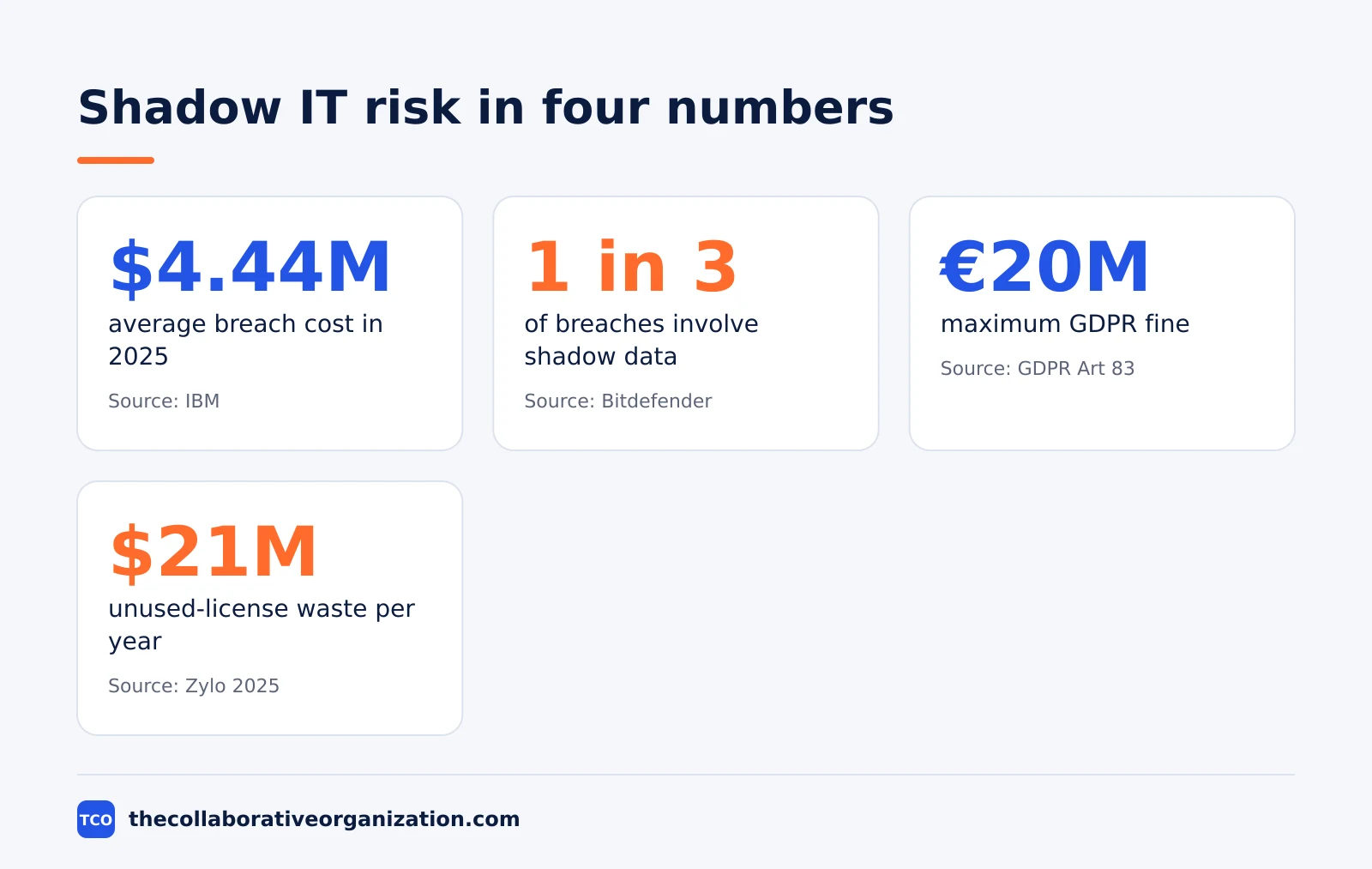
- The average data breach cost $4.44 million in 2025, and shadow AI added $670,000 to the bill (IBM).
- Roughly 1 in 3 breaches involves shadow data, and 37% of apps run outside single sign-on.
- GDPR fines reach 20 million euros or 4% of worldwide turnover for the worst breaches.
- Unused licenses waste about $21 million a year at the average company (Zylo, 2025).
- Shadow AI is the fastest-growing risk: 78% of AI users bring their own tools (Microsoft and LinkedIn, 2024).
What shadow IT risks are
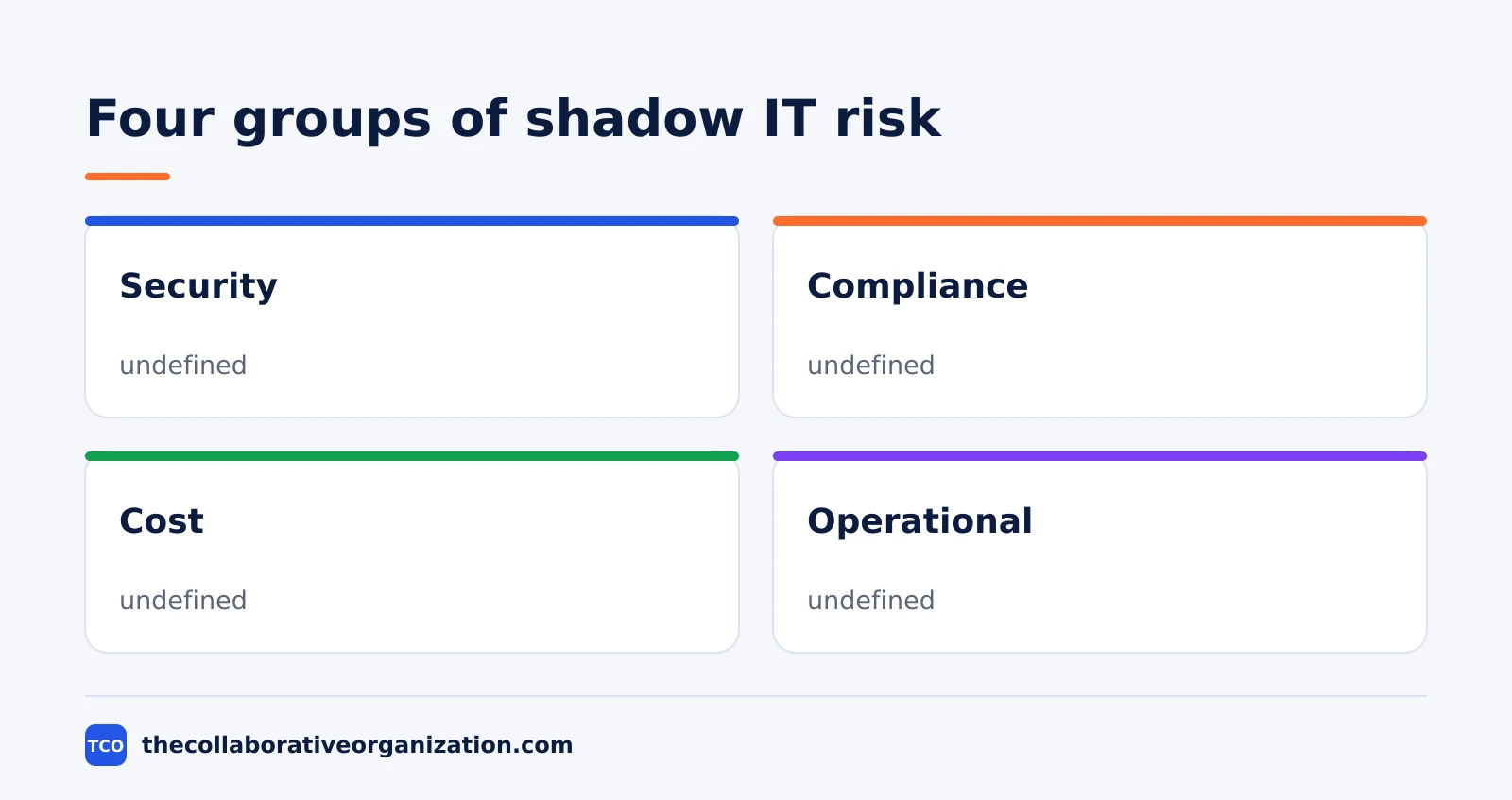
Shadow IT risks are the harms that follow when technology is used without IT oversight. They fall into four groups: security, compliance, cost and operational, and each one grows worse the longer the tool stays unseen.
The NCSC puts the core risk in one line: shadow IT can lead to data exfiltration or malware infection, because unseen tools are not covered by asset management or company IT policy.
The scale of the problem is in the numbers. Our guide to software adoption statistics shows how many apps the average company runs, and how few IT approves.
The 7 shadow IT risks
Shadow IT carries seven risks, and they rarely arrive one at a time. A single unseen app can leak data, break a rule and waste money at once.
| # | Risk | What happens | How bad |
|---|---|---|---|
| 1 | Data breach | An unseen app is attacked, and nobody patches it | High |
| 2 | Data loss and leaks | Files leave through personal accounts | High |
| 3 | Compliance failure | Data rules are broken, and fines follow | High |
| 4 | Wasted spend | Unused licenses and duplicate tools | Medium |
| 5 | Security gaps | No single sign-on, no patching, no monitoring | High |
| 6 | Operational risk | The only user leaves, and the data goes with them | Medium |
| 7 | Shadow AI | Company data is pasted into personal AI accounts | High |
Security gaps are the quietest risk. The gap is in the BetterCloud statistics page: Dashlane found in 2024 that 39% of employees use unmanaged apps and 37% of apps run without single sign-on, so a stolen password opens the door with no second check.
Operational risk shows up when people leave. Nudge Security surveyed 375 IT professionals and found 70% had experienced consequences of incomplete offboarding, such as an ex-employee keeping access to a tool IT never knew existed.
Data breaches and leaks
A data breach is the most expensive shadow IT risk, and the numbers keep rising. The average breach cost $4.44 million in 2025, down 9% from $4.88 million in 2024, while the US average hit a record $10.22 million. IBM published the figures in July 2025, based on a survey of 600 organizations.
Shadow AI makes a breach cost more. IBM found shadow AI a factor in 20% of breaches, adding $670,000 to the bill: organizations with high shadow AI paid $4.74 million on average, against $4.07 million for those with little or none. Breaches involving shadow AI also took 247 days to contain, against 241 days overall.
The scale is in Bitdefender’s summary: roughly 1 in 3 breaches involves shadow data, and shadow APIs account for 31% of malicious API traffic.
The 2026 Verizon Data Breach Investigations Report, summarized by Nudge Security, counted 22,000 or more confirmed breaches across 145 countries. Shadow AI was the third most common non-malicious insider action, up fourfold on the year before.
Breaches start with access, and access is what shadow IT hides. Our guide to how to evaluate SaaS software covers the security checks to run before a tool joins the approved stack.
Compliance fines and audit failure
Compliance is the risk that turns a shadow tool into a legal problem. Under GDPR Article 83, fines reach 20 million euros or 4% of total worldwide annual turnover, whichever is higher, for the worst breaches.
The trigger is usually data, not intent. When client files sit in a personal cloud folder, the company cannot prove where the data lives, who can see it, or how to delete it on request, and that gap is what auditors and regulators look for.
The 2026 BetterCloud survey of 525 IT and security professionals found 21% had discovered unsanctioned tools, 20% had seen sensitive data shared publicly, and 18% had suffered a breach from an offboarded user.
Governance is the missing piece. IBM found in 2025, in a survey of 600 organizations, that 63% lack AI governance policies, and only 37% have policies to manage AI and detect shadow AI.
Compliance improves when the inventory is complete. Our guide to change management for new software covers how to move teams onto approved tools without breaking their work.
Wasted spend and hidden costs
Shadow IT wastes money twice: once on tools nobody uses, and again on tools the company buys twice. Zylo puts unused-license waste at $21 million a year for the average company, up 14.2% on the year before, and 36% of licenses go unused.
The budget share is just as stark. BetterCloud lists IBM’s estimate that 24% of IT budgets is shadow IT, spend that finance never sees in a line item.
Companies overspend by 25% on SaaS without central visibility, according to Gartner, via BetterCloud, and the figure runs through 2028.
Waste is the easiest risk to measure, which makes it the easiest to fix first. Our guide to how to run a software trial covers how to test a tool before it joins the stack and the budget.
Shadow AI: the newest risk
Shadow AI is the fastest-growing shadow IT risk, because AI tools are one click away and company data is one paste away. Microsoft and LinkedIn found in 2024 that 75% of knowledge workers use AI at work, and 78% of those users bring their own tools.
The damage is in IBM’s 2025 numbers: 97% of AI-related breaches lacked proper AI access controls, and 65% of shadow AI breaches exposed customer personal data, against 53% of breaches overall. Another 40% involved theft of intellectual property. IBM published the figures in July 2025.
The 2026 Verizon report, summarized by Nudge Security, found 45% of employees are regular AI users on corporate devices, up from 15%, and 67% access AI through non-corporate accounts. Source code was the most uploaded data type.
AI tools need the same checks as any other tool, plus one more: where does the data go? Our guide to AI in the workplace statistics tracks how fast AI use is growing.
Shadow IT risks example: a 200-person company
A 200-person company shows how the seven risks add up, and the example below is an illustration, not a real company. The company spends $4,830 per employee a year on SaaS, or about $966,000 a year in total. A third of its apps are shadow IT, so about $322,000 of that spend sits outside IT approval.
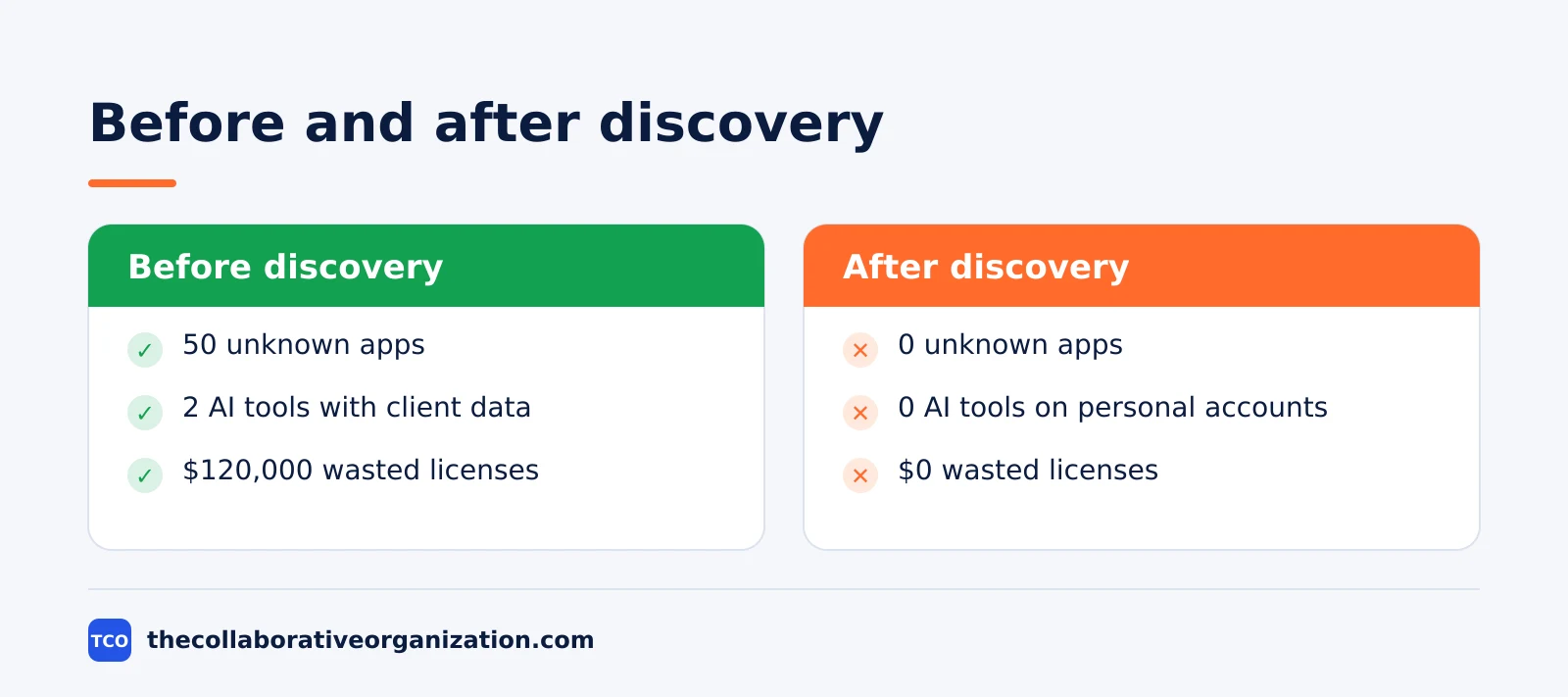
A discovery pass finds 50 more apps than IT knew about, including two AI tools holding client data. The company approves the useful ones, closes the rest, and cuts $120,000 of unused licenses. The shadow-AI breach premium of $670,000 is more than five times that saving, which is why the breach risk comes first.
| Risk | Before discovery | After |
|---|---|---|
| Unknown apps | 50 | 0 |
| Shadow AI tools with client data | 2 | 0 |
| Unused license spend | $120,000 | $0 |
| Breach premium at risk | $670,000 | Reduced |
The lesson is that the cheapest risk to fix is the waste, and the most expensive risk to ignore is the breach. Start with the breach risk, then fix the waste.
Common shadow IT risk mistakes to avoid
Most teams get shadow IT risk wrong in the same few ways, and all of them are easy to spot in a review. Run through the list before you write your next security policy.
- Treating shadow IT as a security problem only. The waste and the compliance fines arrive on their own schedule.
- Counting only the apps IT bought. The 44% of apps without IT approval never appear on that list.
- Ignoring AI tools. Shadow AI is the fastest-growing risk, and it carries company data out through personal accounts.
- Running discovery once. Portfolios grow about 34% a year, so a one-off scan goes stale within months.
- Banning tools without offering a replacement. People go around a ban the same week it lands.
Start with discovery, fix the breach risk first, and repeat the count. A list that is current and owned beats a ban that nobody follows.
Sources
- NCSC - Shadow IT guidance (2023)
- Bitdefender - What is Shadow IT (2026)
- IBM - IBM Report: 13% of Organizations Reported Breaches of AI Models or Applications (2025)
- Nudge Security - What the 2026 DBIR Reveals About Risks from Shadow AI and SaaS Sprawl (2026)
- Nudge Security - Cutting SaaS Sprawl: Here Are the 5 Things You Should Do First (2026)
- BetterCloud - The 2026 State of SaaS Report (2026)
- BetterCloud - SaaS Statistics (2026)
- GDPR - Article 83 GDPR - General Conditions for Imposing Administrative Fines (2018)
- Zylo - Zylo’s 2025 SaaS Management Index (2025)
- Microsoft and LinkedIn - Microsoft and LinkedIn release the 2024 Work Trend Index (2024)
Frequently asked questions
What is the biggest shadow IT risk?
A data breach is the biggest shadow IT risk, because unseen apps are not patched or monitored. The average breach cost $4.44 million in 2025, and shadow AI added $670,000 to the bill, according to IBM. Roughly 1 in 3 breaches involves shadow data, so the risk is not theoretical.
Can shadow IT get a company fined?
Yes. Under GDPR Article 83, fines reach 20 million euros or 4% of total worldwide annual turnover for the worst breaches. When client files sit in a personal cloud folder, the company cannot prove where the data lives, who can see it, or how to delete it on request, and that gap is what regulators look for.
How much money does shadow IT waste?
Unused licenses waste about $21 million a year at the average company, according to Zylo in 2025, and 36% of licenses go unused. Companies also overspend by 25% on SaaS without central visibility, according to Gartner, and 24% of IT budgets is shadow IT, according to IBM.
What is shadow AI risk?
Shadow AI risk is the danger of company data leaving through AI tools used without approval, such as a chat assistant on a personal account. IBM found that 97% of AI-related breaches lacked proper AI access controls, and 78% of AI users bring their own tools to work, according to Microsoft and LinkedIn in 2024.
How do you reduce shadow IT risk?
Start with discovery: pull the payment trail and the login trail, then add browser and network data. Score each app for data access, security controls and cost. Bring the useful tools inside, close or replace the risky ones, and repeat the count every quarter, since portfolios grow about 34% a year.
Related articles

guides
Free Project Management Templates: 7 to Copy (2026)
Seven free project management templates from monday, Wrike, Teamwork, Smartsheet, ClickUp, Asana and Trello, with what each one is for and what free really costs.
November 20, 2026 · 7 min read

guides
Project Proposal Template: Copy and Win Work (2026)
A project proposal template pitches the work before it is approved: problem, solution, scope, budget, timeline and terms. Copy the template and filled example.
November 20, 2026 · 10 min read

guides
Action Plan Template: Goal to Done in One Page (2026)
An action plan template turns one goal into owned steps with dates, dependencies and a success measure. Copy the table and see it filled for a support team.
November 20, 2026 · 11 min read