Change Management for New Software: A Practical Guide (2026) | The Collaborative Organization
By The Collaborative Organization Team · November 19, 2026 · Last verified November 19, 2026 · 11 min read
Change management for new software is the plan for the people side of the switch: who changes what they do, when, and with what help. The install is the easy part. The change succeeds when each person reaches five milestones, the team follows a clear sequence, and the new way of working is still in place three months later.
Key takeaways
- Change management is the people side of a software switch: communication, training, pilots, champions and reinforcement.
- ADKAR tracks five milestones per person: Awareness, Desire, Knowledge, Ability and Reinforcement, in that order.
- Kotter’s 8 steps run the change at organization level, from creating urgency to anchoring the new way in culture.
- Prosci’s research finds initiatives with excellent change management are six times more likely to meet their objectives.
- Measure at the workflow level for at least three months after go-live: completion, usage depth, tickets and outcomes.
What change management for new software actually is
Change management for new software is a structured process for leading the people side of the switch so the team adopts the tool and uses it well. It prepares people, equips them with skills, and supports them while the new way of working becomes normal. The technical install and the people change are two halves of one project.
The work falls into three phases. First, prepare the approach: define the change, assess who it affects, and build the plan. Second, manage the change: communicate, train, run the pilot and support the rollout.
Third, sustain the outcomes: measure adoption, fix gaps, and reinforce the new habits. Those three phases are the Prosci 3-Phase Process: Prepare Approach, Manage Change, Sustain Outcomes.
Change management is not the same as project management. A project can deliver on time and still fail because nobody uses what it built, and that gap is exactly what this guide closes.
In agile teams the same idea applies at a smaller scale. Our guide to what is agile project management shows how change arrives in small steps instead of one big switch.
The ADKAR model: five milestones per person
ADKAR says an organization changes only when its people do, one person at a time, and it names the five outcomes each person must reach. The model comes from Prosci, founded in 1994 by Jeff Hiatt, who developed ADKAR in 1996, first published it in a white paper in 1999, and released the first book on it in 2006.
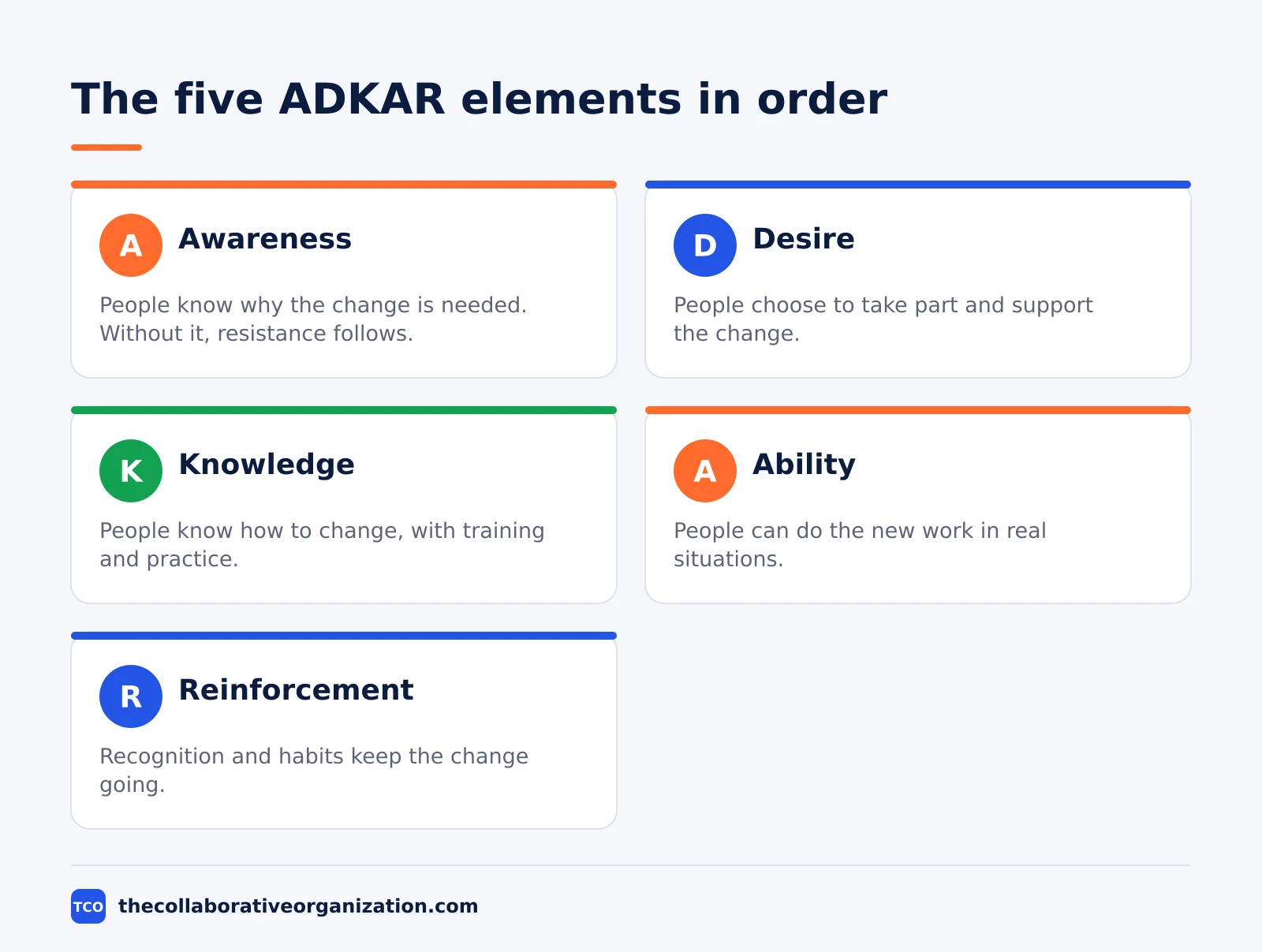
| Element | What it means | What to do when it is missing |
|---|---|---|
| Awareness | People know why the change is needed | Share the reason, the cost of standing still, and the risks |
| Desire | People choose to take part | Address personal motivators and what is in it for them |
| Knowledge | People know how to change | Train, coach on the job, and provide quick guides |
| Ability | People can do it in real work | Give practice time, remove barriers, coach strugglers |
| Reinforcement | The change is kept going | Recognize use, measure adoption, fix backsliding |
The elements are intentionally sequenced, so earlier ones must be reached before later ones can follow. Building Knowledge is ineffective if a person has no Awareness of the need for change or Desire to take part. Prosci’s benchmarking finds that a lack of Awareness is the greatest source of resistance for employees and managers alike.
ADKAR is a model for individual change, not a complete change management methodology. The full Prosci Methodology connects ADKAR with the processes and tools used to plan, manage and sustain organizational change. That distinction comes from Prosci’s own ADKAR page, updated in April 2025.
Kotter’s 8 steps: the organization-level plan
Kotter’s 8 steps give the organization-level sequence, from creating urgency to anchoring the new way in culture. John Kotter, a Harvard Business School professor, introduced the model in his 1995 Harvard Business Review article on why transformation efforts fail and expanded it in his 1996 book Leading Change, after studying more than 100 companies.
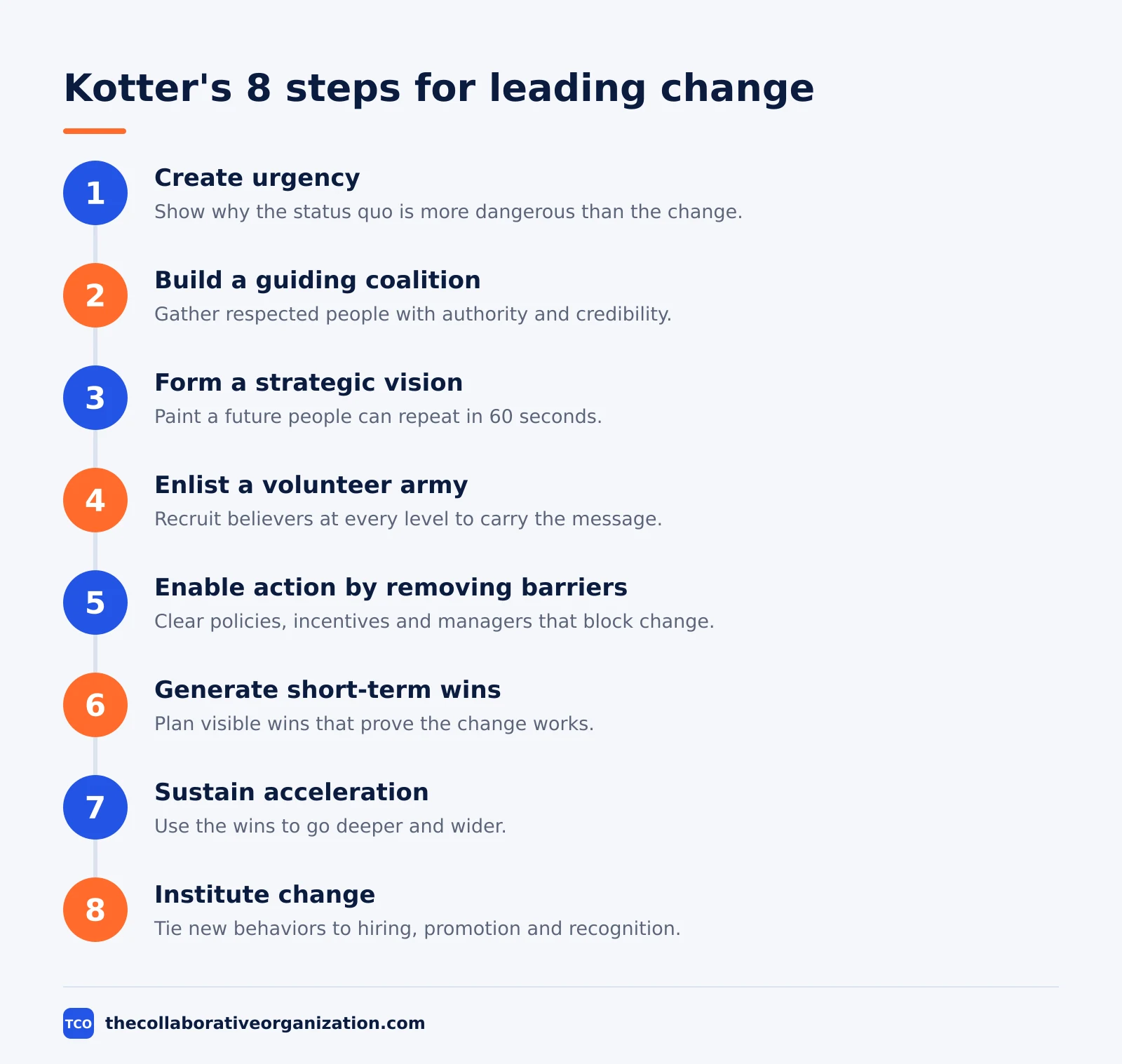
| Step | Name | What it does |
|---|---|---|
| 1 | Create urgency | Show why the status quo is more dangerous than the change |
| 2 | Build a guiding coalition | Gather respected people with authority and credibility |
| 3 | Form a strategic vision | Paint a future people can repeat in 60 seconds |
| 4 | Enlist a volunteer army | Recruit believers at every level to carry the message |
| 5 | Enable action by removing barriers | Clear policies, incentives and managers that block change |
| 6 | Generate short-term wins | Plan visible wins that prove the change works |
| 7 | Sustain acceleration | Use the wins to go deeper and wider, not to declare victory |
| 8 | Institute change | Tie the new behaviors to hiring, promotion and recognition |
The steps are sequential, and skipping one risks the whole effort. Kotter updated the model in 2014 to stress that the steps are iterative rather than a straight line. The step names and the 2014 update come from the Kotter 8-step guide.
The 70% figure needs care. It is often cited that 70% of major change efforts fail, traced to Kotter’s 1995 article and a 2013 McKinsey survey. Analysts note the figure’s basis is thin: the 1995 article did not actually cite 70%.
No source gives a firm method behind the number, so treat it as a warning that change is hard, not as a measurement. That caution comes from the Testlify change management glossary.
ADKAR or Kotter: which one fits your rollout
Use ADKAR to diagnose people and Kotter to run the organization, because the two models answer different questions. Kotter gives the organizational playbook, while ADKAR tells you what is happening inside each person at each stage, and many practitioners use both in parallel.
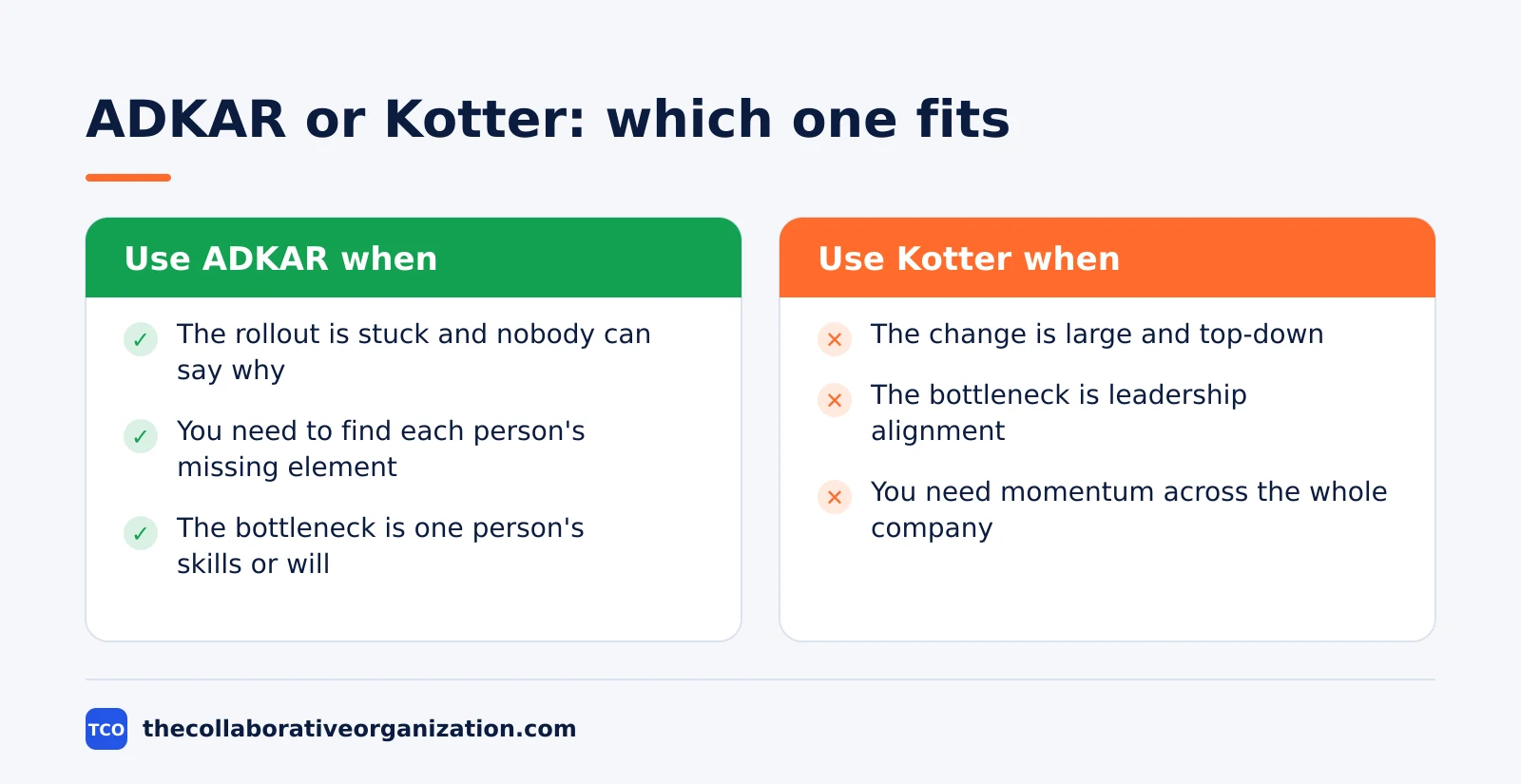
ADKAR fits when the rollout is stuck and nobody can say why. Rate each person on the five elements, find the first one that is missing, and fix that one before anything later in the sequence. Kotter fits when the change is large and top-down, and the bottleneck is leadership alignment and momentum rather than one person’s skills.
The payoff for planning the people side is large. Prosci’s correlation data shows that initiatives with excellent change management are six times more likely to meet objectives than those with poor change management. The figure comes from the WalkMe guide to Prosci, which summarizes Prosci’s Best Practices research.
How to build a change plan in 6 steps
A change plan names the future state, the people it affects, and the help each group gets, in that order. Keep it on one page if you can: a plan nobody reads is worse than no plan at all.
- Define the future state. Write what people will do differently, and by when. A launch date says when the system is ready; it says nothing about when the people are.
- Assess impact and readiness. List the groups affected, what changes for each, and how ready they are. Map owners with a RACI matrix so every task has one Accountable owner.
- Build the coalition and the champions. Recruit a guiding coalition with authority and credibility, then name champions in each team to answer questions and coach peers.
- Communicate in waves. Start 4 to 6 weeks before go-live with the reason and the plan, send training invitations 2 to 3 weeks before, update daily in launch week, and reinforce weekly for 12 weeks.
- Train by role and pilot first. Train each role on the tasks they will use, then pilot with 5 to 10 percent of users and fix what the pilot finds before the wider rollout.
- Measure and reinforce. Review completion rates, usage depth, support trends and workflow speed at 30, 60 and 90 days, and keep the change team active until the numbers hold.
Worked example: a 200-person firm moves to a new CRM
Imagine a 200-person services firm replacing three separate tools with one CRM, and picture how the change plan runs. This example is an illustration, not a case study, and the numbers are made up to show the method.
The change starts with urgency: the CEO shows that follow-ups fall through the cracks between three tools, and two deals were lost last quarter for that reason. A guiding coalition forms with the VP of Sales, the head of revenue operations, a respected senior rep, the IT director and the marketing lead.
Thirty reps across three regions pilot the CRM first. They get early access, extra training and a direct line to the project team. The pilot finds two barriers: the old expense process duplicates CRM fields, and some regional managers still tell reps to keep the old spreadsheets just in case. Both are fixed before the wider rollout.
After 60 days, the pilot team reports a 20% drop in time spent on data entry and a 15% rise in follow-up completion. The results go to the whole company with names attached.
In month three, the rollout expands to the full sales team, and CRM skill joins the hiring scorecard. Twelve months in, the average sales cycle is shorter, and the change holds because it is built into how the firm hires, measures and talks about good work.
Tools that support the change
A project tool holds the change plan, the training tasks and the adoption numbers in one place, so the change team works from one list. Compare the options on our project management software shortlist before you pick, and keep the plan where the team already works.
| Tool | Best for | Free plan | Starting price (as of November 2026) | Notable limit |
|---|---|---|---|---|
| Asana | Change plans with owners, dates and training tasks | Free for 2 people | $10.99 per user per month (Starter), billed annually | Free plan covers 2 people |
| monday.com | Visual boards for rollout waves and adoption | Free plan for up to 2 seats | $9 per seat per month (Basic), billed annually | Paid plans need at least 3 seats |
The Asana price comes from Asana pricing: the Personal plan is free for 2 users, and Starter is $10.99 per user per month when billed annually.
The monday.com price comes from monday.com pricing: Basic is $9 per seat per month billed annually, with a 3-seat minimum.
Common change management mistakes to avoid
Most software changes fail in the same ways, and all of them are decided before go-live. Check this list while the plan is still a draft.
- Announcing the tool before the reason. People cannot support a change they do not understand, and a launch email is not a reason.
- Training before Awareness and Desire. Training people who are not yet convinced wastes everyone’s time and breeds resentment.
- Declaring victory after the first win. Early wins are proof, not the finish line, and the change fades when leadership attention moves on.
- Disbanding the change team on go-live day. Keep the team active for three months, meeting monthly and tracking leading indicators, not just lagging ones.
- Rewarding the old behaviors. If reviews and bonuses still reward the old way of working, no amount of training will change what people do.
- Measuring logins instead of work. A login says someone opened the tool; completion rates and workflow speed say whether the change happened.
The wider context makes the case urgent. In McKinsey’s 2026 global survey, nearly nine in ten respondents report regular use of AI in at least one business function, and 44% report AI scaling across the enterprise, up from 38% a year ago. The figures come from McKinsey’s State of AI survey.
How to measure whether the change stuck
Measure at the workflow level, not at the login screen, and keep measuring for three months. A login tells you someone opened the application; it does not tell you whether they completed the task correctly, used the right feature, or abandoned the process halfway.
Review completion rates, usage depth, support trends, workflow speed and business outcomes at the workflow level. That measurement list comes from WalkMe’s adoption research, which warns that measuring only logins or active users misses the workflows where value is actually lost.
Set the baseline before launch, then review at 30, 60 and 90 days. If one department lags, assign a champion to run targeted coaching there.
If tickets spike around one feature, update the training video and send a reminder. If the numbers hold for three months and the old way stays unused, the change has stuck. If they slip, the reinforcement step was skipped, and it is time to go back to it.
Sources
- Prosci - The Prosci ADKAR Model: Why it Works (2025)
- Prosci - ADKAR: Core to the People Side of Change (2025)
- WalkMe - What Is Prosci Change Management? ADKAR Model Explained (2026)
- Rework - Kotter’s 8-Step Change Model Explained (With Examples) (2026)
- Testlify - Change Management Glossary (2026)
- WalkMe - Software Adoption ROI: Improve Returns (2026)
- McKinsey - The State of AI: Global Survey 2026 (2026)
- UnifyStreams - Change Management Plan for Company-Wide Collaboration Tools Rollout (2026)
Frequently asked questions
What is change management for new software?
It is the plan for the people side of a software switch: who changes what they do, when, and with what help. It covers communication, training, pilots, champions and reinforcement, and it runs next to the technical install. Without it, the software goes live and the team keeps working the old way.
Should we use ADKAR or Kotter's 8 steps?
Use both: they answer different questions. ADKAR diagnoses what each person is missing, from Awareness to Reinforcement, while Kotter's 8 steps run the organization-level change, from urgency to anchoring the new way in culture. Many practitioners use the two models in parallel on the same rollout.
Why do most software changes fail?
They fail on the people side, not on the technology. People resist when they do not know why the change is happening, when the new tool makes their day harder, or when training comes too late. The often-cited figure that 70% of change efforts fail is disputed, but the pattern behind it is consistent: ignored people, failed change.
How do you measure change management success?
Track completion rates, usage depth, support trends, workflow speed and business outcomes at the workflow level, and review them at 30, 60 and 90 days. Success means people complete real tasks in the new tool without workarounds, tickets fall week by week, and the old way of working stays unused.
How long should change management run after go-live?
At least three months. Run weekly office hours in the first month, refresher training at 30 and 90 days, and monthly reviews of adoption numbers. Reinforcement is the step that keeps the change alive after launch attention moves on, so do not disband the change team on go-live day.
Related articles
guides
Free Project Management Templates: 7 to Copy (2026)
Seven free project management templates from monday, Wrike, Teamwork, Smartsheet, ClickUp, Asana and Trello, with what each one is for and what free really costs.
November 20, 2026 · 7 min read
guides
Project Proposal Template: Copy and Win Work (2026)
A project proposal template pitches the work before it is approved: problem, solution, scope, budget, timeline and terms. Copy the template and filled example.
November 20, 2026 · 10 min read
guides
Action Plan Template: Goal to Done in One Page (2026)
An action plan template turns one goal into owned steps with dates, dependencies and a success measure. Copy the table and see it filled for a support team.
November 20, 2026 · 11 min read