Program Management vs Project Management (2026) | The Collaborative Organization
By The Collaborative Organization Team · November 19, 2026 · Last verified November 19, 2026 · 10 min read
Program management coordinates a group of related projects to deliver shared benefits, while project management delivers one defined outcome on scope, time and budget. A project ends when its deliverable ships. A program ends when the benefits it promised are real and measured. The two roles share tools and language, but they answer different questions and succeed by different measures.
Key takeaways
- A project is a temporary effort that creates one defined outcome, while a program is a group of related projects run together to gain benefits none could gain alone.
- PMI puts it simply: projects deliver outputs, programs deliver benefits, and portfolios deliver strategy.
- A project manager controls scope, schedule and budget for one effort, while a program manager aligns several projects, their shared resources and their dependencies.
- Programs last longer, cross more teams and change more often than the projects inside them.
- PMI’s PgMP credential needs 6,000 hours of project management and 10,500 hours of program management experience with a secondary degree, as of November 2026.
What is program management?
Program management is the coordinated management of related projects and program work to obtain benefits that managing them one by one would not obtain. That is the definition in the Standard for Program Management, now in its fifth edition from 2024. The two words that carry the definition are related and benefits: the projects must be connected by a shared benefit that only coordination can gain.
Planview adds that effective program management gives a way to control the strategic, financial and operational risks of major efforts. A program is the translation of strategic aims into measured business outcomes, plus the integration of the many related efforts needed to reach them.
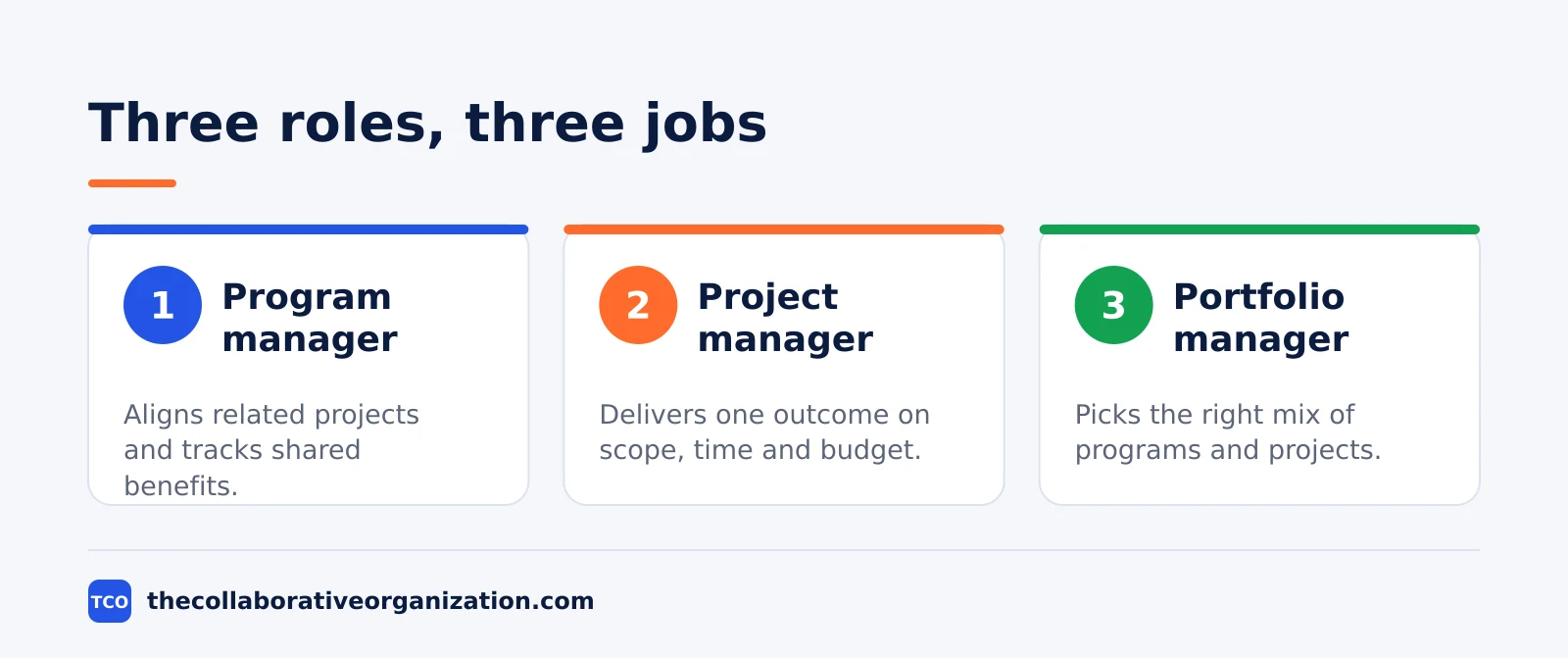
A program manager does not run the daily work of each project. The role covers prioritizing and budgeting the work, setting a cross-team roadmap, freeing shared resources when needed, managing links between projects, and checking program-level goals. Program managers often report to an enterprise PMO or a line of business, and their work spans departments.
What is project management?
Project management is the use of knowledge, skills, tools and techniques on project work to meet the intended value of one defined effort. The eighth edition of the PMBOK Guide defines a project as “a temporary initiative in a unique context undertaken to create value.” Temporary is the key word: a project has a start, an end, and a defined scope.
A project manager owns the daily work: scoping the effort, scheduling tasks, approving changes, managing the budget and the people, watching risks, and reporting status against milestones. Success is concrete: the outcome ships, on scope, on time and on budget. Our guide on project management vs task management draws the line between running a project and running a task list.
Projects vary widely in size, and size alone never turns one into a program. A year-long project with 40 people and one outcome is still a project. It becomes part of a program only when it is grouped with related projects to gain a benefit the projects cannot gain apart.
Program management vs project management: the side-by-side table
The core difference is the unit of success: a project is judged on its output, a program on the benefit its projects create together. Everything else follows from that one line: the time horizon, the audience, the way change is handled, and the way success is measured.
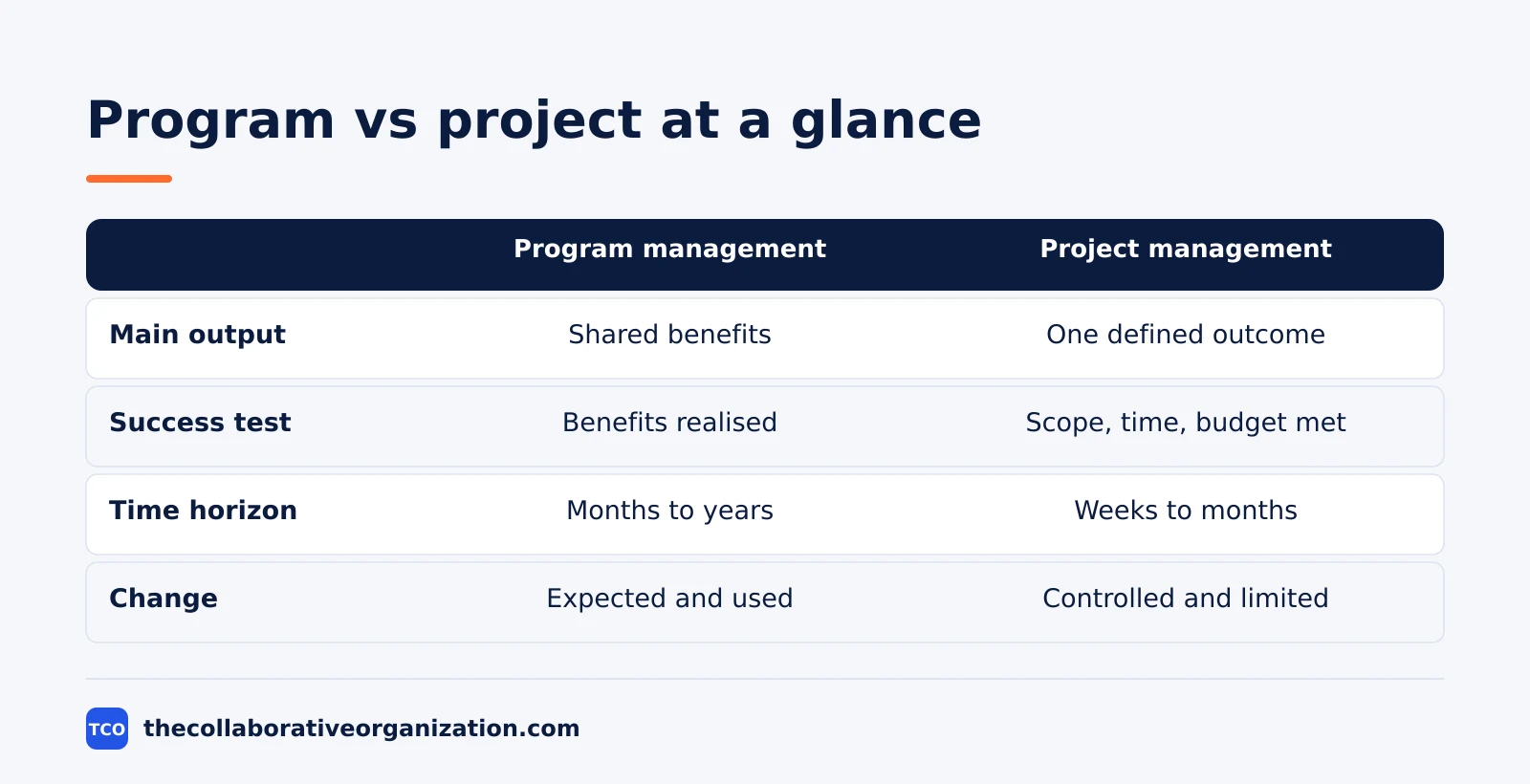
| Aspect | Program management | Project management |
|---|---|---|
| Main output | Shared benefits across projects | One defined outcome |
| Success test | Benefits realised and measured | Scope, time and budget met |
| Time horizon | Months to years | Weeks to months |
| Scope | Several related projects | One project |
| Change | Expected and used | Controlled and limited |
| Main question | Are we gaining the benefit? | Are we building it right? |
| Reports to | Executives and sponsors | Program manager or sponsor |
A project manager tries to control change, because uncontrolled change threatens scope, schedule and budget. A program manager expects change and uses it, adjusting the component projects as needed to protect the benefits. That is why programs fit work that must adapt as conditions shift, while projects fit work with a fixed target.
Program manager vs project manager
A program manager works across projects, while a project manager works inside one project. The program manager keeps communication flowing between project managers, steps in where projects depend on each other, and makes sure the right work moves between the right projects at the right time. The project manager runs the day-to-day work that brings one outcome to life.
The skills differ in the same way. A project manager needs scheduling, budgeting, risk tracking and team leadership for a single effort. A program manager needs those too, plus governance, stakeholder management across departments, and benefits tracking. PMTraining notes that programs drive large organisational change and are not merely large projects.
Certification marks the gap. PMI’s Program Management Professional (PgMP) is the credential for this work, and the bar is high: with a secondary degree, PMI asks for 6,000 hours of project management and 10,500 hours of program management, as of November 2026. The fee is $800 for members and $1,000 for non-members, as of November 2026.
The credential is rare: fewer than 3,000 people worldwide hold it, which makes it one of the rarest PMI awards. That scarcity is the point. A PgMP holder has already run programs, not only studied them, so the credential signals experience that a course alone cannot give.
Which one should you choose?
Choose a program when several related projects share one goal, and choose a project when the work is one outcome with a clear end. The test is not size or budget. It is whether the work gains anything from coordination that it would lose if the projects ran apart.
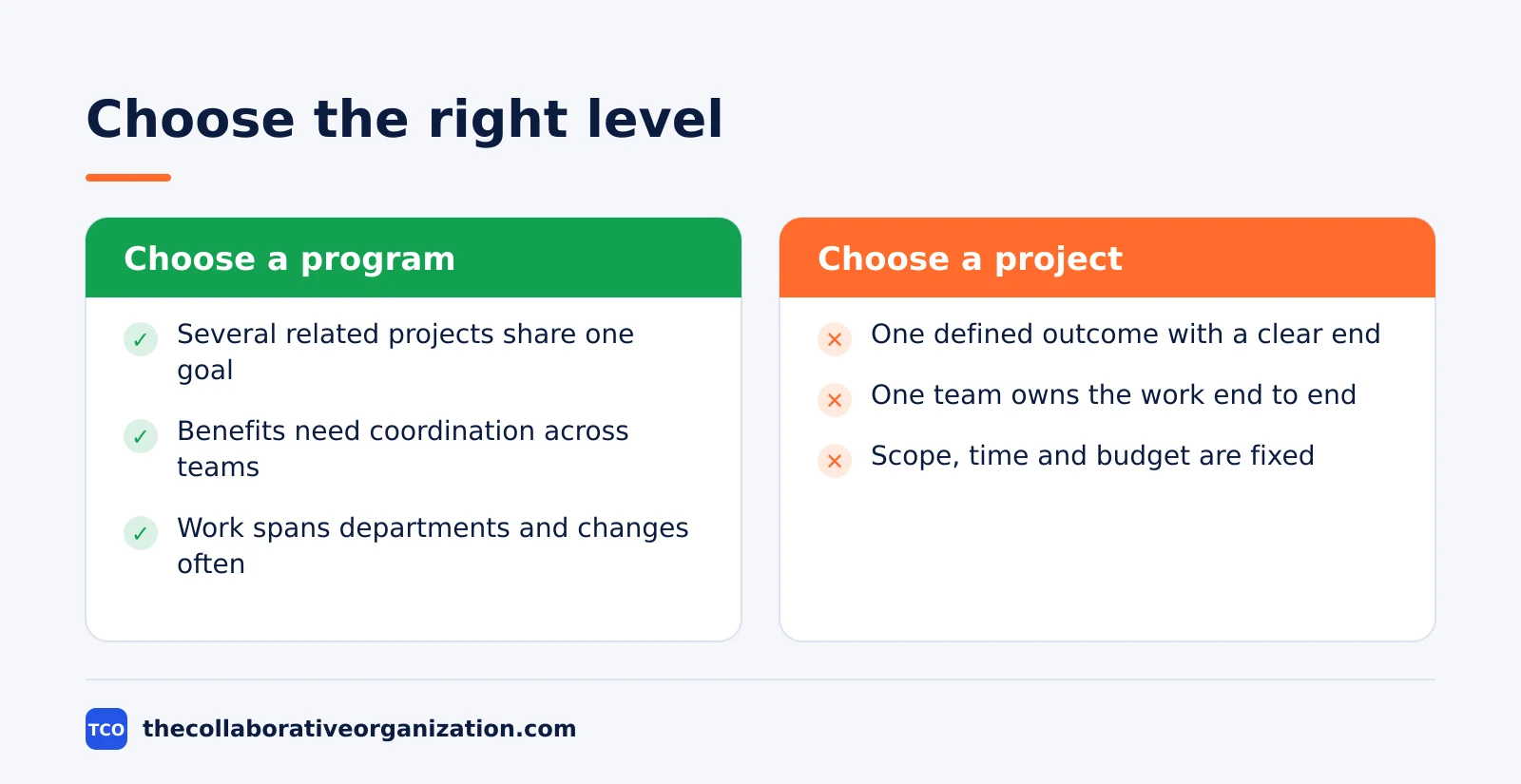
Choose a program if three or more projects depend on each other, share the same people or budget, or must land together for the benefit to count. A product launch that needs a new website, a new billing system and a new support process is a program: each project alone delivers little, and together they deliver a working launch.
Choose a project if one team can own the work end to end, the scope is fixed, and the end date is clear. Adding a program layer there only adds meetings and reports.
A common middle case is a company that runs many projects at once with no shared goal. That is a portfolio, not a program. Grouping unrelated projects under a “program” label gains nothing, because there is no shared benefit to coordinate. Our guide to how to choose project management software covers the tools that fit each level.
Can a project become a program?
Yes, a project grows into a program when related projects appear around it and a shared benefit needs coordination. The shift usually happens in the middle of the work, not at the start. A team builds a new checkout, then a second project starts to rebuild billing, then a third to rebuild support tooling, and suddenly the three need one roadmap and one set of shared decisions.
The signal is dependency. When a delay in one project starts to move the dates of others, or when two projects fight over the same people, the work has outgrown project management. The benefit only arrives if all of them land together.
At that point, name a program manager, write down the shared benefit, and give the program its own governance. Without that step, each project manager optimises their own dates and the shared benefit slips.
The reverse also happens: a program closes when its benefits are delivered, and its remaining projects continue as standalone efforts. A program is temporary, just like a project. It ends when the work is done and the benefits are in hand, not when the calendar runs out.
Worked example: a retailer launches online ordering in three countries
A retailer that wants online ordering in three countries is running a program, not a project. The shared benefit is one customer view across all three markets, with one checkout and one support process. No single project delivers that benefit on its own.
The program holds three projects. Project one rebuilds the website for three languages and three currencies, over 14 weeks. Project two connects the payment systems for each country, over 10 weeks, and it cannot finish until the website team fixes the checkout flow.
Project three trains the support team and writes the help pages, over 8 weeks, and it needs the payment rules before it can write accurate answers. One project manager could run any one of these, but only a program manager sees that a two-week slip in checkout moves the payment and training dates with it.
The program manager tracks the benefit, not only the dates: orders placed online in all three countries, with one support queue, within six months of launch. Each project still has its own scope, budget and dates, and each project manager still reports on those.
The program layer adds the shared roadmap, the shared resource plan, and the decision about what to cut when the three projects compete for the same developers.
Common program vs project management mistakes to avoid
Most confusion between programs and projects comes from five habits, and all five are easy to spot. Run through the list when a new effort starts.
- Calling a big project a program. A large project with one outcome is still a project. A program needs related projects and a shared benefit.
- Grouping unrelated projects as a program. Without a shared benefit, coordination adds cost and no value. That group is a portfolio.
- Measuring a program by project dates. Project dates matter, but a program succeeds when the benefit is real. Track both.
- Letting the program manager run the projects. The program manager aligns the projects. Each project still needs its own manager running the daily work.
- Skipping benefits tracking. If nobody writes down the benefit and checks it after launch, the program has no way to prove it worked. Name the benefit, the measure, and the date it will be checked.
Tools that support programs and projects
A tool that only tracks tasks fits a project, while a program needs portfolios, cross-project views and shared resource plans. The chart below shows three tools that cover both levels, with their starting prices as of November 2026.
| Tool | Best for | Free plan | Starting price (as of November 2026) | Notable limit |
|---|---|---|---|---|
| Asana | Teams that want portfolios over many projects | Free for 2 people | $10.99 per user per month, billed annually | Portfolios need the Advanced plan |
| monday.com | Teams that want a visual board per project | Free plan for up to 2 seats | $9 per seat per month (Basic), billed annually | Paid plans need at least 3 seats |
| ClickUp | Teams that want goals and Gantt views in one place | Free Forever plan | $9 per user per month (Core), billed annually | Yearly billing needed for that price |
The Asana price comes from Asana pricing: the Personal plan is free for 2 users, Starter is $10.99 per user per month when billed annually, and Advanced is $24.99.
The monday.com price is $9 per seat per month for Basic, billed annually, with a 3-seat minimum. The monday.com pricing page renders only FAQ text to our fetcher, so the $9 figure rests on corroboration from a 2026 pricing roundup and several November 2026 checks, as noted in our research notes.
The ClickUp price comes from ClickUp pricing: Core is $9 per user per month billed yearly, with a $12 regular price shown crossed out on the page.
Compare the options on our project management software shortlist before you pick one.
Read our guide on project scope vs product scope to keep the program boundary clear.
Sources
- PMTraining - Project vs. Program vs. Portfolio Management (2026)
- Planview - Project Management vs. Program Management vs. Portfolio Management (2026)
- ONES - Is the Program Management Professional (PgMP) Right for Your Team? (2026)
- Invensis Learning - Top 7 Benefits PgMP Certification in 2026 (2026)
- Mudassir Iqbal - Project vs Program vs Portfolio Management (PMBOK 8) (2026)
- Asana - Pricing (2026)
- monday.com - Pricing (2026)
- ClickUp - Pricing (2026)
Frequently asked questions
What is the main difference between program management and project management?
Project management delivers one defined outcome on scope, time and budget, and ends when that outcome ships. Program management coordinates a group of related projects to deliver shared benefits that no single project could deliver alone, and ends when those benefits are real and measured.
Is a program just a large project?
No. Size is not the test. A program is a group of related projects that share a goal and depend on each other, and it exists to gain benefits that managing the projects one by one would not gain. A very large project with one outcome and one team is still a project.
Can one person be both a program manager and a project manager?
Yes, on a small team one person can hold both roles, but the jobs stay different. As a project manager you track tasks, dates and budget for one effort. As a program manager you align several projects, their shared resources and their dependencies, and you report on benefits, not only on dates.
When should a company use program management instead of project management?
Use program management when several related projects share one strategic goal, depend on each other, or draw on the same people and budget. If the work is one outcome with a clear end, one team and one budget, project management is enough and a program layer only adds meetings.
What certification proves program management skill?
The PgMP from PMI is the main program management credential. As of November 2026, entry needs 6,000 hours of project management experience plus 10,500 hours of program management experience with a secondary degree, or 6,000 hours of each with a four-year degree.
Related articles
guides
Free Project Management Templates: 7 to Copy (2026)
Seven free project management templates from monday, Wrike, Teamwork, Smartsheet, ClickUp, Asana and Trello, with what each one is for and what free really costs.
November 20, 2026 · 7 min read
guides
Project Proposal Template: Copy and Win Work (2026)
A project proposal template pitches the work before it is approved: problem, solution, scope, budget, timeline and terms. Copy the template and filled example.
November 20, 2026 · 10 min read
guides
Action Plan Template: Goal to Done in One Page (2026)
An action plan template turns one goal into owned steps with dates, dependencies and a success measure. Copy the table and see it filled for a support team.
November 20, 2026 · 11 min read