What Is Project Management? Definition and Basics (2026) | The Collaborative Organization
By The Collaborative Organization Team · November 19, 2026 · Last verified November 19, 2026 · 11 min read
Project management is the application of knowledge, skills, tools and techniques to project activities to meet project requirements. That is the definition used by the Project Management Institute (PMI), and it covers the whole job in one sentence. A project is a temporary job with a clear result, a start date and an end date.
Key takeaways
- Project management applies knowledge, skills, tools and techniques to project work so the project meets its requirements, in PMI’s definition.
- A project is temporary and creates a unique result, which is what sets it apart from ongoing operations.
- The five process groups are Initiating, Planning, Executing, Monitoring and Controlling, and Closing.
- Scope, time and cost form the triple constraint, and changing one forces a change in at least one of the others.
- PMI says 25 million project leaders will be needed by 2030, which shows how wide the demand for this skill has grown.
- In the United States, PMP holders reported a median salary of $135,000 in PMI’s 2025 survey, against $109,157 for people without the certificate.
What project management means
Project management means turning an idea into a finished result through planned, tracked work. The work has a goal, a deadline and a budget, and someone is accountable for all three. Without that structure, a team can stay busy for months and still miss the result it was hired to deliver.
The PMI definition names four inputs: knowledge, skills, tools and techniques. Knowledge is what you know about scope, risk and scheduling. Skills are how you lead people, run meetings and settle disagreements.
Tools are the boards, charts and software that hold the plan. Techniques are the named methods, such as a work breakdown structure or a risk register.
A project manager does not do every task. The manager plans the work, gives each task an owner and a date, then watches progress and fixes problems before they grow. When a task slips, the manager decides what to trade: less scope, more time or more money. That decision is the core of the job.
What makes work a project
Work counts as a project when it is temporary and creates a unique product, service or result. PMI uses those two tests, temporary and unique, to draw the line. A product launch is a project. A house move is a project. Answering support tickets every day is not, because it never ends and the output repeats.
Three signs help you spot a project in your own work. First, it has a named result you can point to when it is done. Second, it has a start and a finish, even if the dates move. Third, it needs people, time or money from more than one place, so it needs coordination.
Our guide on project management vs task management draws the line between running one project and keeping daily tasks moving. A task list helps one person get through a day, while project management helps a whole team deliver one shared result.
The five process groups
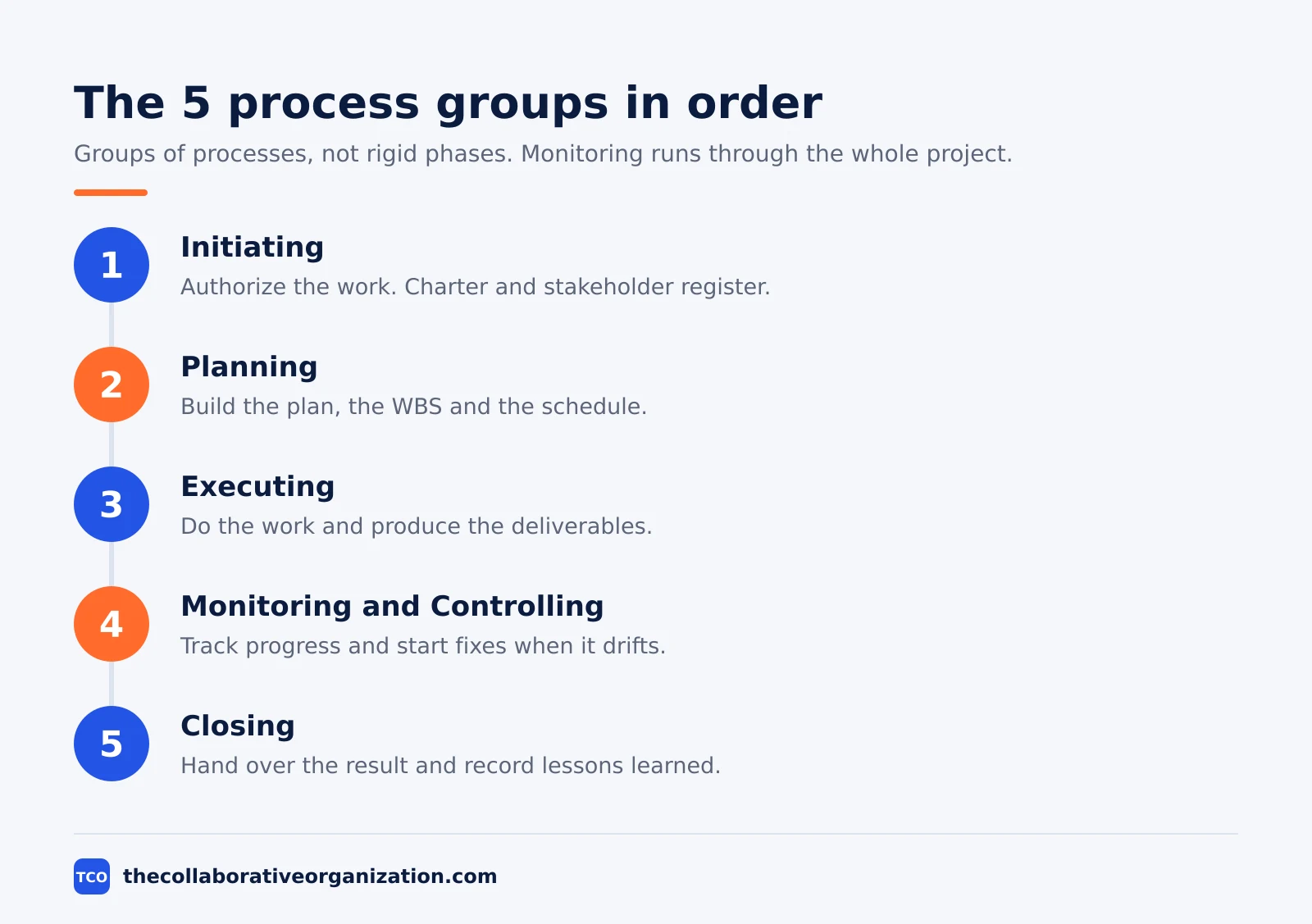
The five process groups are Initiating, Planning, Executing, Monitoring and Controlling, and Closing. They come from the PMBOK Guide, and they describe the kinds of work every project needs. They are groups of processes, not rigid phases, so they overlap during a project.
| Process group | Main question it answers | Key outputs |
|---|---|---|
| Initiating | Should we do this, and who approves it? | Project charter, stakeholder register |
| Planning | How will we do it, and by when? | Project plan, work breakdown structure, schedule |
| Executing | Who does the work, and how? | Deliverables, team performance data |
| Monitoring and Controlling | Are we on track, and what must change? | Change requests, performance reports |
| Closing | Is it done, and what did we learn? | Final report, lessons learned, sign-off |
Initiating authorizes the work and names the sponsor and the manager. Planning builds the plan the team will follow. Executing produces the deliverables.
Monitoring and Controlling runs through the whole project, checking progress against the plan and starting fixes. Closing hands over the result, releases the team and records what the next project should do better.
The triple constraint: scope, time and cost
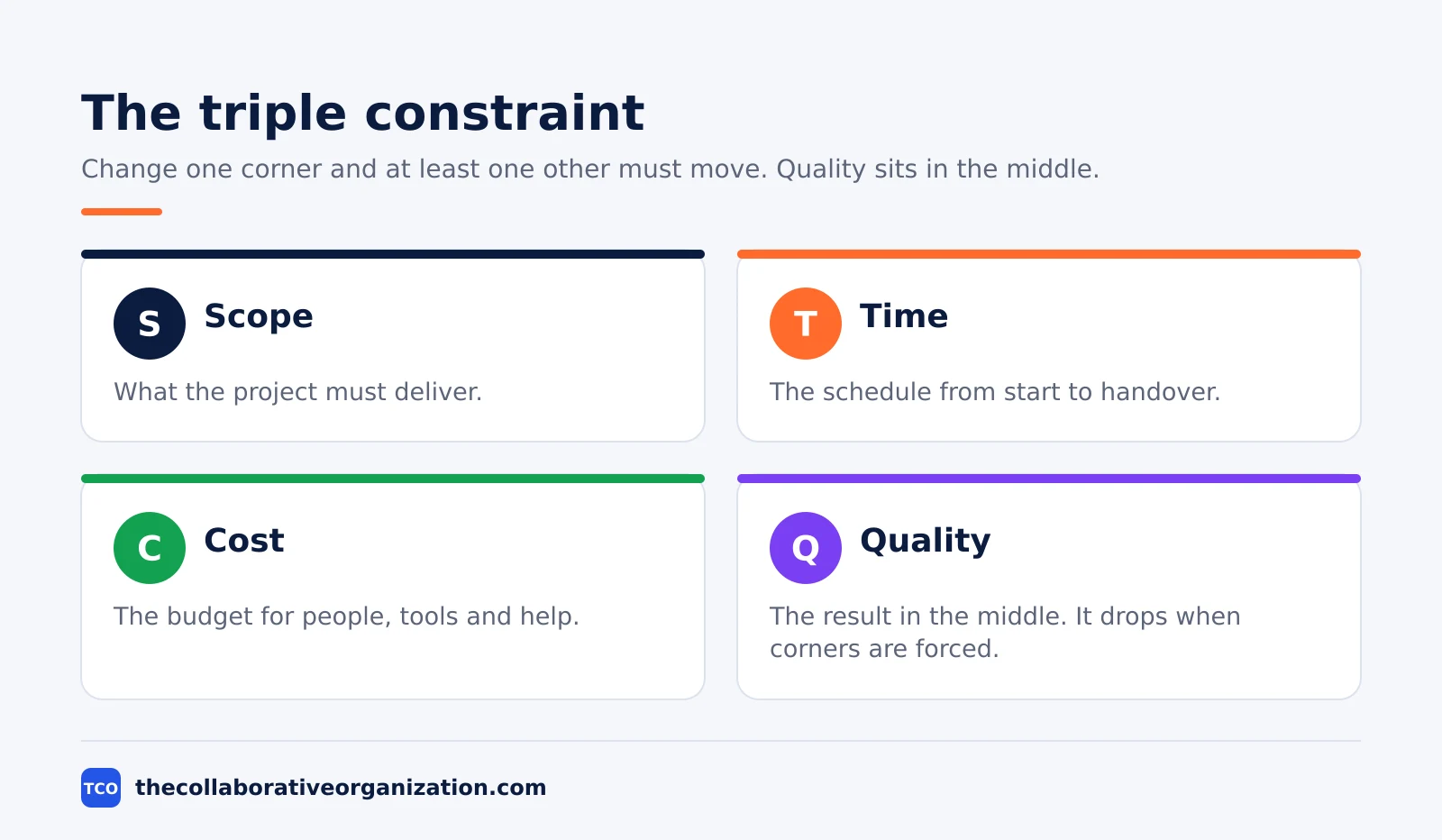
The triple constraint says scope, time and cost are linked, so changing one forces a change in at least one of the others. Asana puts it plainly: you cannot change one part of the project triangle without affecting the other two. Quality sits in the middle of the triangle and drops when the three corners are forced out of balance.
Scope is what the project must deliver. Time is the schedule, from the first task to the final handover. Cost is the budget, including people, tools and outside help.
Add a feature and you need more time or more money. Cut the deadline and you must cut scope or raise the budget. Cut the budget and the work takes longer or delivers less.
Asana also notes that three more limits matter in practice: quality, risk and resources. A team with too few people cannot hit a tight date no matter how good the plan looks. A high-risk project needs spare time and money set aside for problems that will appear.
What a project manager actually does
A project manager plans the work, keeps the team aligned, and protects the result when reality changes the plan. The job is part planner, part communicator and part problem solver. The manager writes the plan, but the real work is keeping it true as the project moves.
Daily work falls into five habits. The manager checks progress against the schedule and the budget. The manager clears blockers so the team can keep working.
The manager talks to stakeholders, so no one is surprised by a delay. The manager logs risks and decides which ones need a response now. The manager records decisions, so the team does not argue the same point twice.
The manager also owns the trade-offs. When a supplier is late, the manager can move a milestone, drop a low-value feature or pay for faster delivery. Each choice costs something, and the manager makes the cost visible to the sponsor before deciding.
Project management approaches: predictive, adaptive and hybrid
PMI describes three approaches: predictive, adaptive and hybrid, and the right one depends on how clear the requirements are. Predictive fits work with stable, well-defined requirements, where each phase finishes before the next begins. Adaptive fits work with high uncertainty, where the team builds in short cycles and learns from feedback. Hybrid mixes the two.
A construction project is usually predictive, because the design is fixed before building starts. A new software product is often adaptive, because users change their minds once they see a working version. A product rollout can be hybrid: fixed dates and compliance steps run in a predictive way, while feature work runs in short cycles.
Our guide on agile vs waterfall compares the two ends of this range in detail. The point is not to pick a fashionable method, but to match the method to how much you know at the start and how much change you expect.
Project management example: a website relaunch
A small website relaunch shows how the definition works on real work. Imagine a team of six people relaunching a company website in eight weeks, with a budget of $40,000 and a launch date tied to a trade show. The project is temporary, the result is one new website, and the date cannot move.
The manager starts by writing down the scope: 20 pages, a new checkout flow and a blog migration, with no new mobile app. The plan breaks that scope into work packages, each with an owner and a date, and sets three milestones: design approved, pages built, launch.
Each week the manager checks progress, spend and open risks in one short meeting.
In week five the checkout tests fail, and fixing them needs four extra days. The manager offers the sponsor three options: move the launch, drop the blog migration, or pay for extra test help. The sponsor picks extra help, the budget rises by $3,000, and the launch date holds. That trade is project management in one decision.
When project management helps, and when it is too much
Project management helps when the work is large, shared across people, or tied to a fixed date or budget. It adds the most value when several teams must finish in the right order, when the result must pass a review, or when a missed date costs money. In those cases a written plan and a named owner prevent the quiet drift that kills projects.
It is too much for small, simple work. A two-person task with one owner and a clear result needs a due date, not a charter and a risk register. The same goes for repeat work with a known routine, where a checklist beats a plan.
The test is simple: if the work has more than a few handoffs, more than one deadline or a result someone else must approve, write it down as a project. If one person can finish it in a day with no handoffs, do not.
Project management vs program management
Project management delivers one temporary result, while program management coordinates several related projects toward a larger goal. A project has one plan, one budget and one end date. A program has several projects that share a goal, such as opening a new office, where the move, the hiring and the IT setup are each a project.
The roles differ too. A project manager tracks tasks, dates and costs for one team. A program manager tracks how the projects fit together, settles clashes between them and reports one combined result to senior leaders. Our guide on program management vs project management explains the two roles side by side.
Do not confuse the two when you hire or plan. A program manager without project managers underneath has no one to run the work, and a project manager given a program has no time to track the detail that makes each project succeed.
Tools that support project management
A project tool keeps the plan, the tasks and the dates in one place the whole team can see. A spreadsheet can hold a first plan, but it hides changes and has no owner per task. A tool shows who owns what, what is late and what is blocked, so the manager spends less time chasing updates.
If you have not picked a tool yet, start with our project management software shortlist.
Our guide on how to choose project management software walks through seat counts, free-plan caps and the features that matter most for a first tool.
| Tool | Best for | Free plan | Starting price (as of November 2026) | Notable limit |
|---|---|---|---|---|
| Asana | Teams that want every task to have a named owner | Free for 2 people | $10.99 per user per month (Starter), billed annually | Free plan covers 2 people |
| ClickUp | Teams that want Gantt charts and custom fields in one tool | Free Forever plan | $9 per user per month (Core), billed annually | Page shows $9 against a $12 regular price, so it may be promotional |
| Trello | Small teams that want a simple board | Free for up to 10 collaborators | $5 per user per month (Standard), billed annually | $6 per user per month if billed monthly |
The Asana price comes from Asana pricing: the Personal plan is free for 2 users, and Starter is $10.99 per user per month when billed annually.
The ClickUp pricing page lists Core at $9 per user per month billed yearly, shown against a $12 regular price.
The Trello pricing page lists Standard at $5 per user per month billed annually, or $6 billed monthly.
How to get started in project management
Start with one small project, write a one-page plan, and track it weekly. Pick a real job with a clear result and a date, such as moving a team to a new tool or running a small event. Write the goal, the deliverables, the owner of each task and the date each task is due.
Run a short weekly check: what is done, what is late, what is blocked and what changed. Keep a list of risks with one line each: what could go wrong, how likely it is and what you will do if it happens. Close the project with a short note on what worked and what to change next time.
If you want a certificate later, the PMP is the best-known one. The exam costs $405 for PMI members as of November 2026, and it needs 35 hours of training plus months of project experience.
In PMI’s 2025 salary survey, US PMP holders reported a median salary of $135,000, against $109,157 for people without the certificate, according to a summary of the PMI survey. That gap reflects experience as well as the certificate, since the exam itself needs years of project work first.
Common project management mistakes to avoid
Most projects fail in the same few ways, and all of them show up early if you look for them. Run through this list at the start of every project.
- No written scope. When the result is not written down, every stakeholder imagines a different one, and the team builds the wrong thing.
- No single owner per task. A task with two owners has none, because each one waits for the other to start.
- A plan nobody updates. A plan written once and never revised becomes fiction within two weeks, and the team stops trusting it.
- Ignoring risks until they happen. A risk found in planning costs a sentence to record, while the same risk found during delivery costs days.
- Reporting good news only. Status reports that hide delays protect no one, and the sponsor learns the truth too late to help.
Sources
- PMI - What Is Project Management (2026)
- Asana - Project Management Triangle (2026)
- Asana - Project Constraints (2026)
- Teamwork - The 5 Project Management Process Groups (2026)
- monday.com - The 5 Project Management Process Groups (2026)
- CertSqill - PMP Salary: What PMI’s Survey Shows (2026)
- Asana - Pricing (2026)
- ClickUp - Pricing (2026)
- Trello - Pricing (2026)
Frequently asked questions
What is project management in simple words?
Project management is the work of planning, organizing and running a temporary job so it finishes on time, within budget and with the agreed result. A project has a start, an end and one clear outcome. The project manager keeps the scope, schedule and budget in balance while the team does the work.
What does a project manager do day to day?
A project manager plans the work, assigns tasks, tracks progress against the schedule and budget, clears blockers, manages risks and reports status to stakeholders. Most days mix short check-ins with the team, updates to the plan, and decisions about trade-offs when scope, time or cost changes.
What is the difference between a project and operations?
A project is temporary and creates a unique result, such as launching a new product or moving offices. Operations are ongoing and repeat, such as answering customer tickets or running payroll. When the work ends and the result is handed over, the project is done, while operations keep going.
Do I need a PMP to become a project manager?
No. Many project managers start without one and learn on the job, then add a certificate later. The PMP exam costs $405 for PMI members as of November 2026, and it needs 35 hours of training plus months of project experience. Employers value a track record of finished projects at least as much as a certificate.
What are the five process groups in project management?
The five process groups are Initiating, Planning, Executing, Monitoring and Controlling, and Closing. They come from the PMBOK Guide and describe the kinds of work a project needs, not fixed phases. Monitoring and Controlling runs through the whole project, while the others peak at different times.
Related articles
project management
How to Choose Project Management Software (2026)
Pick project management software in seven steps: define the work, count seats, price the real cost, and run a two-week pilot before you pay.
November 19, 2026 · 10 min read
project management
What Is a RACI Matrix? Definition, Roles and Examples (2026)
A RACI matrix maps who is Responsible, Accountable, Consulted and Informed for each task. Learn the four roles, how to build one, and see a worked example.
November 19, 2026 · 9 min read
project management
Daily Standup Meeting Format That Works (2026)
A daily standup is a 15-minute meeting where Developers inspect progress toward the Sprint Goal and plan the next day. Use this format to run one that ends on time.
November 19, 2026 · 10 min read