Notion Statistics: 30+ Stats on Users and Growth (2026) | The Collaborative Organization
By The Collaborative Organization Team · November 19, 2026 · Last verified November 19, 2026 · 13 min read
Notion statistics show a workspace that passed 100 million users in August 2024 and reached an $11 billion valuation in January 2026. The 30 numbers below come from Notion’s own blog and announcements, plus the independent research that Notion’s users are usually read against. Each figure names its source and its year, so you can check it yourself.
Key takeaways
- Notion passed 100 million users in August 2024, up from 1 million in 2020.
- A January 2026 tender offer of $270 million valued Notion at $11 billion.
- More than 50% of Notion’s annual revenue came from AI-enabled customers at the end of 2025.
- Plus costs $10 per member per month billed annually as of November 2026, and Business costs $20.
- Notion 3.0 launched in September 2025 with Agents that do multi-step work inside a workspace.
How we chose these stats
We took every number in this article from the publisher’s own blog, announcement, or report, and we checked each one against that source on 19 November 2026. We used the latest edition of each yearly report that includes the figure. Vendor surveys are flagged as vendor surveys, and modelled estimates are flagged as estimates.
Two figures in this article are second-hand, and the text says so. The $500 million annualized revenue figure comes from Notion’s own statement to CNBC in September 2025, as reported by other outlets, because the CNBC page itself was not available to open. The $600 million figure comes from Forbes, citing people familiar with the matter, not from Notion.
Notion’s pricing page shows plan names and features but renders no dollar figures to our reader, so the prices below are corroborated with independent checks from November 2026, and the text says so. Every stat in the table below names its source and the year its data was collected.
Notion by the numbers: users and growth
Notion grew from 1,000 users to 100 million in about a decade, with most of that growth coming after 2020. The milestone post from co-founder and CEO Ivan Zhao is the source for the figures in this section.
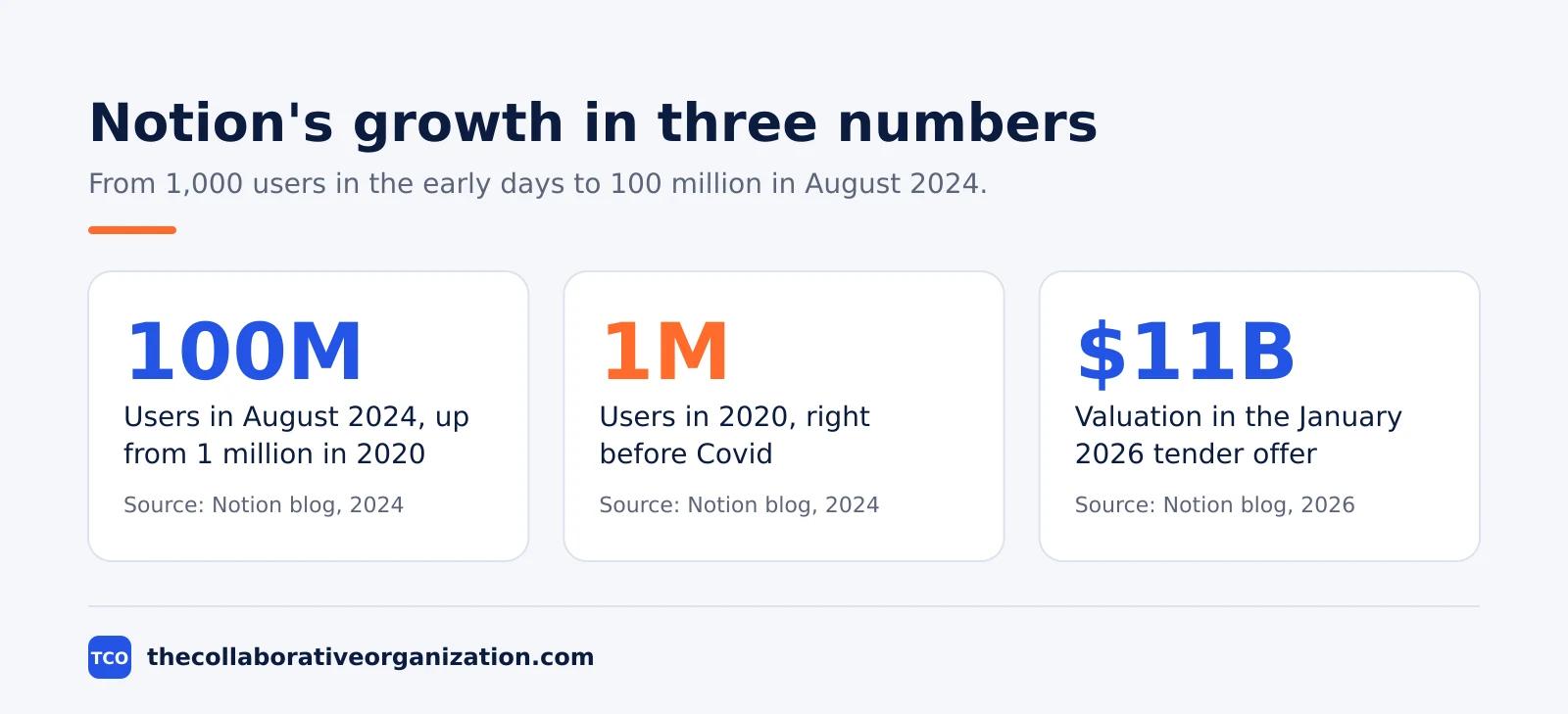
Notion passed 100 million users in August 2024, Ivan Zhao wrote in September 2024. The post marks the climb from 1,000 users in the early days to 1 million in 2020, right before Covid, and then to 100 million four years later. Notion has not published a more recent total since.
The company started in 2013, but it was not until the Notion 2.0 launch in 2018 that it saw signs of traction, the same blog post says. Notion almost died in those early years, and the team rebuilt the product four times before it found its shape.
The creator economy grew on top of the workspace. Some creators made $1 million in 2023 selling tools built in Notion, according to the same Notion post. The original pitch deck imagined a marketplace for builders, and Zhao writes that it took 10 years instead of the 15 months the deck assumed.
Shipping sped up in 2024. Notion shipped more than 7 releases in the summer of 2024, the milestone post says, answering user requests fast. Zhao closes the post by looking ahead to 1 billion users.
Growth is now global. Notion opened a Singapore office in mid-2025, alongside regional offices in Tokyo, Seoul, and Sydney, according to Notion’s January 2026 announcement. The company says growth in the last 12 months happened globally, especially in the Asia-Pacific region.
Our knowledge management statistics guide puts Notion’s user growth next to the wider research on how teams store and find what they know.
Revenue, valuation, and AI
Notion’s revenue passed $500 million in 2025, and AI now drives more than half of it. The figures below mix company statements with reported figures, and the text marks which is which.
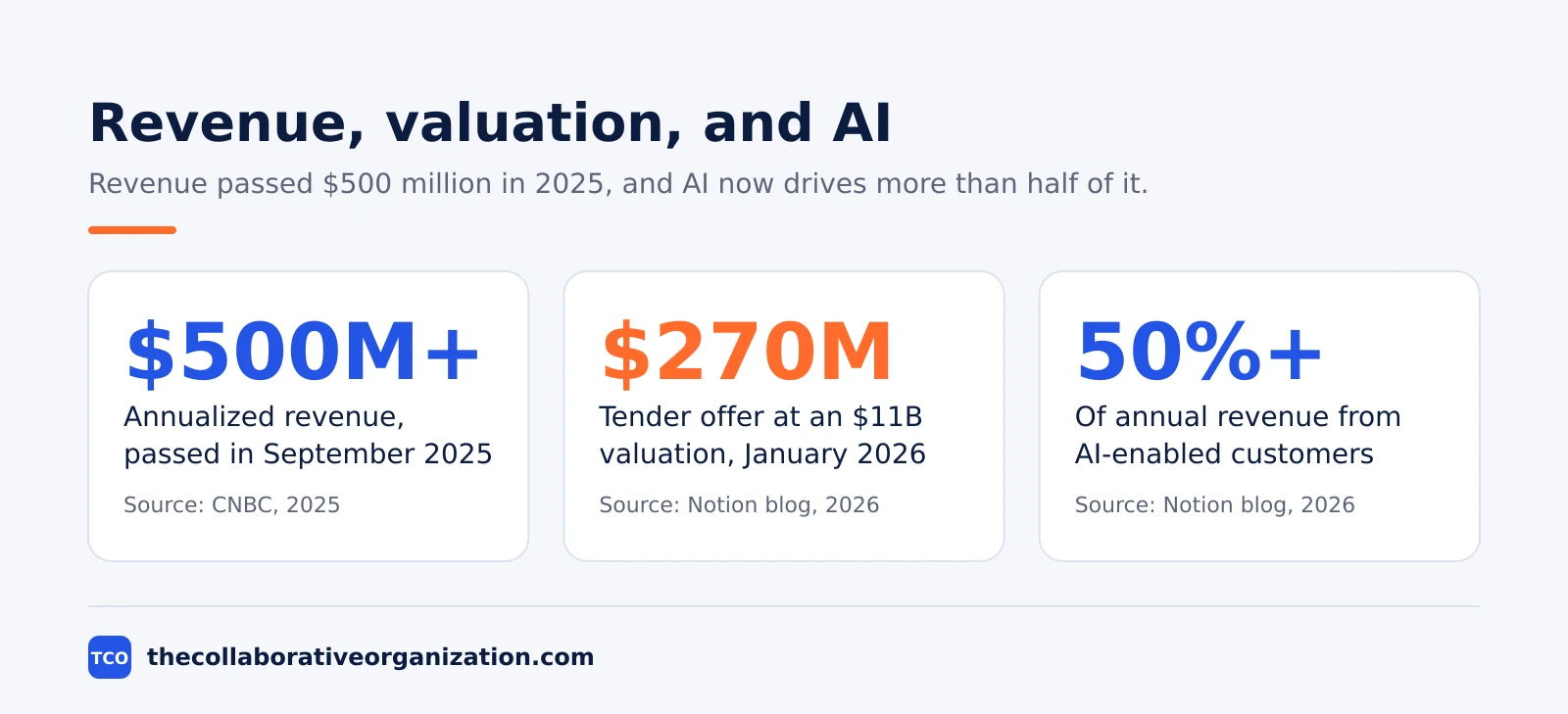
Notion told CNBC in September 2025 that annualized revenue had passed $500 million, as ValueAdd notes in its breakdown of the company’s disclosures. The figure is a company statement reported by CNBC, not a number Notion published on its own blog.
Forbes reported in December 2025 that annual recurring revenue had passed $600 million, with about half from AI products, according to a summary of the report. Forbes cited people familiar with the matter, and the company was cash-flow positive, according to the same report. Treat that figure as reported, not as company-published.
The valuation followed in January 2026. Investors bought about $270 million of shares from current and former employees in a private tender offer at an $11 billion valuation, Notion announced on 26 January 2026. New investor GIC joined returning investors Sequoia Capital and Index Ventures.
No new money went to the company in that deal. The investors bought shares directly from employees, the same Notion announcement states. Notion also waived the one-year vesting cliff on options so almost every employee could take part.
AI is now the growth engine. At the end of 2025, more than 50% of Notion’s annual revenue came from AI-enabled customers, and that share more than doubled over the last year, according to the same tender announcement. Growth accelerated through 2025 on the back of AI adoption inside the platform.
Notion 3.0 launched on 18 September 2025 with Agents, Notion announced. The Agent can do anything a person can do in Notion, co-founder Akshay Kothari writes, because it understands the work and can take action. Agents can work on their own for up to 20 minutes across hundreds of pages, according to a summary of the launch.
Our project management software statistics guide tracks how other vendors in the same market report revenue and growth.
What Notion costs
Notion’s paid plans start at $10 per member per month, and the free plan costs $0. The prices below are corroborated with independent checks from November 2026, because Notion’s own pricing page renders no dollar figures to our reader.
Notion offers four plans: Free, Plus, Business, and Enterprise. Plus costs $10 per member per month when billed annually, or $12 when billed monthly, as of November 2026. Business costs $20 per member per month when billed annually, or $24 monthly. Enterprise pricing is by quote only.
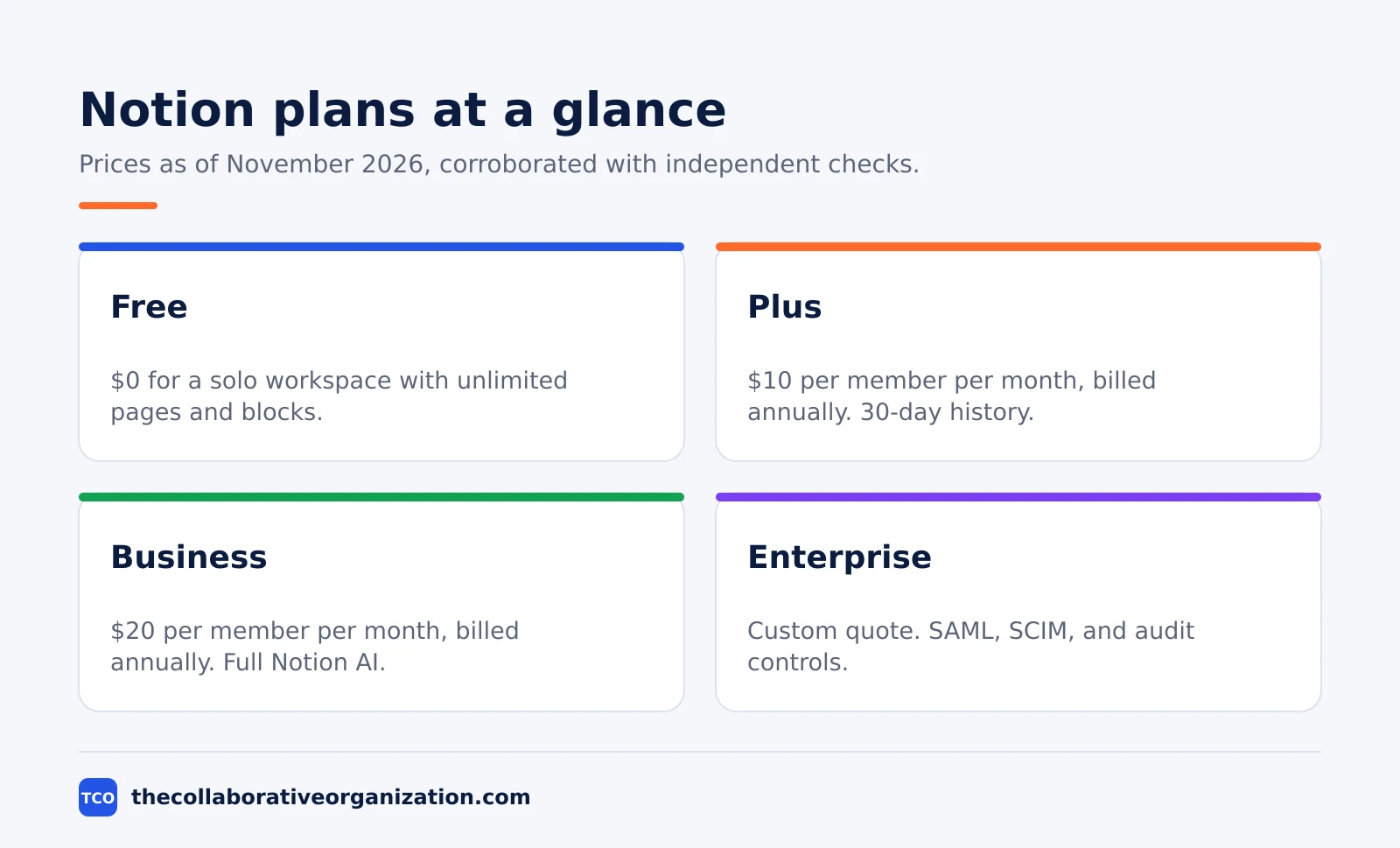
The free plan covers a solo workspace with unlimited pages and blocks, according to Notion’s pricing page. Plus adds 30-day page history, 5 GB file uploads, and unlimited guests. The prices above are confirmed by independent checks, including Nuclino’s pricing comparison.
Full Notion AI lives on Business and above. Business includes the Notion Agent, AI Meeting Notes, and Enterprise Search, plus 90-day page history, SAML single sign-on, and private teamspaces, according to the same pricing comparison. Free and Plus get only a limited AI trial.
| Plan | Price (as of November 2026) | Best for |
|---|---|---|
| Free | $0 | One person organizing notes and personal projects |
| Plus | $10 per member per month, billed annually | Small teams that need shared docs and longer history |
| Business | $20 per member per month, billed annually | Teams that use Notion AI every week |
| Enterprise | Custom quote | Organizations that need SAML, SCIM, and audit controls |
The Business price rose from $15 to $20 per member per month in August 2025, when full Notion AI was folded into the plan, according to a pricing guide that tracked the change. If you see $15 quoted in an older guide, it is out of date.
If you are comparing Notion with its closest rival for documentation, our Notion vs Confluence comparison lays out the differences side by side.
Our software adoption statistics guide shows how teams decide whether a new workspace is worth the switch.
How teams actually use Notion
Teams adopt Notion to cut the time they lose searching for things and repeating low-value work. The figures below come from Asana, Atlassian, Microsoft, and Slack, and they explain why a single workspace appeals to buyers.
Busywork takes 53% of knowledge workers’ time, according to Asana’s State of Work Innovation 2024, a survey of 13,066 knowledge workers in six countries. Chasing the status of work, searching for information, and communicating about work leave only 47% for skilled work.
Teams spend 25% of the workweek searching for information, Atlassian’s State of Teams 2025 found in a survey of 12,000 knowledge workers and 200 Fortune 1000 executives. In the same survey, 56% of workers said they often have to ask someone or book a meeting to get the information they need.
Desk workers report spending 41% of their time on low-value, repetitive tasks, Slack’s Workforce Lab found in 2024. A workspace that holds docs, wikis, and project databases in one place targets exactly that share of the week.
The message load behind those shares is large. Microsoft’s 2025 telemetry shows the average worker receives 117 emails a day and 153 Teams messages per weekday, most emails skimmed in under 60 seconds.
The pattern is old. The McKinsey Global Institute estimated in 2012 that interaction workers spend about 28% of the workweek on email, in its report on social technologies. Bad collaboration is also expensive: it costs up to $16,491 a year per manager, Zoom and Morning Consult estimated in 2024.
Engagement is low across the board. Only 20% of employees worldwide were engaged at work in 2025, Gallup’s State of the Global Workplace 2026 found. Our collaboration statistics guide tracks how the same load shows up across teams that do not share one workspace.
Common Notion statistics mistakes to avoid
Most bad Notion numbers come from calling a total user count an active user count, or from calling a tender offer a funding round. Run through the list below before you quote a figure.
- Calling 100 million “monthly active users”. Notion said it passed 100 million users in total in August 2024. The company has never published daily or monthly active user counts, so do not present the total as actives.
- Calling $500 million “ARR”. Notion told CNBC that annualized revenue had passed $500 million in September 2025. Annualized revenue and annual recurring revenue are not the same measure.
- Calling the $11 billion tender a funding round. The January 2026 deal let employees sell shares to investors. No new money went to the company, and Notion has not raised primary capital since 2021, according to a company profile that tracks its funding history.
- Quoting the old $15 Business price. Business rose from $15 to $20 per member per month in August 2025, when full Notion AI was folded into the plan. Guides that still list $15 are out of date.
- Treating third-party estimates as company figures. Sacra’s estimates of Notion’s revenue are not company disclosures. Use the $500 million company statement, or label the estimate as an estimate.
The full statistics table
The table below lists 30 statistics from the reports above, grouped by theme, with the source and the year for each one. Use it to check a figure before you quote it. Every number in the table also appears in the text above with a link to its original source.
| Statistic | Source | Year |
|---|---|---|
| 100 million users in August 2024 | Notion blog | 2024 |
| 1 million users in 2020 | Notion blog | 2024 |
| 1,000 users in the early days | Notion blog | 2024 |
| Founded in 2013 | Notion blog | 2024 |
| Notion 2.0 launched in 2018 | Notion blog | 2024 |
| Product rebuilt four times in early years | Notion blog | 2024 |
| 7+ releases in summer 2024 | Notion blog | 2024 |
| Some creators made $1M in 2023 | Notion blog | 2024 |
| $270M tender offer in January 2026 | Notion blog | 2026 |
| $11B valuation in the tender offer | Notion blog | 2026 |
| More than 50% of ARR from AI-enabled customers | Notion blog | 2026 |
| AI share of ARR more than doubled in a year | Notion blog | 2026 |
| Singapore office opened mid-2025 | Notion blog | 2026 |
| $500M+ annualized revenue (CNBC, Sept 2025) | CNBC | 2025 |
| $600M+ ARR reported by Forbes (Dec 2025) | Forbes | 2025 |
| Notion 3.0 launched 18 September 2025 | Notion blog | 2025 |
| Agents work autonomously for up to 20 minutes | Notion 3.0, via Design Compass | 2025 |
| Free plan $0 | Notion pricing | 2026 |
| Plus $10 per member per month, billed annually | Notion pricing | 2026 |
| Plus $12 per member per month, billed monthly | Notion pricing | 2026 |
| Business $20 per member per month, billed annually | Notion pricing | 2026 |
| Business $24 per member per month, billed monthly | Notion pricing | 2026 |
| 53% of time goes to busywork | Asana State of Work Innovation | 2024 |
| 25% of the workweek spent searching for information | Atlassian State of Teams | 2025 |
| 41% of time spent on low-value, repetitive tasks | Slack Workforce Lab | 2024 |
| 117 emails received per day on average | Microsoft Work Trend Index | 2025 |
| 153 Teams messages received per weekday | Microsoft Work Trend Index | 2025 |
| 28% of the workweek spent on email | McKinsey Global Institute | 2012 |
| $16,491 a year per manager lost to bad collaboration | Zoom and Morning Consult | 2024 |
| 20% of employees worldwide engaged at work | Gallup State of the Global Workplace | 2026 |
What the numbers mean
The numbers tell a story of a company that grew on users first and turned that base into AI revenue second. Notion passed 100 million users before it passed $500 million in annualized revenue, and more than half of that revenue now comes from AI-enabled customers.
The valuation follows the same order. Investors paid $11 billion in a tender offer for shares from employees, not for new shares from the company. That is a vote on the user base and the AI attach rate, not on a funding round.
Use the numbers to size the buy, not to justify it. A 20-person team on Plus pays $2,400 a year, and $4,800 a year on Business. The $2,400 gap buys Notion AI, and it only pays back if the team uses the Agent weekly. Compare options on our document collaboration software shortlist before you pick a plan.
A worked example shows what the numbers mean for one team. Picture a 20-person team where each person loses 53% of a 40-hour week to busywork, Asana’s 2024 figure. That is 424 hours a week across the team, or more than 10 full-time roles spent on coordination.
Moving that team from Plus to Business costs $2,400 more a year. If the Agent saves each person just 30 minutes a week, that is 10 hours a week back, or about 500 hours a year. The numbers in this example are an illustration, built from Asana’s 53% busywork figure and Notion’s published prices.
Sources
- Notion - 100 Million of You (2024)
- Notion - GIC, Sequoia, Index Purchase Notion Shares (2026)
- Notion - Introducing Notion 3.0 (2025)
- Notion - Pricing (2026)
- ValueAdd - How Does Notion Make Money (2026)
- Okara - How Many People Use Notion (2026)
- Nuclino - Notion Free vs Paid (2026)
- ProcurementVMS - Notion Pricing 2026 (2026)
- Asana - The State of Work Innovation 2024 (2024)
- Microsoft - Breaking Down the Infinite Workday (2025)
Frequently asked questions
How many people use Notion?
Notion passed 100 million users in August 2024, according to a blog post by co-founder and CEO Ivan Zhao. The company had passed 1 million users in 2020 and started from 1,000 users in its early days. Notion has not published a more recent total since, and it does not break out daily or monthly active users.
How much revenue does Notion make?
Notion told CNBC in September 2025 that annualized revenue had passed $500 million. Forbes later reported that annual recurring revenue had passed $600 million by December 2025, with about half from AI products, citing people familiar with the matter. Notion is private and does not publish audited financial results.
What is Notion worth?
Notion was valued at $11 billion in a private tender offer announced on 26 January 2026. Investors GIC, Sequoia Capital, and Index Ventures bought about $270 million of shares directly from current and former employees. No new money went to the company in that deal.
How much does Notion cost?
Notion's Free plan costs $0. Plus costs $10 per member per month when billed annually, or $12 when billed monthly, as of November 2026. Business costs $20 per member per month when billed annually, or $24 monthly, and includes full Notion AI. Enterprise pricing is by quote.
What is Notion 3.0?
Notion 3.0 launched on 18 September 2025 with Agents, AI helpers that carry out multi-step work inside a workspace. Notion describes the Agent as able to do anything a person can do in Notion. Agents can work on their own for up to 20 minutes across hundreds of pages.
Related articles

guides
Free Project Management Templates: 7 to Copy (2026)
Seven free project management templates from monday, Wrike, Teamwork, Smartsheet, ClickUp, Asana and Trello, with what each one is for and what free really costs.
November 20, 2026 · 7 min read

guides
Project Proposal Template: Copy and Win Work (2026)
A project proposal template pitches the work before it is approved: problem, solution, scope, budget, timeline and terms. Copy the template and filled example.
November 20, 2026 · 10 min read

guides
Action Plan Template: Goal to Done in One Page (2026)
An action plan template turns one goal into owned steps with dates, dependencies and a success measure. Copy the table and see it filled for a support team.
November 20, 2026 · 11 min read