Knowledge Worker Productivity Statistics: 28 Stats (2026) | The Collaborative Organization
By The Collaborative Organization Team · November 19, 2026 · Last verified November 19, 2026 · 9 min read
Knowledge workers spend most of their week on work other than the work they were hired to do. A large global survey puts that share at 60%, with the rest lost to meetings, messages and searching for information. The 28 statistics below cover where the hours go, the interruptions, and what AI adds, each with its source and year.
Key takeaways
- About 60% of a knowledge worker’s time goes to work about work, per Asana, with the rest split between skilled work and planning.
- Unnecessary meetings cost about 103 hours a year per worker, and talking about work costs 352 hours.
- The average worker gets 117 emails and 153 Teams messages a day, per Microsoft in 2025.
- Teams spend over 25% of the workweek searching for information, per Atlassian in 2025.
- Only 20% of employees worldwide were engaged in 2025, per Gallup, and daily AI users report 64% higher productivity, per Slack.
How we chose these 28 statistics
We picked statistics from named studies published in 2025 and 2026, and we dropped any figure we could not trace to its source. Each number below names its study and year, and the table at the end repeats all 28 with links. Vendor surveys are named as vendor surveys, and modelled estimates are flagged as estimates.
Two scope notes matter. Microsoft’s 275 daily interruptions describe the most heavily pinged fifth of users, not the average worker, and the figure spans a full 24 hours. The RingCentral figures come from a 2018 survey, so they are older than the rest and are marked with their year. Several base figures also appear in our remote work productivity statistics.
Where the knowledge worker’s week goes
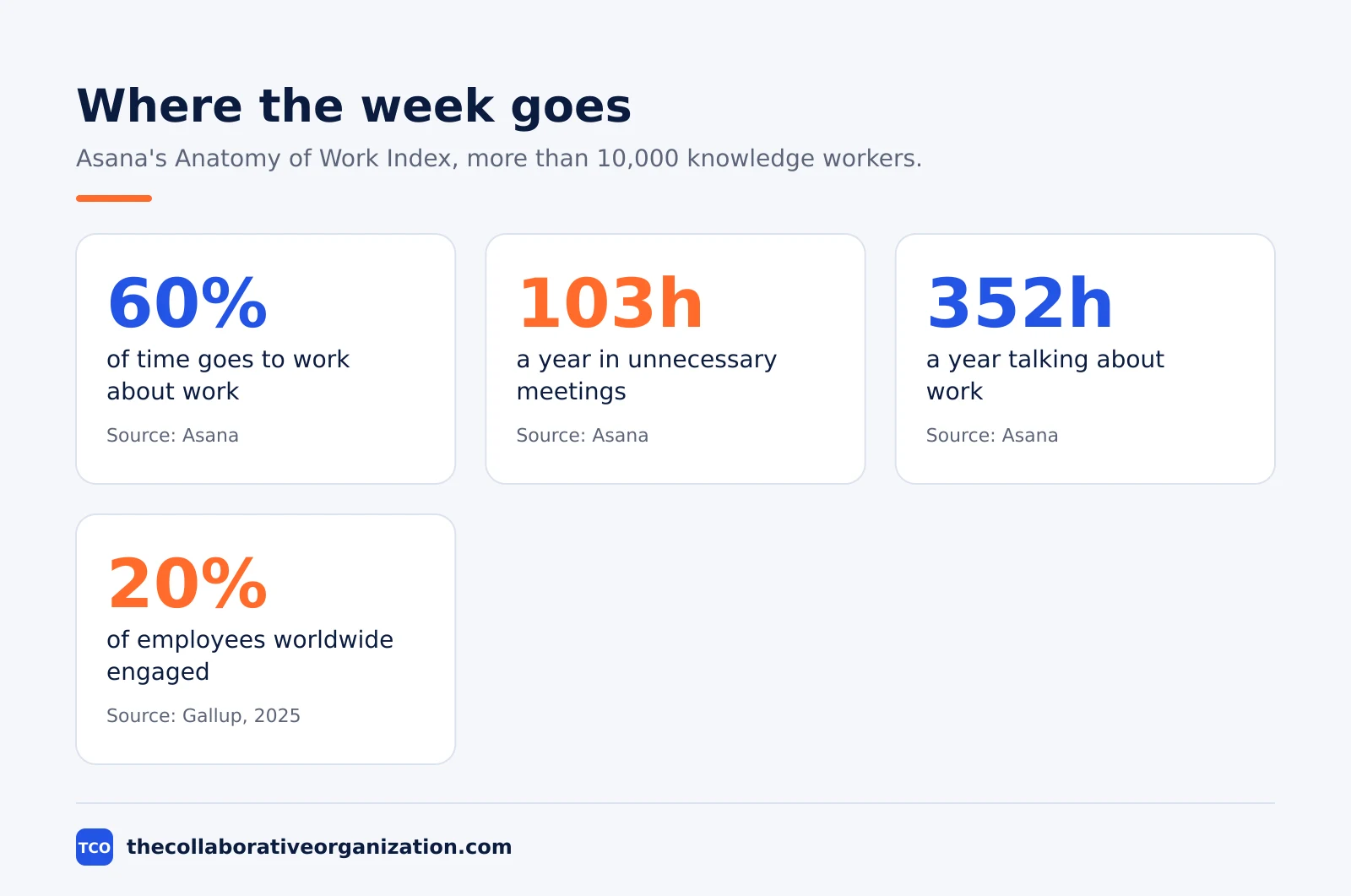
Most of the week goes to coordination, not skilled work. Asana puts the share at 60% in its Anatomy of Work Index, which surveyed more than 10,000 knowledge workers. The term Asana uses for that time is “work about work”: chasing updates, attending unnecessary meetings, searching for information and switching between apps.
The hours add up fast. Asana counts 103 hours a year in unnecessary meetings, 209 hours a year on duplicative work, and 352 hours a year talking about work. Together that is 664 hours a year, or about 16 working weeks, spent on coordination rather than the skilled work people were hired to do.
The cost shows up in missed deadlines. Asana found 88% of knowledge workers agree that time-sensitive projects have fallen behind because of the volume of tasks on their plate. Only 43% of respondents were clear on their organization’s objectives for the year, and only 46% were clear on how their work adds value to the company.
Meetings carry a large share of the load. Our too many meetings statistics guide covers the meeting figures in full, including who loses the most hours. The pattern is the same in every dataset: the calendar fills first, and focused work takes what is left.
Interruptions, messages and the endless day
The working day is now a stream of messages with no clear end. Microsoft counted 117 emails and 153 Teams messages received per day by the average employee in its June 2025 Work Trend Index special report. That is 270 messages a day before any meeting starts.
Interruptions are the other half of the story. Microsoft found workers are interrupted about every two minutes during core hours, adding up to about 275 interruptions across a full day. That figure describes the most heavily pinged fifth of users, not the typical worker, and it explains why focus time is so hard to protect.
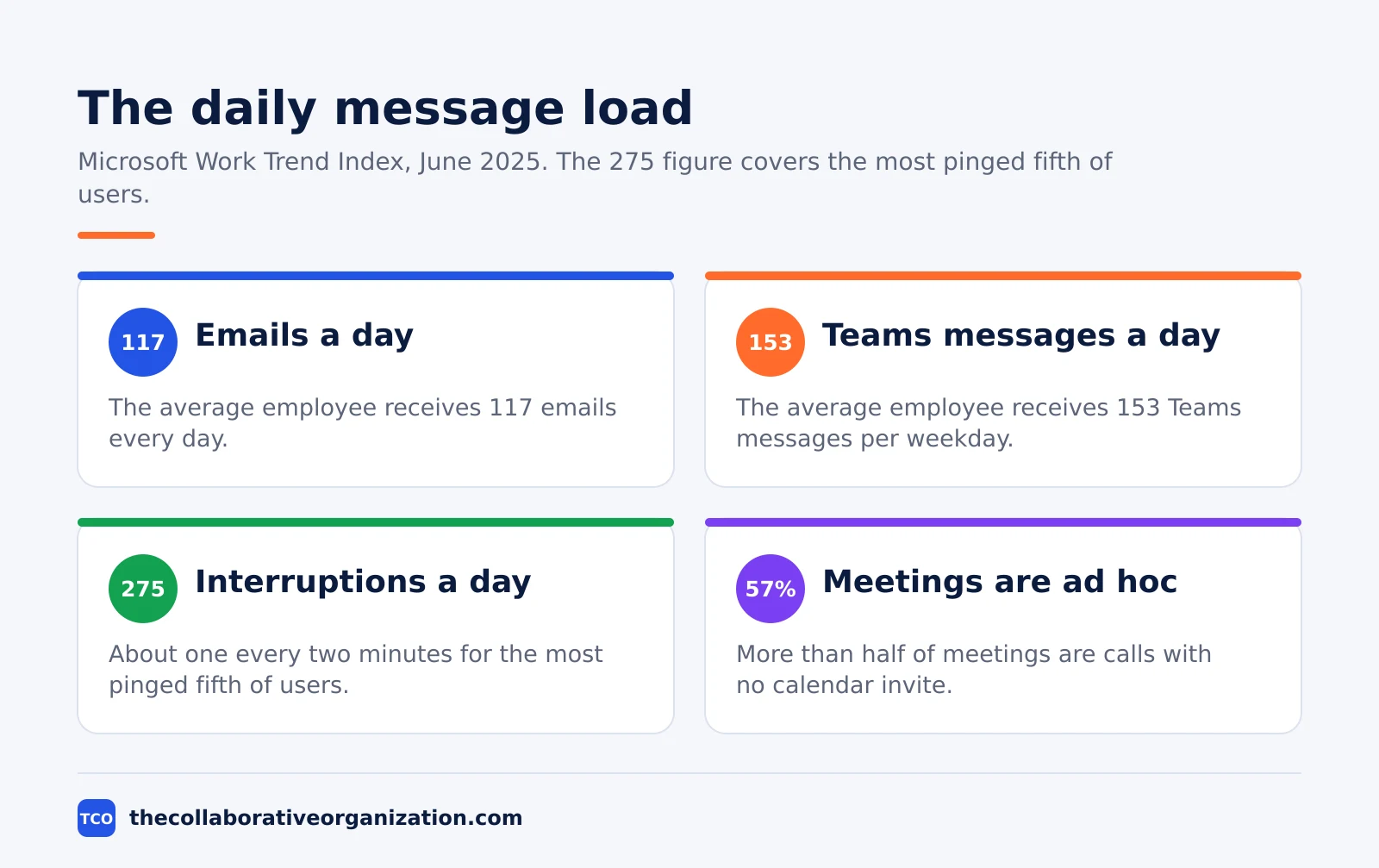
The day also stretches at both ends. Microsoft found 40% of employees check email before 6 in the morning, 29% are back in their inbox by 10 at night, and 20% work on weekends. Meetings after 8 in the evening rose 16% year over year, and 57% of meetings are now ad hoc calls with no calendar invite.
The result is a workforce that feels stretched. Microsoft found 48% of employees and 52% of leaders say their work feels chaotic and fragmented, while 80% of the global workforce say they lack the time or energy to do their work. Our remote work productivity statistics guide puts these day patterns beside home-office data.
Searching, switching and the cost of finding things
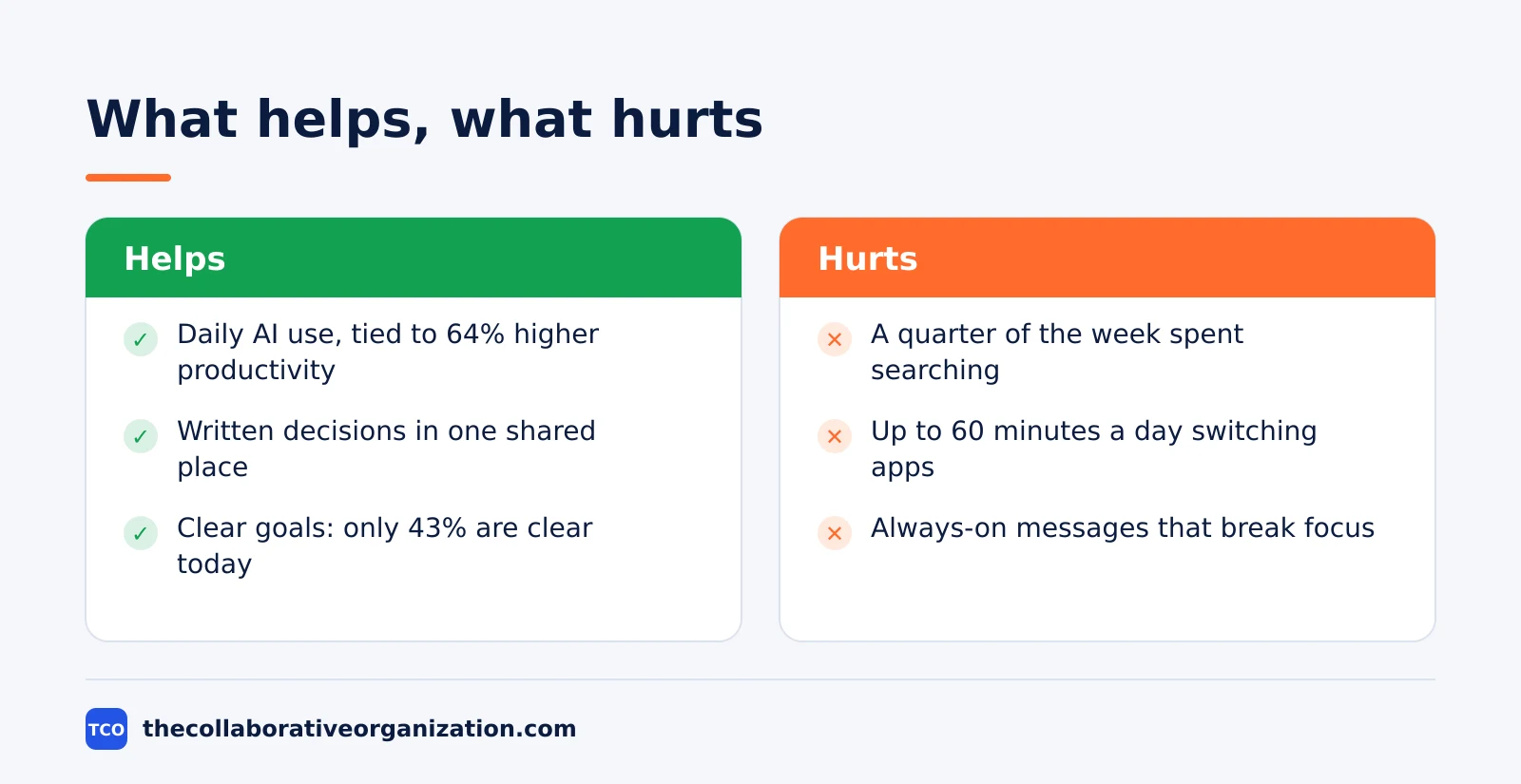
A quarter of the week goes to finding information that should already be at hand. Atlassian found teams spend over 25% of their workweek searching for information in its State of Teams 2025 survey of 12,000 knowledge workers and 200 executives. Difficulty finding information was the top barrier to moving fast in the same survey.
Asking someone is often the only way through. Atlassian found 56% of knowledge workers often have to ask someone or book a meeting to get the information they need. Across the Fortune 500, Atlassian puts the wasted search time at 2.4 billion hours, which shows how a small daily delay scales across a large company.
App switching adds its own tax. The average employee uses 10 different apps every day, according to Asana, and the more apps people use, the longer they spend feeling distracted.
RingCentral found 69% of workers waste up to 60 minutes a day navigating between apps in its 2018 survey, which adds up to 32 days a year. That study is older than the rest here, so treat it as a baseline, not a 2025 reading.
AI, engagement and what actually helps
AI helps the workers who use it every day, and engagement is still low. Slack’s 2025 Workforce Index found 60% of desk workers now use AI, and daily use rose 233% in six months. Daily users report 64% higher productivity and 81% greater job satisfaction than colleagues who do not use AI.
Engagement is the weak spot underneath the AI numbers. Gallup found only 20% of employees worldwide were engaged in 2025, and managers explain at least 70% of the variance in team engagement. Our employee engagement statistics guide covers the engagement trend in full.
Performative work is part of the drag. Grammarly found knowledge workers admit to spending about 21% of their workweek on performative or unproductive tasks, while 88% of workers report wasting time on unproductive tasks. Grammarly puts the cost at $16.4 million a year for a company of 1,000 workers.
The AI gains are real but uneven. Slack found 96% of AI users have used AI to do tasks they could not have done themselves, yet 29% of desk workers say their company has issued no formal AI guidance. Our AI productivity statistics guide covers which AI habits pay off and which do not.
The 28 knowledge worker productivity statistics in one table
The table below lists all 28 statistics with their source and year. Figures that describe a subgroup say so in the statistic itself.
| Statistic | Source | Year |
|---|---|---|
| 60% of time goes to work about work | Asana | 2026 |
| 103 hours a year in unnecessary meetings | Asana | 2026 |
| 209 hours a year on duplicative work | Asana | 2026 |
| 352 hours a year talking about work | Asana | 2026 |
| 88% say time-sensitive projects slipped due to task volume | Asana | 2026 |
| 43% are clear on their organization’s objectives for the year | Asana | 2026 |
| 46% are clear on how their work adds value | Asana | 2026 |
| 80% of knowledge workers felt close to burnout | Asana | 2026 |
| 10 different apps used per day on average | Asana | 2026 |
| 117 emails received per day | Microsoft | 2025 |
| 153 Teams messages received per weekday | Microsoft | 2025 |
| 275 interruptions per day (most heavily pinged fifth) | Microsoft | 2025 |
| 57% of meetings are ad hoc calls with no invite | Microsoft | 2025 |
| 40% check email before 6 a.m. | Microsoft | 2025 |
| 29% return to their inbox by 10 p.m. | Microsoft | 2025 |
| 20% work on weekends | Microsoft | 2025 |
| 48% say work feels chaotic and fragmented | Microsoft | 2025 |
| 80% say they lack the time or energy to do their work | Microsoft | 2025 |
| 25% of the workweek spent searching for information | Atlassian | 2025 |
| 56% often ask someone or book a meeting for information | Atlassian | 2025 |
| 2.4 billion hours wasted searching (Fortune 500) | Atlassian | 2025 |
| 69% waste up to 60 minutes a day navigating between apps | RingCentral | 2018 |
| 32 days a year lost to app switching | RingCentral | 2018 |
| 21% of the workweek spent on performative tasks | Grammarly | 2025 |
| 88% waste time on unproductive tasks | Grammarly | 2025 |
| 60% of desk workers use AI | Slack | 2025 |
| Daily AI users report 64% higher productivity | Slack | 2025 |
| 20% of employees worldwide engaged | Gallup | 2025 |
What the numbers mean for your team
The pattern is clear: coordination eats the week, interruptions break what is left, and AI helps only the workers who use it daily. The fix is not more hours. It is fewer channels, written decisions, and a search system that answers questions without a meeting. Start by cutting one recurring meeting and one tool, then measure whether skilled-work time rises.
Worked example: a 10-person team reclaims a day a week
Take a 10-person team as an illustration. At 60% work about work (Asana, 2026), each person on a 40-hour week spends 24 hours on coordination and 16 hours on everything else, including skilled work and planning. If the team cuts unnecessary meetings by half, each person saves about 51 hours a year, or 510 hours across the team. The numbers are an illustration from the published figures, not a measurement of a real team.
One change does most of the work. Put decisions in writing in one shared place, and point every question there first. See our guides index for the full set of team guides, including how to run fewer, better meetings.
Common knowledge worker productivity statistics mistakes to avoid
Most bad takes on these numbers come from the same five errors, and all five are easy to avoid.
- Reading the 275 interruptions as an average. It describes the most heavily pinged fifth of users across a full day, not the typical worker.
- Quoting the 2018 RingCentral figures as current. App switching has changed since 2018, so label the year when you use the 69% or the 32 days.
- Adding the 103, 209 and 352 hours without care. They are separate survey categories from one study, so add them only as Asana’s own total of 664 hours.
- Treating the 60% as measured time. It is self-reported survey data from a vendor that sells work management software, so read it as how workers see their week.
- Treating AI use as AI value. Slack found 60% of desk workers use AI, but only daily users report the big productivity gains.
Sources
- Asana - How Work About Work Gets in the Way of Real Work (2026)
- Microsoft - Breaking down the infinite workday (2025)
- Atlassian - How the System of Work connects distributed teams (2025)
- RingCentral - App Overload Is Creating Chaos at Work (2018)
- Grammarly - The Workforce Productivity Trends That Define 2025 (2025)
- Slack - The New AI Advantage (2025)
- Gallup - Quiet Quitting Is on the Rise in India (2026)
Frequently asked questions
What share of a knowledge worker's time goes to real skilled work?
About 60% goes to work about work, according to Asana's Anatomy of Work Index. That covers chasing updates, attending unnecessary meetings, searching for information and switching between apps. The same research counts 103 hours a year in unnecessary meetings, 209 hours on duplicative work and 352 hours talking about work.
How many hours a year do unnecessary meetings cost a knowledge worker?
About 103 hours a year, according to Asana's Anatomy of Work Index. The same research puts duplicative work at 209 hours a year and talking about work at 352 hours a year. Together, the three add up to 664 hours a year spent on coordination rather than skilled work.
How often are knowledge workers interrupted during the day?
Microsoft counted an interruption about every two minutes during core hours, adding up to about 275 interruptions across a full day. That figure describes the most heavily pinged fifth of Microsoft 365 users, not the average worker, so read it as a picture of the worst-hit group rather than a typical day.
Does using AI make knowledge workers more productive?
Daily users say so. Slack's 2025 Workforce Index found daily AI users report 64% higher productivity, 58% better focus and 81% greater job satisfaction than colleagues who do not use AI. Casual users who open AI less than once a week show little to no difference from non-users, so frequency is what matters.
What does work about work mean?
It means the activities that take time away from meaningful work: communicating about work, searching for information, switching between apps, managing shifting priorities and chasing the status of work. Asana coined the term in its Anatomy of Work research, and it now covers most of what fills a knowledge worker's week.
Related articles
guides
Free Project Management Templates: 7 to Copy (2026)
Seven free project management templates from monday, Wrike, Teamwork, Smartsheet, ClickUp, Asana and Trello, with what each one is for and what free really costs.
November 20, 2026 · 7 min read
guides
Project Proposal Template: Copy and Win Work (2026)
A project proposal template pitches the work before it is approved: problem, solution, scope, budget, timeline and terms. Copy the template and filled example.
November 20, 2026 · 10 min read
guides
Action Plan Template: Goal to Done in One Page (2026)
An action plan template turns one goal into owned steps with dates, dependencies and a success measure. Copy the table and see it filled for a support team.
November 20, 2026 · 11 min read