How to Run Effective One-on-Ones: A Weekly Guide (2026) | The Collaborative Organization
By The Collaborative Organization Team · November 19, 2026 · Last verified November 19, 2026 · 11 min read
A one-on-one is a weekly 30-minute meeting that belongs to the employee, not the manager, and its job is to coach, clear blocks, and talk about growth. It is the highest-return habit in management. Gallup found that one meaningful conversation per week with each team member builds high-performance relationships more than any other leadership activity.
Key takeaways
- Gallup recommends one meaningful conversation per week with each team member, and says 15 minutes can be enough.
- 15- to 30-minute conversations have a bigger effect than 30- to 60-minute ones when they happen regularly, in Gallup’s research.
- Only 16% of nearly 15,000 employees said their last conversation with their manager was extremely meaningful.
- Recognition for recent work is the top characteristic of a meaningful conversation, ahead of goals, collaboration and strengths.
- The employee sets most of the agenda, the manager listens most of the time, and every meeting ends with written actions and owners.
What a one-on-one is for, and what it is not
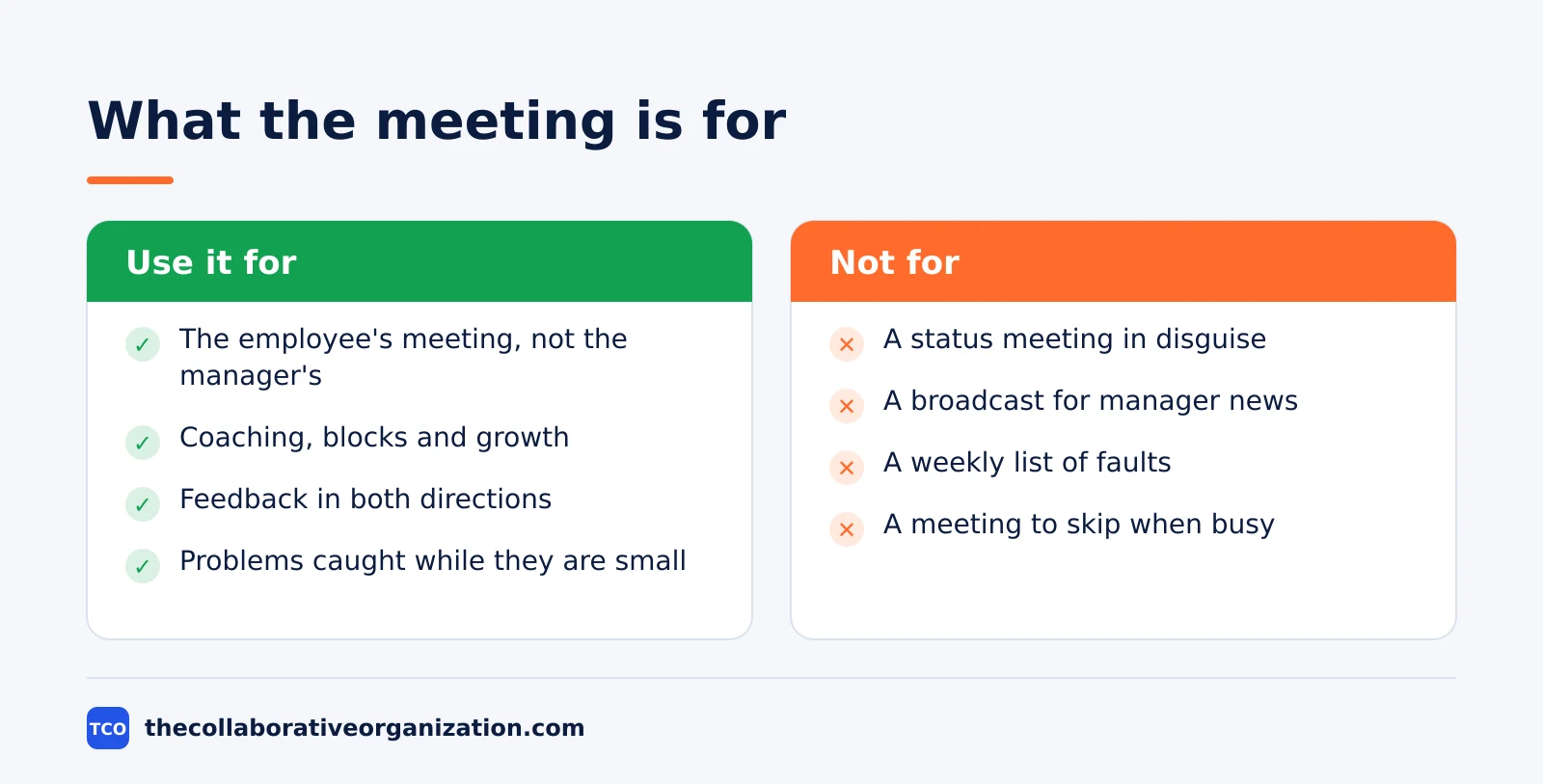
A one-on-one is the employee’s meeting, and its job is to help that person do their best work. That means removing blocks, giving feedback in both directions, talking about growth, and noticing problems early. It is not a status meeting, and it is not a place for the manager to broadcast news.
The difference shows in who talks. In a good one-on-one, the employee does most of the talking and the manager asks questions. The manager’s job is to listen, to ask what the person needs, and to clear the path. When the manager fills the time with updates, the meeting turns into a briefing the team could have read in email.
Gallup’s research gives the meeting a clear shape. Its list of the five characteristics of a meaningful conversation starts with recognition for recent work, then collaboration and relationships, then current goals and priorities, then short regular sessions, then the person’s strengths. A one-on-one that covers those five things is doing its job.
The same research shows how rare that is. Only 16% of nearly 15,000 employees said their last conversation with their manager was extremely meaningful. The gap is not effort: most managers meet their people already. The gap is what the meeting is used for.
Google’s Project Oxygen points the same way. Coaching ranked first among the ten behaviors of its most effective managers, and the coaching behavior includes holding regular one-on-ones. A team that meets weekly with its manager gets better results, and the meeting is where that coaching happens.
People only raise real problems when they feel safe to speak. Our guide on how to build psychological safety in a team explains how that safety is built, one conversation at a time.
How often and how long to meet
Meet weekly for 30 minutes with each direct report, and keep the slot fixed. Gallup’s advice is one meaningful conversation per week with each team member, and its research says the talk can be as short as 15 minutes. Weekly is the default because problems caught in a week are small, while problems caught in a month have grown roots.
Length matters less than regularity. Gallup found that 15- to 30-minute conversations have a greater effect than 30- to 60-minute ones, as long as they happen often. A short talk every week beats a long talk once a month, because the short talk keeps the relationship warm and the facts fresh.
Adjust the rhythm to the person. New starters and people going through a hard patch usually need weekly meetings, sometimes twice a week for a short while. Experienced people who work independently may prefer every other week, and that is fine once trust is built. Never let the gap grow past two weeks without a reason.
Protect the slot. A one-on-one that gets skipped three weeks in a row tells the person their time with you is optional. If you must cancel, reschedule it in the same week. If the other person cancels twice, ask whether the time or the format is wrong, and change it.
A weekly 30-minute agenda that runs itself
A one-on-one runs itself when the same five blocks repeat every week, with the employee’s topics first. The agenda below takes 30 minutes and needs no preparation beyond a shared note. Both of you add topics to the note before the meeting, and the note becomes the record after it.
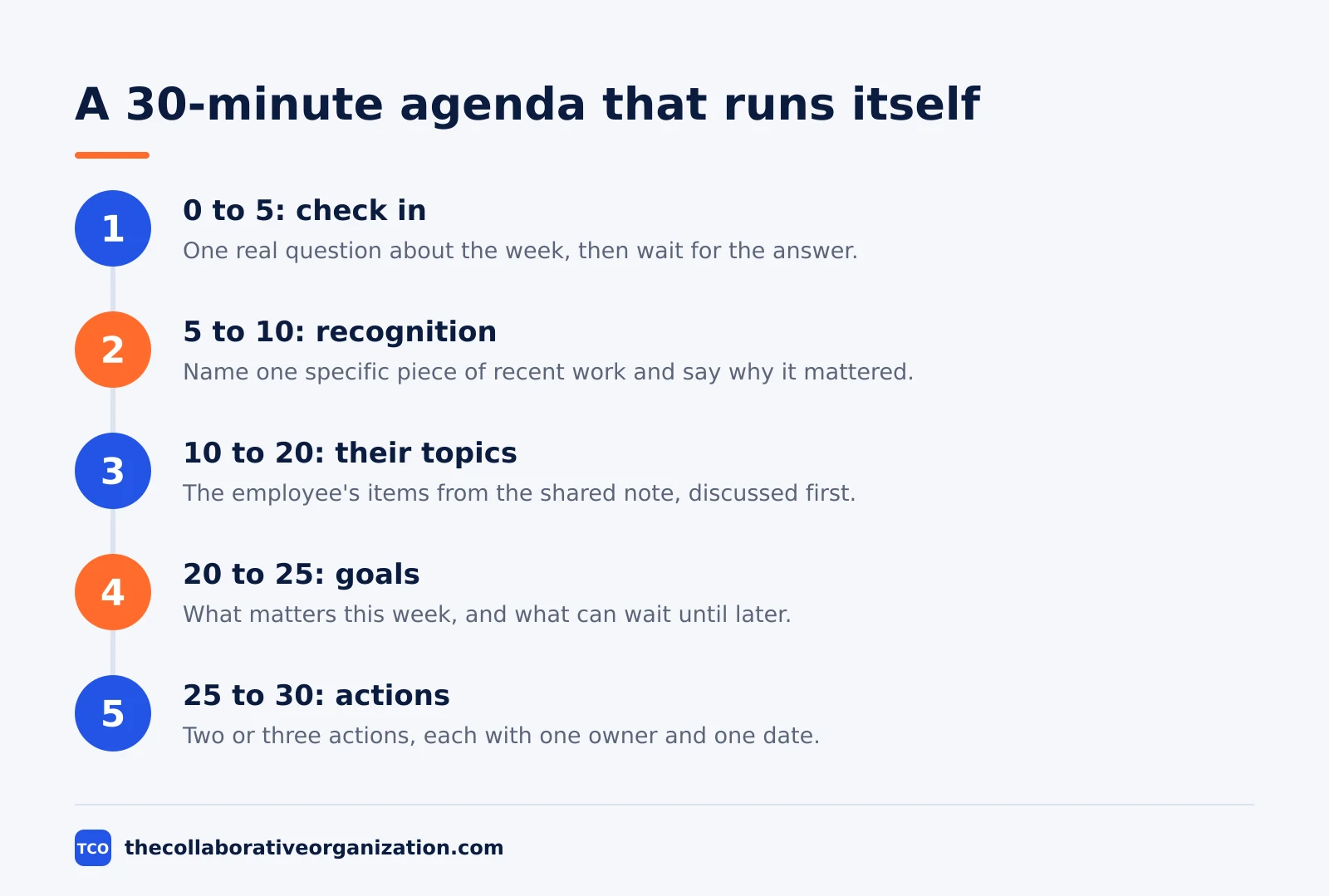
| Minutes | Block | What happens |
|---|---|---|
| 0 to 5 | Check in | How is the week going, and how is the person doing |
| 5 to 10 | Recognition | One specific piece of recent work, named and praised |
| 10 to 20 | Their topics | The employee’s items from the shared note, discussed first |
| 20 to 25 | Goals and priorities | What matters this week, and what can wait |
| 25 to 30 | Actions | Two or three actions, each with one owner and one date |
Open with the person, not the task. One real question about how their week is going, then wait for the answer. Recognition comes next because Gallup found it is the strongest feature of a meaningful conversation. Name one specific thing the person did well, and say why it mattered.
The middle ten minutes belong to the employee’s topics. These are the items they added to the shared note: a block, a decision they need, a worry about the work. Your job here is to ask questions and remove obstacles, not to solve everything yourself.
Close with goals and actions. Agree on what matters this week, and write down two or three actions with one owner and one date each. Our guide on how to set team goals shows how to keep those goals visible between meetings.
The questions that make a one-on-one work
Good one-on-one questions are open, short, and about the person’s work, not about your agenda. Ask one, then listen. The list below is a bank to draw from, not a script to read through. Pick two or three per meeting.
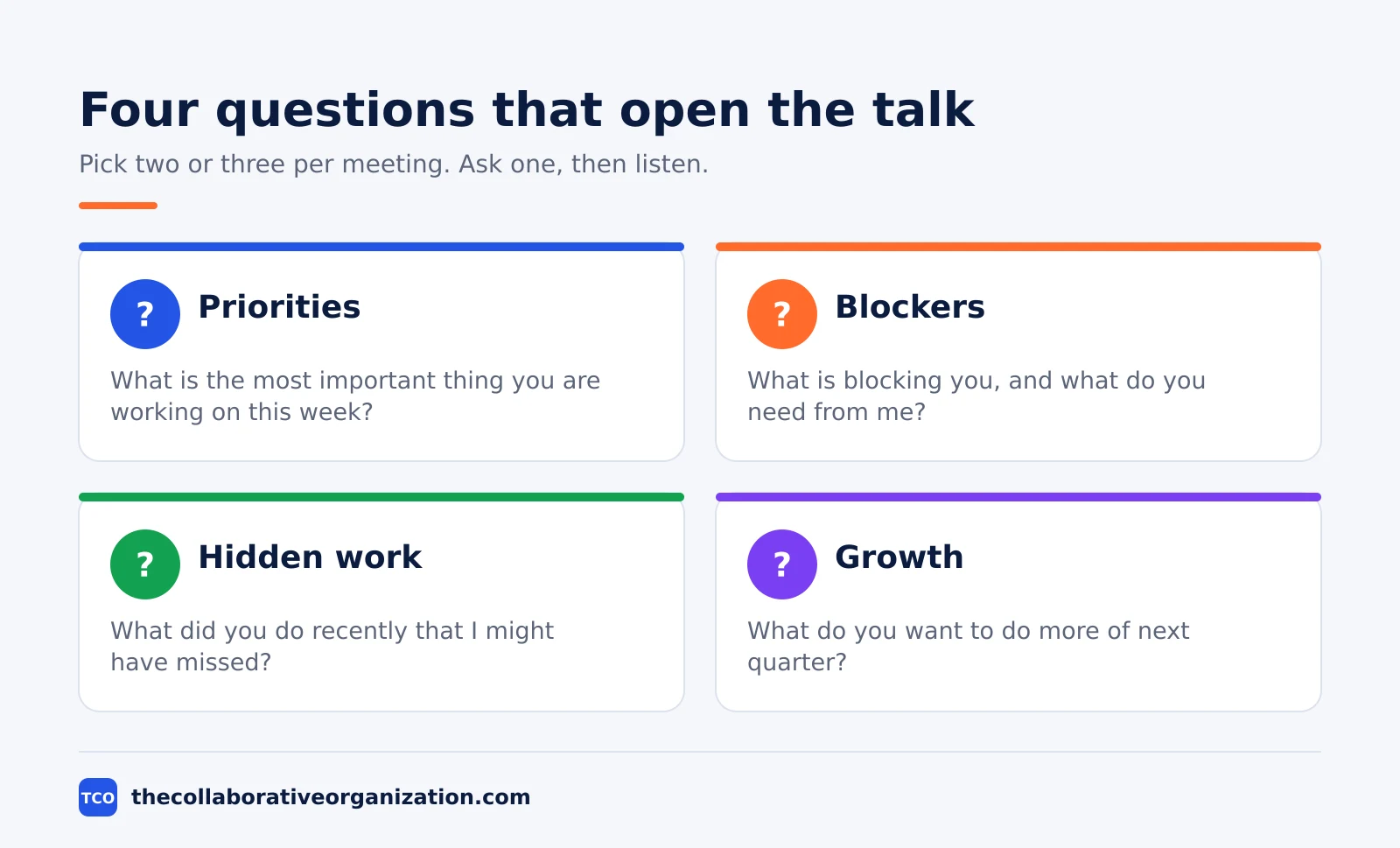
- “What is the most important thing you are working on this week?” This shows what the person thinks matters, and it often differs from what you think matters.
- “What is blocking you, and what do you need from me?” This is the fastest way to clear a block, because the person names the fix they need.
- “What did you do recently that I might have missed?” This catches good work you never saw, and it gives you something real to recognize.
- “What do you want to do more of next quarter?” This opens the growth talk without making it a formal career review.
- “What has not come up in meetings that I should know?” This invites the news people only share one to one.
- “Who helped you this week?” This surfaces the quiet helpers and tells you who the team relies on.
Ask about strengths, not only problems. Gallup lists strengths among the five characteristics of a meaningful conversation, while talking about weaknesses is the topic employees rate as least meaningful. That does not mean avoiding hard topics. It means the meeting should not be a weekly list of faults.
Listen more than you talk. A useful rule is that the employee speaks about two-thirds of the time and the manager speaks about one-third, mostly in questions. When you catch yourself giving a long answer, stop and ask what the person thinks.
Notes and follow-through
A one-on-one only works when the notes and actions from last week get reviewed this week. Keep one shared note per person, with the date, the topics, and the actions. The note is the memory of the relationship, and it stops the same problem from being discussed three times with no fix.
Write the actions down before the meeting ends. Each action needs one owner and one date, and most actions should belong to the manager, not the employee. When the manager’s actions keep slipping, the employee stops bringing problems, because nothing changes.
Keep the notes short. Three bullets for topics and three lines for actions are enough. A long transcript helps nobody, and it makes people careful about what they say. The note should record decisions and promises, not every word.
Follow-through is where trust is built. Gallup and Workhuman found that employees who get feedback and recognition from their manager at least once a week are 61% engaged, against 38% for those who get weekly feedback but less frequent recognition. The weekly note turns that recognition from a one-off comment into a pattern the person can count on.
Worked example: one weekly 30-minute one-on-one
This worked example is an illustration of the agenda above, not a real case. Leo manages a team of five and meets Sara, a support engineer, every Tuesday at 10 in the morning for 30 minutes. They share one note, and Sara adds her topics to it on Monday.
This Tuesday, the note has two items from Sara: a customer escalation that needs a decision, and a request to learn the new billing system. Leo adds one item: praise for Sara’s handling of a difficult outage last week.
The meeting opens with a check-in. Sara says the week is busy but fine. Leo names the outage work: Sara kept the customer informed while the team fixed the fault, and the customer wrote back to say thanks. That takes two minutes, and it is specific.
Sara’s first topic is the escalation. A customer wants a refund for a service gap, and Sara needs to know whether she can approve it. Leo asks what she recommends, she says a partial refund, and he agrees on the spot. The decision takes four minutes because Sara already did the thinking.
Her second topic is the billing system. She wants to learn it before the next release. Leo agrees to pair her with a teammate for two hours next week, and writes that action down with his own name on it.
They close with goals: the escalation reply goes out today, and Sara’s learning session is booked by Friday. The meeting ends at 10:30, and the note holds two actions, one for each of them.
Tools that support one-on-ones
The tools for one-on-ones are simple: a shared note, a place to track actions, and a chat channel for the follow-ups between meetings. The table below shows starting prices as of November 2026, taken from each vendor’s own pricing page.
| Tool | Best for | Free plan | Starting price (as of November 2026) | Notable limit |
|---|---|---|---|---|
| Slack | Quick notes and follow-ups between meetings | Free plan with 90 days of history | $7.25 per user per month (Pro), billed annually | Free plan keeps 90 days of history |
| Asana | Tracking actions with an owner and a date | Free for 2 people | $10.99 per user per month (Starter), billed annually | Free plan covers 2 people |
| Trello | A simple board for one-on-one actions | Free for up to 10 collaborators | $5 per user per month (Standard), billed annually | Free plan covers 10 collaborators |
The Slack pricing page lists Pro at $7.25 per user per month when billed annually. The Asana pricing page lists Starter at $10.99 per user per month when billed annually. The Trello pricing page lists Standard at $5 per user per month billed annually.
If you have not picked a tool yet, compare the options on our team communication software shortlist before you set one up. The right tool is the one both of you will open between meetings, not the one with the longest feature list.
Common one-on-one mistakes to avoid
Most one-on-ones fail in the same five ways, and each one has a simple cure. Run through the list before your next round of meetings.
- Turning it into a status meeting. If the whole 30 minutes lists task updates, move status to a written update and use the meeting for blocks, growth and feedback.
- Skipping it when work gets busy. A cancelled one-on-one is the first sign the relationship is slipping down the priority list. Reschedule in the same week, every time.
- Talking more than listening. A meeting where the manager speaks two-thirds of the time is a briefing. Ask a question, then wait for the answer.
- Never following up. Actions with no owner and no date are wishes. Review last week’s actions first, and say plainly which ones are done.
- Saving hard topics for the review. Feedback given once a year helps nobody. Our guide on how to give feedback to a coworker shows how to name one behavior and its impact while the moment is fresh.
How to tell your one-on-ones work
One-on-ones work when actions get done, problems surface early, and the person brings their own topics. Watch for three signs over a month. First, the actions from last week are mostly done, and the ones that slipped have a reason and a new date.
Second, the employee brings topics without being asked. A shared note that fills up before the meeting means the person trusts the meeting enough to use it. An empty note week after week means the meeting has not earned that trust yet.
Third, hard news arrives in the one-on-one before it arrives anywhere else. When a person tells you about a conflict, a missed deadline or a wish to leave, the meeting is doing its job. Gallup found that 80% of employees who received meaningful feedback in the past week are fully engaged.
Count the cost of skipping, too. Note how many one-on-ones were cancelled in a month and how many actions went stale. Those numbers make the case for protecting the slot, because a 30-minute talk beats a month of guessing what your team thinks.
Sources
- Gallup - Gallup Finds a Silver Bullet: Coach Me Once Per Week (2021)
- Gallup - A Great Manager’s Most Important Habit (2023)
- Gallup - How Effective Feedback Fuels Performance (2022)
- Google re:Work - Following the Data: The Research Behind Great Managers (2026)
- Gallup - Organizations Can Redefine Feedback by Including Recognition (2024)
- Slack - Pricing (2026)
- Asana - Pricing (2026)
- Trello - Pricing (2026)
Frequently asked questions
How often should you hold one-on-ones?
Weekly for most direct reports, for 15 to 30 minutes each. Gallup found that one meaningful conversation per week with each team member builds high-performance relationships more than any other leadership activity. Short and regular beats long and rare, so protect the slot and only skip it when one of you is on leave.
How long should a one-on-one last?
Thirty minutes works for most teams. Gallup found that 15- to 30-minute conversations have a bigger effect than 30- to 60-minute ones when they happen regularly. New starters and people going through a hard patch usually benefit from weekly meetings, while experienced people who work independently may prefer every other week.
Who sets the agenda for a one-on-one?
The employee sets most of it. Ask each person to add their topics to a shared note before the meeting, and you add one or two of your own. A meeting where the manager brings the whole agenda is a status meeting with a new name, and it misses the point of the one-on-one.
What should you do when someone cancels a one-on-one?
Reschedule it in the same week instead of dropping it. A skipped one-on-one tells the person their time with you is the first thing to go when work gets busy. If cancellations keep happening, ask the person whether the time, the length, or the format is wrong, and change it.
Should one-on-ones be in person or on video?
Either works if the conversation is real. In person suits teams in one office, and video suits remote and hybrid teams. What matters is undivided attention: close other tabs, silence notifications, and take notes by hand or in the shared doc. A video call with the camera on beats an in-person meeting where you check your phone.
Related articles
team communication
Communication Plan for a Project: Template (2026)
A communication plan for a project names who gets which update, in which channel, how often, and from whom. Copy the template and the filled example below.
November 20, 2026 · 10 min read
team communication
How Often Should Managers Communicate With Teams? (2026)
Managers should hold one meaningful conversation with each person every week, plus a weekly team update. See the cadence table for meetings, updates and feedback.
November 20, 2026 · 9 min read
team communication
Upward Communication Examples: 10 That Work (2026)
Upward communication is a message that travels from an employee to a manager or leader. See 10 concrete examples, each with why it works and when to use it.
November 20, 2026 · 9 min read