How to Set Team Goals That Your Team Actually Hits (2026) | The Collaborative Organization
By The Collaborative Organization Team · November 19, 2026 · Last verified November 19, 2026 · 9 min read

Setting team goals means picking three to five measurable outcomes for the quarter, writing each one so the team can tell when it is done, and reviewing progress every week. The process starts from a company priority, not from a blank page, and it ends with one owner and one number per goal.
Key takeaways
- A team goal names a measurable outcome with a deadline, not a list of tasks.
- Gallup found that employees involved in setting their goals are 3.6 times more likely to be engaged.
- Cap the list at three to five goals so the team can focus on each one.
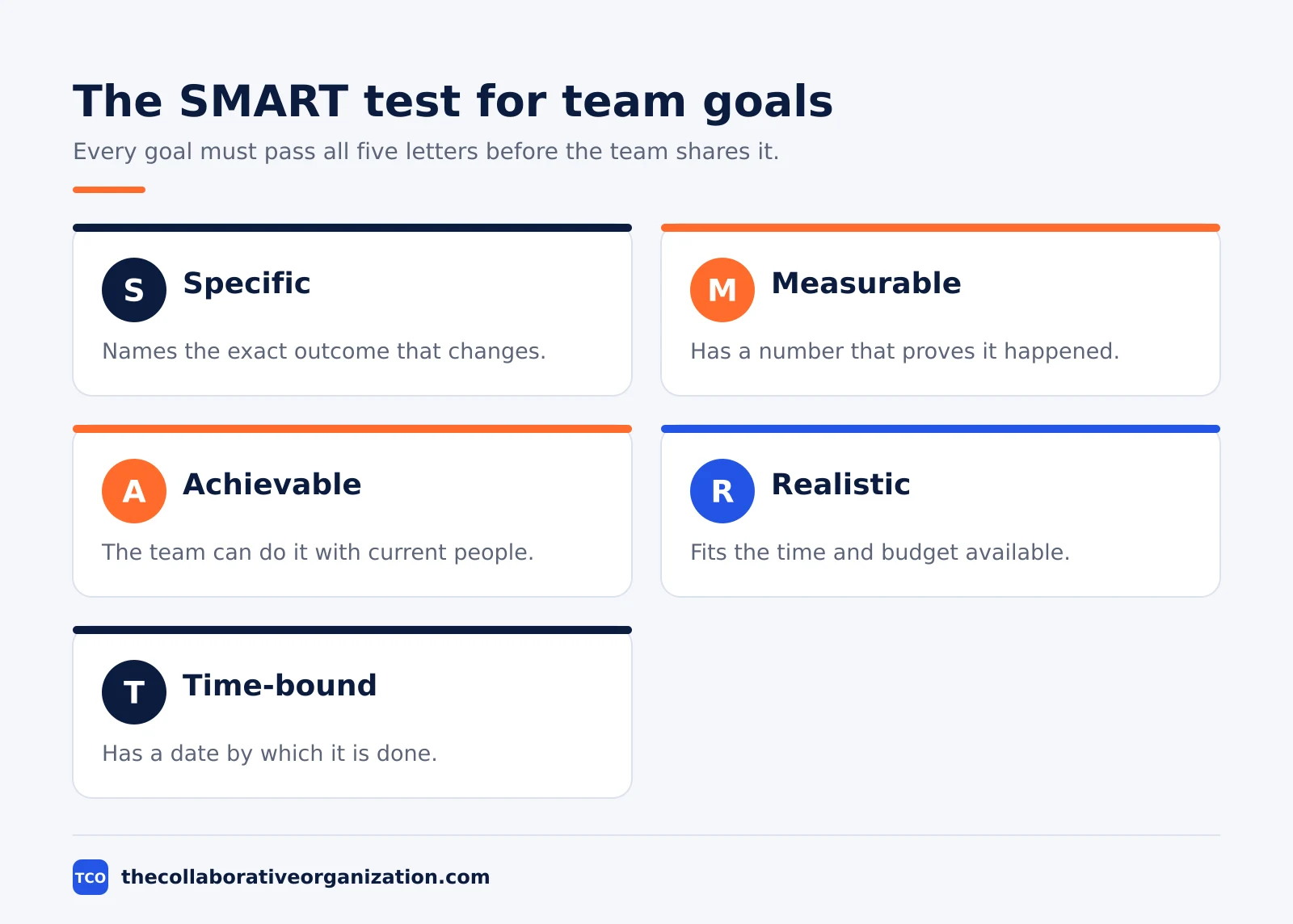
- Write every goal SMART: specific, measurable, achievable, realistic and time-bound.
- Review progress weekly and review the goals themselves once a month.
What a good team goal looks like
A good team goal states an outcome, a number and a date in one sentence. It answers three questions: what changes, by how much, and by when. If any of those three is missing, the goal is a wish, not a target.
The SMART test is the fastest way to check a goal. Asana spells SMART out as specific, measurable, achievable, realistic and time-bound, and gives a five-step writing method that follows the same order. Run each draft goal through the five letters before you share it with the team.
| Letter | Question to ask | Weak version | Strong version |
|---|---|---|---|
| Specific | What exactly changes? | Improve support | Cut first-response time |
| Measurable | What number proves it? | Faster replies | Under 2 hours, from 4.5 hours |
| Achievable | Can the team do it? | Reply in 5 minutes | Reply in under 2 hours |
| Realistic | Does it fit the resources? | With no new hires | With the current 6-person team |
| Time-bound | By when? | Soon | By 31 March 2027 |
A goal also needs one owner and one measure. Asana Goals puts it plainly: each goal has one owner, a time period and a progress measure. A goal owned by the whole team is owned by no one, so name the person who reports the number each week.
How to set team goals in 6 steps
Setting team goals takes six steps: start from the company priority, involve the team, write each goal SMART, cap the list, assign an owner and a measure, then set the review rhythm. Budget about two hours for the first session and 30 minutes a week after that.
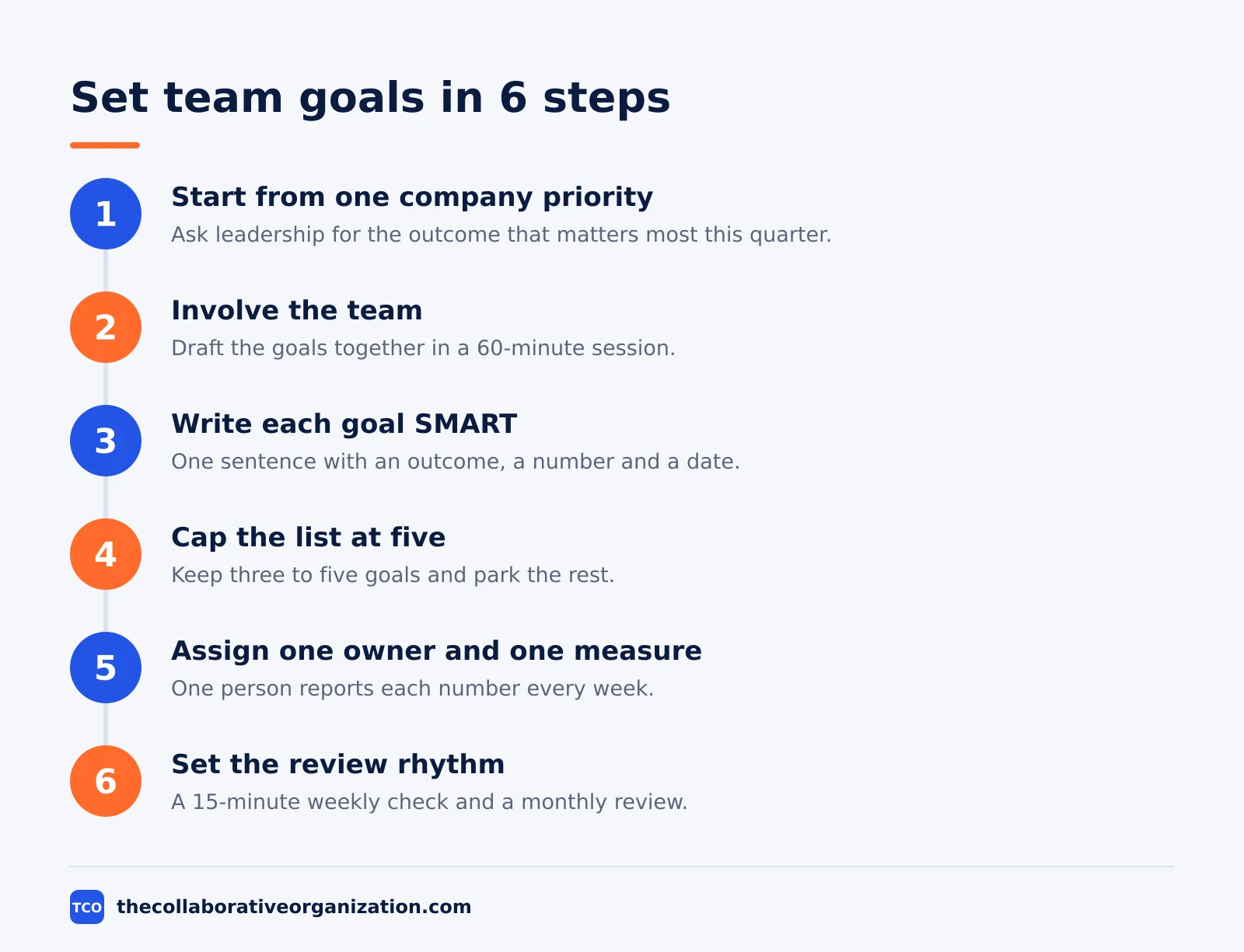
Step 1: Start from one company priority
Ask leadership for the one company outcome that matters most this quarter, such as keeping more customers or shipping a new product. Write it at the top of the page before anyone suggests a team goal. A team goal that does not connect to a company priority is hard to defend when time gets short.
Step 2: Involve the team in shaping the goals
Hold a 60-minute session where the team drafts the goals together. The manager brings the priority and the deadline, and the team brings the detail on what is realistic. Gallup found that only 30% of employees strongly agree their manager involves them in setting goals, yet those employees are 3.6 times more likely to be engaged than the rest.
Step 3: Write each goal SMART
Turn each draft into one sentence with an outcome, a number and a date. Test it against the table above and fix the weak letters. A goal that fails the measurable test cannot be tracked, so rewrite it until the number is clear.
Step 4: Cap the list at three to five goals
Rank the drafts by impact and keep the top three to five. Move the rest to a parking list for next quarter. A team with ten goals has no priority, and the goals that matter most get the same attention as the rest.
Step 5: Assign one owner and one measure per goal
Give each goal a single owner who reports the number, and pick one measure that proves progress. Asana Goals offers manual or automatic progress tracking, and automatic tracking suits goals that move every week. Record the starting number now, so later progress means something.
Step 6: Set the review rhythm before you start
Put a 15-minute weekly check-in on the calendar and a 45-minute monthly review. The weekly check covers the current number and the next action. The monthly review asks whether each goal still fits, and changes the ones that do not.
Worked example: a support team sets its goals
A six-person support team used the six steps to set three goals for one quarter, and the example below shows the result. The numbers are an illustration, not a real company plan. The team started from the company priority of keeping more customers, then picked the three outcomes that would move it most.
| Goal | Measure | Start | Target | Owner |
|---|---|---|---|---|
| Cut first-response time | Median hours to first reply | 4.5 hours | Under 2 hours | Support lead |
| Lift the satisfaction score | Post-ticket survey score | 4.1 out of 5 | 4.5 out of 5 | Support lead |
| Clear the ticket backlog | Tickets older than 7 days | 86 tickets | Under 20 tickets | Senior agent |
The team rejected a fourth goal, answering every ticket within one hour, because it failed the achievable test with six people and no new hires. It also rejected a goal to rewrite the help centre, because that work belonged to the content team. The three goals that survived each had one owner, one number and one date.
How many goals should a team set?
Three to five goals is the right range for most teams. Fewer than three leaves important work without a target, and more than five splits attention so thin that none of them gets real focus. Small teams should aim for three, and larger teams can stretch to five.
The count matters because goals compete for the same hours. Focus needs a short list.
Research by Donald Sull and Charles Sull, published in MIT Sloan Management Review, found that specific, ambitious goals lift an average team to the 80th percentile of performance, based on more than 500 studies over 50 years.
Sull and Sull also found that adding a metric to each goal and giving regular feedback lifts an average team further, to the 88th percentile.
Their meta-analysis covered 83 interventions in settings that included the US Air Force, high-tech plants and hospitals. The lesson is simple: a short list of measured goals beats a long list of vague ones.
How to measure success
A team goal succeeds when its number hits the target by the date, and the team can show the work that moved it. Track the number weekly and record the starting point, so progress is a comparison, not a guess.
Use the FAST test to keep the goals alive after the first week. FAST stands for Frequently discussed, Ambitious, Specific and Transparent.
Sull and Sull introduced FAST in MIT Sloan Management Review in 2018 as a fix for goals set in January and forgotten by February. Discuss the goals every week, keep them ambitious, and make them visible to everyone.
Visibility matters more than most teams expect. In the same MIT Sloan research, more than 90% of users on the BetterWorks goal platform chose to make their goals public. When goals are public, other teams can see them, check their own work against them, and spot clashes before they cost a quarter.
Tools that help teams set and track goals
A shared tool keeps the goals, the owners and the numbers in one place, so the weekly review takes minutes instead of an hour. Pick the tool the team already opens every day. Our project management software shortlist compares the full set side by side.
| Tool | Best for | Free plan | Starting price (as of November 2026) | Goal tracking |
|---|---|---|---|---|
| Asana | Teams that link goals to daily work | Free for 2 people | $24.99 per user per month (Advanced), billed annually | Goals with sub-goals and automatic progress |
| ClickUp | Teams that want goals on the entry plan | Free Forever plan | $9 per user per month (Core), billed annually | Goals included in Core |
| Trello | Small teams that track simple targets | Free for up to 10 collaborators | $5 per user per month (Standard), billed annually | Track targets as cards |
The Asana price comes from the Asana pricing page: Goals sit on Advanced at $24.99 per user per month billed annually, while Starter is $10.99.
ClickUp lists Goals in its Core plan at $9 per user per month billed yearly on its pricing page, shown against a $12 regular price, so the $9 rate may be a promotion.
Trello lists Standard at $5 per user per month billed annually on its pricing page, with Premium at $10.
Our guide to Asana Goals explained shows how the goal types, owners and progress measures work inside Asana.
If you have not picked a tool yet, our guide on how to choose project management software covers seat counts and free-plan caps.
Common team goal-setting mistakes to avoid
Most team goals fail in the same five ways, and all five are easy to spot before the quarter starts. Run through the list below each time the team sets new goals.
- A goal with no number. “Improve support” is a wish, not a goal. Add a measure and a target, such as cutting first-response time to under 2 hours by 31 March 2027.
- Too many goals. Ten goals mean no goal is the priority. Keep three to five and park the rest for next quarter.
- Goals set without the team. A target handed down with no discussion gets no buy-in. Gallup found that only 30% of employees strongly agree their manager involves them in setting goals.
- No owner. A goal owned by the team is owned by no one. Name one person who reports the number each week.
- Goals never reviewed. A goal checked once a quarter is a poster, not a tool. Review it weekly and post the current number where the team can see it.
Sources
- Gallup - Re-Engineering Performance Management (2018)
- MIT Sloan Management Review - With Goals, FAST Beats SMART (2018)
- Asana - What Are SMART Goals? (2026)
- Asana - Goals: set and track measurable objectives (2026)
- Asana - Pricing (2026)
- ClickUp - Pricing (2026)
- Trello - Pricing (2026)
Frequently asked questions
How many goals should a team set at once?
Three to five goals is the right range for most teams. Fewer than three leaves important work without a target, and more than five splits attention so thin that none of them gets real focus. If the list is longer, rank the goals and move the rest to next quarter.
Who should set team goals, the manager or the team?
Both. The manager brings the company priority and the deadline, and the team brings the detail on what is realistic and how the work will get done. Gallup found that employees whose managers involve them in goal setting are 3.6 times more likely to be engaged than other employees.
Should team goals be SMART or FAST?
Use both. SMART shapes each goal so it is specific, measurable, achievable, realistic and time-bound. FAST keeps the set alive: discuss the goals often, make them ambitious, keep them specific, and make them visible to everyone. SMART builds the goal and FAST keeps it moving.
How often should a team review its goals?
Review progress every week in a short check-in, and review the goals themselves once a month. Weekly checks catch drift early, while the monthly review lets you change a target that no longer fits. A goal checked only at the end of the quarter is a poster, not a tool.
What makes a team goal different from a task?
A goal names an outcome, such as cutting first-response time to under two hours, while a task names one piece of work, such as writing a reply template. Tasks end when the work is done. A goal ends when the number hits its target, and several tasks usually feed one goal.
Related articles

project management
How to Choose Project Management Software (2026)
Pick project management software in seven steps: define the work, count seats, price the real cost, and run a two-week pilot before you pay.
November 19, 2026 · 10 min read

project management
What Is a RACI Matrix? Definition, Roles and Examples (2026)
A RACI matrix maps who is Responsible, Accountable, Consulted and Informed for each task. Learn the four roles, how to build one, and see a worked example.
November 19, 2026 · 9 min read
project management
Daily Standup Meeting Format That Works (2026)
A daily standup is a 15-minute meeting where Developers inspect progress toward the Sprint Goal and plan the next day. Use this format to run one that ends on time.
November 19, 2026 · 10 min read