How to Build Psychological Safety in a Team (2026) | The Collaborative Organization
By The Collaborative Organization Team · November 19, 2026 · Last verified November 19, 2026 · 10 min read
To build psychological safety in a team, the leader goes first: admit mistakes in public, thank people who raise problems, and act on what they say. Safety grows from repeated reactions, not from one workshop, so the seven steps below are weekly habits rather than a single event.
Key takeaways
- Safety is built team by team, not company-wide, because it is a property of one team.
- Only 26% of leaders in a 2021 McKinsey survey frequently showed behaviours that build psychological safety.
- The four stages give the build order: inclusion, learner, contributor, then challenger safety.
- The leader’s reaction to the first piece of bad news sets the climate for the whole team.
- Measure progress with Edmondson’s seven-item survey, run anonymously and repeated every few months.
What you need before you start
Before you start, you need three things: a baseline score, a leader who will go first, and one team to focus on. Without a baseline, you cannot tell whether anything changed. Without a leader who models the behaviour, the team will not believe the change is real.
Run Edmondson’s seven-item survey first, anonymously, and share the average. The survey takes five minutes and gives you a number to beat: each member rates seven statements from 1 to 7, with three items reverse-scored. A low score on one item shows where to start, such as “it is difficult to ask for help”.
Pick one team, not the whole company. Safety varies team by team inside the same firm, so a company-wide program spreads effort thin and hides the teams in trouble. One team that improves becomes the proof that the next team can copy.
Get the leader’s agreement in plain terms: they will admit their own mistakes in public, thank people who raise problems, and act on at least one raised issue each week. If the leader will not do that, fix the leadership first, because no workshop survives a leader who punishes the first speaker.
How to build psychological safety in a team in 7 steps
Building psychological safety takes seven steps: measure the baseline, go first as a leader, invite dissent, respond well to bad news, make it easy to ask for help, share decisions, and measure again. Each step is a habit, and the order matters: trust in the leader comes before trust in the room.
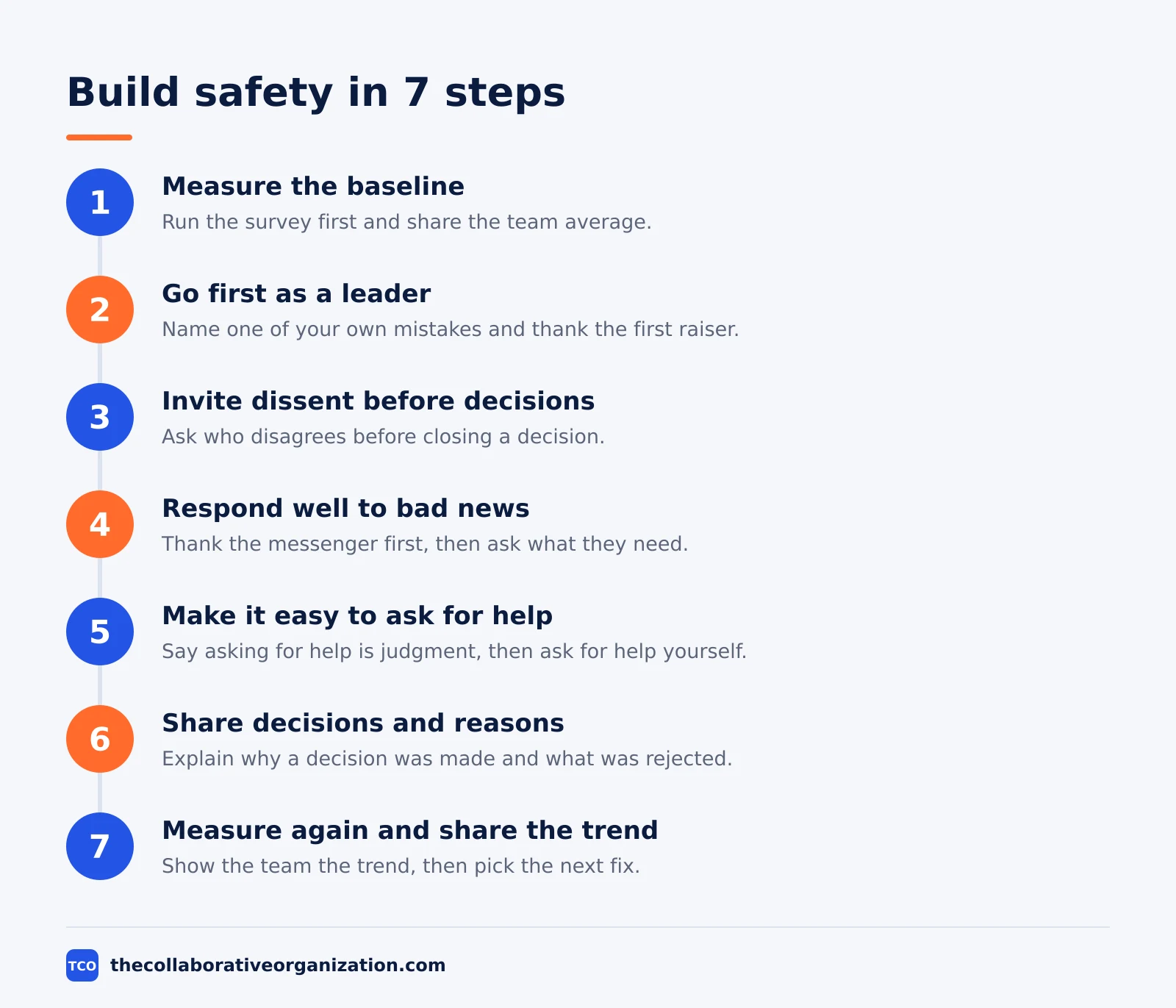
Step 1: Measure the baseline
Run the seven-item survey anonymously and share the team average. Tell the team what the number means and what you will do about the lowest item. A baseline turns a vague feeling into a target, and it gives the team proof later that the work paid off.
Step 2: Go first as a leader
Open the next team meeting by naming one of your own mistakes and what you learned from it. Then thank the first person who raises a problem, in front of the team, before you debate the issue. The team copies what the leader does far more than what the leader says.
Step 3: Invite dissent before decisions
Before closing a decision, ask directly: “What are we missing, and who disagrees?” Give the quieter people the first word, and wait through the silence instead of filling it. A decision made after real dissent holds longer than one made after polite nods.
Step 4: Respond well to bad news
When someone brings a problem, thank them first, then ask what they need. Never shoot the messenger, even when the news is late or the problem is large. The team’s memory of your reaction lasts longer than the problem itself, and it decides whether the next problem gets raised early.
Step 5: Make it easy to ask for help
Say out loud that asking for help is a sign of judgment, not weakness, then prove it by asking for help yourself. Pair new members with a buddy for their first month, and answer questions in the shared channel so the whole team learns from each answer.
Step 6: Share decisions and reasons
Explain why a decision was made, including what was rejected and why. When people see the reasons, they can disagree with the reasons instead of guessing at motives. A team that understands the “why” speaks up more, because it can argue about facts rather than feelings.
Step 7: Measure again and share the trend
Repeat the survey after three months and show the team the trend, not just the new number. Celebrate the items that moved, name the ones that did not, and pick the next fix from the lowest score. Measurement without a follow-up is a survey; measurement with a follow-up is a program.
The 4 stages as your build order
Build safety in the order people need it: inclusion first, then learner, contributor, and challenger safety last. Timothy R. Clark set out the four stages in his 2020 book, and his research shows people seek them in that sequence.
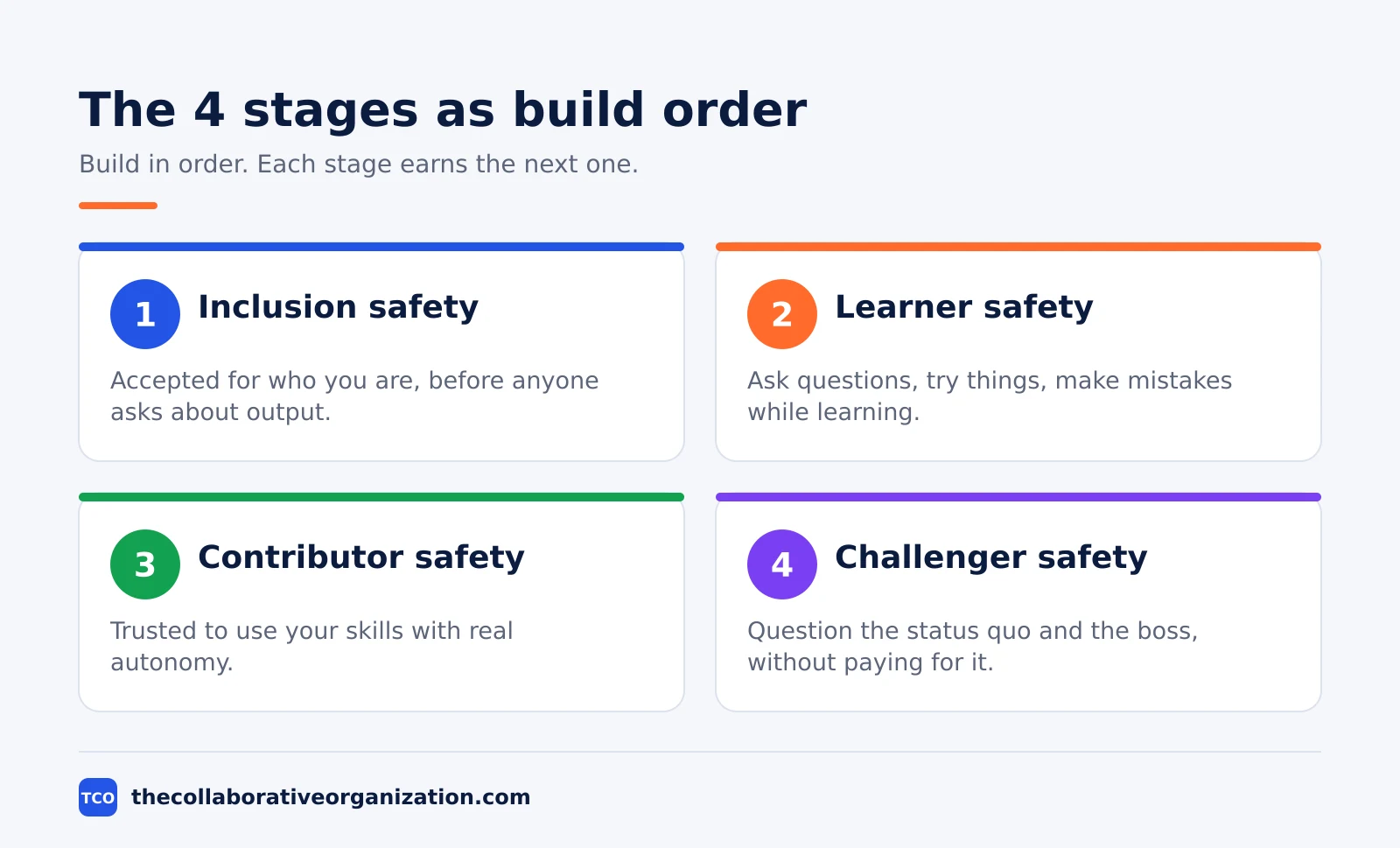
| Stage | What to do this month | Sign it is working |
|---|---|---|
| 1. Inclusion safety | Learn names, invite everyone to speak, greet new members by name | People show up as themselves |
| 2. Learner safety | Welcome questions, treat errors as lessons, praise asking for help | Questions come early, not late |
| 3. Contributor safety | Give real work with real autonomy, credit the author | People volunteer ideas unprompted |
| 4. Challenger safety | Ask for dissent, protect people who challenge you | Someone disagrees with the leader |
Most teams get stuck just before the final stage, because challenging the leader feels like the biggest risk of all. Clark’s survey of 3,366 employees across more than 20 organisations found that 86% put challenging how things are done last, after inclusion, learning and contributing.
Do not skip a stage to reach challenger safety faster. A team that has not felt included will not risk a challenge, and a team that has never been thanked for learning will not volunteer a dissenting idea. Each stage earns the next one, and rushing the order breaks the chain.
Worked example: the quiet standup that changed
A worked example shows the seven steps on a team whose standups had gone silent: eight people, fifteen minutes, and only two voices. Imagine a support team that meets each morning. The lead talks, one senior engineer answers, and the other six nod. Bugs surface late, fixes take days, and the lead blames the team for not speaking up.
In week one, the lead runs the survey. The lowest item is “it is difficult to ask other members of this team for help”, which scores 2.4 out of 7. In week two, the lead opens the standup by naming a routing mistake she made the day before, and she thanks the junior engineer who spotted it.
In week three, she changes the format: each person names one blocker before the lead speaks, and she waits through the silence instead of filling it.
By week five, three people have raised blockers early, and one fix that used to take days now takes an afternoon. The survey at month three shows the help item up to 4.8, and the standup has six voices instead of two.
Nothing in the example needed a budget or a consultant. It needed a leader who went first, a format that gave quiet people the first word, and a measurement that showed the change was real. A team kickoff is a good place to set these habits, because the first meeting of a new team sets the tone for months.
How leaders set the tone
Leaders set the tone for safety through three behaviours: consultative, supportive and challenging. McKinsey’s February 2021 study named those three as the behaviours that build safety, and it found that only 26% of leaders showed them often.
Consultative leaders ask for input and weigh the team’s views before deciding. Supportive leaders show concern for people as individuals, not only as workers. Challenging leaders ask the team to re-examine its assumptions and to reach past what feels comfortable. The three work together: asking without support feels like a test, and support without challenge feels like comfort.
The style that harms safety is the classic command-and-control approach, where the leader decides and the team obeys. McKinsey’s survey found that only 43% of employees reported a positive climate in their team, and the gap between what people want and what they get starts with how leaders act in ordinary meetings.
One habit ties the three behaviours together: narrate your thinking. Say why you are asking, what you do not know yet, and what would change your mind. A leader who thinks out loud gives the team permission to do the same, and that permission is the sound of safety being built.
Tools that help teams build safety
A shared tool helps build safety because it lets people speak up in writing, where quieter members often find it easier than in a live meeting. Written updates, shared boards and visible decisions give everyone the same chance to contribute, not only the fastest talkers.
If you have not picked a tool yet, compare the options on our project management software shortlist before you set up the board. The right tool is the one the team opens every day, not the one with the longest feature list.
| Tool | Best for | Free plan | Starting price (as of November 2026) | Notable limit |
|---|---|---|---|---|
| Asana | Written status updates and clear owners | Free for 2 people | $10.99 per user per month, billed annually | Free plan covers 2 people |
| monday.com | A shared board where everyone can comment | Free plan for up to 2 seats | $9 per seat per month (Basic), billed annually | Paid plans need at least 3 seats |
| ClickUp | Docs, chat and tasks in one place | Free Forever plan | $9 per user per month (Core), billed annually | Yearly billing needed for that price |
The Asana price comes from Asana pricing: Starter is $10.99 per user per month when billed annually.
On the monday.com pricing page, Basic is $9 per seat per month billed annually, with a 3-seat minimum.
The ClickUp pricing page lists Core at $9 per user per month billed yearly.
How to measure progress
Measure progress with the same seven-item survey, repeated every three months, and watch the trend rather than one number. Edmondson’s scale runs from 1 to 7, with items 1, 3 and 5 reverse-scored, and the team average is the score.
Look at the lowest item first, because one low item points at the next fix. If “members can bring up tough issues” scores low, the fix is in how meetings handle dissent.
If “it is difficult to ask for help” scores low, the fix is in how the team pairs people and answers questions. The survey is a map, not a grade.
Share the results back to the team, including the items that did not move. Hiding a bad score breaks trust faster than the score itself does, and a team that sees its leader face a flat number learns that honesty is safe.
Google’s study of 180 teams ranked psychological safety first among five dynamics of effective teams, so the trend you are tracking is the one that matters most.
Our guide on how to improve team collaboration gives more habits that move the same numbers.
Common psychological safety mistakes to avoid
Five habits undo safety faster than any workshop can rebuild it, and leaders are usually the ones doing them. Check the list against your own last month.
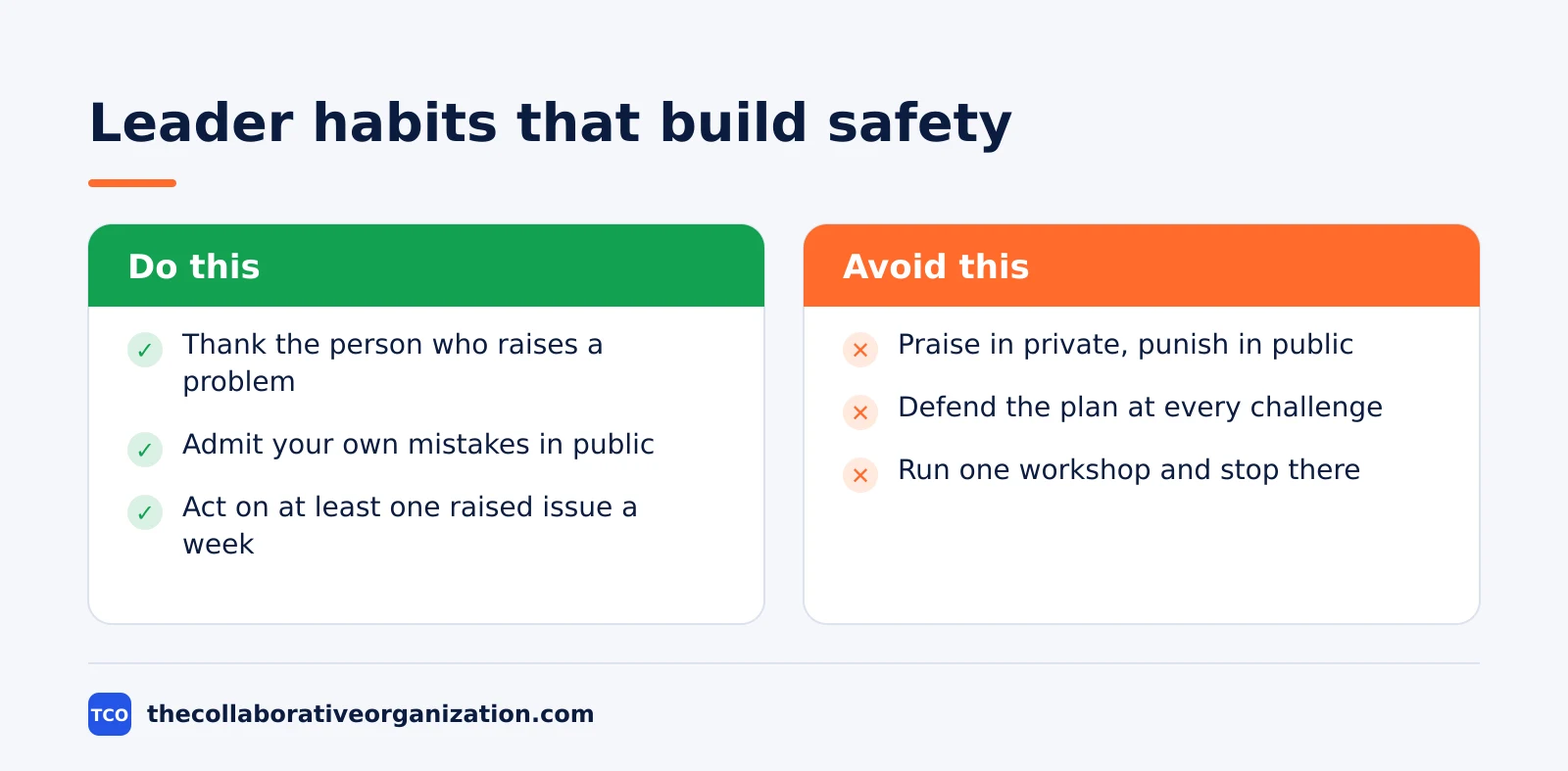
- Thanking people in private, punishing them in public. Praise that only happens behind closed doors does not count. The team watches the public reaction.
- Asking for dissent, then defending the plan. If every challenge meets a rebuttal, the team learns that “what do you think?” means “agree with me”. Pause, write the challenge down, and answer it the next day.
- Running one workshop and calling the job done. A training day starts the work; the daily reactions finish it. Safety is a habit, not an event.
- Measuring the company instead of the team. A company average hides the two teams in trouble. Score each team on its own and act on the lowest score first.
- Blaming the quiet people. Silence is usually a signal about the room, not about the person. Ask what happens when someone speaks up before asking why someone stays quiet.
Sources
- McKinsey - Psychological Safety and the Critical Role of Leadership Development (2021)
- LeaderFactor - Dr. Timothy R. Clark on Psychological Safety: The 4 Stages (2026)
- PEAKTEAMS - Psychological Safety Survey: Questions and Scoring (2026)
- Unfreeze - Psychological Safety at Work: Meaning, History, Evidence (2026)
- Google - The Five Dynamics of Effective Teams (2018)
- Asana - Pricing (2026)
- monday.com - Pricing (2026)
- ClickUp - Pricing (2026)
Frequently asked questions
How long does it take to build psychological safety in a team?
Expect the first visible change in four to six weeks, and a real shift in three to six months. People test a new climate with small risks first, like asking a question, before they risk a big dissent. A team that sees its leader welcome bad news twice will start to believe the change is real.
Who should lead the work of building psychological safety?
The team leader must go first, because the team watches how the leader reacts to bad news more than what the leader says about safety. A peer group or an outside coach can help with surveys and workshops, but no workshop fixes a leader who punishes the first person to speak up.
What is the single most effective thing a leader can do?
Admit a mistake in public and thank the person who points one out. That pair of acts shows the team that honesty is rewarded, not punished. McKinsey found that consultative, supportive and challenging leader behaviours build safety, and admitting a mistake is the fastest way to show all three at once.
Should psychological safety be built team by team or company-wide?
Team by team. Safety is a property of one team, so a company-wide average hides the teams that need help most. Start with one team, measure it with the seven-item survey, learn what works there, then spread the practices to the next team with the lessons included.
What if the team leader is the problem?
Then the work starts above the team. A leader who shuts down dissent will undo every workshop and survey, so the leader's own manager must name the behaviour and coach it. If that does not work, the team needs a different leader or a new reporting line before safety can grow.
Related articles
project management
How to Choose Project Management Software (2026)
Pick project management software in seven steps: define the work, count seats, price the real cost, and run a two-week pilot before you pay.
November 19, 2026 · 10 min read
project management
What Is a RACI Matrix? Definition, Roles and Examples (2026)
A RACI matrix maps who is Responsible, Accountable, Consulted and Informed for each task. Learn the four roles, how to build one, and see a worked example.
November 19, 2026 · 9 min read
project management
Daily Standup Meeting Format That Works (2026)
A daily standup is a 15-minute meeting where Developers inspect progress toward the Sprint Goal and plan the next day. Use this format to run one that ends on time.
November 19, 2026 · 10 min read