How to Give Feedback to a Coworker (Without the Awkwardness) | The Collaborative Organization
By The Collaborative Organization Team · November 19, 2026 · Last verified November 19, 2026 · 9 min read
Give feedback to a coworker soon after the moment, in private, using one clear example of what they did and what it caused. Gallup found 80% of employees who got meaningful feedback in the past week are fully engaged, and daily feedback makes staff 3.6 times more likely to feel motivated to do outstanding work.
Key takeaways
- Give feedback within a day, while the moment is fresh.
- Use one clear example: what happened, what the person did, what it caused.
- Keep it about behavior, not character.
- Ask what the other person was trying to do before you judge the result.
- Follow up once, then move on.
Why feedback from a coworker matters
Coworker feedback fills the gap managers leave: Gallup found 80% of employees who received meaningful feedback in the past week are fully engaged. Peers see the daily work a manager never sees, so a short note from a teammate often lands harder than a formal review.
Frequency beats formality. Gallup found employees are 3.6 times more likely to strongly agree they are motivated to do outstanding work when their manager gives feedback daily rather than once a year. The same logic holds between peers: a quick word after the moment beats a long talk months later.
Most conversations with managers miss the mark. Gallup found only 16% of nearly 15,000 employees said their last conversation with their manager was extremely meaningful. A peer who speaks up early can say the thing a manager never gets around to.
Feedback also protects the team. A 1996 meta-analysis in Psychological Bulletin found feedback improved performance on average, but over a third of feedback interventions made performance worse. The difference is how the feedback is given, which is what the rest of this guide covers.
Peer feedback also builds the relationship itself. Gallup notes that peer-to-peer feedback strengthens relationships between colleagues, because it shows people are paying attention to each other’s work. A team that talks about the work early talks about it more easily later.
What good feedback looks like
Good feedback is frequent, focused and future-oriented, in Gallup’s words. Frequent means a few times a week for most jobs, focused means it speaks to the person’s own talents and work, and future-oriented means it looks at what comes next rather than past blunders.
Good feedback names a behavior, not a character trait. Say what the person did and what happened next, and leave out labels like lazy or careless. Behavior can change; a label sticks and starts a fight.
Good feedback is short. Gallup found 15- to 30-minute conversations are enough for a meaningful talk when they happen often, and they beat longer talks that happen rarely. A two-minute note after a meeting can count.
Good feedback asks before it judges. The Center for Creative Leadership suggests asking what the person was trying to do, because intent and impact often differ. A question turns a lecture into a conversation.
Feedback should name what you can see. Gallup says to give feedback on discernible behaviors, not on traits or characteristics, because a behavior is something the person can change. A trait is a judgment, and judgments end conversations.
The SBI method in 3 steps
The SBI method gives feedback a shape: Situation, Behavior, Impact. The Center for Creative Leadership built the model, and its research found it lowers anxiety for the giver and defensiveness for the receiver.
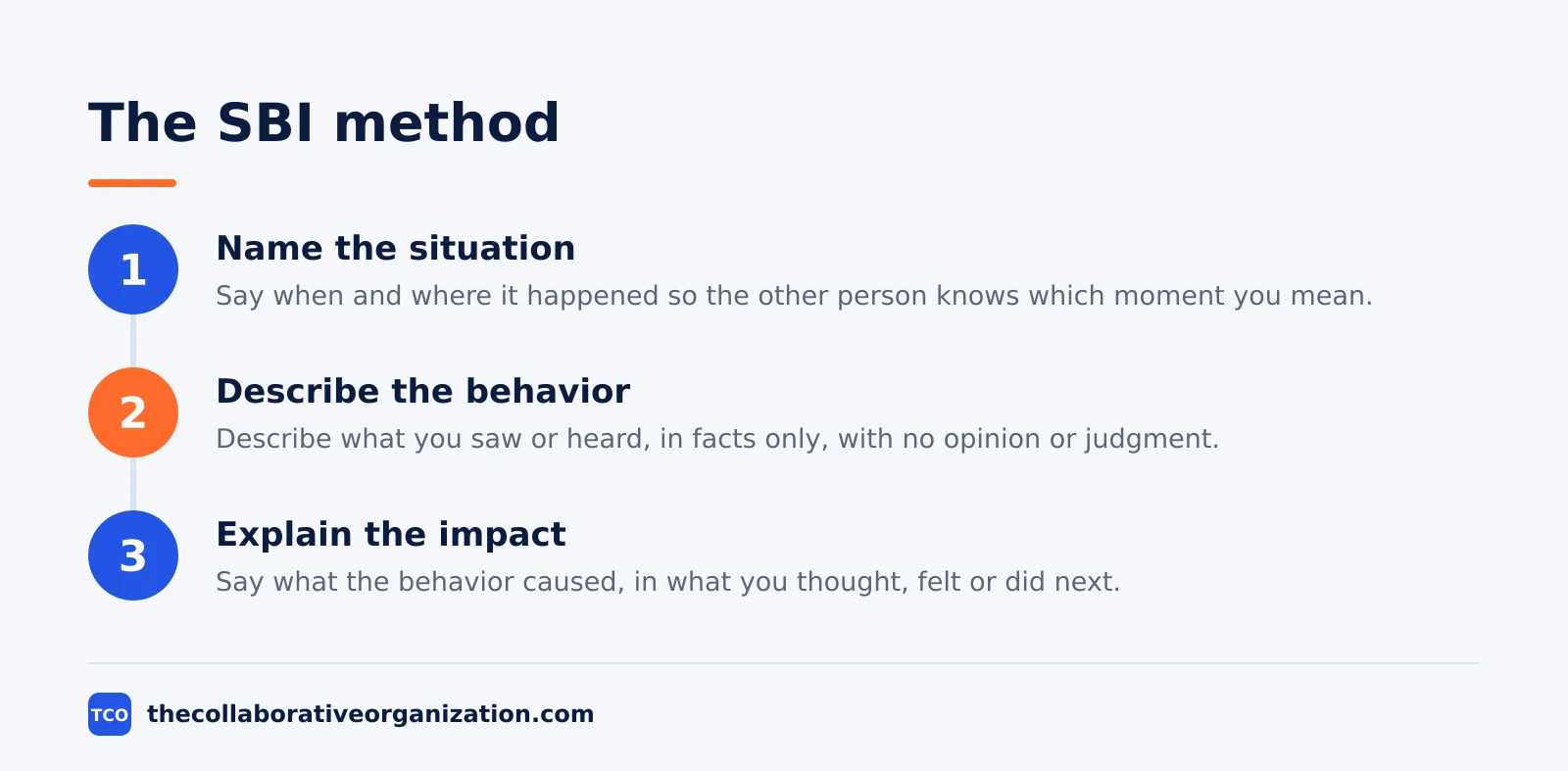
- Situation. Name the time and place so the other person knows which moment you mean.
- Behavior. Describe what you saw or heard, in facts only, with no opinion or judgment.
- Impact. Say what the behavior caused, in terms of what you thought, felt or did next.
Add a fourth step when the intent is unclear: ask what the person was trying to do. The Center for Creative Leadership calls this SBII, and it closes the gap between intent and impact. The Center for Creative Leadership explains the model and the intent step on its own site.
How to give positive feedback
Positive feedback works best when it is specific, not general. Say what the person did and why it helped, instead of a vague “great job” that could mean anything.
Recognition is the most meaningful topic in manager conversations, per Gallup, ahead of goals and strengths. Peers can do the same work: name the recent task, name the result, and say thank you in the same breath.
Keep positive feedback public when the person likes that, and private when they do not. Gallup and Workhuman found only 10% of employees are asked how they like to be recognized. Ask once, remember the answer, and use it.
Write it down when it matters. A short note after a good piece of work gives the person something to keep, and it takes less than a minute to send. The note also helps at review time, when both of you will have forgotten the details.
How to give corrective feedback
Corrective feedback works when it stays on the work and offers a next step. Say what happened, say what it cost, then agree on what to do differently next time.
Pick the smallest fix first. A long list of faults makes people stop listening, while one clear change gives them something to do on Monday. If the list is long, pick the item that matters most and save the rest.
Ask for the other side before you finish. A question like “What got in the way?” often turns up a blocked tool, a missing brief or a clash of priorities that no one named. Fix the cause, not just the symptom.
End with a clear next step. Agree on what happens next, who does it, and when you will check back. A conversation with no next step is a chat, not feedback.
When and where to give feedback
Give feedback within a day, in private, and never in front of the person’s team. The moment is still fresh, the details are still clear, and no one has to save face in front of others.
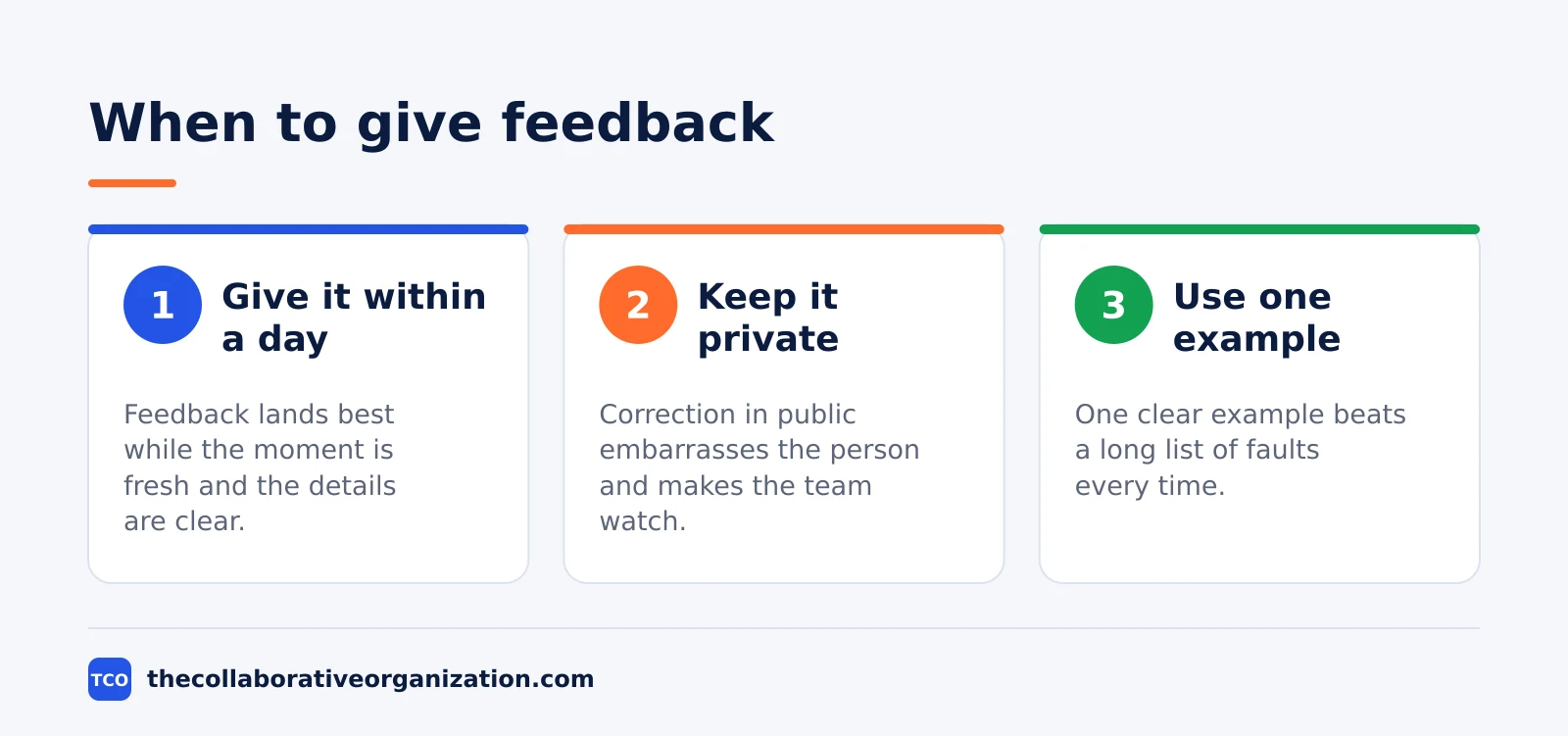
Pick a calm moment, not a heated one. Feedback given right after a bad meeting often says more about your mood than their work. Wait an hour, write down the one example, then start the talk.
Use the channel the person reads. A short message in Slack or Microsoft Teams works for a quick note, and a short call works better when the topic is sensitive. Do not give feedback in a group chat or a meeting, where the whole team watches.
Remote teams need the same rules with one extra step: write the feedback down first. A written note gives the other person time to read it twice before they reply, and it keeps the tone calm across time zones.
Keep a record where the work lives. A task comment in Asana ties the feedback to the work itself, so neither of you has to remember the details a month later.
A worked example: one feedback conversation
Here is one feedback conversation, written out as an illustration. A designer, Priya, sent a draft to the client before the team had reviewed it, and the client replied with a list of changes the team had already planned.
- Situation. In yesterday’s client call, the draft went out before the team review.
- Behavior. Priya sent version 3 at 10 in the morning, and the client replied with changes the team had already fixed in version 4.
- Impact. The team spent the afternoon re-doing work it had already done, and the client now thinks the team missed their notes.
Then comes the question: what was Priya trying to do? She was trying to hit the client’s deadline, and she did not know version 4 was ready. The fix is a shared checklist before any client send, not a rule against sending drafts.
The whole talk takes about five minutes. It names one moment, one behavior and one impact, then asks one question and agrees one fix. That shape works for most coworker feedback, whether the news is good or bad.
Tools that make feedback easier
A short note beats a long review, and the right tool keeps the note where the work lives. The tools below cover chat, video and task tracking, with starting prices as of November 2026.
| Tool | Starting price (as of November 2026) | Best for |
|---|---|---|
| Slack | $7.25 per user per month (Pro), billed annually | Quick notes and praise in channels |
| Microsoft Teams | $4.00 per user per month (Teams Essentials), billed annually | Feedback inside the Microsoft 365 flow |
| Asana | $10.99 per user per month (Starter), billed annually; Personal free for 2 users | Tying feedback to the task itself |
| ClickUp | $9 per user per month (Core), billed annually | Task comments plus docs in one place |
| Trello | $5 per user per month (Standard), billed annually | Small teams that track work on boards |
Prices change, so check the vendor page before you buy. The prices above are the entry paid plans as of November 2026, and each vendor also offers a free plan or trial.
A guide to the best team communication software compares the chat tools above side by side, so a team can match the tool to the way it already works.
The habits matter more than the tools. A guide on how to improve team collaboration covers the practices that make feedback land, from written updates to shared priorities.
Common mistakes when giving feedback to a coworker
The most common mistake is feedback about character, not behavior. Saying someone is careless or slow attacks who they are, and it starts a fight instead of a fix.
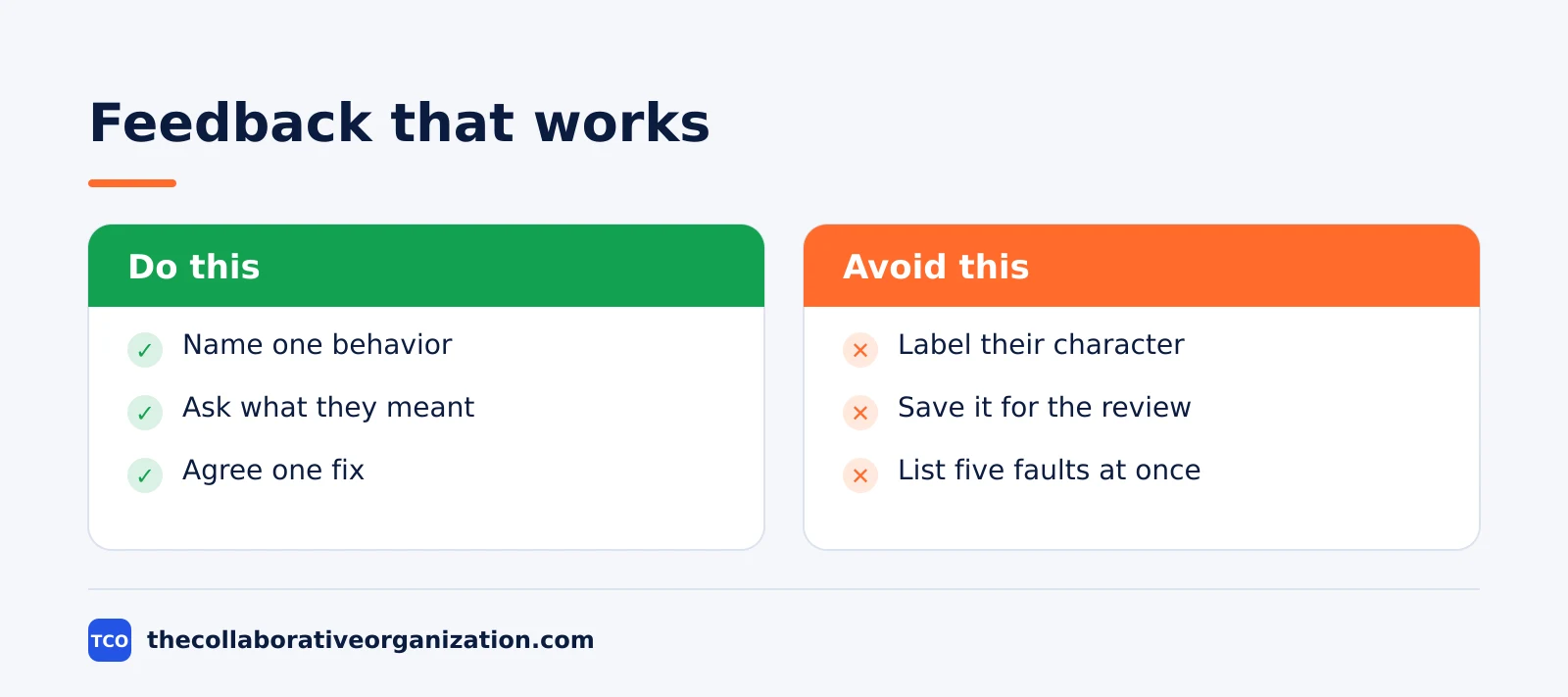
A second mistake is saving feedback for the review. A year-old example helps no one, because neither of you remembers the details. Give it within a day, while the moment is fresh.
A third mistake is giving feedback as a lecture. A talk with no question in it tells the other person you have already decided what happened. Ask what they were trying to do, and listen to the answer before you finish.
A fourth mistake is giving five faults at once. A long list makes people stop listening, while one clear change gives them something to do. Pick the item that matters most and save the rest.
The fix for all four is the same shape: one moment, one behavior, one impact, one question. A guide on how to build psychological safety in a team explains why that shape only works where people feel safe to speak.
Sources
- Gallup - How Effective Feedback Fuels Performance (2022)
- Gallup - A Great Manager’s Most Important Habit (2023)
- Center for Creative Leadership - Use SBI to Inquire About Intent (2025)
- Slack - Pricing (2026)
- Microsoft - Compare Microsoft Teams business options (2026)
- Asana - Pricing (2026)
- ClickUp - Pricing (2026)
- Trello - Pricing (2026)
Frequently asked questions
How soon should I give feedback to a coworker?
Within a day, while the moment is fresh and the details are clear. Gallup found employees are 3.6 times more likely to feel motivated when feedback comes daily rather than once a year. A short note the same day beats a long talk months later, because both of you still remember what happened.
Should I give feedback in public or in private?
Keep praise public and correction private. Public correction embarrasses the person and makes the rest of the team watch a conflict instead of working. Give praise where others can see it, when the person likes that, and take corrective feedback to a private chat or call.
What is the SBI feedback model?
SBI stands for Situation, Behavior, Impact. You name the time and place, describe what you saw or heard in facts only, and say what the behavior caused. The Center for Creative Leadership built the model, and its research found it lowers anxiety for the giver and defensiveness for the receiver.
How do I give feedback to a coworker who is senior to me?
Use the same shape, and keep it shorter. Name one moment, one behavior and one impact, then ask a question instead of giving an order. Most senior colleagues welcome a clear, private note about their work, because it saves them from hearing about it later from someone else.
What if the coworker gets upset when I give feedback?
Pause and listen before you defend yourself. Ask what they heard you say, because intent and impact often differ. If the talk turns heated, agree to come back to it the next day, and keep the next try to one example and one fix.
Related articles

team communication
Communication Plan for a Project: Template (2026)
A communication plan for a project names who gets which update, in which channel, how often, and from whom. Copy the template and the filled example below.
November 20, 2026 · 10 min read
team communication
How Often Should Managers Communicate With Teams? (2026)
Managers should hold one meaningful conversation with each person every week, plus a weekly team update. See the cadence table for meetings, updates and feedback.
November 20, 2026 · 9 min read
team communication
Upward Communication Examples: 10 That Work (2026)
Upward communication is a message that travels from an employee to a manager or leader. See 10 concrete examples, each with why it works and when to use it.
November 20, 2026 · 9 min read