How Many SaaS Apps Does a Company Use? The 2026 Numbers | The Collaborative Organization
By The Collaborative Organization Team · November 19, 2026 · Last verified November 19, 2026 · 10 min read
The average company runs 118 to 305 SaaS apps, and the right number depends on size and on who is counting. BetterCloud puts the average at 118 apps, Zylo at about 305, and the median small company at 32 tools. This guide explains why the counts differ, gives the numbers by size, and shows how to count your own stack.
Key takeaways
- The average company runs 118 SaaS apps (BetterCloud, 2026) or about 305 (Zylo, 2026): the gap is the population measured.
- Small companies with 1 to 500 staff run 152 apps on average; enterprises with 10,000 or more run 660 (Zylo, 2025).
- The median small company pays for 32 software tools (Cledara, 2026).
- App counts are rising again: up 11% in 2026 after two years of cuts (BetterCloud).
- Only 56% of apps in use carry IT approval, so a count from IT alone misses nearly half the stack (BetterCloud, 2026).
How many SaaS apps does the average company use
The average company runs 118 SaaS apps, or about 305, and both numbers are right for the companies each source measured. BetterCloud, surveying 525 IT and security professionals, puts the average at 118 apps in 2026, up 11% on 106 in 2025.
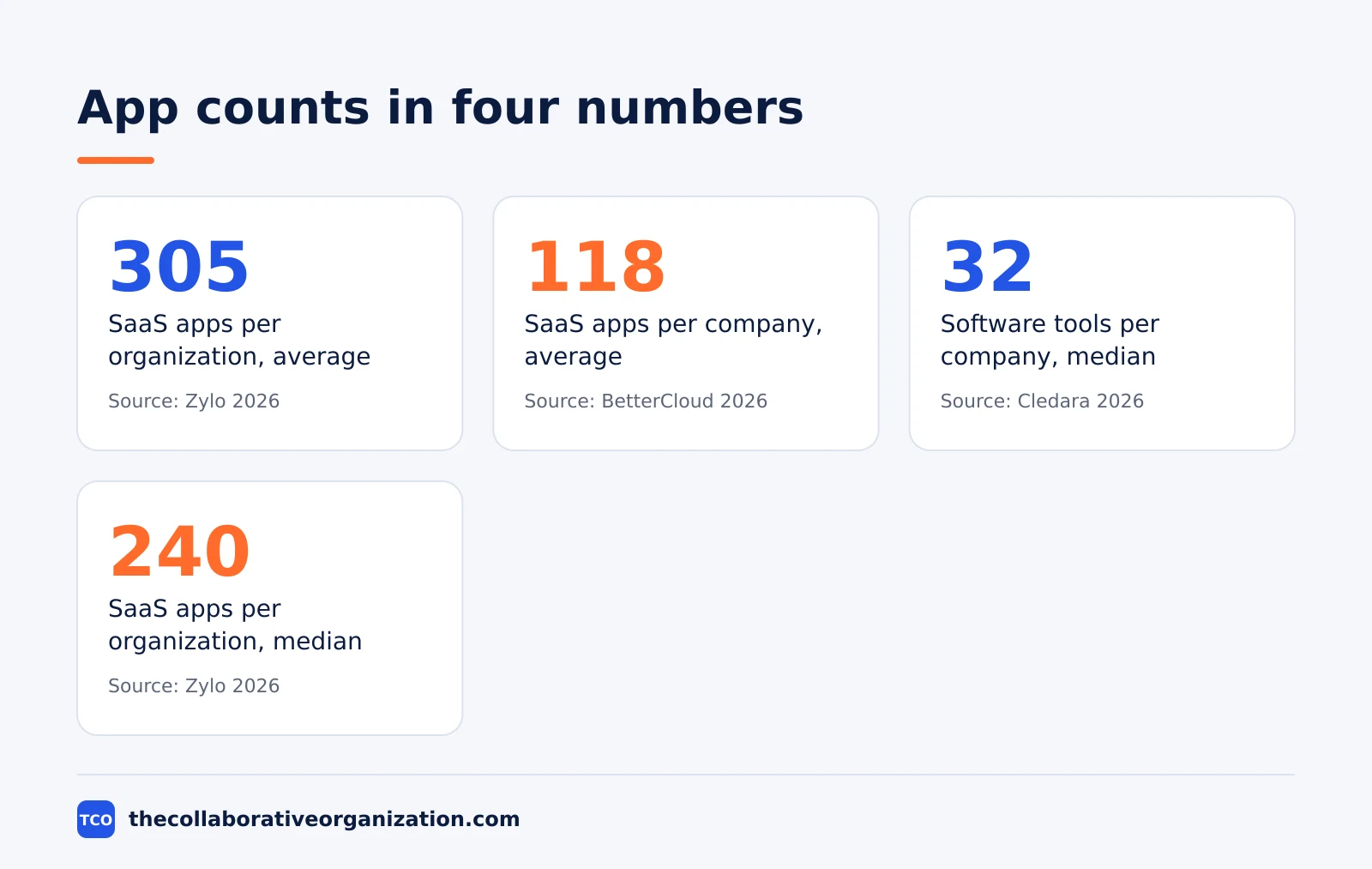
Zylo counts a different population: large enterprise portfolios under its management. Its 2026 index puts the average at about 305 applications, with a median of 240, and average spend of $55.7 million a year.
Cledara counts small and mid-sized paying customers. Across 989 companies, its 2026 benchmarks put the median company at 32 tools.
Vertice tracks spend across vendors and puts the number of SaaS apps per business at 144, a record level. Four sources, four populations, one lesson: always name the population with the count.
Nudge Security counts every cloud app it can find, not just paid seats. Most organizations run 1,000 or more cloud apps, while IT typically sees fewer than 10% of them.
How many SaaS apps companies use by size
App counts rise with headcount, and the jump from small to large is roughly fourfold. Zylo puts small companies, with 1 to 500 staff, at 152 apps and $11.5 million a year, while large enterprises with 10,000 or more staff run 660 apps for $284 million.
| Company size | Apps on average | Annual SaaS spend |
|---|---|---|
| 1 to 500 staff | 152 | $11.5 million |
| 10,000 or more staff | 660 | $284 million |
| Median, all sizes | 240 | $20.6 million |
| Average, all sizes | 305 | $55.7 million |
| Mid-sized, 1,500 to 4,999 staff | 164 | - |
| Median small company | 32 tools | - |
Mid-market firms grew fastest. BetterCloud reports their average jumped 41% in a year, from 116 to 164 apps, as AI tools piled onto existing stacks.
Cledara shows the same pattern in spend. Companies with up to 20 staff spend $121,336 a year on software, those with 50 to 100 staff spend $193,716, and those with 100 to 200 staff spend $251,119.
Size also shapes what to buy next. Our guide on how to evaluate SaaS software sets out the checks for a new tool at any headcount.
Growth in app counts usually means growth in change. Our guide to change management for new software covers how to bring a new tool into the stack without adding to the sprawl.
Why the counts differ so much
The counts differ because each source measures a different set of companies with a different definition of an app. Zylo counts large enterprise portfolios under its management, BetterCloud surveys SaaS-first IT teams, Cledara counts paying small companies, Vertice tracks spend across vendors, and Nudge counts every cloud app it can find.
AI tools are the fastest-growing part of the count. Zylo reports that AI apps in portfolios rose 181% in a year, and large enterprises add an average of 21 apps a month.
BetterCloud counts 27 AI-powered SaaS apps per organization on average, about 22% of the total portfolio, up from 7% a year earlier.
Counts from IT alone miss the apps employees buy themselves. Zylo reports that individual employees alone account for 34% of applications in the average portfolio, and 51% of expensed apps are miscategorized or mislabeled in expense reports.
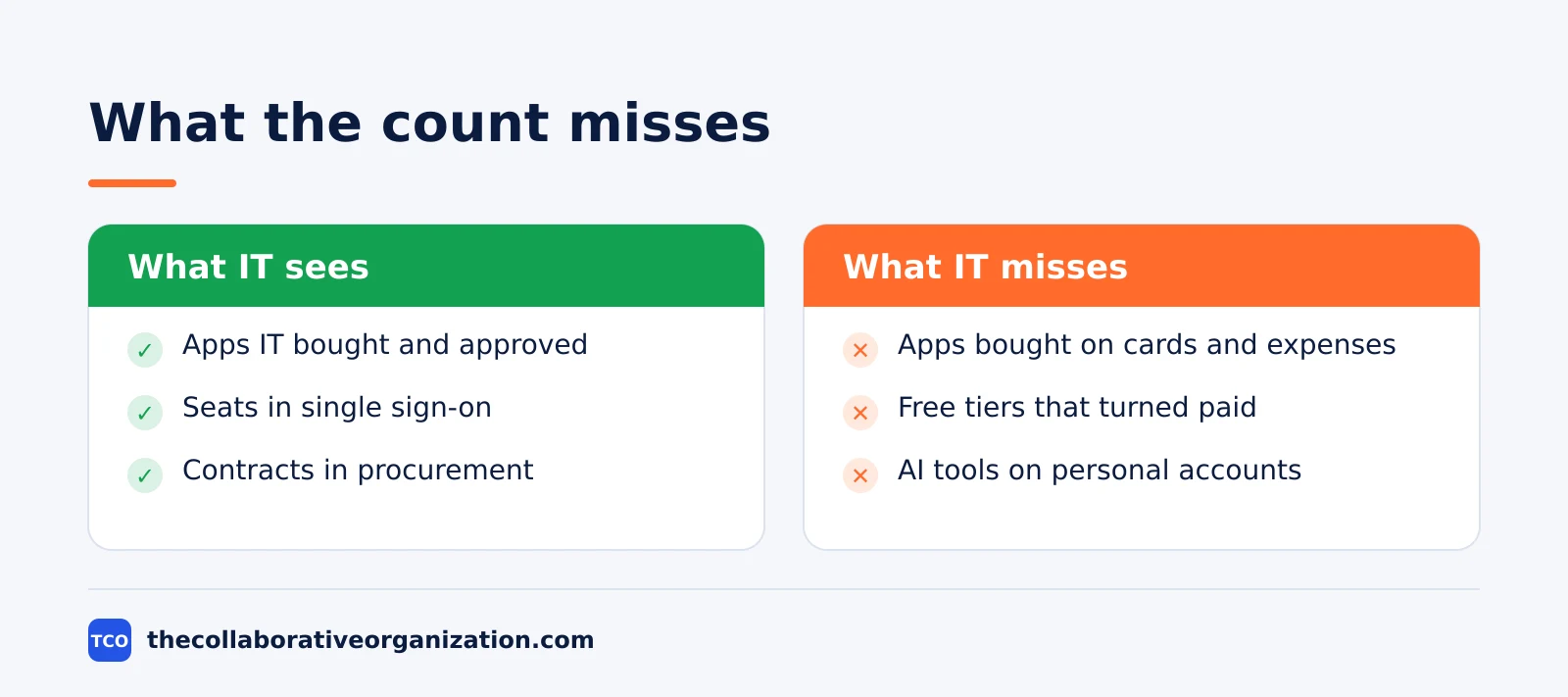
The approval gap shows the same blind spot. BetterCloud reports that only 56% of apps in use carry IT approval, so 44% run without it, and 21% of organizations discovered new unsanctioned tools in 2026.
What counts as a SaaS app, and what gets missed
A SaaS app is any software you use over the internet on a subscription, and the count should include free tiers, trials and AI add-ons, not just paid seats. A free tier that the team relies on is still an app, and so is a paid AI add-on inside a tool you already own.
The count grows one account at a time. Nudge Security reports that the average employee creates 18 different SaaS accounts during their tenure, and Nudge has found 70,000 or more unique SaaS apps across customer environments.
Apps also outlive their buyers. Zylo notes that when the employee who signed up moves teams or leaves, the subscription keeps billing with no one watching it, and orphaned tools renew year after year.
Counting is the first step, not the whole job. Our guide to how to run a software trial helps you test a tool before it joins the count for good.
How the count is growing
App counts are rising again after two years of cuts, and AI tools are doing most of the pushing. BetterCloud counts an 11% rise in 2026, after falls of 14% in 2024 and 5% in 2025.
The average portfolio grows about 34% a year, adding roughly nine apps a month, mostly outside any central process, according to Zylo.
The trend has further to run. Gartner predicted in 2023 that by 2027, 75% of employees will acquire, modify or create technology outside IT’s visibility, up from 41% in 2022.
AI tools arrive through employees, not procurement. Microsoft and LinkedIn found in 2024, in a survey of 31,000 people in 31 countries, that 75% of knowledge workers use AI at work, and 78% of those users bring their own tools.
The count costs money. Zylo puts average annual SaaS spend at $55.7 million in 2026, up 8% on the year, with a median of $20.6 million.
The market behind the count is large. Gartner forecast SaaS spending of $299.1 billion in 2025, up 19.2% on 2024.
Our guide to AI in the workplace statistics tracks the same AI adoption from the employee side.
SaaS app count statistics table
How we chose these stats: every number below comes from the original publisher, opened on November 19, 2026, and each row names its source and year. Counts differ because each source measures a different population, so the table keeps the population with the number.
| Stat | Source | Year |
|---|---|---|
| 305 SaaS apps per organization, average | Zylo | 2026 |
| 240 SaaS apps per organization, median | Zylo | 2026 |
| 118 SaaS apps per company, average | BetterCloud | 2026 |
| 106 SaaS apps per company in 2025 | BetterCloud | 2025 |
| 8 SaaS apps per company in 2015 | BetterCloud | 2015 |
| 116 to 164 apps at mid-sized firms in one year, up 41% | BetterCloud | 2026 |
| 152 apps at companies with 1 to 500 employees | Zylo | 2025 |
| 660 apps at enterprises with 10,000 or more employees | Zylo | 2025 |
| 32 software tools per company, median | Cledara | 2026 |
| 144 SaaS apps per business, record level | Vertice | 2026 |
| 1,000 or more cloud apps at most organizations | Nudge Security | 2026 |
| 21 apps added per month at large enterprises | Zylo | 2026 |
| 34% portfolio growth per year, about 9 apps a month | Zylo | 2026 |
| 27 AI-powered SaaS apps per organization, average | BetterCloud | 2026 |
| 22% of SaaS apps AI-powered, up from 7% | BetterCloud | 2026 |
| 181% rise in AI apps in portfolios in one year | Zylo | 2026 |
| 56% of apps carry IT approval | BetterCloud | 2026 |
| 44% of apps not IT-sanctioned | BetterCloud | 2026 |
| 34% of applications from individual employees | Zylo | 2026 |
| 51% of expensed apps miscategorized in expense reports | Zylo | 2026 |
| 18 SaaS accounts created per employee during tenure | Nudge Security | 2026 |
| 70,000 or more unique SaaS apps discovered across customers | Nudge Security | 2026 |
| 75% of employees will use tech outside IT visibility by 2027 | Gartner | 2023 |
| 78% of AI users bring their own tools | Microsoft and LinkedIn | 2024 |
| 75% of knowledge workers use AI at work | Microsoft and LinkedIn | 2024 |
| 21% of organizations discovered new unsanctioned tools in 2026 | BetterCloud | 2026 |
| $55.7 million average annual SaaS spend | Zylo | 2026 |
| $4,830 SaaS spend per employee, up 21.9% | Zylo | 2025 |
| $9,455 median SaaS spend per employee | Zylo | 2026 |
| 54% of licenses used on average | Zylo | 2026 |
| 36% of licenses unused | Zylo | 2026 |
| 211 renewals a year per organization | Zylo | 2026 |
What the numbers mean
The numbers mean your stack is bigger than you think, and the gap between what IT sees and what exists is the real story. A count from IT alone misses the apps employees buy on cards, the free tiers that turned paid, and the AI tools on personal accounts.
Take a 200-person company as an illustration. At the Zylo 2025 average of 152 apps for a company of its size, it runs about three apps for every four people. If a third of those apps are shadow IT, about 50 sit outside IT approval, and at $4,830 per employee the bill is about $966,000 a year.
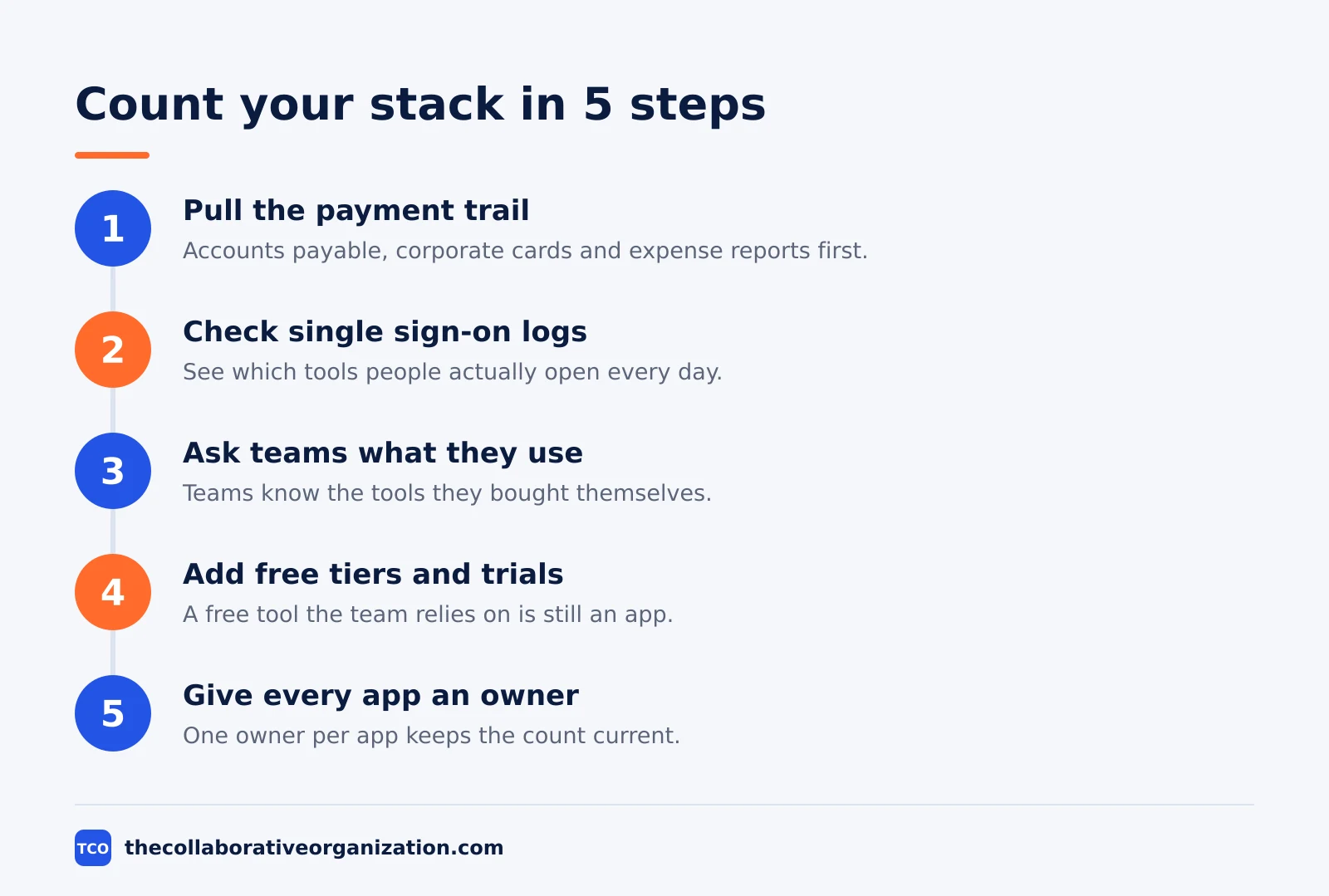
The second lesson is to count by source, not by memory. Finance records catch invoiced contracts, cards and expenses catch employee buys, and login logs catch the tools people open every day. No single source is complete, so use all three.
Once you have the count, the next job is deciding what stays. Our guide to software adoption statistics shows which tools teams actually open, so the count turns into decisions.
Common mistakes about SaaS app counts
Most app-count mistakes come from trusting one source, one year or one definition. Run through the list before you quote a count to your team.
- Counting only the apps IT bought. Business units control 81% of spend, so the IT list misses most of the stack (Zylo, 2026).
- Leaving out free tiers and trials. A free tool the team relies on is still an app, and it still holds company data.
- Comparing counts across sources. Zylo’s 305 and BetterCloud’s 118 measure different populations, so they are not two answers to one question.
- Treating the average as the norm. The median of 240 apps is the better guide for most companies.
- Counting once and stopping. Portfolios grow about 34% a year, so a count goes stale within months.
Count from three sources, name the population, and repeat the count every quarter. A count with a method behind it is worth acting on.
Sources
- Zylo - SaaS Subscription Management: A Guide for Buyers (2026)
- Zylo - 2025 SaaS Management Index (2025)
- Zylo - 2026 SaaS Management Index (2026)
- BetterCloud - The 2026 State of SaaS Report (2026)
- BetterCloud - The big list of SaaS statistics that you should know (2026)
- Cledara - SaaS Spend Per Employee 2026 (2026)
- Vertice - SaaS Inflation Index (2026)
- Nudge Security - Shadow IT Discovery: A Complete 2026 Guide (2026)
- Gartner - Gartner Unveils Top Eight Cybersecurity Predictions for 2023-2024 (2023)
- Microsoft and LinkedIn - Microsoft and LinkedIn release the 2024 Work Trend Index (2024)
Frequently asked questions
How many SaaS apps does the average small business use?
Cledara puts the median small company at 32 software tools in 2026, while Zylo puts small companies with 1 to 500 staff at 152 apps on average in 2025. The gap is the population: Cledara counts paying small customers, Zylo counts larger portfolios under its management. Use the figure that matches your size and the source that measured it.
How many SaaS apps does a large enterprise use?
Zylo puts large enterprises with 10,000 or more staff at 660 apps on average in 2025, and its 2026 index reports that large enterprises add an average of 21 applications a month. At that pace the count turns over fast, so a large enterprise needs a live inventory, not a once-a-year count.
Why do SaaS app counts differ between reports?
Each source measures a different set of companies with a different definition of an app. Zylo counts large enterprise portfolios under its management, BetterCloud surveys SaaS-first IT teams, Cledara counts paying small companies, and Nudge counts every cloud app it can find. Quote the count with its source and population, never on its own.
How can I count how many SaaS apps my company uses?
Start with the payment trail: accounts payable, corporate cards and expense reports. Add single sign-on logs and ask teams what they use, then add free tiers and trials. Give every app a named owner and repeat the count every quarter, because portfolios grow about 34% a year and a count goes stale within months.
How many of a company's SaaS apps are shadow IT?
BetterCloud finds that only 56% of apps in use carry IT approval, so 44% run without it. Zylo puts shadow IT at a third of a company's applications. Gartner predicted in 2023 that by 2027, 75% of employees will acquire, modify or create technology outside IT visibility, up from 41% in 2022.
Related articles
guides
Free Project Management Templates: 7 to Copy (2026)
Seven free project management templates from monday, Wrike, Teamwork, Smartsheet, ClickUp, Asana and Trello, with what each one is for and what free really costs.
November 20, 2026 · 7 min read
guides
Project Proposal Template: Copy and Win Work (2026)
A project proposal template pitches the work before it is approved: problem, solution, scope, budget, timeline and terms. Copy the template and filled example.
November 20, 2026 · 10 min read
guides
Action Plan Template: Goal to Done in One Page (2026)
An action plan template turns one goal into owned steps with dates, dependencies and a success measure. Copy the table and see it filled for a support team.
November 20, 2026 · 11 min read