Employee Communication Statistics: 28 Key Stats (2026) | The Collaborative Organization
By The Collaborative Organization Team · November 19, 2026 · Last verified November 19, 2026 · 11 min read
Employee communication statistics show a wide gap between what leaders think staff hear and what staff actually hear. The 28 numbers below cover the function, the intranet, email, deskless workers, feedback, recognition, and the business case, each with its source and year.
Key takeaways
- A modern intranet lifts reported engagement to 83%, against 69% without one, Simpplr found in 2025.
- Poor communication costs $62.4 million a year per large company, David Grossman reported in 2011.
- The average internal email open rate is 76%, ContactMonkey found in 2026, but 86% of communicators say staff miss key updates at least sometimes.
- 84% of frontline workers say they do not get enough direct communication from head office, Rippl found in 2025.
- Only 15% of organizations tell staff what happened after they gave feedback, ContactMonkey found in 2026.
How we chose these 28 statistics
We picked statistics from named studies, and we dropped any figure we could not trace to its source. Each number below names its study and year, and the table at the end repeats all 28 with links. Vendor surveys are named as vendor surveys, and older studies stay in when they are still the original source of a figure.
This article covers employee communication as a function: the teams that run it, the intranet, internal email, deskless workers, and feedback. Message volume and meeting load sit in our team communication statistics, which uses a different set of studies.
The internal communications function is small
Half of organizations run internal communications with a team of 2 to 5 people, ContactMonkey found in 2026. The survey of internal communicators found 49% of teams had 2 to 5 people, 19% had one person, and 9% had no dedicated function at all. Most teams have five people or fewer.
The function is still young. The same report found 33% of teams at a foundational stage, 49% established, and 18% advanced. The top priorities were engagement at 42%, leadership communication at 40%, and change management at 30%.
Budgets are moving. Simpplr found 58% of organizations increased internal communications budgets in 2025, up from 35% in 2024. The survey covered 786 professionals in the US and UK, in organizations with 501 to 20,000 employees.
A modern intranet changes the numbers
Organizations with a modern intranet report far better engagement than those without one, Simpplr found in 2025. Engagement reached 83% with a modern intranet, against 69% without one. The productivity impact was 78% against 63%, and the revenue impact was 67% against 54%.
Nine in ten organizations now have an intranet. Simpplr found 91% of organizations have one, and those with one rate their internal communication as excellent far more often: 30% against 13% without an intranet. The gap shows in measurement too: 55% of intranet users track engagement surveys, against 37% without one.
Leaders see the link to money. In the same survey, 81% of leaders tied internal communication to revenue, and 89% tied it to engagement. The figures come from Simpplr’s survey of 786 professionals, so they describe what leaders believe, not measured revenue.
What leaders see is not what staff experience
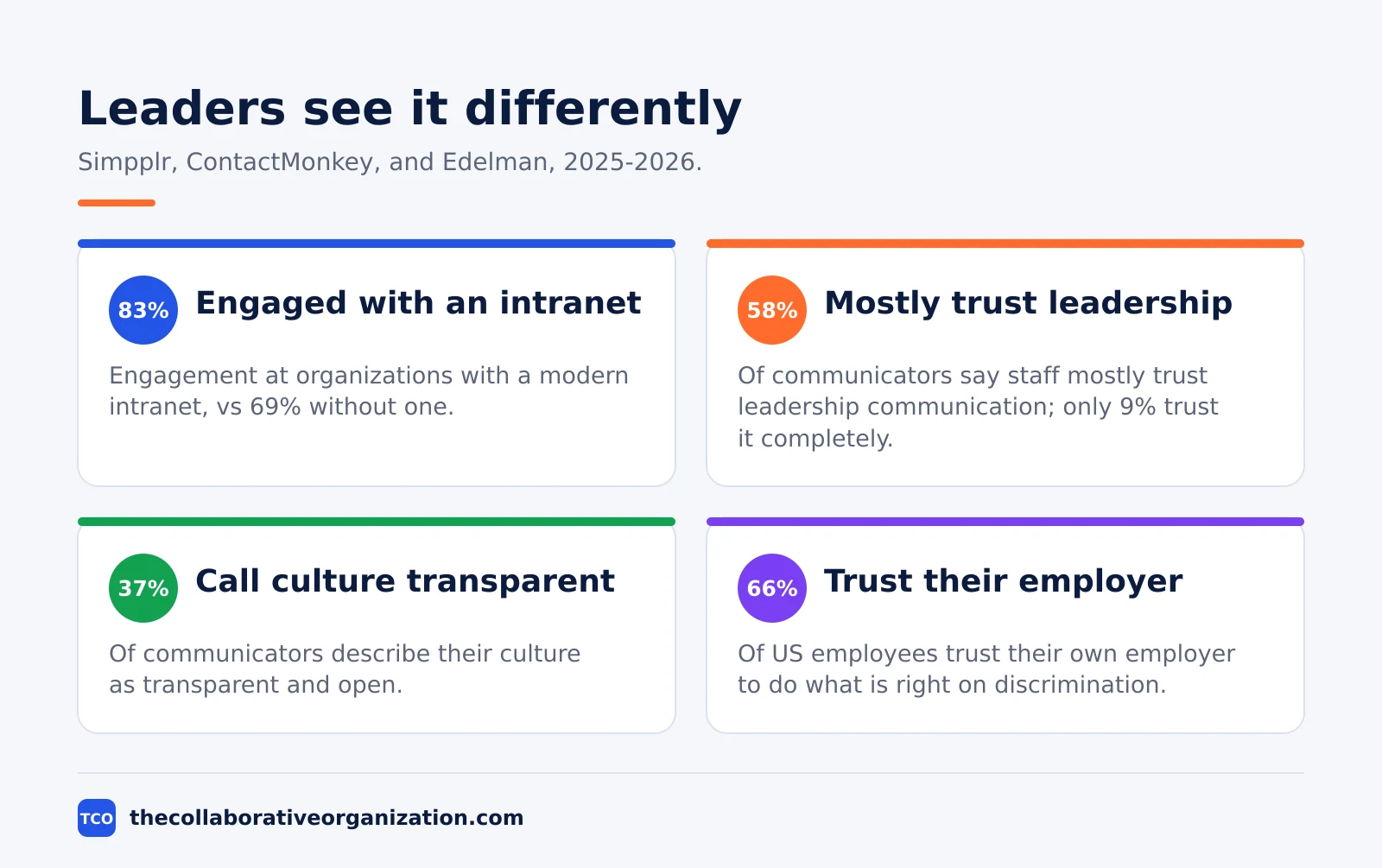
Leaders rate internal communication far higher than staff do. ContactMonkey found in 2026 that 65% of communicators rate leadership communication as very or somewhat transparent, yet only 37% describe their culture as transparent and open. Trust is partial too: 58% mostly trust leadership communication, and only 9% trust it completely.
The gap shows in how leaders view their own work. Simpplr found 79% of executives understand the importance of internal communication, and 47% of organizations say leadership consistently does a good job with it, up from 37% the year before. The rest see the gap from the other side.
Trust in the employer runs deeper than trust in its messages. Edelman found in 2025 that 66% of US employees trust their own employer to do what is right on discrimination, the only institution to earn that trust. The figure comes from Edelman’s Trust Barometer special report on fairness and opportunity.
Internal email: opened, skimmed, missed
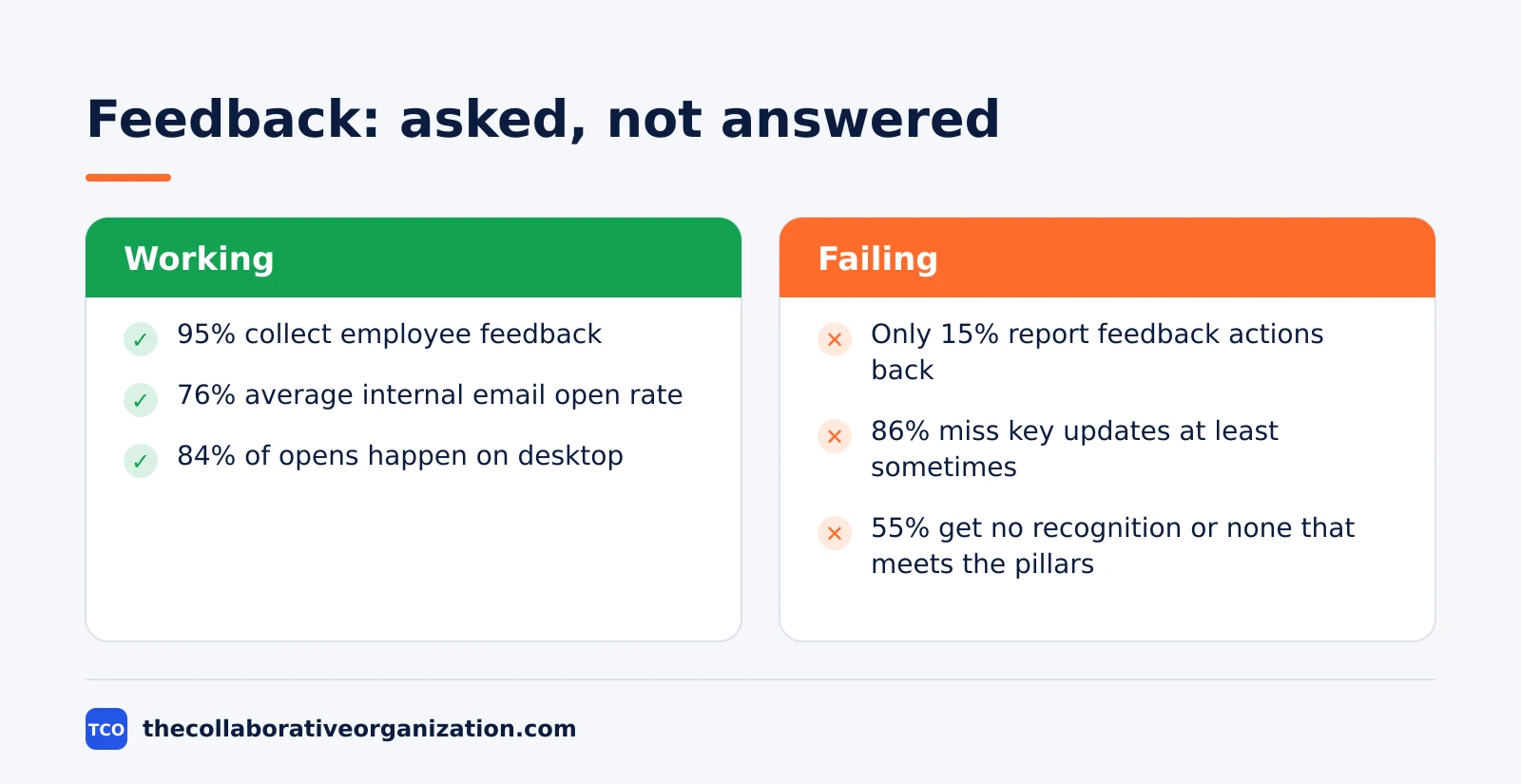
Internal emails are opened 76% of the time on average, ContactMonkey found in its 2026 benchmark of more than 255,000 campaigns. The open rate falls as organizations grow: 89% at companies with 1 to 50 employees, against 73% at companies with more than 10,000. The benchmark covered more than 20 industries.
Opens do not mean reads. In the same benchmark, 44% of readers read for more than 9 seconds, 29% skim for 3 to 9 seconds, and 21% glance for 1 to 3 seconds. Most opens happen on desktop at 84%, with 16% on mobile.
And much still gets missed. ContactMonkey found 86% of communicators say employees miss key updates at least sometimes, with 30% saying it happens often or very often. The fix is a second channel and a shorter message, not a louder subject line.
Email also eats the communicator’s week. One communicator spends about 240 hours a year creating and sending internal emails, ContactMonkey estimated, worth more than $10,000 in time. Half of communicators say employees lose 1 to 3 hours a week to poor or unclear communication, and 29% say they lose 4 to 6 hours.
Many teams add a chat tool such as Slack as the second channel, so the update reaches people who never open email.
For how message volume grows with company size, see our workplace communication statistics.
Deskless workers hear the least
Deskless workers make up about 80% of the global workforce, yet they hear the least from head office. Rippl found in 2025 that 84% of frontline employees do not receive enough direct communication from headquarters. Only 56% feel connected to their company’s mission.
The gap is structural. Firstup surveyed 1,000 US deskless workers in 2024 and found 32% felt their organization was less effective reaching deskless workers than office staff. The same survey found 22% said there were too many places to look, and 25% did not know where to find critical information.
Email is the wrong channel for this group. Firstup found 69% of organizations rely mainly on email, while 54% of deskless workers have limited email access. Half of deskless workers prefer text messages or push notifications for timely updates, and 42% prefer to hear critical information from their manager.
The fix is relevance and timing. Firstup found 53% of deskless workers say company-wide updates are only somewhat relevant, and 21% call them entirely irrelevant. Yet 61% believe timely, relevant updates would improve their performance.
Frontline teams often get updates through Microsoft Teams, which runs on a shared device or a personal phone.
Feedback is collected, rarely answered
Almost every organization asks for feedback, and few answer it. ContactMonkey found in 2026 that 95% of organizations collect employee feedback, but only 15% tell employees what happened after they gave it. Another 47% do so sometimes, and 31% are inconsistent or delayed.
Recognition is part of the same loop. Gallup and Workhuman tracked about 3,500 employees from 2022 to 2024 and found well-recognized employees were 45% less likely to have left after two years. They were also 65% less likely to be actively looking or watching for another job.
Most staff get little of it. The same study found only 22% of employees get the right amount of recognition, and 55% receive none or none that meets any of the five pillars. Recognition that meets four or more pillars makes an employee 9 times as likely to be engaged.
Recognition is one part of engagement, covered in our employee engagement statistics.
The business case for fixing it
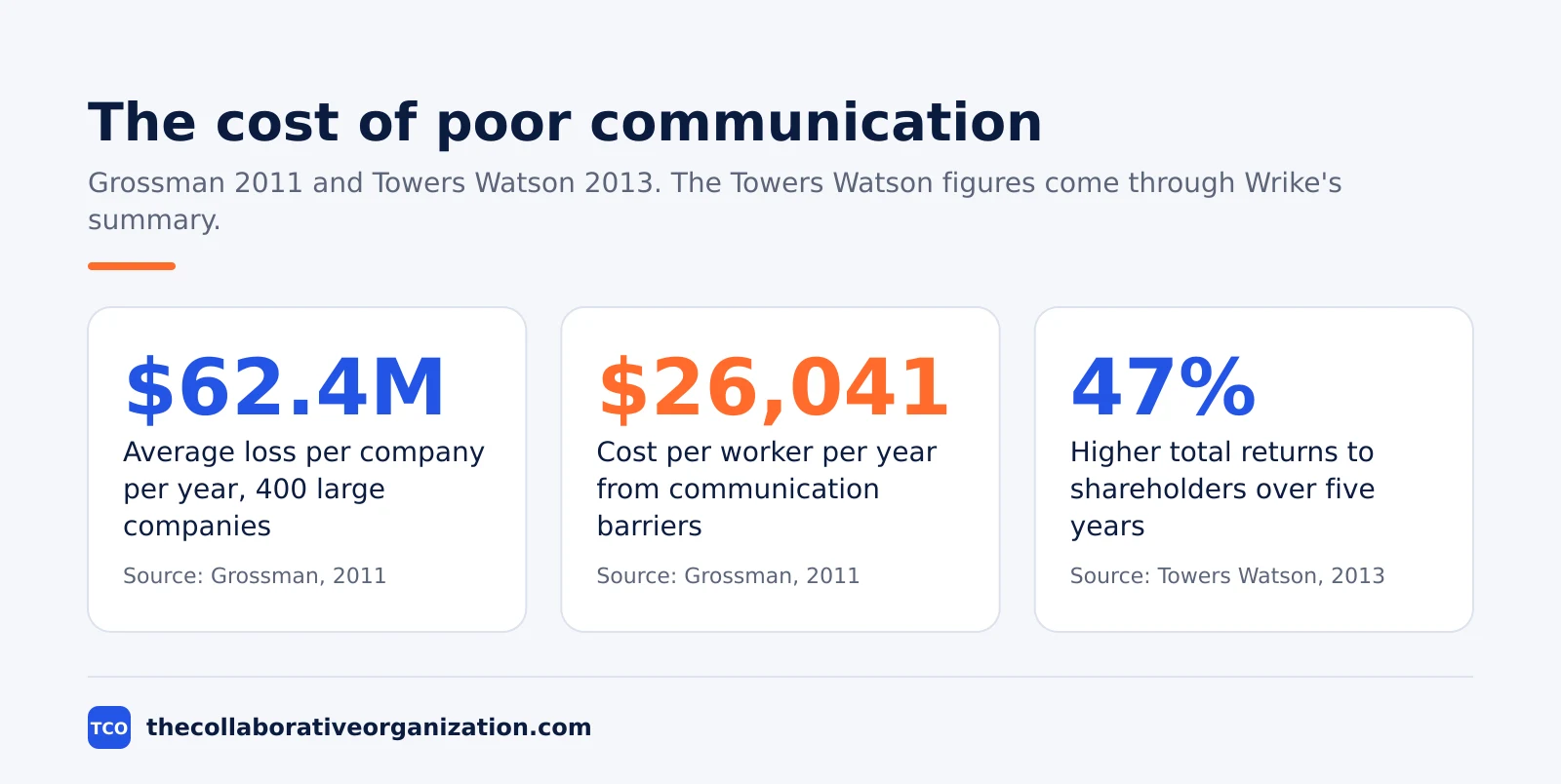
Poor communication has a price tag measured in millions, not minutes. David Grossman reported in 2011 that a survey of 400 companies with 100,000 employees each found an average loss of $62.4 million a year per company from inadequate communication. The total across the 400 companies was about $37 billion.
The cost lands on every worker. The same study put the cumulative cost at $26,041 per worker per year from productivity lost to communication barriers. Smaller companies are not spared: a 100-employee company loses about $420,000 a year to miscommunication, the study found.
Good communication pays back. Companies with highly effective communication had 47% higher total returns to shareholders over five years than the least effective, Towers Watson found. The same study found they were 3.5 times more likely to outperform their industry peers.
The Towers Watson figures reach us through Wrike’s summary, since the original report is no longer public.
What the numbers mean
The numbers describe one problem from three sides: small teams, the wrong channels, and unanswered feedback. The intranet and email data show the tools exist. The deskless and feedback data show who they fail.
Take a 200-person company as an illustration. At $26,041 lost per worker per year, poor communication costs this company about $5.2 million a year. At 1 to 3 hours lost per employee each week, the company loses 200 to 600 hours a week. The numbers are an illustration, not a measurement of a real company.
Start where the gap is widest. If frontline staff hear the least, put the update on their channel first. If feedback goes unanswered, answer the last round before asking for the next one. If email is the only channel, add one more.
Our guide on how to improve team communication turns these steps into a plan.
Common mistakes when quoting employee communication statistics
- Reading the 86% missed-updates figure as a reader problem. It comes from a survey of communicators, so the fix is a second channel, not a sharper subject line.
- Quoting the 76% open rate as a read rate. Most opens are glances and skims, so put the key point in the body.
- Comparing intranet figures across years. The 83% engagement figure is from 2025, and the 91% intranet figure is from the same survey, so keep them together.
- Using the $62.4 million figure for a small company. It comes from a survey of companies with 100,000 employees each, so use the $420,000 figure for a 100-person company instead.
- Citing the Towers Watson figures as if they came from the original report. They reach us through Wrike’s summary, so name that in the citation.
The 28 employee communication statistics
The table below lists 28 statistics from the reports above, grouped by theme, with the source and the year for each one. Use it to check a figure before you quote it. Every number in the table also appears in the text above with a link to its source.
| Statistic | Source | Year |
|---|---|---|
| 49% of organizations run internal communications with a team of 2 to 5 people | ContactMonkey | 2026 |
| 58% of organizations increased internal communications budgets in 2025, up from 35% in 2024 | Simpplr | 2025 |
| 91% of organizations have an intranet | Simpplr | 2025 |
| Engagement reaches 83% with a modern intranet, against 69% without one | Simpplr | 2025 |
| Productivity impact reaches 78% with a modern intranet, against 63% without one | Simpplr | 2025 |
| Revenue impact reaches 67% with a modern intranet, against 54% without one | Simpplr | 2025 |
| 81% of leaders tie internal communication to revenue | Simpplr | 2025 |
| 30% of organizations with an intranet rate their internal communication as excellent, against 13% without one | Simpplr | 2025 |
| Internal emails are opened 76% of the time on average | ContactMonkey | 2026 |
| 86% of communicators say employees miss key updates at least sometimes | ContactMonkey | 2026 |
| 50% of communicators say employees lose 1 to 3 hours a week to poor communication | ContactMonkey | 2026 |
| 95% of organizations collect employee feedback | ContactMonkey | 2026 |
| Only 15% of organizations tell employees what happened after they gave feedback | ContactMonkey | 2026 |
| 58% of communicators say staff mostly trust leadership communication | ContactMonkey | 2026 |
| 37% of communicators describe their culture as transparent and open | ContactMonkey | 2026 |
| One communicator spends about 240 hours a year creating and sending internal emails | ContactMonkey | 2026 |
| Deskless workers make up about 80% of the global workforce | Firstup | 2024 |
| 32% of deskless workers say their organization is less effective reaching them than office staff | Firstup | 2024 |
| 61% of deskless workers believe timely, relevant updates would improve their performance | Firstup | 2024 |
| 84% of frontline employees do not receive enough direct communication from headquarters | Rippl | 2025 |
| Poor communication costs $62.4 million a year per company on average, in a survey of 400 companies with 100,000 employees each | Grossman | 2011 |
| Communication barriers cost $26,041 per worker per year in lost productivity | Grossman | 2011 |
| 66% of US employees trust their own employer to do what is right on discrimination | Edelman | 2025 |
| Well-recognized employees were 45% less likely to have left after two years | Gallup and Workhuman | 2024 |
| Only 22% of employees get the right amount of recognition | Gallup and Workhuman | 2024 |
| 55% of employees receive no recognition or none that meets any of the five pillars | Gallup and Workhuman | 2024 |
| Companies with highly effective communication had 47% higher total returns to shareholders over five years | Towers Watson | 2013 |
| Companies with highly effective communicators were 3.5 times more likely to outperform their industry peers | Towers Watson | 2013 |
Sources
- Simpplr - State of Internal Communications and Intranet Technology (2025)
- Simpplr - The ROI of Internal Communications (2025)
- ContactMonkey - Internal Communications Statistics 2026 (2026)
- Firstup - Deskless Communication Survey (2024)
- Rippl - Engaging Frontline Employees: Closing the Deskless Gap (2025)
- Grossman - The Cost of Poor Communications (2011)
- Edelman - Trust Barometer Special Report: Fairness and Opportunity in the U.S. (2025)
- Gallup and Workhuman - Employee Retention Depends on Getting Recognition Right (2024)
- Wrike - 6 Strategic Ways to Keep Your Team Communication Streamlined (2017)
Frequently asked questions
How big is the average internal communications team?
Small. ContactMonkey found in 2026 that 49% of organizations run internal communications with a team of 2 to 5 people, and 19% have a one-person team. That is a small crew for a function that touches every employee, so tools and workflows decide how much actually gets done.
What does poor communication cost a company?
David Grossman reported in 2011 that a survey of 400 companies with 100,000 employees each found an average loss of $62.4 million a year per company from inadequate communication. The cost per worker was $26,041 a year in lost productivity. A 100-employee company loses about $420,000 a year.
What is a good internal email open rate?
The average internal email open rate is 76%, according to ContactMonkey's 2026 benchmark of more than 255,000 campaigns. Open rates fall as organizations grow: 89% at companies with 1 to 50 employees, against 73% at companies with more than 10,000. Compare a result against your own history first, not against another company's number.
Do deskless workers get the same information as office staff?
No. Rippl found in 2025 that 84% of frontline employees do not receive enough direct communication from headquarters. Firstup found in 2024 that 32% of deskless workers say their organization is less effective reaching them than office staff, and 69% of organizations rely mainly on email, which most deskless workers rarely open.
Does recognition really affect whether people stay?
Yes. Gallup and Workhuman tracked about 3,500 employees from 2022 to 2024 and found well-recognized employees were 45% less likely to have left after two years. They were also 65% less likely to be actively looking for another job. Only 22% of employees get the right amount of recognition.
Related articles
guides
Free Project Management Templates: 7 to Copy (2026)
Seven free project management templates from monday, Wrike, Teamwork, Smartsheet, ClickUp, Asana and Trello, with what each one is for and what free really costs.
November 20, 2026 · 7 min read
guides
Project Proposal Template: Copy and Win Work (2026)
A project proposal template pitches the work before it is approved: problem, solution, scope, budget, timeline and terms. Copy the template and filled example.
November 20, 2026 · 10 min read
guides
Action Plan Template: Goal to Done in One Page (2026)
An action plan template turns one goal into owned steps with dates, dependencies and a success measure. Copy the table and see it filled for a support team.
November 20, 2026 · 11 min read