What Is Hybrid Work? Definition and How It Works (2026) | The Collaborative Organization
By The Collaborative Organization Team · November 19, 2026 · Last verified November 19, 2026 · 11 min read

Hybrid work is a work arrangement that splits the week between the office and a remote location, usually home. The worker has an office to go to and a home to work from, and the split is set by the employer, the team, or the worker.
Hybrid work is not a halfway house on the way back to the office: it is the most common arrangement for people whose jobs can be done remotely.
Key takeaways
- Hybrid work means splitting the week between the office and a remote location; Gallup defines it as working remotely 10 percent to less than 100 percent of the time.
- 51 percent of remote-capable United States employees worked hybrid in May 2025, making it the most common arrangement for that group.
- Hybrid workers spend 46 percent of their workweek in the office, about 2.3 days, and three office days is the most common pattern.
- Team-decided schedules work best: 91 percent of those workers see the policy as fair, the same rate as workers who decide it themselves.
- A randomized trial found two home days a week cut resignations by 33 percent with no effect on performance or promotions.
What hybrid work means
Hybrid work means the same job happens in two places: the office on some days, and home or another remote location on the rest. The split can be fixed, with set office days each week, or flexible, with the worker choosing which days to come in. What makes it hybrid is the mix, not the exact number of days.
The definition matters because surveys count it differently. Gallup defines hybrid as working from home or a remote location 10 percent to less than 100 percent of the time.
Exclusively remote means 100 percent, and on-site means less than 10 percent. A worker who comes in one day a month is hybrid, and so is a worker who comes in four days a week.
The scale is large. Remote-capable workers are about half of the total United States workforce, and hybrid work is their most common arrangement. Gallup found 51 percent of that group worked hybrid in May 2025, with 28 percent exclusively remote and 21 percent on-site. Our comparison of remote vs hybrid vs office work sets the three models side by side.
The main hybrid work models
Hybrid work comes in four models, and the model decides who picks the office days. Most employers use one of them, and the choice is usually written into the policy rather than left to each worker.
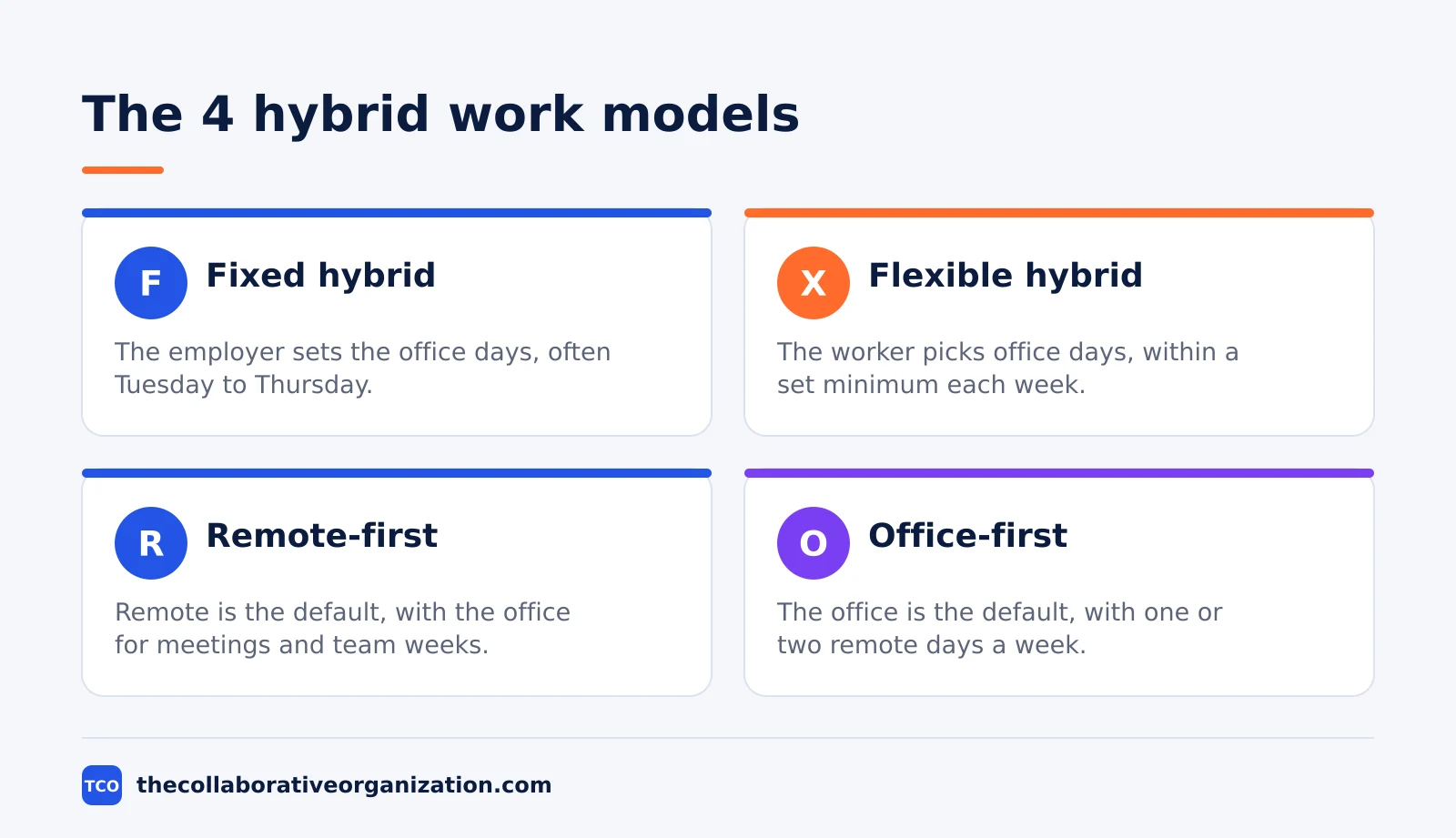
- Fixed hybrid. The employer sets the office days, often Tuesday to Thursday. Everyone is in on the same days, so collaboration is easy, but the worker has no choice.
- Flexible hybrid. The worker picks which days to come in, within a minimum number. The worker has choice, but the office can sit empty on some days and full on others.
- Remote-first hybrid. The default is remote, and the office is there for meetings, onboarding, and team weeks. The team meets in person on purpose, not by habit.
- Office-first hybrid. The default is the office, with one or two remote days a week. The team keeps the office habit, and remote days are for focus work.
The fixed model is the most common in large companies, because it makes planning easy. The flexible model is the most popular with workers, because it gives them control. The evidence favors a middle path: shared office days set by the team, which our guide on how to run a hybrid meeting covers in practice.
How a hybrid week works in practice
A hybrid week works when the office days are shared and the home days are protected. Without that rule, the team splits into people who happen to be in and people who happen to be out, and neither group gets the benefit of the other.
Shared office days are the anchor. The team picks two or three days when everyone comes in, and puts its collaboration on those days: planning, reviews, brainstorming, and the conversations that need a whiteboard.
Hybrid workers spend 46 percent of their workweek in the office, about 2.3 days, according to Gallup.
Owl Labs found 39 percent go in three days a week, the most common pattern, with 34 percent going in four days.
Home days are for focus work. The worker does the writing, the coding, and the calls that need quiet, and the team agrees not to book meetings that could have been a written update. A clear rule helps: no meeting on a home day unless the decision needs a live conversation.
The handover between the two matters most. A decision made in the office on Tuesday must be written down, so the person working from home on Wednesday can read it. A team that writes its decisions down does not need everyone in the room, and a team that does not will keep re-deciding the same things.
Hybrid work vs remote work vs office work
Hybrid work keeps the office part-time, remote work removes it, and office work keeps it full-time. The three models differ in who they suit and what they cost, and the table below shows the split.
| Feature | Hybrid | Remote | Office |
|---|---|---|---|
| Where work happens | Office plus home | Home or anywhere | Office |
| Office days | 1 to 4 a week | None | 5 a week |
| Best for | Mixed focus and face time | Focus work, wide hiring | Hands-on work, new starters |
| Main risk | Unequal experience | Loneliness, weak ties | Commute, narrow hiring |
| Commute cost | Part-time | Near zero | Full-time |
The numbers behind the table are stable. Pew Research Center found 41 percent of remote-capable workers on a hybrid schedule in 2023, up from 35 percent in January 2022.
59 percent of hybrid workers work from home three or more days in a typical week, according to the same Pew survey. Cisco found 45 percent hybrid globally in 2025, down from 62 percent in 2022, in a survey of 21,513 employers and employees across 21 markets.
The choice between the models is rarely about preference alone. Employers pick hybrid when the work needs some face time, remote when the talent pool matters more than the building, and office when the work needs hands on site. McKinsey found hybrid is the most favored option, particularly among office-based workers, in its American Opportunity Survey of summer 2024.
Who decides the hybrid schedule
Team-decided schedules beat both self-decided and employer-decided schedules on fairness and on burnout. That finding is the most useful one in this article for anyone writing a hybrid policy.
The decision is split three ways. The share of hybrid workers who set their own schedule fell from 37 percent in 2024 to 34 percent in 2025, while 35 percent have it decided by their manager or team and 31 percent by their employer or leadership, according to Gallup.
91 percent of employees whose team decides their hybrid schedule see the policy as fair, the same rate as those who decide it themselves. When the employer decides, only 73 percent see the policy as fair.
Self-decided schedules carry a cost: compared with team-decided schedules, those workers are 76 percent more likely to say burnout is the greatest challenge, according to Gallup.
The lesson is simple: let the team set its shared office days together, and write the decision down. A team that picks its own anchor days will show up on them, and a team that has the days imposed will find reasons to stay home.
Trust follows the same pattern: 54 percent of managers who manage remote workers strongly agree they trust their teams to be productive remotely. Four simple practices can raise that trust by nearly 30 percentage points, according to Gallup.
A worked example: a hybrid design team
A small design team shows how the pieces fit together in practice. Imagine a team of eight designers for a software company, with an office in one city and two designers in other cities. The team ships new screens every two weeks, and the work needs both quiet focus and live critique.
The team picks Tuesday and Thursday as shared office days, and the six local designers come in on both. Mondays, Wednesdays, and Fridays are home days for focus work, and the two remote designers join by video.
Critique sessions happen on Tuesdays in the office, with a video link and a shared board, so the remote designers can comment in real time.
Decisions from the critique go into a shared document the same day, with the reason written next to each one. The team lead checks the document on Friday, not by watching who is online, but by reading what was decided. The setup works because the office days are shared, the home days are protected, and the decisions are written down.
Tools that make hybrid work run
Four tools cover the whole hybrid stack: chat for quick questions, video for live talk, documents for shared work, and a workspace for plans. A team that picks one of each and uses it every day avoids the tool sprawl that kills hybrid teams. Our guide on how to choose team communication software walks through the same choice in more detail.
| Tool | Best for | Free plan | Starting price (as of November 2026) | Notable limit |
|---|---|---|---|---|
| Slack | Team chat and quick questions | Free plan for small teams | $7.25 per user per month (Pro), billed annually | 90-day message history on Free |
| Zoom | Video meetings and calls | Basic free, 40-minute group meetings | $14.16 per user per month (Pro), billed annually | 100 participants on Pro |
| Google Meet | Video inside Google Workspace | Free for personal Google accounts | $7 per user per month (Business Starter), billed annually | 100 participants on Starter |
| Notion | Shared docs and team workspace | Free plan for individuals | $10 per member per month (Plus), billed annually | Full AI features need Business |
The Slack price comes from Slack pricing, where Pro is $7.25 per user per month billed annually and Business+ is $15. Slack’s own page returns a JavaScript shell to our fetcher, so the figures are confirmed by independent checks against Slack’s pages in October and November 2026.
Zoom’s Pro price is $14.16 per user per month billed annually, or $16.99 billed monthly, read from Zoom pricing in October and November 2026.
Google Workspace Business Starter is $7 per user per month billed annually, or $8.40 on the flexible plan, and the Notion pricing page lists Plus at $10 per member per month billed annually. Compare the full shortlist on our team communication software shortlist before you pick.
When hybrid work works, and when it does not
Hybrid work works when the office days are shared, the results are visible, and the team meets on purpose. It fails when the office days are random, results are judged by presence, and meetings happen by accident.
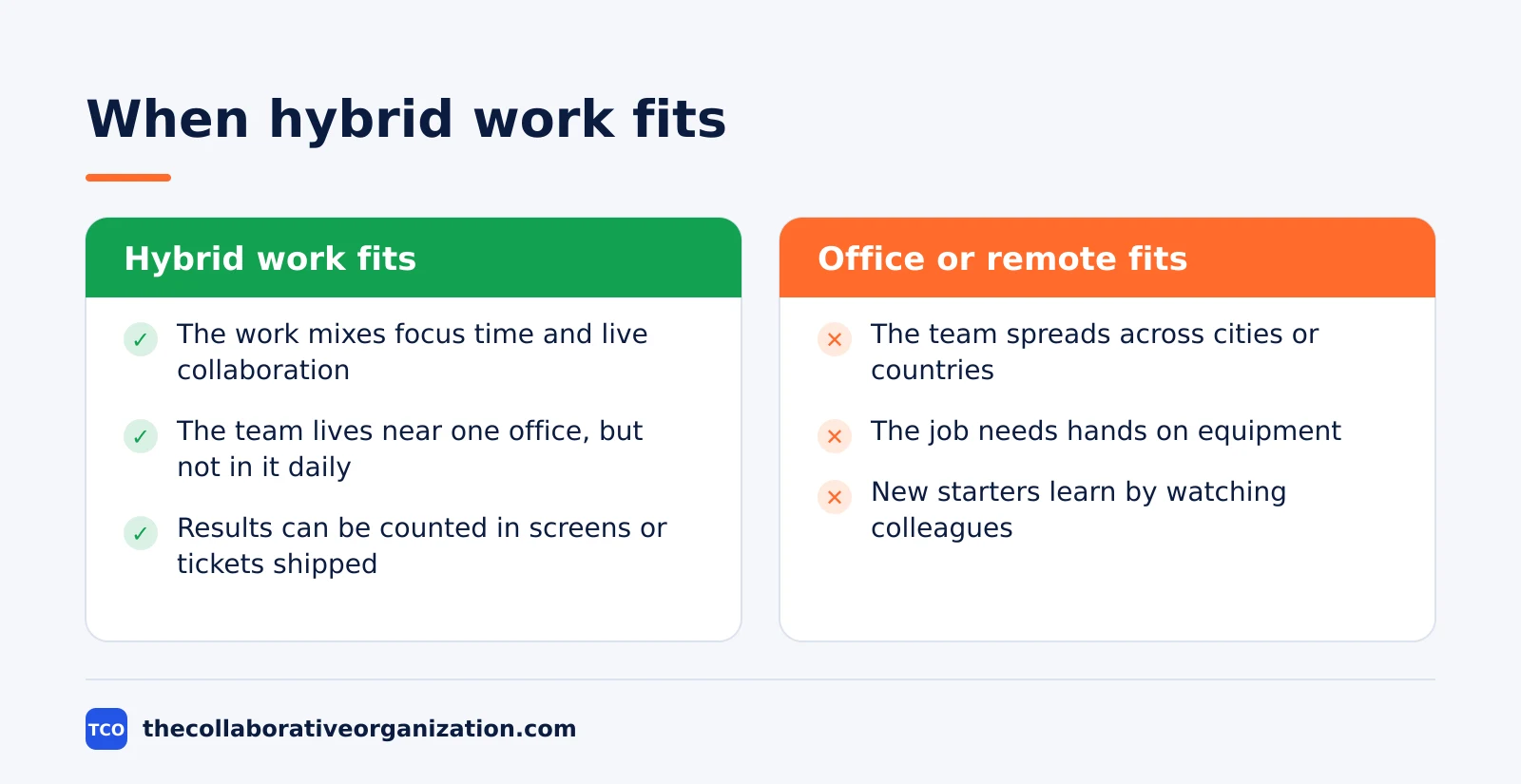
Hybrid work fits when the work mixes focus and collaboration, when the team lives near one office but not in it every day, and when results can be counted in screens shipped, tickets closed, or deals won. It also fits when hiring matters: a hybrid team can hire in nearby cities, not just in one postcode.
Fully remote work fits better when the team spreads across cities or countries, since a hybrid policy cannot cover people who live far from the office.
Office work fits better when the job needs hands on equipment, or when new starters need to learn by watching. A team that forces hybrid on a distributed team gets the worst of both: an office nobody uses and a policy nobody follows.
The evidence backs the middle path. A randomized trial of 1,612 Trip.com employees found two home days a week had no effect on performance grades or promotions, while resignations fell by 33 percent.
FlexJobs found 76 percent of workers would look for a new job if forced back to the office full-time, while only 2 percent prefer full-time office work.
Common hybrid work mistakes to avoid
Hybrid teams fail in the same five ways, and all five come from copying office habits into a hybrid setting. Fix the habit, not the person.
- Random office days. A team with no shared office days cannot collaborate in person, and the office becomes an expensive place to take video calls. Pick two or three shared days and protect them.
- Judging work by presence. A worker in the office is not more productive than a worker at home, and a team that rewards presence will punish its best remote days.
- Making every decision in the office. Decisions made in a room exclude anyone working from home that day. Write the decision down with the reason, or the team splits in two.
- Letting the employer set the days alone. Employer-decided schedules score lowest on fairness, and the team will find ways around them. Let the team set its own anchor days.
- No home-day rules. A home day with back-to-back video calls is an office day without the commute. Protect home days for focus work, and keep meetings on office days where possible.
Sources
- Gallup - Indicator: Hybrid Work (2026)
- Gallup - Hybrid Work in Retreat? Barely. (2025)
- Owl Labs - State of Hybrid Work 2025 (2025)
- Pew Research Center - About a Third of U.S. Workers Who Can Work from Home Do So All the Time (2023)
- Cisco - Global Hybrid Work Study 2025 (2025)
- McKinsey - Let’s Get Flexible (2024)
- FlexJobs - 2025 State of the Workforce Report (2025)
- Slack - Pricing (2026)
- Zoom - Pricing (2026)
- Notion - Pricing (2026)
Frequently asked questions
What is the difference between hybrid work and remote work?
Remote work means the job is done away from the office, usually all the time. Hybrid work splits the week between the office and a remote location. Gallup defines hybrid as working remotely between 10 percent and less than 100 percent of the time, while exclusively remote means 100 percent. A hybrid worker still has an office to go to on some days.
How many days a week do hybrid workers go to the office?
Hybrid workers spend 46 percent of their workweek in the office, about 2.3 days, according to Gallup in 2025. Owl Labs found 39 percent of hybrid workers go in three days a week, the most common pattern, and 34 percent go in four days. The exact number is set by the employer or the team, not by a fixed rule.
Who decides a hybrid work schedule?
Gallup found the decision is split three ways: 34 percent of hybrid workers set their own schedule, 35 percent have it decided by their manager or team, and 31 percent have it set by their employer or leadership. Team-decided schedules work best: 91 percent of those workers see the policy as fair, the same rate as workers who decide it themselves.
Does hybrid work hurt productivity?
No, according to the strongest evidence available. A randomized trial of 1,612 Trip.com employees found two home days a week had no effect on performance grades or promotions, while resignations fell 33 percent. In surveys, 69 percent of managers say hybrid and remote work made their team more productive, and 81 percent of employers see a direct link between flexibility and performance.
What is the best hybrid work schedule?
Three office days and two home days is the most common pattern, and it is also the pattern tested in the strongest trial. The trial found no performance cost and a 33 percent drop in resignations. The best schedule for a given team is the one the team sets together, with shared office days for collaboration and home days for focus work.
Related articles

team communication
Communication Plan for a Project: Template (2026)
A communication plan for a project names who gets which update, in which channel, how often, and from whom. Copy the template and the filled example below.
November 20, 2026 · 10 min read

team communication
How Often Should Managers Communicate With Teams? (2026)
Managers should hold one meaningful conversation with each person every week, plus a weekly team update. See the cadence table for meetings, updates and feedback.
November 20, 2026 · 9 min read
team communication
Upward Communication Examples: 10 That Work (2026)
Upward communication is a message that travels from an employee to a manager or leader. See 10 concrete examples, each with why it works and when to use it.
November 20, 2026 · 9 min read