Project Charter vs Project Plan: Key Differences (2026) | The Collaborative Organization
By The Collaborative Organization Team · November 19, 2026 · Last verified November 19, 2026 · 10 min read
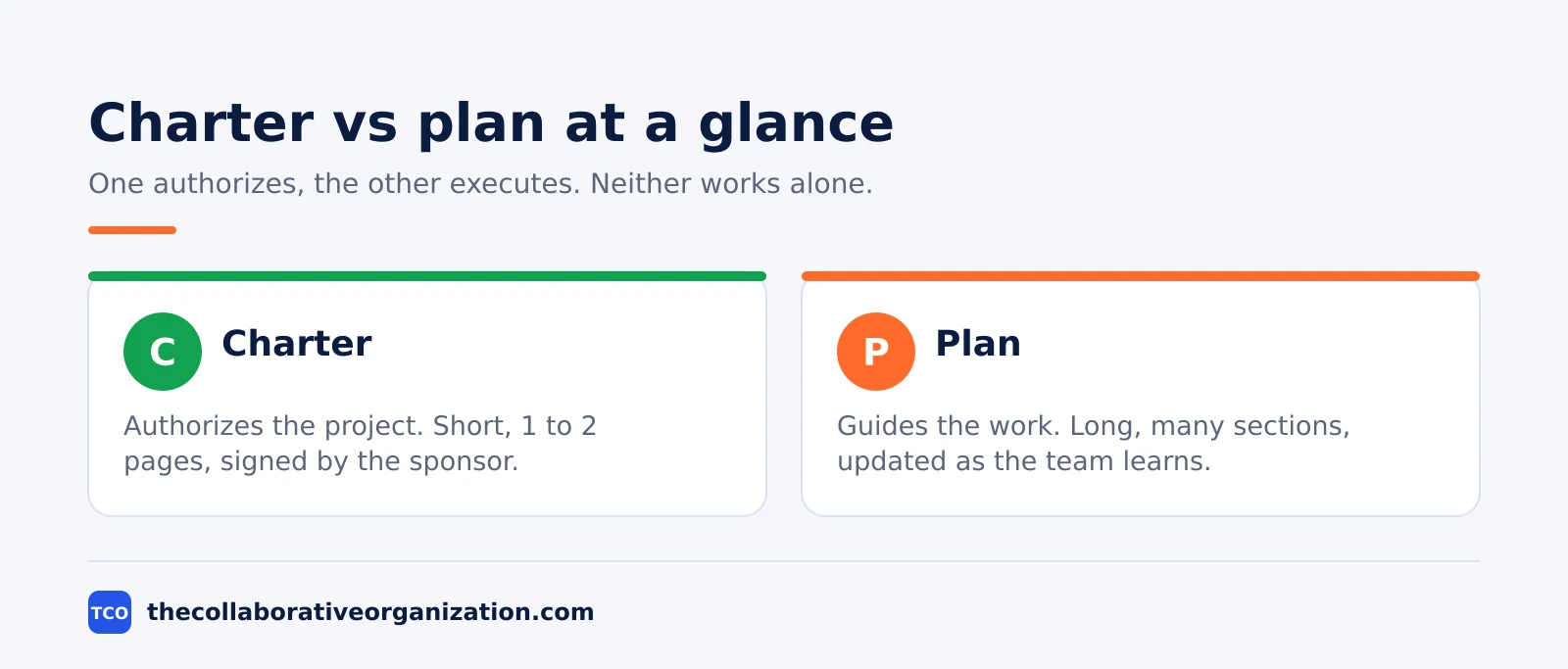
A project charter authorizes the project to exist, while a project plan explains how the team will run it. One answers “should we do this, and who may spend resources on it”, and the other answers “how exactly will we do it, and how will we know it worked”.
Key takeaways
- A charter is issued by the sponsor and gives the project manager formal authority to use resources.
- A plan is built by the project manager after the charter is approved, and it guides execution day to day.
- Charters are short, usually 1 to 2 pages, while plans are long documents with many parts.
- The charter almost never changes, while the plan changes often as the team learns.
- PMI research, as reported in 2026, found only 31 percent of projects land on time, on budget and on scope.
The core difference in one sentence
The core difference is the job each document does: the charter authorizes, and the plan executes. One is a permission slip from the sponsor, and the other is the team’s working manual for the project.
A charter is written before planning begins. It names the sponsor, the project manager, the purpose, the high-level scope, and the success criteria, and it records the authority the manager holds. A plan is written during the planning phase, after the charter is approved, and it spells out schedules, budgets, risks and work in detail.
Confusing the two is a planning failure, not a formatting one. A team that writes a plan without a charter has no agreed authority, and a team that writes a charter and calls it a plan has no working detail.
What is a project charter?
A project charter is a short formal document that authorizes a project to exist and gives the project manager the authority to apply organizational resources to it. It is the first document that says, in writing, “this project is real”.
The Project Management Institute defines it in those exact terms: a document issued by the project initiator or sponsor that formally authorizes the existence of a project and gives the project manager authority over organizational resources.
PMI repeats that definition in its September 2026 guide to writing a charter, and adds that authority is the whole point of the document.
A useful charter answers four questions. Does the sponsor agree the project should exist? Who is leading it?
What authority does the project manager have to decide and to use resources? Is that authorization captured somewhere the team can point to?
The sponsor issues and authorizes the charter, but the project manager often drafts it. PMI notes that the sponsor only has to authorize the charter, not write it.
The manager should be named as early as possible, ideally while the charter is being written. A charter can be a page, an email, or another formal record, as long as it clearly authorizes the project and names who leads it.
What is a project plan?
A project plan is the document the project manager builds after the charter is approved, and it explains how the project will be carried out from start to finish. It covers scope, schedule, budget, resources, risks and quality, and it changes often as the team learns.
The formal PMI term is “project management plan”, which documents the actions needed to define, prepare, integrate and coordinate all subsidiary plans.
The shorter phrase “project plan” is the common name for the same document, though PMBOK does not define it as a separate term. The plan holds the subsidiary plans for scope, schedule, cost, quality, resources, communication, risk, procurement and stakeholders, plus plans for requirements, change and configuration.
The plan is a living document. The charter, by contrast, almost never changes, because it records the authorization itself. When the team learns that a task takes longer than planned, the plan is updated, while the charter stays as it was signed.
One number shows why the plan matters. PMI research, as reported in 2026, found that only 31 percent of projects are delivered on time, on budget and on scope.
Charter vs plan: side-by-side table
The table below puts the two documents side by side, so you can see at a glance which one a meeting needs. Start with the purpose row, since that is the row teams mix up most often.
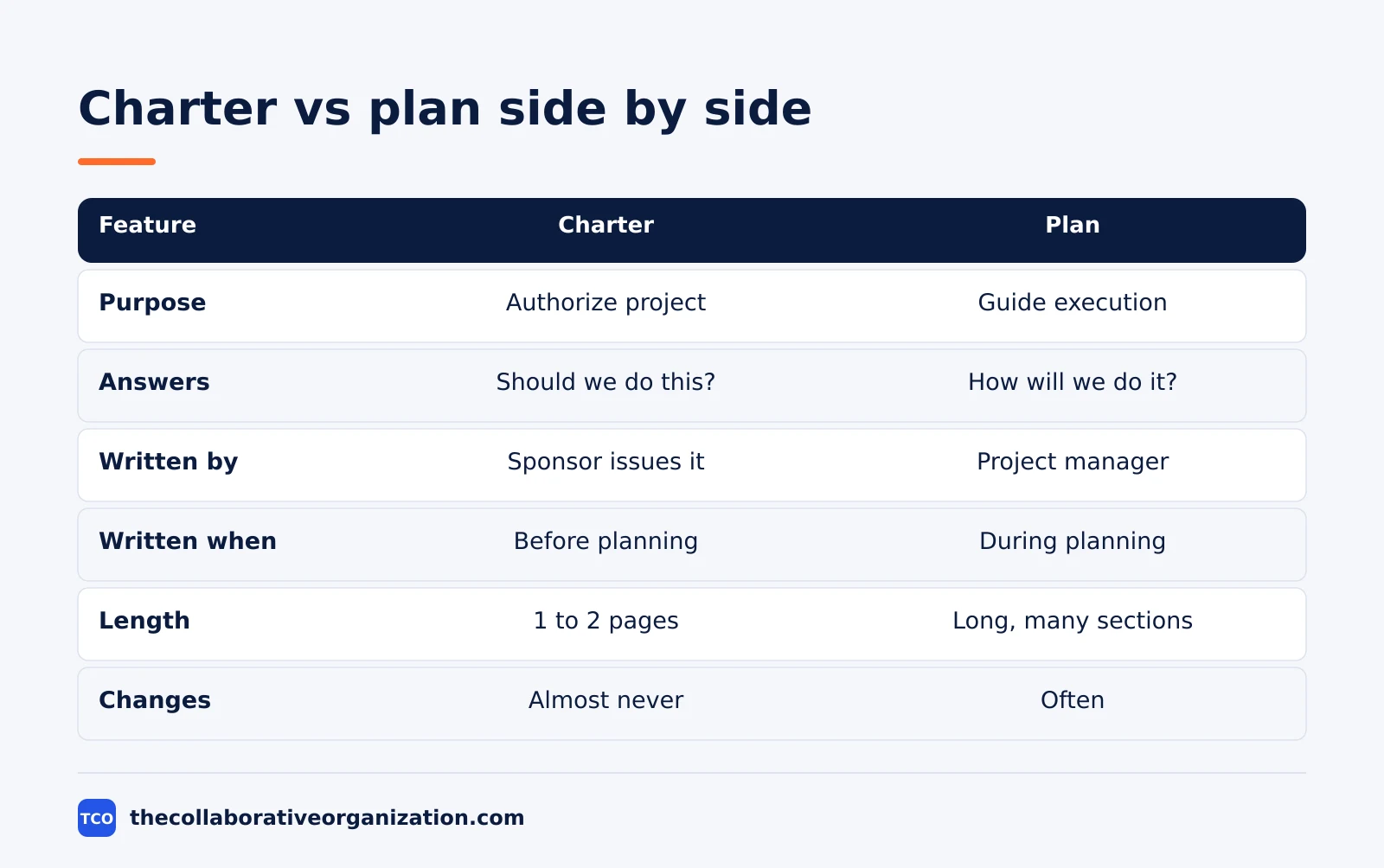
| Feature | Project charter | Project plan |
|---|---|---|
| Purpose | Authorize the project | Guide execution |
| Answers | Should we do this? | How will we do it? |
| Written by | Sponsor issues it; PM often drafts it | Project manager |
| Written when | Before planning, in initiation | During planning, after approval |
| Length | 1 to 2 pages | Long, many sections |
| Audience | Sponsor, stakeholders, PM | Whole project team |
| Changes | Almost never | Often, as the team learns |
| Main contents | Purpose, scope, sponsor, PM, authority | Schedule, budget, risks, work plans |
| Without it | No authority to use resources | No agreed way to run the work |
One row deserves extra care: the “changes” row. A plan that never changes is a plan nobody reads, because real projects always teach the team something new. A charter that changes every week is not a charter at all, because the authorization it records would mean nothing.
Worked example: one charter, one plan
A five-person team replacing a clinic’s booking system shows how the two documents work in sequence. The example is an illustration, not a case study, and the team is made up to show the method.
The charter fits on one page. It names the sponsor, the clinic director, and the project manager, a senior analyst.
It states the purpose: replace the phone booking process with online booking by 30 June. It lists the high-level scope, the pre-approved budget, and the success test: 70 percent of bookings made online within a month of launch. The director signs it, and the project starts.
The plan runs to 20 pages. It lists the schedule week by week, the budget broken down by task, the risks, such as a delay in the calendar sync, and the work plan for each team member. It names who tests the booking page, who trains the front desk, and how the team reports progress each Friday.
In week three, the calendar sync takes twice as long as planned. The plan is updated with a new date, and the team tells the sponsor. The charter does not change, because the purpose, the budget and the sponsor are all the same.
Which document do you need first?
You need the charter first, because no plan can stand without the authority it records. The order is fixed: authorize, then plan, then build.
Start with the charter when the project crosses teams, spends real money, or needs resources the manager does not control. The charter is what lets the manager ask another department for staff time and get a yes. Without it, every request is a negotiation.
Build the plan once the charter is signed. The plan turns the charter’s goals into a schedule, a budget, and named work. A plan written before the charter risks being thrown away, because the sponsor may change the scope or the budget when the charter is finally discussed.
Our guide on how to run a team kickoff covers the meeting where a team like this agrees the plan.
Our guide on what is a RACI matrix shows how to name one owner per task, so the plan’s authority lines stay clear.
How the charter and the plan work together
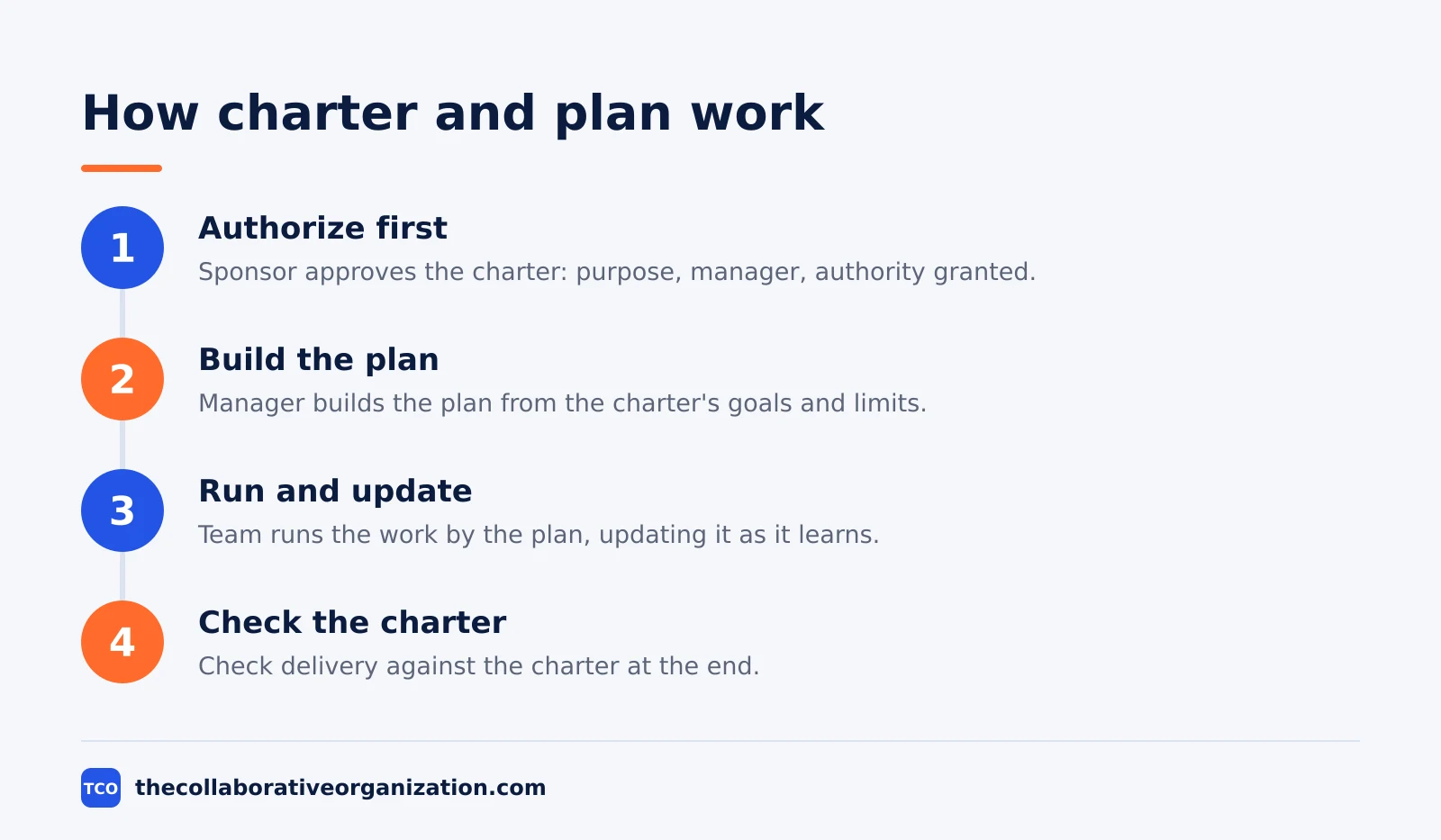
The charter and the plan work as a pair: the charter sets the terms, and the plan carries them out. Neither one replaces the other, and neither one works alone.
The flow runs in four steps. First, the sponsor approves the charter, which names the purpose, the manager, and the authority granted. Second, the manager builds the plan from the charter’s goals and limits.
Third, the team runs the work by the plan, updating it as it learns. Fourth, the charter is checked at the end: did the project deliver what the charter promised, and did the manager stay inside the authority it granted?
The plan’s subsidiary parts all trace back to the charter. The scope plan expands the charter’s high-level scope, the schedule plan turns its milestones into dates, and the budget plan turns its funds into line items.
When a change request arrives, the team checks it against both documents: does the plan allow it, and does the charter still cover it?
If the charter’s purpose changes so much that it no longer fits, the right move is a new authorization, not a quiet edit. A plan can absorb new dates and tasks, but only the sponsor can rewrite why the project exists.
Tools that hold charters and plans
A project tool keeps the charter, the plan and the work in one place, so the team can check the authorization without digging through email. The right tool is the one the team opens every day, not the one with the longest feature list.
Asana, monday.com and ClickUp all hold project docs next to tasks, so the charter can sit beside the plan it authorizes. Pick the tool that matches how your team already plans, and keep the charter where the team can find it in one click.
| Tool | Best for | Free plan | Starting price (as of November 2026) | Notable limit |
|---|---|---|---|---|
| Asana | Teams that want docs linked to tasks | Free for 2 people | $10.99 per user per month, billed annually | Free plan covers 2 people |
| monday.com | Teams that want a visual project board | Free plan for up to 2 seats | $9 per seat per month (Basic), billed annually | Paid plans need at least 3 seats |
| ClickUp | Teams that want docs, tasks and goals together | Free Forever plan | $9 per user per month (Core), billed annually | Yearly billing needed for that price |
The Asana price comes from Asana pricing: Starter is $10.99 per user per month when billed annually. On the monday.com pricing page, Basic is $9 per seat per month billed annually, with a 3-seat minimum. The ClickUp pricing page lists Core at $9 per user per month billed yearly.
If you have not picked a tool yet, compare the options on our project management software shortlist before you write your first charter.
Our guide on how to choose project management software covers seat counts and free-plan caps in detail.
Common charter and plan mistakes to avoid
Most charter and plan pairs fail in the same five ways, and all five are easy to spot in a review. Run through the list below before the project starts.
- A plan with no charter behind it. Work that starts without written authority stalls the first time the team needs resources it does not control.
- A charter that tries to be the plan. A 20-page charter is a plan in disguise, and nobody will read it as an authorization.
- A charter the sponsor never signed. A draft the sponsor has not approved is a wish, not an authorization, and the manager has no authority yet.
- A plan nobody updates. A plan that still shows week-one dates in week eight misleads the team, so update it at each review.
- Editing the charter to hide a change. When the purpose or the sponsor changes, get a new authorization instead of quietly rewriting the old one.
Sources
- PMI - Project Charter: What It Is and How to Write One (2026)
- PM Aspirant - What Is A Project Charter vs Project Plan (2024)
- JadeALM - Project Charter, Project Plan, and WBS Contrast (2022)
- Dee Project Manager - Project Charter vs Project Plan: Key Differences (2024)
- TMetric - How to Create a Project Charter: Key Elements, Template, and Example (2026)
- Asana - Pricing (2026)
- monday.com - Pricing (2026)
- ClickUp - Pricing (2026)
Frequently asked questions
Can a project start without a charter?
It can, but it starts on shaky ground. Without a charter, the project manager has no written authority to use resources, and the sponsor has not agreed in writing that the project should exist. Small internal work often skips the formality, but any project that crosses teams or spends real money needs the written yes first.
Is the project plan part of the project charter?
No. The charter authorizes the project and sets its high-level terms, while the plan is a separate document built after the charter is approved. The plan expands the charter's goals into schedules, budgets, and work plans. Keep the two apart, so a change to the plan does not look like a change to the authorization.
How long should a project charter be?
One to two pages is the norm. A charter covers purpose, goals, high-level scope, key stakeholders, the sponsor, the project manager, and the authority granted. Anything longer usually means the team is writing the plan inside the charter, which defeats the point of a short authorization document.
Who writes the project charter?
The sponsor issues and authorizes it, but the project manager often drafts it. PMI notes that the sponsor only has to authorize the charter, not write it. What matters is who approves it: the person with the authority to start the project and commit resources must say yes on the record.
Does the charter ever change after approval?
Almost never. The charter is a fixed record of the authorization, while the plan changes often as the team learns more. If the project's purpose or sponsor changes so much that the charter no longer fits, the right move is a new authorization, not a quiet edit to the old one.
Related articles
guides
Free Project Management Templates: 7 to Copy (2026)
Seven free project management templates from monday, Wrike, Teamwork, Smartsheet, ClickUp, Asana and Trello, with what each one is for and what free really costs.
November 20, 2026 · 7 min read
guides
Project Proposal Template: Copy and Win Work (2026)
A project proposal template pitches the work before it is approved: problem, solution, scope, budget, timeline and terms. Copy the template and filled example.
November 20, 2026 · 10 min read
guides
Action Plan Template: Goal to Done in One Page (2026)
An action plan template turns one goal into owned steps with dates, dependencies and a success measure. Copy the table and see it filled for a support team.
November 20, 2026 · 11 min read