How to Run a Team Kickoff Meeting: Agenda and Steps (2026) | The Collaborative Organization
By The Collaborative Organization Team · November 19, 2026 · Last verified November 19, 2026 · 10 min read
To run a team kickoff, prepare the goal, scope and roles in advance, send the agenda 48 hours early, then run a 60-minute meeting that ends with named owners for the first two weeks of work. A kickoff aligns the team on what success looks like before any real work begins.
Key takeaways
- A team kickoff aligns the whole team on the goal, scope, roles, timeline and working rules before work starts.
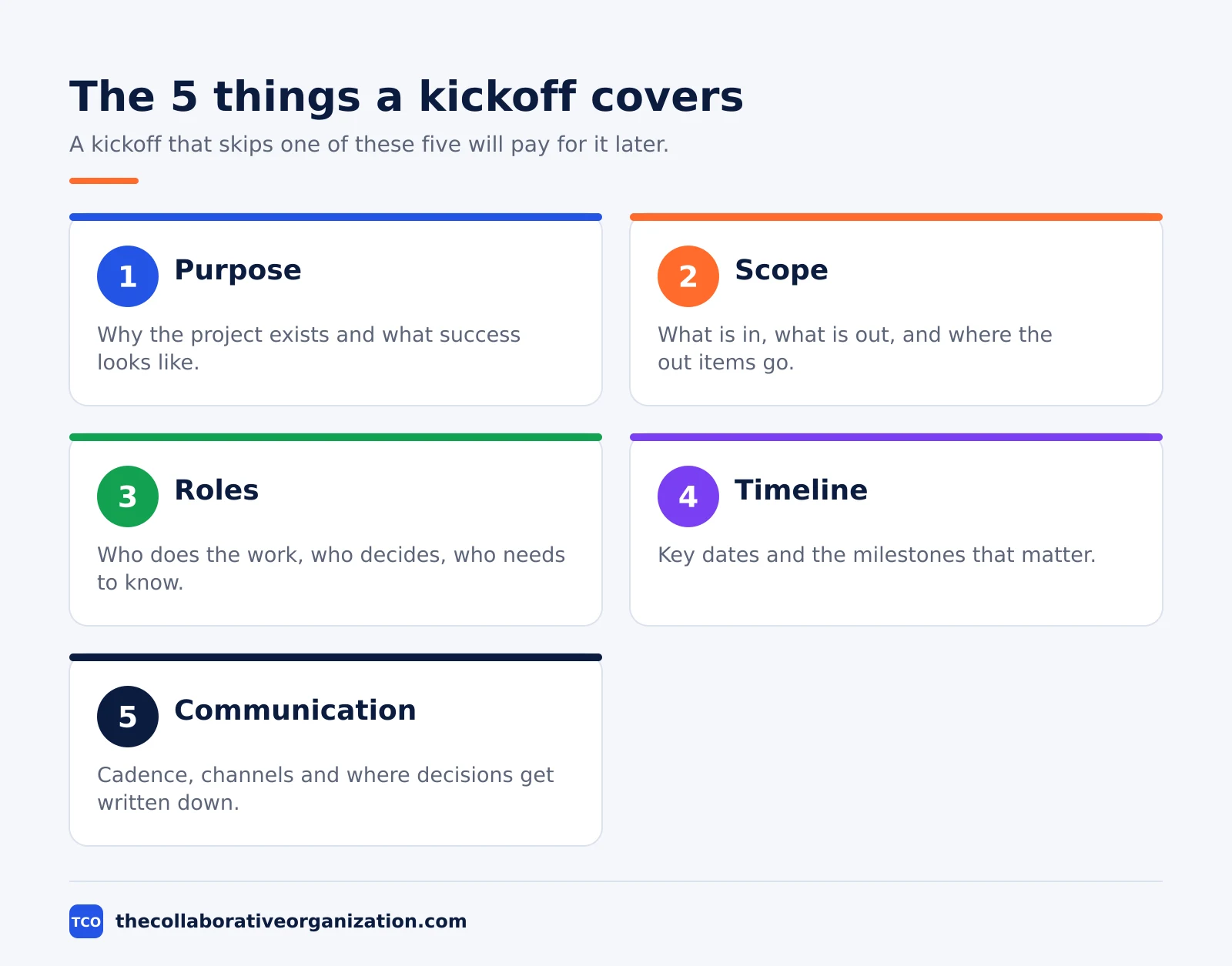
- A good kickoff covers five things: purpose, scope, roles, timeline and communication norms.
- Send the agenda and pre-reads at least 48 hours before the meeting, and the notes within 24 hours after it.
- Plan 60 minutes for a normal project, 45 for a small one, and up to two hours for a complex multi-team effort.
- Every decision and action from the meeting needs a name and a date, or it will not happen.
What a team kickoff is
A team kickoff is the first official gathering where the whole team and key stakeholders align on what success looks like before any real work begins. Rework defines it this way, and adds that it is a structured session that launches a project by aligning everyone on goals, scope, roles, timelines and the working agreement.
A kickoff is not a status meeting and not a party. It is a working session with written outputs: an agreed goal, a scope list, named owners and dated tasks. If the meeting ends with no written record, it was not a kickoff, it was a chat.
It also has one job. Quire puts it plainly: a kickoff agenda has one job, to send everyone out of the room knowing the goal, what done looks like, who decides when two teams disagree, and what they personally own in the first two weeks.
What you need before the kickoff
A good kickoff is built in the week before it, not on the day. Gather four items before you send the invite.
- A one-sentence goal. Write the goal in one sentence, naming the business outcome and the number that proves it. If you cannot write it in one sentence, the team is not ready.
- A draft scope list. List what the project will deliver and what it will not. Scope out is the most valuable list: NoterAI calls it the most valuable section on the page, because it stops the project growing later.
- A roster with roles. Name the people and their roles, with one owner per workstream. Our guide to what a RACI matrix is shows how to map who does the work, who approves it and who needs to know.
- A sketch of the first two weeks. List the first tasks with names and dates. Quire lists this as one of three pre-work items, next to drafting the goal and putting roles on the roster.
Send all four with the invite, at least 48 hours before the meeting. Rework advises sending the agenda that early with any pre-reads, because people who arrive informed contribute more.
The 60-minute kickoff agenda
The agenda below fits a normal project into 60 minutes, with each item timed and owned. Adjust the times to fit your project, but keep the order.
| # | Agenda item | Owner | Time | Written output |
|---|---|---|---|---|
| 1 | Welcome and introductions | Project lead | 5 min | Names and roles on the record |
| 2 | Project purpose and goals | Sponsor | 10 min | One-sentence goal, agreed |
| 3 | Scope: what is in, what is out | Project lead | 10 min | In list and out list |
| 4 | Roles and decision rights | Project lead | 10 min | RACI chart, one owner per task |
| 5 | Timeline and milestones | Project lead | 10 min | Five to eight dated milestones |
| 6 | Risks and dependencies | Whole team | 5 min | Top risks with a watcher each |
| 7 | Communication plan | Project lead | 5 min | Cadence, channels, decision log |
| 8 | Next steps and owners | Project lead | 5 min | Action list with names and dates |
Rework suggests a 75-minute agenda for a mid-sized project, with 45 minutes for small projects and up to two hours for complex multi-team work. Laxis offers a 60-minute version with the same nine building blocks: purpose, scope, roles, timeline, risks, communication, success measures, questions and next steps.
Keep the times visible during the meeting. When the first topic eats the whole hour, the later items never get decided, and the team leaves with a goal but no owners.
Scope deserves the most care. Each item in the “in” list should be short enough to fit on one line, and each “out” item should say where it goes instead. Our guide on how to write user stories shows how to phrase scope items so the team can test whether each one is done.
How to run a team kickoff in 5 steps
Running a kickoff takes five steps, and only one of them happens in the meeting room. The work before and after decides whether the hour counts.
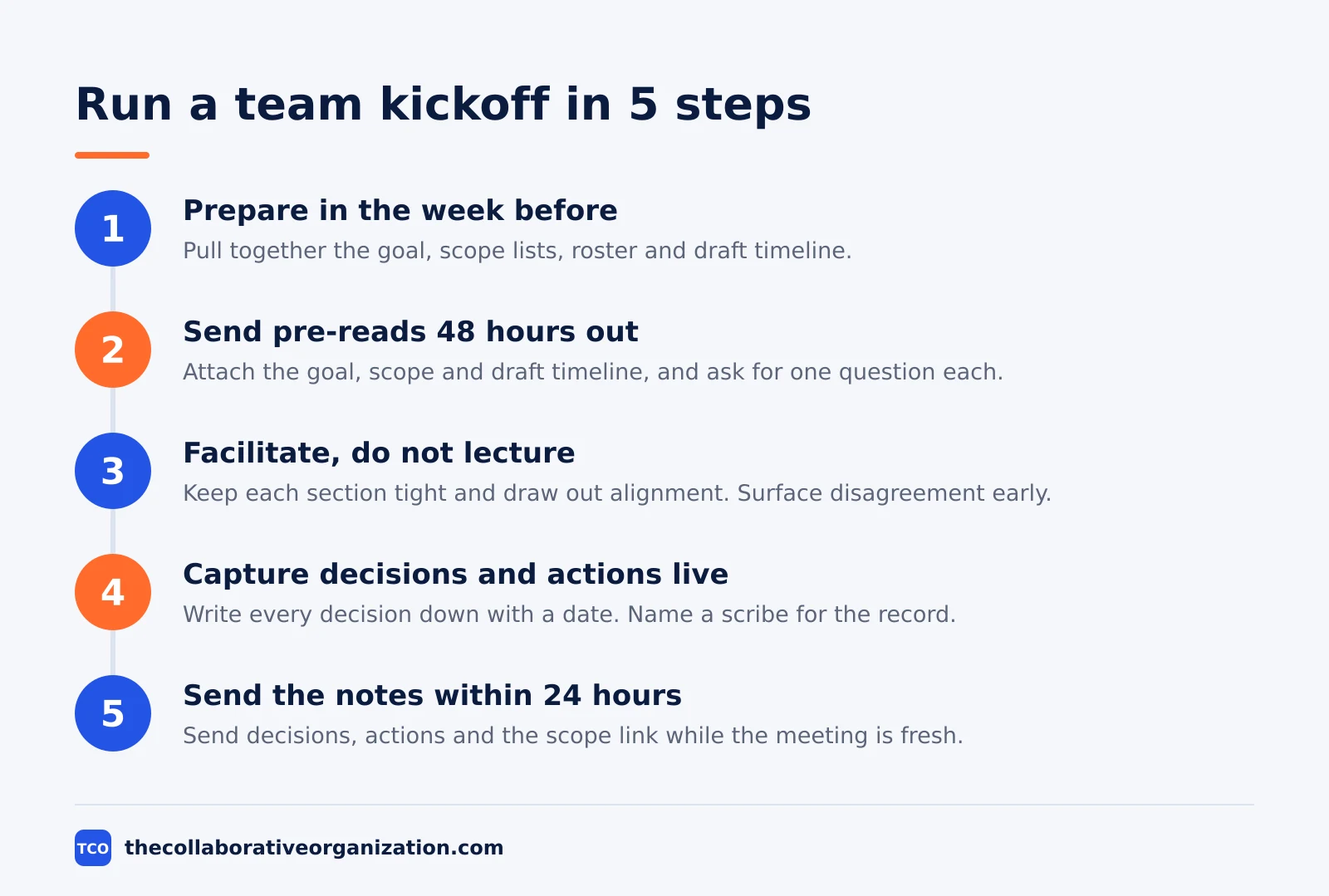
Step 1: Prepare in the week before
Pull together the goal, the scope lists, the roster and the draft timeline. Do not wait until they are perfect: a draft the team can fix beats a polished plan nobody has seen. Outcome: the invite goes out with real pre-reads, not a blank agenda.
Step 2: Send pre-reads 48 hours out
Attach the goal, scope and draft timeline with a short note. Ask each person to arrive with one question or concern about their own area. Laxis advises sending the hard questions in advance, two days before the kickoff, so the meeting answers them instead of discovering them.
Step 3: Facilitate, do not lecture
Keep each section tight and draw out alignment. Your job is to surface disagreement early, not to deliver a presentation. If one person talks for 20 minutes, the rest of the team has stopped deciding.
Step 4: Capture decisions and actions live
Write every decision down with a date, and give every action an owner and a due date. Name a scribe, because the facilitator cannot run the room and write the record at the same time. NoterAI makes the same point: whoever facilitates should not also write.
Step 5: Send the notes within 24 hours
Send the notes while the meeting is still fresh, with the decisions, the actions, the agreed scope and a link to the shared workspace. Ask for corrections within 48 hours, and book the first check-in within a week.
Worked example: a kickoff for a six-person website project
A six-person team is rebuilding a company website in eight weeks, and the kickoff runs on a Tuesday morning. This is an illustration of the process, not a real case.
The sponsor opens with the goal in one sentence: cut the time visitors need to find pricing from three clicks to one, and lift quote requests by 20% in the first month after launch. The lead then walks the scope: new homepage, pricing page and quote form are in, while the blog redesign and the customer portal are out.
Roles take 10 minutes. The designer owns the pages, the developer owns the build, the writer owns the copy, and the lead owns the launch decision. The timeline has six milestones, from design sign-off in week two to launch in week eight.
The team names two risks: the pricing data arrives late, and the quote form needs legal review. By the end of the hour, 14 actions have owners and dates, and the first check-in is booked for Friday.
The project then runs in two-week sprints, and our guide to what a sprint in Scrum is explains how that rhythm works. The kickoff did not plan the whole project; it planned the first two weeks and the rules for the rest.
How to measure a good kickoff
A good kickoff shows up in the first two weeks, not in the meeting room. Check four signs.
| Sign | How to check it | A good result |
|---|---|---|
| Everyone knows the goal | Ask three people to state it | All three give the same goal |
| Owners are clear | Count tasks with no owner | Zero tasks without an owner |
| Work started on time | Check the first-week tasks | The first tasks start on their dates |
| No surprise dependencies | Ask what blocked the first week | No blocker nobody had named |
If the first week stalls, the kickoff missed something. The most common miss is a hidden dependency: a person or a system the team needs but did not invite. A short review at the end of the first sprint catches it early. Our guide on how to run a sprint planning meeting shows how to build that review in.
A kickoff that ends with applause but no owners is a failed kickoff. The applause fades by Friday, and the work stalls by Monday.
Tools that keep the kickoff alive after the meeting
The kickoff ends, but the project lives in a shared tool, where the goal, the owners and the dates stay visible. Pick the tool the team will open every day.
| Tool | Best for | Free plan | Starting price (as of November 2026) | Notable limit |
|---|---|---|---|---|
| Asana | Teams that want every kickoff action to have a named owner | Free for 2 people | $10.99 per user per month, billed annually | Free plan covers 2 people |
| monday.com | Teams that want a visual timeline of milestones | Free plan for up to 2 seats | $9 per seat per month (Basic), billed annually | Paid plans need at least 3 seats |
| ClickUp | Teams that want docs, tasks and the agenda in one place | Free Forever plan | $9 per user per month (Core), billed annually | Yearly billing needed for that price |
The Asana price comes from Asana pricing: the Personal plan is free for 2 users, and Starter is $10.99 per user per month when billed annually. On the monday.com pricing page, Basic is $9 per seat per month billed annually, with a 3-seat minimum. The ClickUp pricing page lists Core at $9 per user per month billed yearly.
Put the kickoff notes in the tool the same day, with the goal at the top and the action list below it. Our guide on how to choose project management software walks through seat counts and free-plan caps.
Compare the main options on our project management software shortlist before you commit to one.
Common team kickoff mistakes to avoid
Five mistakes waste the hour and stall the first week. Each one is easy to spot once you know it.
- Inviting everyone. A room of 20 people cannot decide anything. Invite the doers, the owner and the sponsor, and send the rest the notes.
- No pre-reads. A team that arrives cold spends the hour learning the goal instead of deciding the work.
- Skipping scope out. Without an out list, the project grows every week until the date slips.
- Ending with no owners. An action with no name and no date is a wish, not a plan.
- No notes within 24 hours. After two days, people remember different decisions, and the record is lost.
Sources
- Rework - Project Kickoff Meeting: Agenda, Checklist, and Template (2026)
- Laxis - Project Kickoff Meeting Agenda Template (2026)
- Quire - Project Kickoff Meeting Agenda and a Free Template (2026)
- NoterAI - Project Kickoff Meeting Template: Agenda and Filled Example (2026)
- Asana - Pricing (2026)
- monday.com - Pricing (2026)
- ClickUp - Pricing (2026)
Frequently asked questions
How long should a team kickoff meeting last?
Plan 60 minutes for a normal project. A small project fits in 45 minutes, while a complex project with several teams can need up to two hours. The length matters less than the pre-work: if people arrive having read the goal and the draft plan, an hour is enough.
Who should attend a team kickoff?
Invite the people doing the work, the person who owns the result, and the sponsor who funds it. Leave out anyone who only needs an update, and send them the notes instead. Too many people turns the kickoff into a briefing, and too few leaves hidden dependencies.
What should you send before a kickoff meeting?
Send the agenda, a one-sentence goal, a draft timeline and the list of roles at least 48 hours before the meeting. Ask each person to arrive with one question or concern about their own area. People who arrive informed contribute far more than people who arrive cold.
Should the kickoff be the first meeting of the project?
Yes. The kickoff is the first official working session, where the team agrees on the goal, what done looks like, who owns what, and the first two weeks of tasks. Work that starts before the kickoff usually has to be redone once the team agrees on the goal.
What happens after a kickoff meeting?
Send the notes within 24 hours, with every decision, every action item with a name and a date, and a link to the shared project workspace. Ask for corrections within 48 hours. The first check-in should happen within a week, while the agreements are still fresh.
Related articles
project management
How to Choose Project Management Software (2026)
Pick project management software in seven steps: define the work, count seats, price the real cost, and run a two-week pilot before you pay.
November 19, 2026 · 10 min read
project management
What Is a RACI Matrix? Definition, Roles and Examples (2026)
A RACI matrix maps who is Responsible, Accountable, Consulted and Informed for each task. Learn the four roles, how to build one, and see a worked example.
November 19, 2026 · 9 min read
project management
Daily Standup Meeting Format That Works (2026)
A daily standup is a 15-minute meeting where Developers inspect progress toward the Sprint Goal and plan the next day. Use this format to run one that ends on time.
November 19, 2026 · 10 min read