Tuckman Stages of Team Development Explained (2026) | The Collaborative Organization
By The Collaborative Organization Team · November 19, 2026 · Last verified November 19, 2026 · 10 min read
The Tuckman stages of team development are forming, storming, norming, performing and adjourning: five phases a small group moves through as it becomes a working team. Psychologist Bruce Tuckman proposed the first four in 1965 and added the fifth, adjourning, in 1977 with Mary Ann Jensen.
Key takeaways
- Tuckman proposed forming, storming, norming and performing in 1965, based on a review of 50 studies of small groups.
- Adjourning, the stage where a team disbands, was added in 1977 with Mary Ann Jensen.
- Storming is normal and needed: teams that skip open disagreement usually hit it later, near a deadline.
- Each stage asks for a different kind of leadership, from directing in forming to stepping back in performing.
- Teams can move backwards: new members or a new goal can send a performing team back to forming or storming.
What the Tuckman stages of team development are
The Tuckman stages describe how a new group of people becomes a team that can do hard work together. The model gives leaders a map: it names what the team is feeling, what usually goes wrong at each point, and what kind of leadership helps most.
Bruce Tuckman was a research psychologist at the US Naval Medical Research Institute in Bethesda when he published “Developmental Sequence in Small Groups” in Psychological Bulletin in 1965. He did not watch one team. He reviewed 50 published studies of small groups: therapy groups, training groups, natural groups such as those in a company, and laboratory groups.
From that review he drew four stages, and he gave them rhyming names that are easy to remember: forming, storming, norming and performing. He was careful about what he had built, calling it “a conceptual statement suggested by the data presented and subject to further test”. The model was a proposal, not a proven law.
Twelve years later, Tuckman and Mary Ann Jensen reviewed 22 newer studies and added a fifth stage: adjourning, the group’s ending. Their 1977 paper in Group and Organization Studies gave the model the five-stage form most people use today.
The 5 stages at a glance
The five stages run in order, from polite strangers to a team that runs itself, then to a planned ending. The table below shows what each stage looks like and what the leader should do, and the sections after it walk through each stage in full.
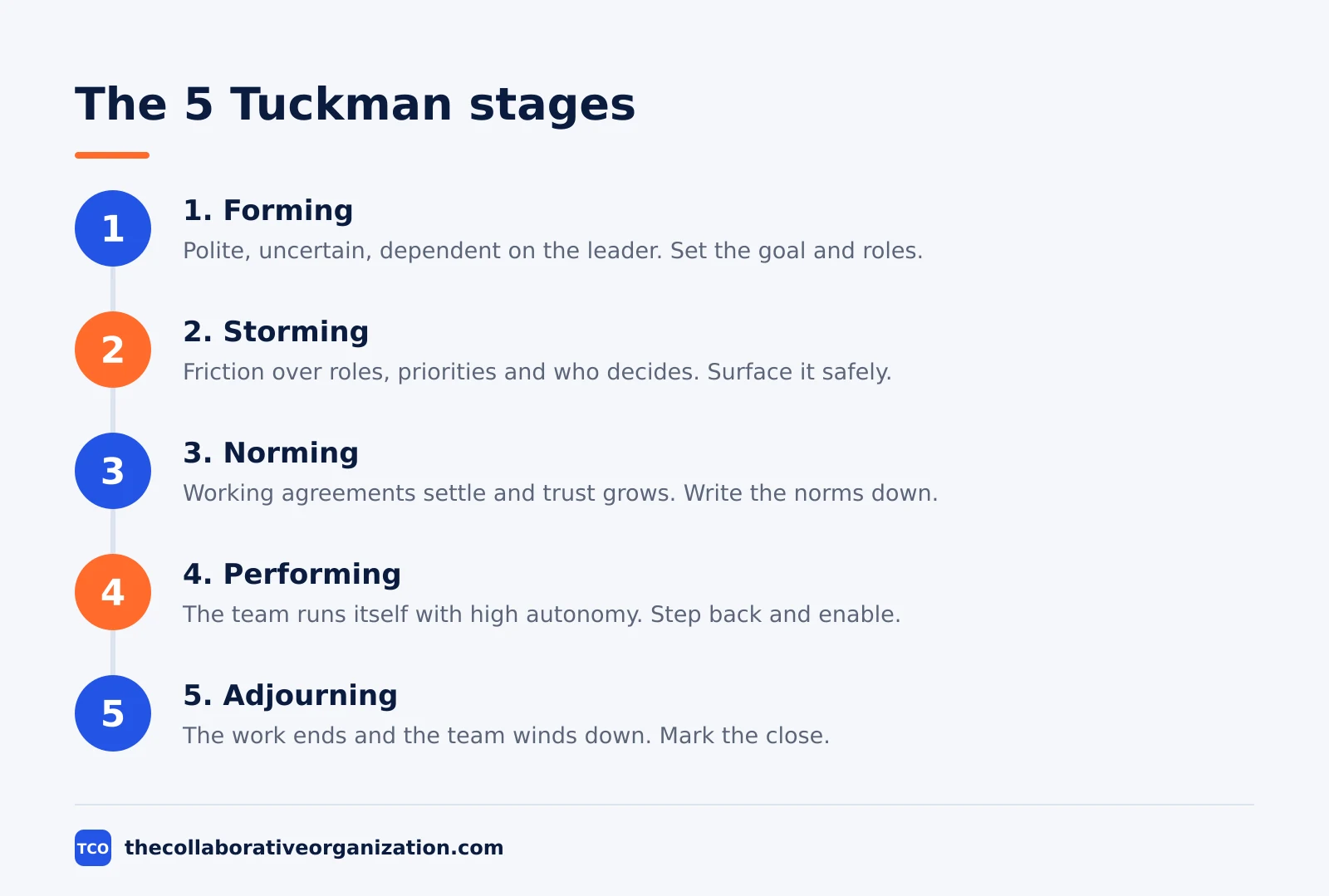
| Stage | What it looks like | What the leader should do |
|---|---|---|
| 1. Forming | Polite, cautious, lots of questions | Be directive: set the goal, roles and ground rules |
| 2. Storming | Friction over roles, priorities and decisions | Surface the conflict and re-anchor on the shared goal |
| 3. Norming | Working agreements settle, trust grows | Make the norms explicit so they hold under pressure |
| 4. Performing | The team runs itself with high autonomy | Step back: remove obstacles and develop people |
| 5. Adjourning | The work ends and the team winds down | Mark the close, reflect on lessons, celebrate the work |
The order matters, but it is not a one-way road. A new member, a new goal or a big setback can send a team back to an earlier stage. The model works best as a way to read the room: when you know which stage the team is in, you know what help it needs.
Stage 1: Forming
In forming, the team is polite, uncertain and heavily dependent on the leader. People are working out what is expected, who does what, and how the group will treat them. Little real disagreement shows up, because nobody wants to be the first to challenge the group.
Tuckman described this stage as orientation: the group explores the task, tests the boundaries and leans on whoever coordinates. Questions fly at the leader, and answers matter more than debate. The team needs structure: a clear goal, named roles, and a few ground rules about how meetings run and how decisions get made.
The common mistake in forming is reading politeness as agreement. A team that nods at everything has not agreed; it has not started talking yet.
Give the team a small early win, such as a first task finished together, so it learns it can deliver. A team kickoff is the natural place to do this work, because the first meeting sets the tone for the forming stage.
Stage 2: Storming
In storming, differences come into the open: friction over roles, priorities, methods and who decides. Frustration shows up, sometimes as open argument and sometimes as silence, missed deadlines or the same debate on repeat.
This is the stage most teams stall in, and it is also the stage they most need. The friction is the team working out what it really thinks, and a team that never storms often stores its disagreements until they explode near a deadline.
Tuckman’s own review found that only about half of his sources showed a distinct conflict stage, which is one reason the model is debated, but in practice most workplace teams recognise this phase at once.
The leader’s job in storming is to surface the conflict safely and re-anchor everyone on the shared goal. Name the disagreement in plain words, give each side time to speak, and keep the argument about the work rather than about people.
Trying to smooth it over or skip it is the classic error: it buys quiet today and costs far more later.
Stage 3: Norming
In norming, the team settles into working agreements and starts operating as a unit. People know how the group works, defer to each other’s strengths, and cover for each other when someone is away. Meetings run smoother, feedback gets easier, and the team develops a shorthand of its own.
The leader’s job changes here: make the norms explicit so they hold under pressure. Write down how decisions get made, who owns what, and how the team handles a missed deadline. Norms that live only in people’s heads fade the first time the team is stressed, while written norms can be pointed at and kept.
One risk in norming is harmony that suppresses useful dissent. A team that agrees too fast stops testing its own ideas, and the first sign is a meeting where nobody asks a hard question.
Keep healthy debate alive by asking for the dissenting view before closing a decision. Our guide on how to improve team collaboration covers the habits that keep debate open once norms have settled.
Stage 4: Performing
In performing, the team runs itself: confident, autonomous and aligned, with energy going into the work instead of into the team itself. Problems get solved before they reach the leader, roles flex to fit the task, and the team handles its own disagreements.
The leader’s job now is to step back and enable. Remove obstacles, develop people, and protect the team’s focus from outside noise. A leader who keeps directing a performing team slows it down and signals distrust, so the hardest move in this stage is doing less.
Not every team reaches performing, and some reach it only briefly. A team that stalls usually has an unresolved storming issue: a role nobody owns, a decision nobody explained, or a grudge nobody named.
If the team slips, look back at the earlier stages before blaming the people. The roles in a scrum team show one way high-performing teams split the work once they reach this stage.
Stage 5: Adjourning
In adjourning, the project ends and the team winds down, and closure matters more than most leaders expect. Tuckman and Jensen added this stage in 1977 for project and event teams that eventually disband, and it covers the final weeks of a team’s life.
The signs are easy to read: work is wrapping up, energy turns to what comes next, and people start to detach. Some members feel proud, others feel sad, and a few feel anxious about their next assignment. All three reactions are normal, and a leader who ignores them leaves the team with an unfinished ending.
Mark the close on purpose. Run a short review of what worked and what did not, name what each person contributed, and celebrate the work that shipped.
Capture the lessons in writing so the next team can use them, then help people move to their next team with a clear handover. A team that ends well carries its trust into the next project.
Worked example: a product launch team
A worked example shows all five stages on one team: six people launching a new pricing page in eight weeks. In week one, forming, the team is polite and full of questions. The lead sets the goal, names the roles, and writes three ground rules: one owner per task, decisions in writing, and blockers raised by 10 a.m.
In week three, storming arrives. The designer and the developer disagree on whether the page needs a calculator, and the argument fills two standups. The lead names the clash, gives each side five minutes, and asks what the customer needs. They agree to ship without the calculator and test it after launch.
By week five, norming, the team has a rhythm: a short daily check, a shared board, and a rule that anyone can challenge a plan before noon.
In week seven, performing, the team ships the page two days early and fixes a payment bug without involving the lead. In week eight, adjourning, the lead runs a review, thanks each person by name, and writes down three lessons for the next launch.
The same team, the same people, five different stages in eight weeks. The lead did not change the people; she changed what she did at each stage, and that is the whole point of the model.
Where the Tuckman model falls short
The Tuckman model is a useful map, but its evidence base is narrower than its fame suggests. Tuckman’s 1965 paper reviewed existing studies, many of them on therapy and training groups rather than workplace teams, and only one of the 22 studies in the 1977 review had set out to test the model directly.
Real project teams also break the sequence. Research on project teams found that some skip the ladder entirely, moving through long quiet stretches and then a burst of change near the midpoint instead of five neat stages.
A team with a hard deadline and a clear brief may storm on day one, while a team of old colleagues may form in an afternoon.
Use the model to read the room and pick your next move, not to predict the calendar. When the signs fit a stage, act on that stage’s advice. When they do not, trust what you see in the room over what the model says should happen.
For a fuller picture of how teams work together day to day, see what team collaboration is.
Common Tuckman model mistakes to avoid
Five mistakes turn a helpful model into a trap, and the first is treating the stages as a schedule. Run through the list before you plan around the model.
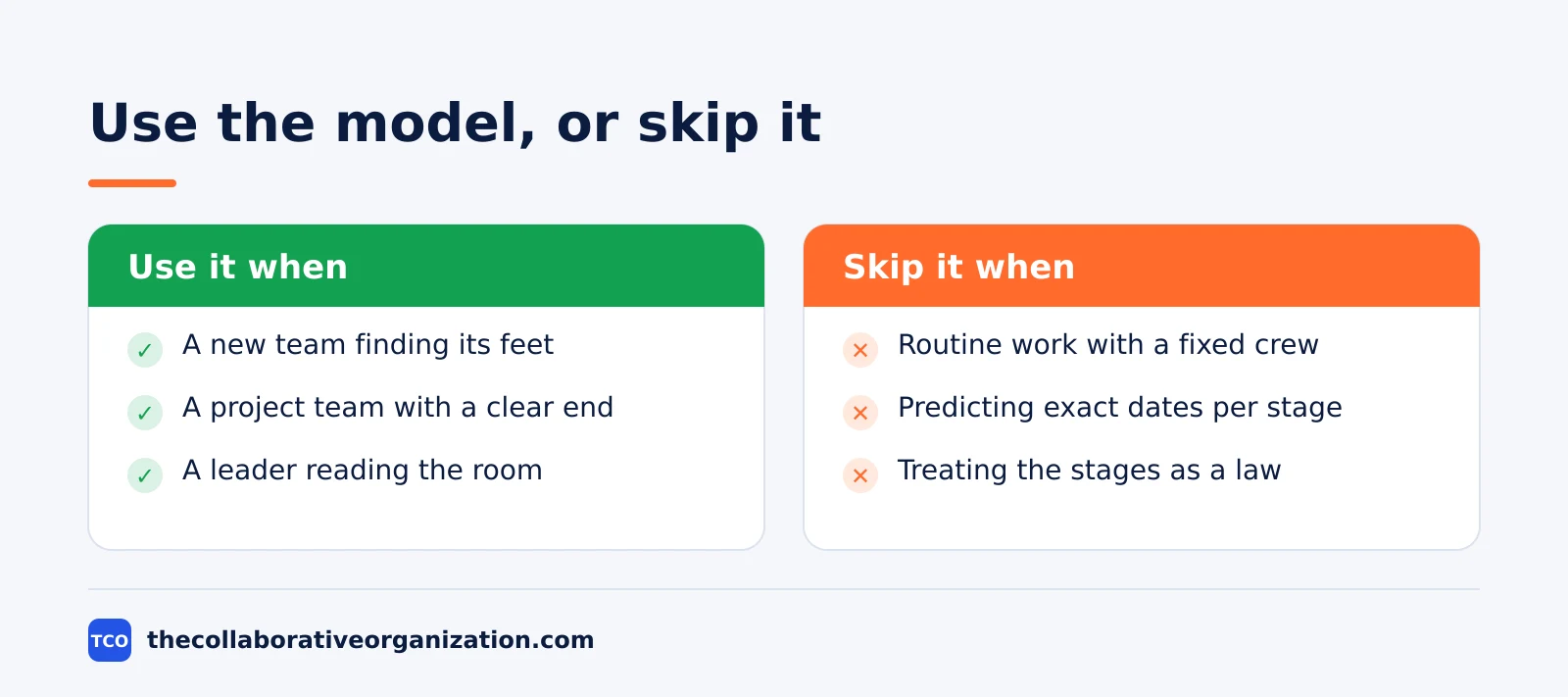
- Treating the stages as a schedule. Stages have no fixed length. Watch the team’s behaviour, not the date on the plan.
- Trying to skip storming. Smoothing over conflict buys quiet today and a blow-up near the deadline. Let the team argue about the work, with rules.
- Mistaking politeness for agreement. A forming team that nods at everything has not agreed yet. Ask each person to state the goal in their own words.
- Keeping the leader in charge during performing. A team that runs itself does not need daily direction. Step back, remove obstacles, and let it work.
- Skipping adjourning. A team that just stops, with no review and no thanks, carries the unfinished ending into its next project. Mark the close.
If you want a broader view of team tools, compare the options on our project management software shortlist, since the board a team uses shapes how easily it can see which stage it is in.
Sources
- Asana - Stages of Team Development (2025)
- Personaramic - Tuckman’s 5 Stages, from Forming to Adjourning (2026)
- My Positive Impact - Tuckman’s Model: The 5 Stages of Team Development Explained (2026)
- Building Teams - Tuckman’s 5 Stages: Forming, Storming, Norming, Performing (2026)
- Yu-kai Chou - Tuckman’s Stages: S-Tier Behavioral Designer’s Guide (2026)
- Umbrex - Tuckman Stages of Group Development (2026)
Frequently asked questions
How long does each Tuckman stage last?
There is no fixed length. A small team with a clear goal can move through forming in a week, while a large team with unclear roles can stay in storming for months. The stage changes when the team's behaviour changes, not when a date passes, so watch for the signs rather than the calendar.
Can a team skip the storming stage?
Rarely, and trying to skip it usually backfires. Teams that avoid open disagreement often store the tension and hit it later, harder, usually near a deadline. A short, honest storming phase with clear rules is faster than months of polite avoidance that ends in a blow-up.
What should a leader do when a team goes back to storming?
Treat it as normal, not as failure. New members, a new goal or a big setback can send a performing team back to storming. Re-anchor the team on its shared goal, surface the disagreement in the open, and re-agree the roles. The team usually moves through the stage faster the second time.
Is the Tuckman model backed by strong research?
Only in part. Tuckman's 1965 paper was a review of 50 studies, many of them therapy and training groups rather than workplace teams, and he called the model a conceptual statement open to further testing. Use it as a map for what to watch for, not as a proven law of team behaviour.
Does every team reach the performing stage?
No. Some teams stall in storming and never settle, usually because roles stay unclear or the same argument never gets resolved. Others reach performing and then slip back when members change. Reaching performing takes clear goals, agreed norms, and a leader who knows when to step back.
Related articles
project management
How to Choose Project Management Software (2026)
Pick project management software in seven steps: define the work, count seats, price the real cost, and run a two-week pilot before you pay.
November 19, 2026 · 10 min read
project management
What Is a RACI Matrix? Definition, Roles and Examples (2026)
A RACI matrix maps who is Responsible, Accountable, Consulted and Informed for each task. Learn the four roles, how to build one, and see a worked example.
November 19, 2026 · 9 min read
project management
Daily Standup Meeting Format That Works (2026)
A daily standup is a 15-minute meeting where Developers inspect progress toward the Sprint Goal and plan the next day. Use this format to run one that ends on time.
November 19, 2026 · 10 min read