High-Performing Team Characteristics: 10 Signs (2026) | The Collaborative Organization
By The Collaborative Organization Team · November 19, 2026 · Last verified November 19, 2026 · 10 min read
A high-performing team is one that ships quality work on time, learns from its mistakes, and keeps its promises to each other. The traits behind that record are not talent or luck; they are five dynamics Google found in its own teams, plus habits any team can build.
Key takeaways
- Google studied 180 teams and found five dynamics behind effective teams, with psychological safety ranked first.
- The five dynamics are psychological safety, dependability, structure and clarity, meaning, and impact.
- High-performing teams share ten traits, from trust and clear goals to peer accountability and shared results.
- Lencioni’s five dysfunctions show the same picture in reverse: no trust, no honest conflict, no commitment, no accountability, no results.
- Only 43% of employees in a 2021 McKinsey survey reported a positive climate in their team, so most teams have room to grow.
What makes a team high-performing
A team is high-performing when it delivers results that matter, on time, and keeps doing so as people and projects change. One good quarter does not make a high-performing team. The test is whether the team repeats the result, learns from misses, and keeps its members engaged while it does so.
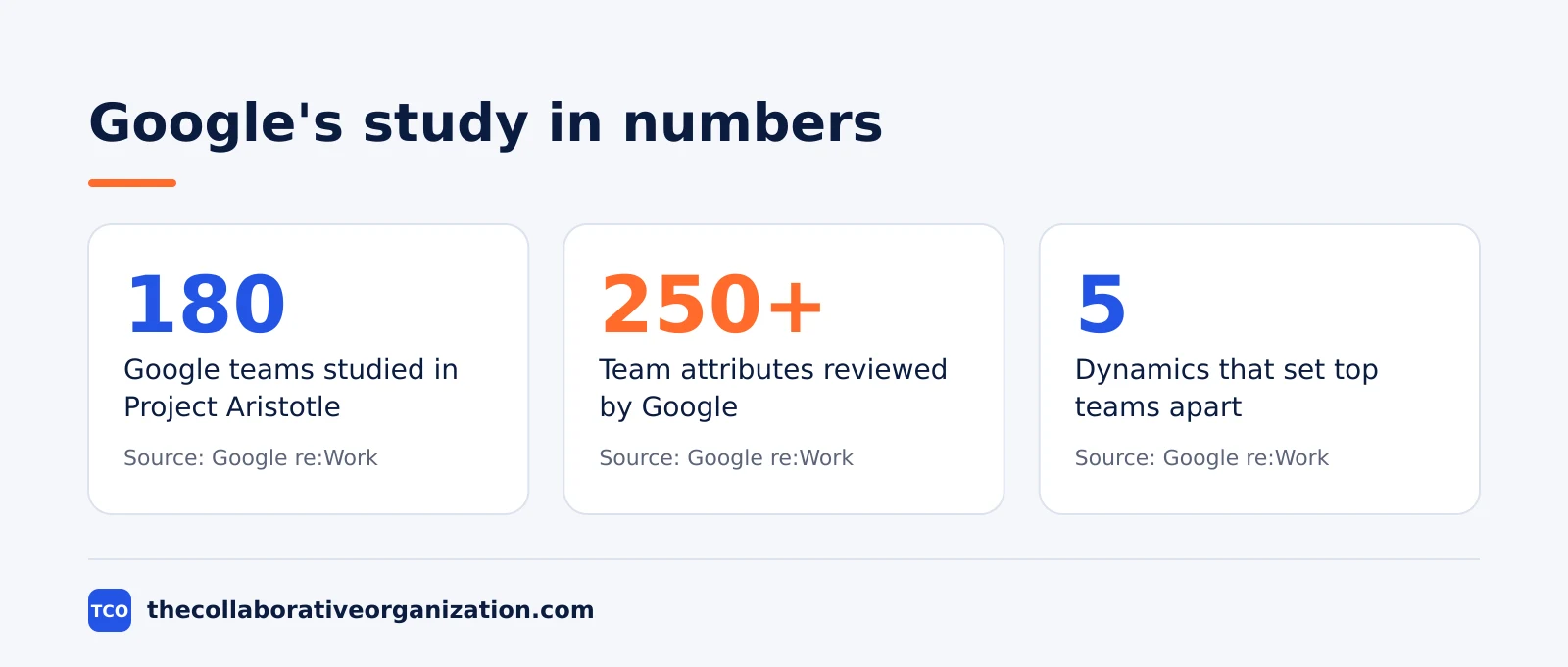
Google set out to answer this question in 2012 with Project Aristotle, a two-year study by its People Analytics team. The researchers studied 180 teams, ran more than 200 interviews, and reviewed over 250 team attributes, comparing the strongest teams with the weakest.
The finding surprised them: who is on a team matters far less than how members interact, structure their work, and view their contributions.
That finding is good news for every team, because it means performance is built from habits, not hired from outside. The five dynamics below are the habits Google found, and the ten characteristics after them turn those dynamics into signs you can check in your own team this week.
The 5 dynamics from Google’s Project Aristotle
Google’s five dynamics of effective teams, in order of importance, are psychological safety, dependability, structure and clarity, meaning, and impact. Psychological safety was not simply first among equals; Google called it by far the most important of the five, and the foundation the rest stand on.
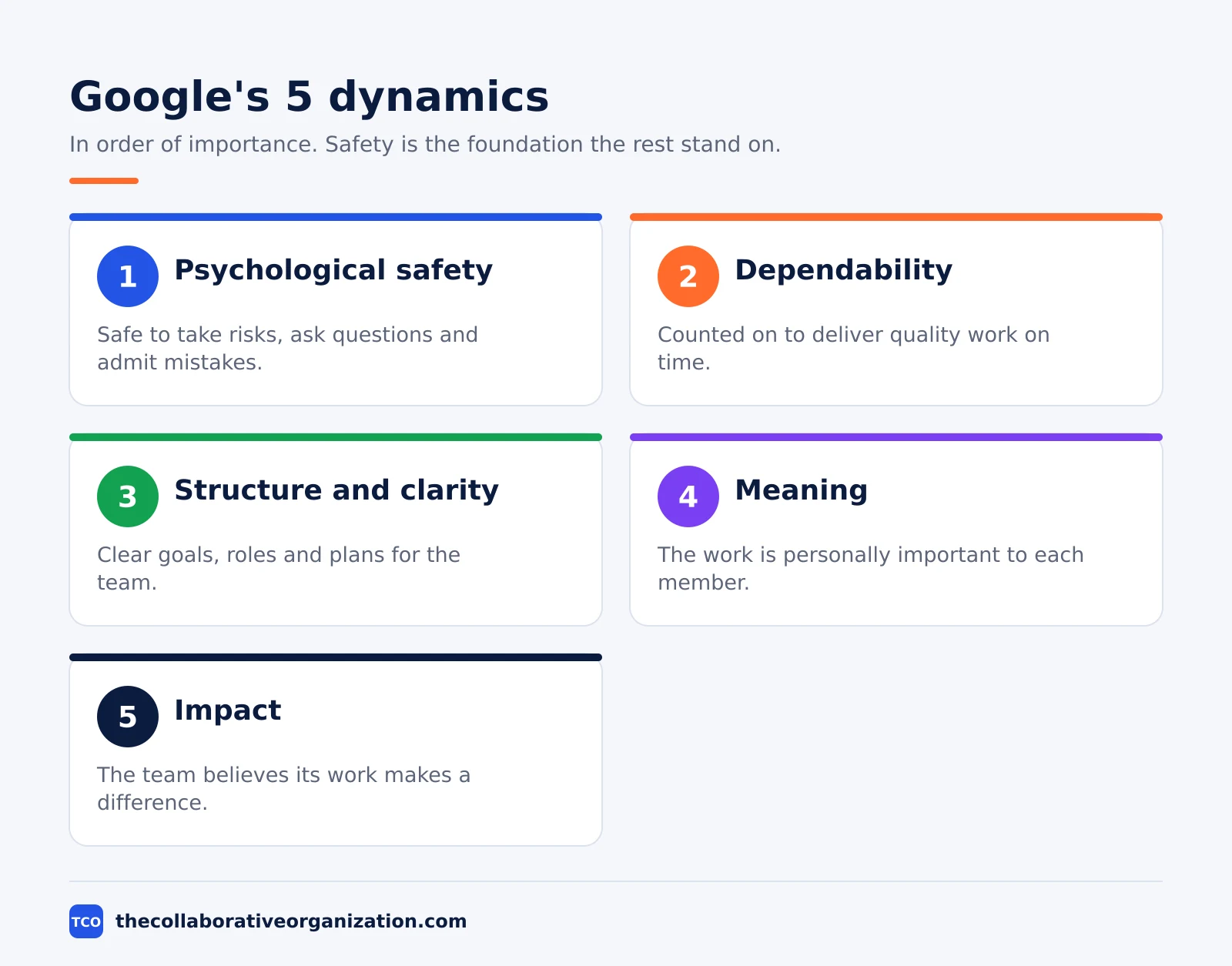
| Rank | Dynamic | The question it answers |
|---|---|---|
| 1 | Psychological safety | Can we take risks here without feeling embarrassed or punished? |
| 2 | Dependability | Can we count on each other to deliver quality work on time? |
| 3 | Structure and clarity | Do we know the goals, our roles, and how we decide? |
| 4 | Meaning | Does this work matter to me personally? |
| 5 | Impact | Do we believe our work makes a difference? |
Two behaviours showed up again and again on the strongest teams. Speaking time was shared fairly evenly, so no one person held the floor for the whole meeting. Members were also skilled at reading how others felt from tone and expression, a habit the researchers called social sensitivity.
The dynamics build on each other in order. Safety lets people admit a mistake, which makes dependability possible. Dependability plus clear roles gives structure.
Structure frees people to find meaning in the work, and meaning makes the impact feel real. Skip the foundation and the rest wobble, which is why safety comes first in every plan to build a better team.
10 characteristics of high-performing teams
Ten characteristics mark a high-performing team, and you can check each one in a normal working week. Score your team honestly against the list, then pick the lowest score as your next fix.
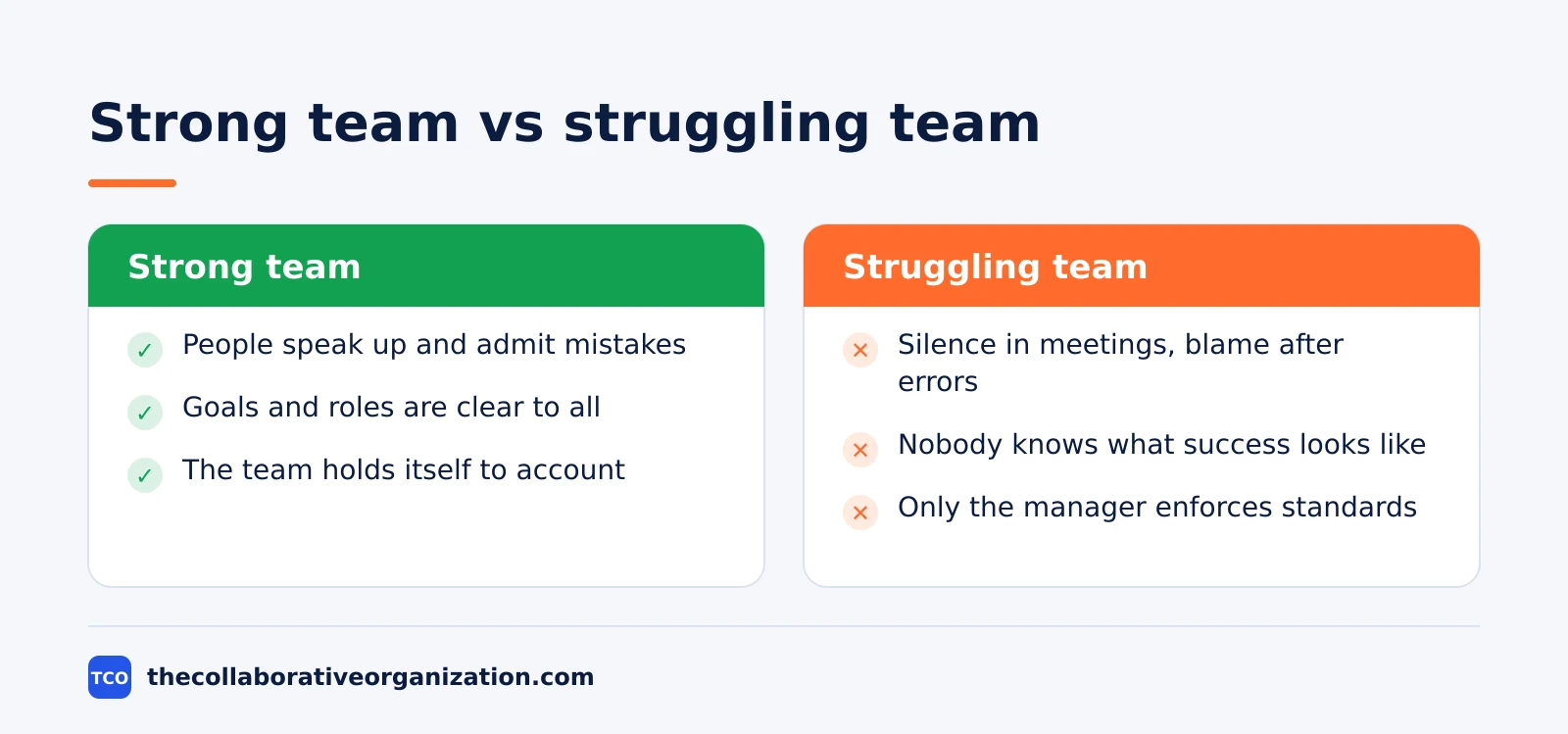
- Psychological safety. People ask questions, admit mistakes and disagree in the open. Edmondson defined it in 1999 as a shared belief that the team is safe for interpersonal risk-taking, and Google ranked it first.
- Trust. Members admit what they do not know and ask for help early. Trust here is vulnerability-based: showing a weakness without fear it will be used against you.
- Clear goals. Everyone can state the team’s goal and their part in it in one sentence. Vague goals split effort; a written goal aims it.
- Defined roles. Each person knows what they own and what they do not. Overlap causes friction, and gaps cause dropped work.
- Dependability. Promises are kept, deadlines are met, and quality holds when nobody is watching. The team trusts the work, not only the people.
- Open, honest conflict. Disagreement happens in the room, about ideas, and ends in a decision. Teams that argue well decide faster than teams that nod along.
- Shared accountability. Members hold each other to the agreed standard, not only the manager. Peer accountability is faster and fairer than waiting for the boss.
- Fast learning. Mistakes are logged, discussed and fixed, then the lesson is written down. A team that learns from one failure rarely repeats it.
- Meaning in the work. Each person can say why the work matters to them, whether that is the customer, the craft, or the team itself. Meaning is personal, so it varies person by person.
- Focus on team results. The scoreboard shows the team’s outcome, not individual status. When the team wins, everyone wins, and credit is shared the same way.
A team with eight of the ten is usually strong already, and the missing two point at the next fix. A team with fewer than five needs to start at the top: safety first, then goals, then roles. Workplace collaboration statistics show how common the gaps are across teams, and how much they cost when they stay open.
The 5 dysfunctions that block high performance
Lencioni’s five dysfunctions show the same picture in reverse: a pyramid where each broken layer causes the one above it. Patrick Lencioni set out the model in his 2002 book The Five Dysfunctions of a Team, and The Table Group reports it has since sold more than three million copies.
| Dysfunction | What the team loses | The healthy opposite |
|---|---|---|
| Absence of trust | Open talk about mistakes and weaknesses | Vulnerability-based trust |
| Fear of conflict | Clear decisions and new ideas | Honest debate about ideas |
| Lack of commitment | Pace, direction and buy-in | Clear decisions with real commitment |
| Avoidance of accountability | Quality, standards and fairness | Peer-to-peer accountability |
| Inattention to results | The team outcome itself | Focus on collective results |
The pyramid is causal, not just a list. Without trust, fear of conflict follows, because nobody risks an honest view. Without honest conflict, real commitment never forms, because people never said what they thought. Without commitment, nobody holds anyone to account, and without accountability, personal goals quietly replace team results.
The fix runs bottom-up as well. Start with trust: share a mistake, ask for help, and thank the person who points out a flaw. Each layer you repair makes the next one easier, and the pyramid becomes a checklist you can work through one layer at a time.
Worked example: the support team that turned around
A worked example shows the ten characteristics on a team that went from missed targets to the strongest in its company in six months. Imagine a customer support team of nine. Response times are slow, the same complaints repeat, and two senior agents handle the hard cases while the rest avoid them. Morale is low and the manager is tired of firefighting.
In month one, the lead writes one goal on the wall: every ticket answered within four hours, with a named owner. Roles are split so each agent owns one product area, and a short daily check replaces the long weekly meeting.
In month two, the lead admits she had hidden a backlog for weeks, and she thanks the agent who first said the queue was unmanageable.
By month three, the team logs every repeated complaint and fixes the top three at the source. By month four, agents hold each other to the four-hour promise without the manager stepping in, and speaking time in the daily check is shared across all nine.
In month six, the team hits its target for the third month running, and the lead’s review names the turnaround: safety first, then goals, then roles, then accountability.
The team did not hire stars or buy new tools. It built the characteristics in order, and the results followed. The benefits of collaboration in the workplace describe the same pattern at company scale: teams that trust each other and share goals outperform teams that merely share a floor.
Tools that help high-performing teams
A shared project tool helps a high-performing team because it makes goals, owners and deadlines visible to everyone at once. When the work, the decision and the date live in the same board, dependability stops being a promise and becomes something the team can see.
If you have not picked a tool yet, compare the options on our project management software shortlist before you set up the board. The right tool is the one the team opens every day, not the one with the longest feature list.
| Tool | Best for | Free plan | Starting price (as of November 2026) | Notable limit |
|---|---|---|---|---|
| Asana | Clear goals with owners and dates | Free for 2 people | $10.99 per user per month, billed annually | Free plan covers 2 people |
| monday.com | A shared board the whole team can see | Free plan for up to 2 seats | $9 per seat per month (Basic), billed annually | Paid plans need at least 3 seats |
| ClickUp | Docs, chat and tasks in one place | Free Forever plan | $9 per user per month (Core), billed annually | Yearly billing needed for that price |
The Asana price comes from Asana pricing: Starter is $10.99 per user per month when billed annually.
On the monday.com pricing page, Basic is $9 per seat per month billed annually, with a 3-seat minimum.
The ClickUp pricing page lists Core at $9 per user per month billed yearly.
How to measure whether your team is high-performing
Measure a team on results and behaviour together: delivery numbers plus a short survey of safety, clarity and trust. Numbers alone hide a team that ships by burning people out, and feelings alone hide a team that is happy but slow.
Start with three delivery numbers: the share of work delivered on time, the share that needed rework, and the average time from a problem being found to it being fixed. A high-performing team scores well on all three, because dependability and fast learning show up in the numbers.
Then run a short survey each quarter. Edmondson’s seven-item scale measures safety, and two questions cover the rest: “I know what our team is trying to achieve” for clarity, and “I can count on my teammates to deliver” for dependability. Score it per team, share the average back, and track the trend.
McKinsey’s 2021 survey found only 43% of employees reported a positive climate in their team, so a team that measures and improves is already ahead of most.
Our guide on how to improve team collaboration gives the weekly habits that move these numbers, from shorter meetings to written decisions with named owners.
Common high-performing team mistakes to avoid
Five mistakes stall teams that have the talent to be great, and the first is hiring for stars instead of building habits. Check your team against the list.
- Hiring stars instead of building habits. A group of stars who do not trust each other loses to an average team with clear goals and safety. Build the habits first.
- Measuring output without measuring safety. A team can ship fast for a quarter while burning out, then collapse. Track safety and clarity beside delivery numbers.
- Letting the loudest voice decide. When one person holds the floor, the team loses the ideas of everyone else. Share speaking time on purpose.
- Confusing busy with effective. Full calendars and long hours are not results. Judge the team by what shipped and what it learned, not by how tired it looks.
- Freezing the norms. A team that never revisits its working agreements keeps rules that stopped fitting months ago. Review the norms every quarter and change the ones that no longer work.
Sources
- Google - The Five Dynamics of Effective Teams (2018)
- Parabol - Google Project Aristotle (2026)
- LeaderFactor - Google’s Project Aristotle: Findings, 5 Keys, and Limits (2026)
- Unify Partnership - The Five Dysfunctions of a Team (2026)
- McKinsey - Psychological Safety and the Critical Role of Leadership Development (2021)
- Asana - Pricing (2026)
- monday.com - Pricing (2026)
- ClickUp - Pricing (2026)
Frequently asked questions
What is the most important characteristic of a high-performing team?
Psychological safety comes first. Google studied 180 teams and ranked it ahead of dependability, structure, meaning and impact, because people who feel safe to speak up catch problems early and share ideas freely. Without safety, the other nine characteristics rarely show up at all.
How do you know if your team is high-performing?
Look at results and behaviour together. A high-performing team ships quality work on time, keeps its promises, and handles disagreement without blame. Check the numbers too: on-time delivery, rework rates, and a short survey of safety and clarity will show whether the team is strong or just busy.
Can a team of average talent outperform a team of stars?
Yes. Google found that who is on a team matters far less than how members interact, structure their work, and view their contributions. A team with clear goals, shared norms and safety beats a group of stars who do not trust each other, because the first team learns faster from every mistake.
How long does it take to build a high-performing team?
A new team usually needs three to six months to settle its norms and reach steady performance, and longer if roles or goals keep changing. The fastest path is to set clear goals, agree working norms in the first weeks, and review both every month so small problems never grow into big ones.
What kills high performance fastest?
Unclear goals and broken trust kill it fastest. When people do not know what success looks like, they pull in different directions, and when trust breaks, they stop raising problems early. Both are fixable: write the goal down, name the owner, and react well the next time someone brings bad news.
Related articles
project management
How to Choose Project Management Software (2026)
Pick project management software in seven steps: define the work, count seats, price the real cost, and run a two-week pilot before you pay.
November 19, 2026 · 10 min read
project management
What Is a RACI Matrix? Definition, Roles and Examples (2026)
A RACI matrix maps who is Responsible, Accountable, Consulted and Informed for each task. Learn the four roles, how to build one, and see a worked example.
November 19, 2026 · 9 min read
project management
Daily Standup Meeting Format That Works (2026)
A daily standup is a 15-minute meeting where Developers inspect progress toward the Sprint Goal and plan the next day. Use this format to run one that ends on time.
November 19, 2026 · 10 min read