How to Write an RFP for Software (2026) | The Collaborative Organization
By The Collaborative Organization Team · November 19, 2026 · Last verified November 19, 2026 · 10 min read
Write an RFP for software by defining the outcome first, then the scope, then the scoring, and send the same document to every vendor on the same day. A good RFP takes a day to write and saves weeks of clarification, because vendors price uncertainty and every blank becomes a risk margin in the quote.
Key takeaways
- An RFP tells vendors what you need to achieve, by when, and how you will decide, so the proposals come back comparable.
- Two to six pages is normal for a software RFP, with the scope section carrying the weight and the rest there so vendors can price the work.
- Decide the scoring criteria and weights before you read any proposal, and publish the weights in the RFP.
- Have two or three people score independently, then shortlist two or three vendors for a demo or working session.
- Send the same document to every vendor on the same day with the same deadline, and answer questions in a shared log.
What an RFP is, and when to use one
A request for proposal is a formal document that invites vendors to explain how they would deliver a defined job, at what cost, and in what time. It describes the outcome you need, the users, the constraints, and the rules for deciding, then asks each vendor to answer the same questions in the same format. The point is comparability: five vendors answering five different questions cannot be compared.
Use an RFP when the buy is large, custom, or regulated. A custom build, a multi-year contract, or a purchase that needs a paper trail all justify the work. Use an RFI when you are still learning what the market offers, and an RFQ when the specification is already complete and only the price is open.
Skip the RFP for small off-the-shelf buys with published prices. Our guide on how to evaluate SaaS software covers that case: define the job, score three vendors, and run a structured trial with real data. A two-week trial tells you more about a $500-a-month tool than any proposal will.
The 10 sections every software RFP needs
A good RFP does not have to be long, but it does need ten sections, written plainly. Copy the table below as your outline, and fill in every section, even the ones that feel obvious. Vendors price uncertainty, so each blank is a risk margin added to the quote or a question you answer six times by email.
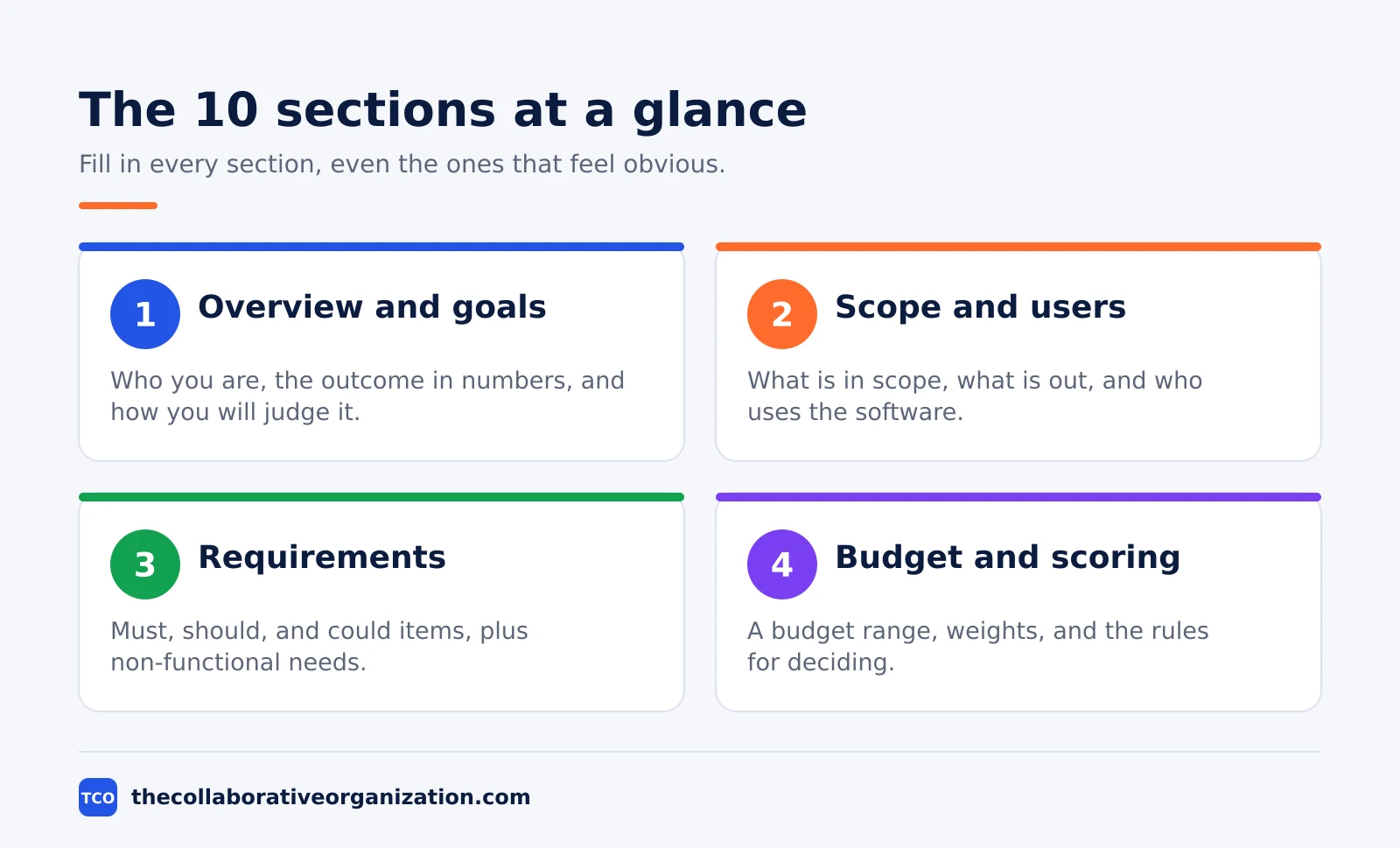
| Section | What to include | Why vendors need it |
|---|---|---|
| 1. Company and project overview | Who you are, what you do, who sponsors the work | Context for every assumption they make |
| 2. Goals and success measures | The outcome, in numbers, and how you will judge it | Tells vendors what good looks like |
| 3. Scope of work | What is in scope, and what is out of scope | The core of what they price |
| 4. Users | Who uses it, how many, and what they do | Sizes the build and the rollout |
| 5. Requirements | Must, should, and could items, plus non-functional needs | The detail behind the price |
| 6. Integrations and technical constraints | Systems, APIs, hosting, and limits | Stops a design that cannot connect |
| 7. Timeline | Milestones, go-live date, and hard deadlines | Sets the staffing plan |
| 8. Budget range | A range, not a single number | Tells vendors if the work is worth bidding for |
| 9. Evaluation criteria | Scoring factors, weights, and who decides | Tells vendors where to put their effort |
| 10. Submission details | Format, page limits, deadline, and contact | Keeps the proposals comparable |
The scope section carries the weight. Describe outcomes rather than technology, and separate in-scope work from out-of-scope work in writing, because scope creep and pricing disputes start in the gap between the two lists.
How to write requirements vendors can price
Write requirements as outcomes with a test, not as a list of features. “The system must let a manager approve leave in under a minute” can be priced and tested. “The system must be user-friendly” cannot. Each requirement needs a must, should, or could label, so vendors know what is fixed and what is open to trade.
Split requirements into functional and non-functional needs. Functional requirements cover what the software does: create, approve, report, and integrate. Non-functional requirements cover how it behaves: speed, uptime, security, data protection, and accessibility. A vendor that meets the functional list but fails the security list has not met the RFP.
Name the standards in the RFP itself. Specify the compliance rules that apply, the authentication method, the encryption standard, and the data protection rules. Measurable security beats a promise: ask for the SOC 2 Type II report, name the data residency you need, and state the incident response time you expect. Vague security language gets vague answers.
How to write an RFP for software in 7 steps
Writing an RFP takes seven steps, and the first three happen before you open a blank document. The steps below turn a vague need into a document vendors can price fairly.
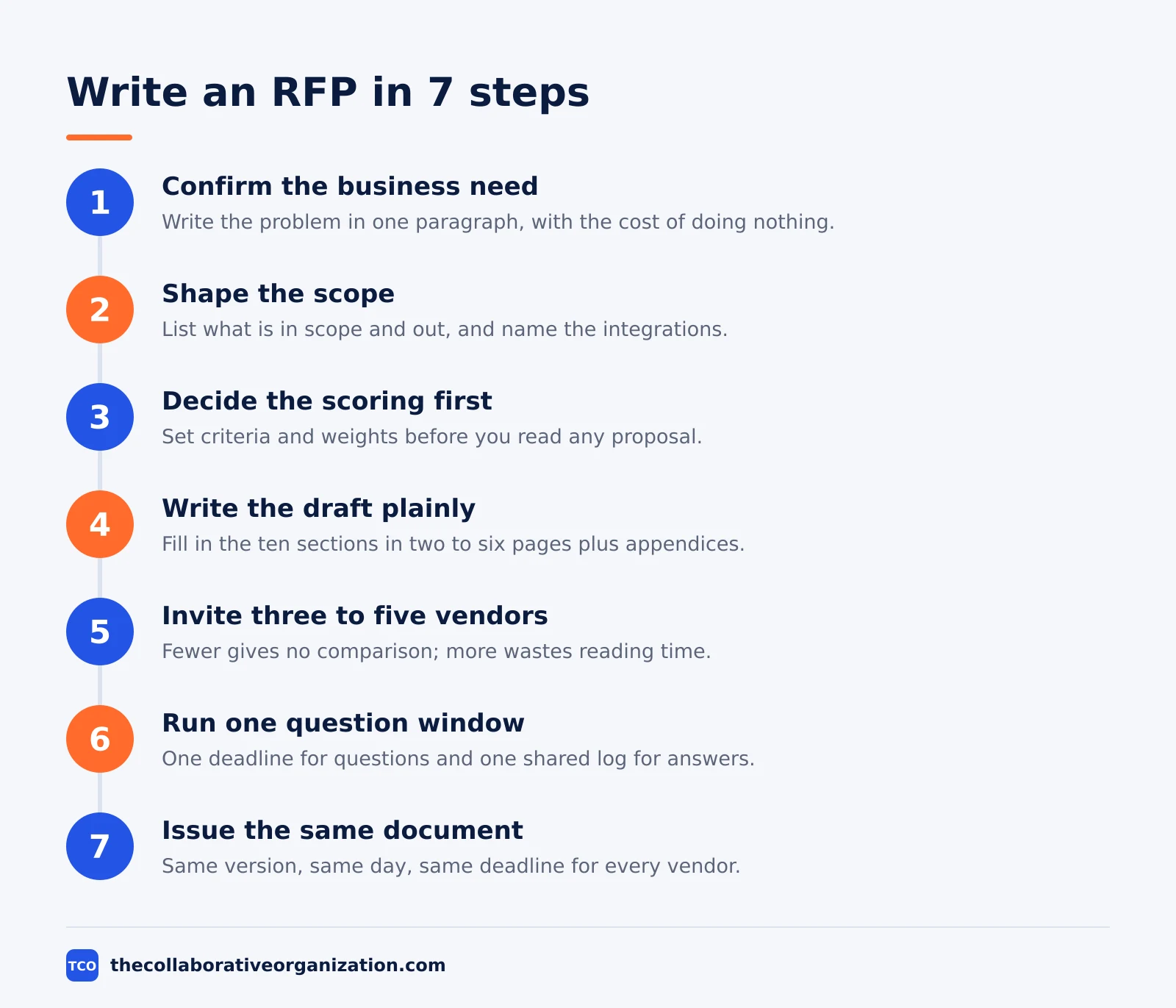
Step 1: Confirm the business need
Write the problem in one paragraph, with the cost of doing nothing. Name the sponsor, the users, and the outcome in numbers. If you cannot write the problem, you are not ready to ask vendors for a solution.
Step 2: Shape the scope
List what is in scope and what is out, and name the integrations the work must touch. Talk to the people who will use the software before you write this section, because the scope they describe is the scope vendors must price.
Step 3: Decide the scoring before you write the RFP
Set the criteria and the weights now, not after the proposals arrive. A scorecard built after reading the proposals will be built around the vendor you already like. Publish the weights in the RFP so vendors know where to spend their effort.
Step 4: Write the draft in plain words
Fill in the ten sections from the table above, keeping the whole document to two to six pages plus appendices. Describe outcomes rather than technology, and ask every vendor the same questions so the proposals come back comparable.
Step 5: Invite a focused vendor list
Send the RFP to three to five vendors that already pass a basic fit check. Fewer than three gives you no comparison, while more than five means you spend more time reading proposals than running the project.
Step 6: Run a controlled question window
Give vendors one deadline for questions and one shared log for the answers, so everyone sees the same answers. A vendor that gets a private answer has an unfair edge, and the other vendors will price the gap.
Step 7: Issue the same document to everyone on the same day
Send the same version to every vendor on the same day with the same deadline. Give vendors at least two weeks for a standard RFP, and three to four weeks for a complex build with integrations. Shorter deadlines cut proposal quality, because good vendors will not rush a priced answer.
Worked example: an RFP for project software at a 40-person firm
A 40-person services firm shows how the seven steps fit together on a real buy. The firm runs client projects on spreadsheets and email, and the work is slipping: deadlines move without anyone noticing, and nobody can say which projects are late. Their problem paragraph is: “We run 30 client projects at once, and we cannot see which ones are late until the client asks.”
The scope is one tool for 40 people, with timelines, task owners, and a weekly report that shows late work. Out of scope: time tracking, invoicing, and any custom build.
The must-haves are a timeline view, guest access for clients, and a data export the firm can test. The budget range is $300 to $600 a month, and the go-live date is eight weeks after signing.
The scoring weights are published in the RFP: understanding of the problem 25%, approach and plan 20%, team and experience 20%, price and pricing model 20%, and ways of working 15%.
Three people score each proposal independently on a 1 to 5 scale, then meet to compare. The top two vendors get a working session on the firm’s real project data, and the winner is the one whose tool shows the late work without a workaround.
Our guide on how to choose project management software covers the same buy from the product side, with prices and a two-week pilot plan. The RFP is the document that runs the process, while the pilot is the test that proves the tool.
How to score proposals fairly
Score proposals before you fall for one, because the best-written proposal is not always the best vendor. Decide the criteria and weights before opening a single response, and share the model in the RFP. A simple weighted scorecard is enough, and the weights should match the project: a regulated platform needs heavier security review, while an early product may favor discovery strength.
| Criterion | Weight | What a score of 5 looks like |
|---|---|---|
| Understanding of the problem | 25% | Restates your goals, asks sharp questions, challenges weak assumptions |
| Approach and plan | 20% | Clear phases, first release defined, risks named with mitigations |
| Team and relevant experience | 20% | Named people, similar work you can verify, references you can call |
| Price and pricing model | 20% | Itemised, assumptions stated, change pricing explained |
| Ways of working | 15% | Demo cadence, reporting, code ownership, handover, support |
Have two or three people score independently, then compare the scores and discuss the gaps. Shortlist two or three vendors for a demo or working session, and ask every vendor the same questions there too.
US public procurement guidance points the same way, toward modular delivery and pricing based on project risk, and the Attract Group RFP guide sets out the same process in detail.
Judge the proposal on proof, fit, and delivery risk, not on presentation polish. A vendor that restates your workflows correctly, names the risks, and itemises the price is a better bet than a vendor with the glossiest deck and the vaguest numbers.
Our methodology page explains how we score tools on this site, and the same discipline applies here: define the criteria first, then score every option on the same sheet.
More buying guides live on our guides index.
Common RFP mistakes to avoid
Most weak RFPs fail in the same five ways, and all five are easy to spot before you issue the document. Run through this list before you send it out.
- No scoring model. Evaluating proposals without a pre-defined scoring model brings bias, slows the decision, and makes the choice hard to defend internally. Set the weights before you read anything.
- Requirements as features, not outcomes. A list of features gets you a list of prices for the wrong thing. Write each requirement as an outcome with a test.
- No budget range. Vendors that guess your budget will guess high to cover the risk. A range tells them whether the work is worth bidding for.
- Different answers for different vendors. A private answer to one vendor is an unfair edge for that vendor. Use one shared question log for everyone.
- Judging the deck, not the delivery. A polished presentation hides a weak team and a vague price. Score the proof, the named people, and the itemised numbers.
Sources
- Innovation Insight - Software Development RFP Template (2026)
- Attract Group - How to Write a Software Development RFP (2026)
- Bright Infonet - How to Write a Software RFP: Sections and Checklist (2026)
- WeDoWebApps - How to Write a Software Development RFP That Works (2026)
- S3 Corp - Software Development RFP: Template, Examples and Guide (2026)
Frequently asked questions
How long should a software RFP be?
Two to six pages is normal for a software request for proposal, excluding appendices. Some guides allow eight to 20 pages for complex builds, but length matters less than clarity. The scope section carries the weight, and the rest exists so vendors can staff and price the work correctly.
How many vendors should receive an RFP?
Send it to three to five vendors that you have already checked for basic fit. Fewer than three gives you no real comparison, while more than five means you will spend more time reading proposals than running the project. Shortlist two or three for a demo or working session after scoring.
Should you publish the budget in an RFP?
Publish a budget range, not a single number. A range tells vendors whether the work is worth bidding for and stops them from pricing your uncertainty. Vendors that come in far above the range are telling you the scope is bigger than you thought, which is useful information.
What is the difference between an RFP, an RFI, and an RFQ?
An RFI asks vendors what exists and what it can do, an RFP asks vendors how they would deliver a defined job and at what price, and an RFQ asks for a price on a fully defined specification. Use an RFI when you are still learning the market, an RFP when you know the outcome, and an RFQ when you know every detail.
How long do vendors need to answer an RFP?
Give vendors at least two weeks for a standard software RFP, and three to four weeks for a complex build with integrations. Shorter deadlines cut the quality of the proposals you receive, because good vendors will not rush a priced answer. Set one deadline for everyone and answer questions in a shared log.
When should you skip the RFP and buy direct?
Skip the RFP when the buy is small, the product is off-the-shelf software with published prices, and a two-week trial will tell you more than any proposal. Run a structured trial instead, and save the RFP for custom builds, large contracts, and regulated purchases that need a paper trail.
Related articles
guides
Free Project Management Templates: 7 to Copy (2026)
Seven free project management templates from monday, Wrike, Teamwork, Smartsheet, ClickUp, Asana and Trello, with what each one is for and what free really costs.
November 20, 2026 · 7 min read
guides
Project Proposal Template: Copy and Win Work (2026)
A project proposal template pitches the work before it is approved: problem, solution, scope, budget, timeline and terms. Copy the template and filled example.
November 20, 2026 · 10 min read
guides
Action Plan Template: Goal to Done in One Page (2026)
An action plan template turns one goal into owned steps with dates, dependencies and a success measure. Copy the table and see it filled for a support team.
November 20, 2026 · 11 min read