What Is Scope Creep? Causes, Signs and Costs (2026) | The Collaborative Organization
By The Collaborative Organization Team · November 19, 2026 · Last verified November 19, 2026 · 12 min read
Scope creep is the uncontrolled growth of a project’s scope after the work has started, with no matching change to the budget, schedule or team. New features, tasks or deliverables get added, and the extra work is never priced, never scheduled, and never approved. The key word is uncontrolled: change itself is normal, but change nobody decided is creep.
Key takeaways
- PMI defines scope creep as the uncontrolled expansion of scope without adjustments to time, cost and resources.
- In PMI’s 2018 Pulse survey, 52% of projects completed in the prior year had scope creep, up from 43% five years earlier.
- The most common causes are vague requirements, missing exclusions, late stakeholders and no change control process.
- Scope creep is not the same as a scope change, gold plating or feature creep, and each needs a different fix.
- One unapproved addition can cost 10% of the budget and 30% more time, as the worked example below shows.
- The fix is a written scope baseline plus a change control process that prices every request before it is approved.
What scope creep is
Scope creep is what happens when a project keeps growing but its deadline, budget and team stay the same. A client asks for one more report. A sponsor adds a language. A designer improves a screen nobody asked for. Each addition is small, and together they move the finish date and drain the budget.
PMI defines it plainly. The TeamGantt scope creep guide quotes the PMI definition: scope creep is “the uncontrolled expansion of product or project scope without adjustments to time, cost, and resources.” Atlassian says the same thing in its own words: scope creep is the uncontrolled expansion of a project’s goals, tasks or deliverables beyond the original plan.
Scope is one corner of the triangle of scope, time and cost. Add to one corner without adjusting the others, and quality or morale pays the difference. That is why creep is so hard to spot while it happens: no single addition breaks the project, but ten of them do.
Our guide on project scope vs product scope explains the two kinds of scope that creep can hit. Project scope is the work needed to deliver the product, and product scope is the features the product has. Creep can grow either one, and both kinds cost time and money.
Scope creep vs scope change vs gold plating vs feature creep
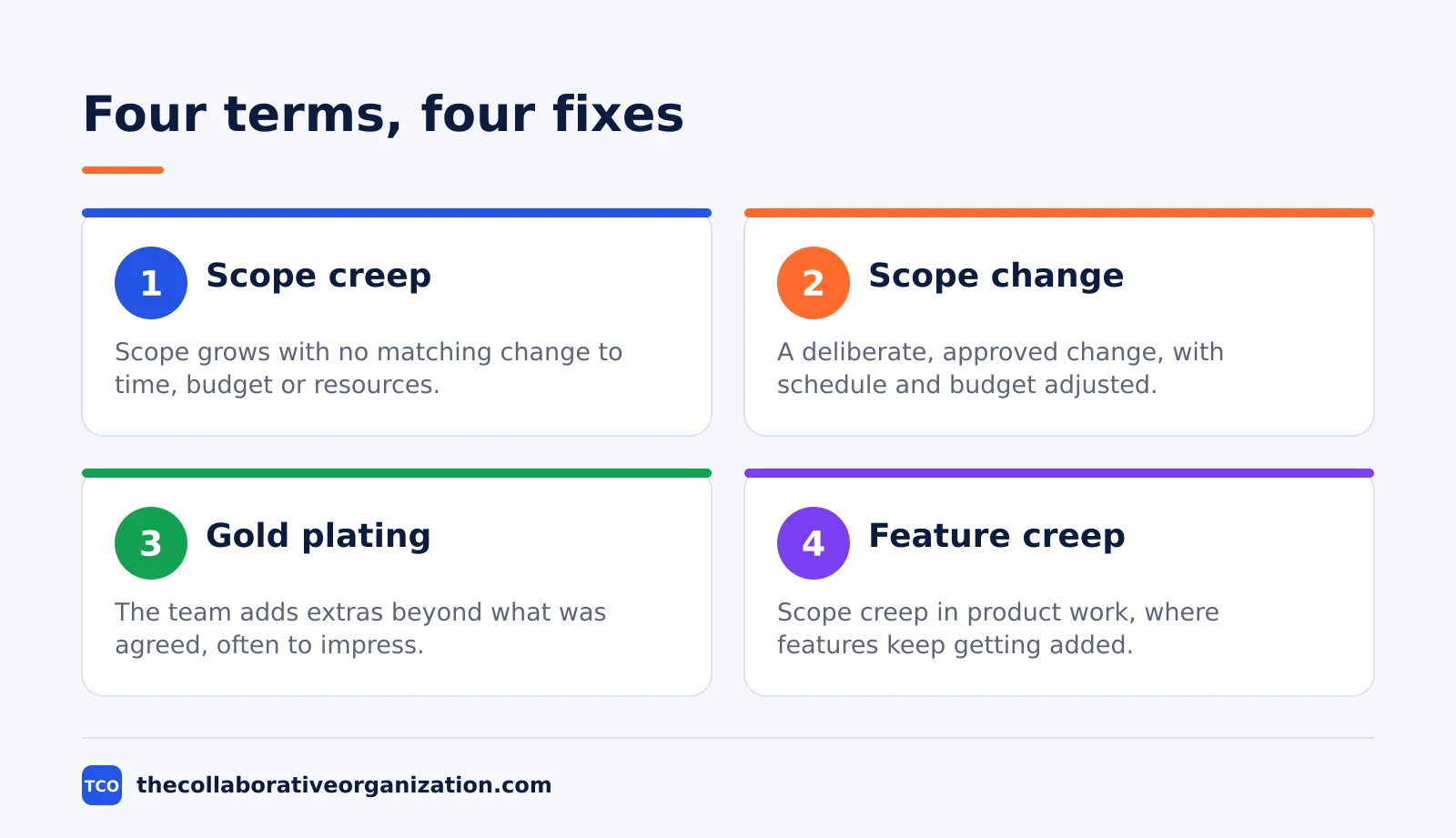
Four terms get mixed up, and they need different fixes, so it helps to name which one you are facing. Only one of the four is healthy, and only one of them starts inside the team.
| Term | What it means | Usually starts with | The fix |
|---|---|---|---|
| Scope creep | Scope grows with no matching change to time, budget or resources | Clients or sponsors, through informal requests | A change control process |
| Scope change | A deliberate, approved change, with schedule and budget adjusted | Anyone, through a formal request | None, this is the healthy version |
| Gold plating | The team adds extras beyond what was agreed, often to impress | The project team | Deliver what was agreed, raise ideas as change requests |
| Feature creep | Scope creep in product work, where features keep getting added | Product owners, users, sales or leadership | A prioritized backlog and a release goal |
The test is simple. If an expansion of scope was approved, it is not scope creep. A client changing their mind is not scope creep, and a new requirement showing up in week six is not scope creep. It becomes creep when the work starts without a decision, a price, or a new date.
Gold plating deserves its own warning, because it comes from good intent. A developer adds a nicer animation, a designer adds an extra screen, and each one is cheap. Together they are not cheap, and none of them was ever approved. The fix is to raise ideas as change requests, so the team can say yes with open eyes.
How common is scope creep?
Scope creep is one of the most common reasons projects miss their goals, and the numbers behind it are large. The most cited figure comes from PMI, and two more figures show why requirements sit at the root of the problem.
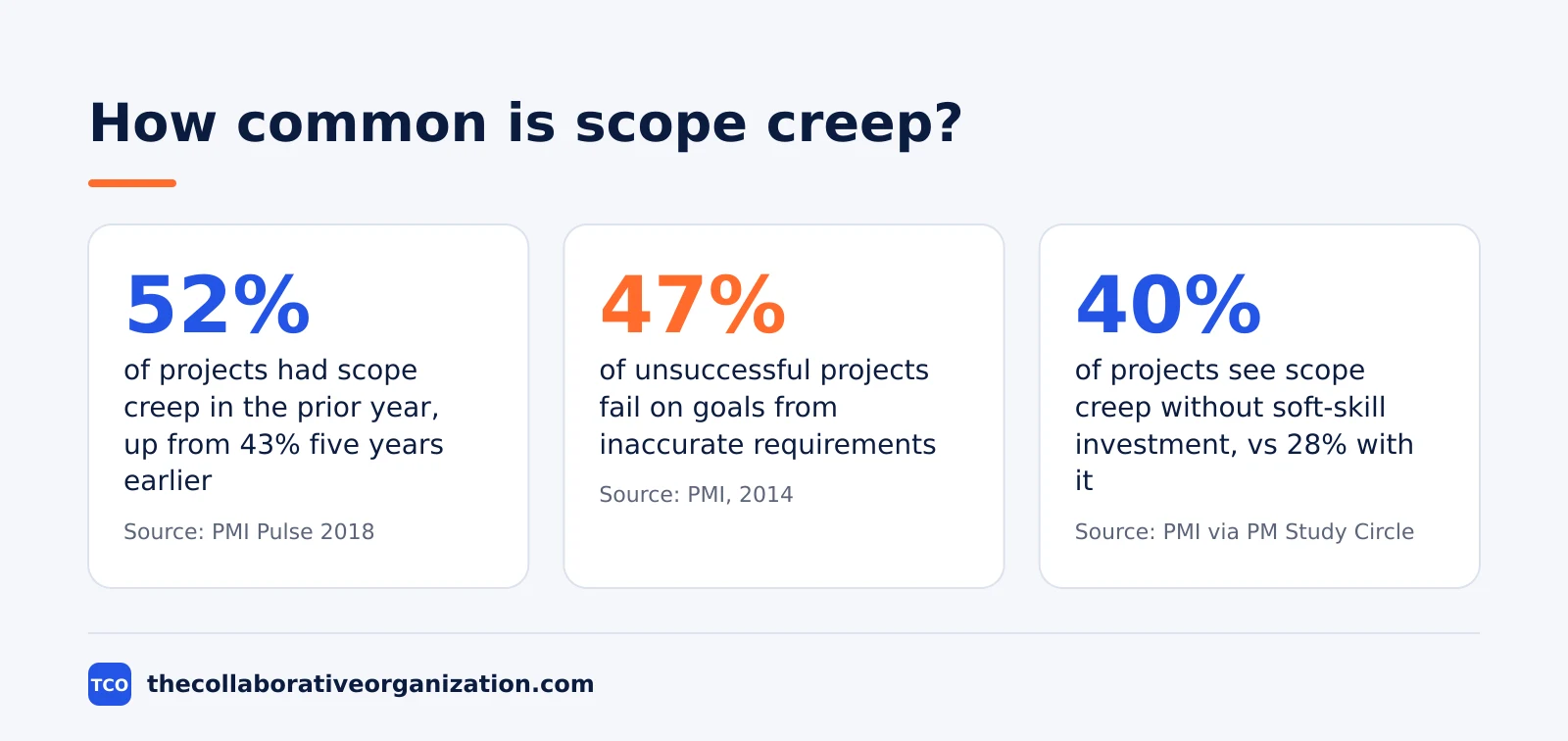
PMI reported in its 2018 Pulse of the Profession survey that 52% of projects completed in the prior 12 months had scope creep, up from 43% five years earlier. That figure is reported in the Villanova scope creep guide, which cites PMI’s PM Network. The problem is not shrinking.
A second PMI figure points at the cause. The Villanova guide also cites PMI 2014: 47% of unsuccessful projects fail to meet goals because of inaccurate requirements management. When the requirements are wrong, the scope is wrong, and every correction after that looks like a new request.
A third figure, from the PM Study Circle scope creep guide, ties creep to people skills: organizations that do not invest in soft skills see scope creep on 40% of their projects, against 28% when leadership puts communication and people skills first. Saying no well is a skill, and teams that lack it pay for it in scope.
There is even a formula for it. The PMBOK Guide lists a scope creep measure in its scope performance domain: scope creep (%) equals unplanned deliverables divided by total deliverables, times 100. The Projeric scope creep guide quotes that measure. A project with 5 unplanned deliverables out of 25 has a scope creep rate of 20%.
What causes scope creep
Scope creep rarely comes from bad intent, and it almost always comes from gaps in the plan and the process. The causes below show up again and again, and most projects have more than one of them at once.
- Vague requirements. If “done” was never defined, everyone fills the gap with their own idea. Two people can agree on a sentence and picture two different products.
- No definition of what is out of scope. Saying what is in is not enough. Without exclusions, anything related feels like fair game, and every request can be argued to be included.
- Missing stakeholders. A stakeholder who joins late brings new needs. PMI’s PM Network gives a case where an organization had overlooked several company locations that also needed the equipment.
- Late requests from sponsors or clients. Hard to refuse, especially when the person asking is senior. The request arrives as a favour, and the cost arrives later.
- No change control. If there is no formal way to request a change, requests arrive by hallway chat, email and meeting side comments, and nobody counts them.
- Team enthusiasm. Developers, designers and analysts add small improvements. Each one is cheap, and together they are not.
- Pressure to say yes. Higher stakeholder expectations and a fast pace make it tempting to agree first and count the cost later, which is how a small yes becomes a large overrun.
Atlassian names four of the same causes in its scope creep guide: poor communication with stakeholders, unclear project objectives, too many stakeholders, and an ineffective change control process. When many stakeholders each bring their own ideas and nobody has the final say, the scope grows with every meeting.
Warning signs of scope creep
Creep is cheap to fix early and expensive to fix late, so watch for the signs below in the first weeks, not the last ones. Each sign on its own is small, and three of them together mean the baseline has already moved.
- You hear “while you are in there, could you also…” more than once a week.
- The task list is longer than the approved scope baseline, and nobody can say when it grew.
- Team members are working on things nobody can trace to a requirement.
- Deadlines slip by small amounts, repeatedly, with no single cause to point at.
- Stakeholders describe the project differently from each other in the same meeting.
- Requests arrive directly to team members, bypassing the project manager.
- Nobody remembers who approved a feature, or whether anyone did.
The Villanova scope creep guide lists the same warning signs, and its advice is to act on the first one, not the fifth. A scope review at the weekly meeting takes ten minutes when the list is short, and it takes a re-plan when the list has grown for a month.
One habit catches most of it: keep the baseline visible. When the approved scope, the current task list and the change log sit in one place, an extra item stands out the day it appears instead of the week the deadline slips.
What scope creep costs: a worked example
One unapproved addition is rarely small, because the work behind it is larger than the request sounds. The example below is an illustration with made-up numbers, not a real project, and it shows why a “small” addition is rarely small.
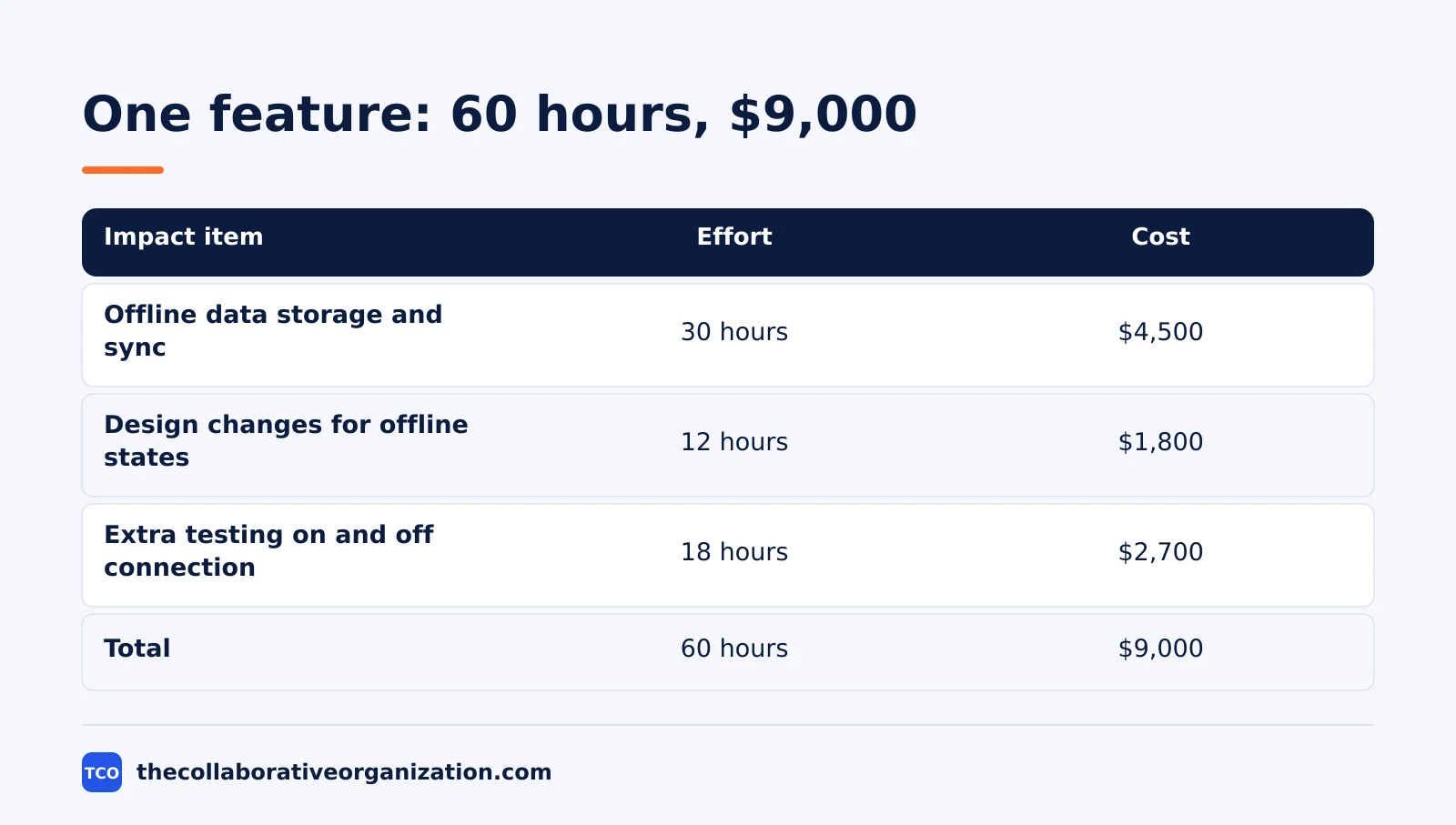
A team is building a mobile app for $90,000 over 10 weeks. In week 6, the sponsor asks for offline mode, so the app works without a connection. It sounds like one feature, but the work behind it spreads across design, build and testing.
| Impact item | Effort | Cost |
|---|---|---|
| Offline data storage and sync | 30 hours | $4,500 |
| Design changes for offline states | 12 hours | $1,800 |
| Extra testing on and off connection | 18 hours | $2,700 |
| Total | 60 hours | $9,000 |
| Schedule effect | 3 extra weeks | Team is fully booked |
The sponsor now has a real choice, and the choice is the point. Approve it and add $9,000 and three weeks. Swap it and drop a lower-priority feature of similar size.
Defer it and schedule offline mode for a second phase. Without the process, the request would likely have been absorbed as a favour, and the cost would show up later as overtime, defects or a missed launch.
The numbers are the lesson. One feature is 10% of the budget and 30% more time, and it arrived in a single sentence in week 6. A project that absorbs three requests like that has no budget left and no date left, and nobody ever made a decision to spend either one.
Scope creep in agile projects
Agile welcomes change, but that does not mean unlimited change, and backlogs can still grow without anyone checking the budget and timeline. The flexibility of agile is a tool for handling change well, not a licence to add work without a trade-off.
Three habits keep an agile backlog honest. Groom the backlog every sprint and remove items that no longer matter. When something new comes in, swap it for something of similar effort, so the budget and timeline hold. Agree the sprint goal with the client before each cycle, so new items are judged against a goal.
Treating agile as a licence for unlimited changes is one of the traps PMI warns about, and the warning is quoted on the LetsBuildMyApp scope creep guide. A sprint goal that changes mid-sprint is not flexibility, it is a re-plan that nobody recorded.
The same change control ideas apply, in a lighter form. A backlog item still needs an owner, an estimate and a decision, even when the decision takes five minutes in a standup. The form is shorter, but the decision is the same: approve, defer, swap or reject.
Tools that make scope visible
Scope creep hides in chat threads and hallway asks, so the best defence is a tool where the scope, the tasks and the change log live in one place. When the baseline is visible, an extra item stands out the day it appears. Compare the options on our project management software shortlist before you pick one.
| Tool | Best for | Free plan | Starting price (as of November 2026) | Notable limit |
|---|---|---|---|---|
| Asana | Teams that want the scope baseline next to the tasks | Free for 2 people | $10.99 per user per month, billed annually | Free plan covers 2 people |
| ClickUp | Teams that want a change log as tasks with custom fields | Free Forever plan | $9 per user per month (Core), billed annually | $9 price is shown against a $12 regular price |
| Trello | Small teams that track change requests as cards | Free for up to 10 collaborators | $5 per user per month (Standard), billed annually | Timeline view needs a paid plan |
The Asana price comes from Asana pricing: the Personal plan is free for 2 users, and Starter is $10.99 per user per month when billed annually. The ClickUp pricing page lists Core at $9 per user per month billed yearly, with a $12 regular price struck through, so the $9 figure may be promotional.
The Trello pricing page lists Standard at $5 per user per month billed annually, or $6 billed monthly. Two vendor pages showed no prices to our reader on 19 November 2026: the monday.com and Wrike pricing pages rendered no dollar figures, and the Jira page returned an error.
Common scope creep mistakes to avoid
Most scope creep is not a failure of effort, it is a failure of process, and the mistakes below are the ones that let it in. Fix the process and the requests still come, but they come through the front door.
- Starting work without a written scope. A scope statement that lives in a meeting is not a baseline. Write it down, list the exclusions, and get it signed off before the build starts.
- Letting requests bypass the project manager. When stakeholders ask team members directly, the work starts before anyone prices it. Route every request through one log, however small it sounds.
- Saying yes without a trade. Every yes without a swap, a new date or new money is scope creep by another name. Offer the trade in the same sentence as the yes.
- Treating gold plating as a favour. Extra work the team adds to impress the client still costs time and testing. Raise it as a change request like any other addition.
- Waiting until the deadline slips to act. By the time the date moves, the extra work is already done. Review the scope weekly and compare the task list with the baseline.
Sources
- TeamGantt - Scope Creep: Write a Scope of Work That Holds Up (2026)
- Atlassian - Scope Creep in Project Management: How to Manage It (2026)
- Villanova University - Project Scope Creep: The Silent Budget Killer (2026)
- PM Study Circle - Scope Creep in Project Management (2025)
- Projeric - What Is Scope Creep? Causes, Examples and Prevention (2026)
- LetsBuildMyApp - Scope Creep Control: Keep Software Projects on Track (2026)
- Asana - Pricing (2026)
- ClickUp - Pricing (2026)
- Trello - Pricing (2026)
Frequently asked questions
What is scope creep in project management?
Scope creep is the uncontrolled growth of a project's scope after work starts. New features, tasks or deliverables get added without a matching change to the budget, schedule or team. The key word is uncontrolled: a change that is assessed, priced and approved is a scope change, not creep.
What causes scope creep?
The most common causes are vague requirements, no defined exclusions, stakeholders who join late, unmanaged sponsor requests, no change control process, and well-meaning extras added by the team. Each one lets new work enter the project without a decision, so the cost is never counted.
What is the difference between scope creep and gold plating?
Scope creep usually starts outside the team, with clients, sponsors or stakeholders asking for more. Gold plating starts inside the team, when developers or designers add extras beyond what was agreed, often to impress. Both add unapproved work, and both need the same fix: a change request.
Is all scope change bad?
No. Change is normal, and a change that is requested, assessed, priced and approved is good project management. Scope creep is the uncontrolled version, where work slips in through informal requests and nobody checks the effect on time, budget or resources.
How common is scope creep?
Very common. PMI reported in its 2018 Pulse of the Profession survey that 52% of projects completed in the prior 12 months had scope creep or uncontrolled scope changes, up from 43% five years earlier. Unclear requirements and uncontrolled change are among the most common reasons projects miss their goals.
Does agile eliminate scope creep?
No. Agile makes change easier to handle, but backlogs can still grow without checking budget and timeline. Groom the backlog every sprint, swap new items for old ones of similar effort, and agree the sprint goal with the client before each cycle starts.
Related articles
project management
How to Choose Project Management Software (2026)
Pick project management software in seven steps: define the work, count seats, price the real cost, and run a two-week pilot before you pay.
November 19, 2026 · 10 min read
project management
What Is a RACI Matrix? Definition, Roles and Examples (2026)
A RACI matrix maps who is Responsible, Accountable, Consulted and Informed for each task. Learn the four roles, how to build one, and see a worked example.
November 19, 2026 · 9 min read
project management
Daily Standup Meeting Format That Works (2026)
A daily standup is a 15-minute meeting where Developers inspect progress toward the Sprint Goal and plan the next day. Use this format to run one that ends on time.
November 19, 2026 · 10 min read