How to Build Trust in Remote Teams (2026) | The Collaborative Organization
By The Collaborative Organization Team · November 19, 2026 · Last verified November 19, 2026 · 10 min read
Trust in a remote team means each person believes the others will do what they said, tell the truth about problems, and act in the team’s interest without being watched. You cannot see your colleagues work, so trust is what lets a remote team move fast. Without it, every task needs a check and work slows to a crawl.
Key takeaways
- Trust in remote teams grows from kept promises, visible work, and honest news about delays.
- Pew found in 2023 that 79% of fully remote workers say their manager trusts them a great deal.
- Gallup found teams with a written collaboration plan were 66% more likely to be engaged.
- The fastest trust builder is a small promise kept in public, repeated every week.
- Monitoring software and secret decisions destroy trust faster than any missed deadline.
What trust means in a remote team
Trust in a remote team has three parts: reliability, honesty, and care. Reliability means work arrives when promised. Honesty means problems surface early, before they become crises. Care means people act in the team’s interest, not only their own. A team can have one part without the others, but it needs all three to move fast.
Reliability is the easiest part to see. When a draft lands on the day promised, the next promise gets believed. When it slips twice with no warning, the team starts to check every date. Honesty is harder, because it needs safety: people must believe that bad news will be met with help, not blame.
Care is the part most managers miss. It shows in small acts: crediting shared work in public, covering for a colleague who is ill, and asking how a person is doing before asking for the task. Our guide to psychological safety at work covers the team habits that make honesty safe.
Why trust is harder at a distance
Trust is harder in remote teams because the small signals of office life are gone. In an office, you see a colleague stay late to help, hear a manager praise good work, and notice when someone is struggling. At a distance, you see only the output: messages, files, and finished tasks. The rest has to be built on purpose.
The numbers show the gap. Pew Research Center found in 2023 that 53% of people who work from home at least some of the time say it hurts their ability to feel connected with co-workers. Only 10% say it helps.
Distance also hides intent. A short message can read as cold, a delayed reply can read as disinterest, and a decision made in a private chat can read as a secret. Gallup found in its 2025 report that 27% of fully remote workers felt lonely a lot of the previous day, against 23% of hybrid workers.
A team that feels lonely will also feel unsure about each other, so the manager has to make intent visible in writing.
How to build trust in remote teams in 6 steps
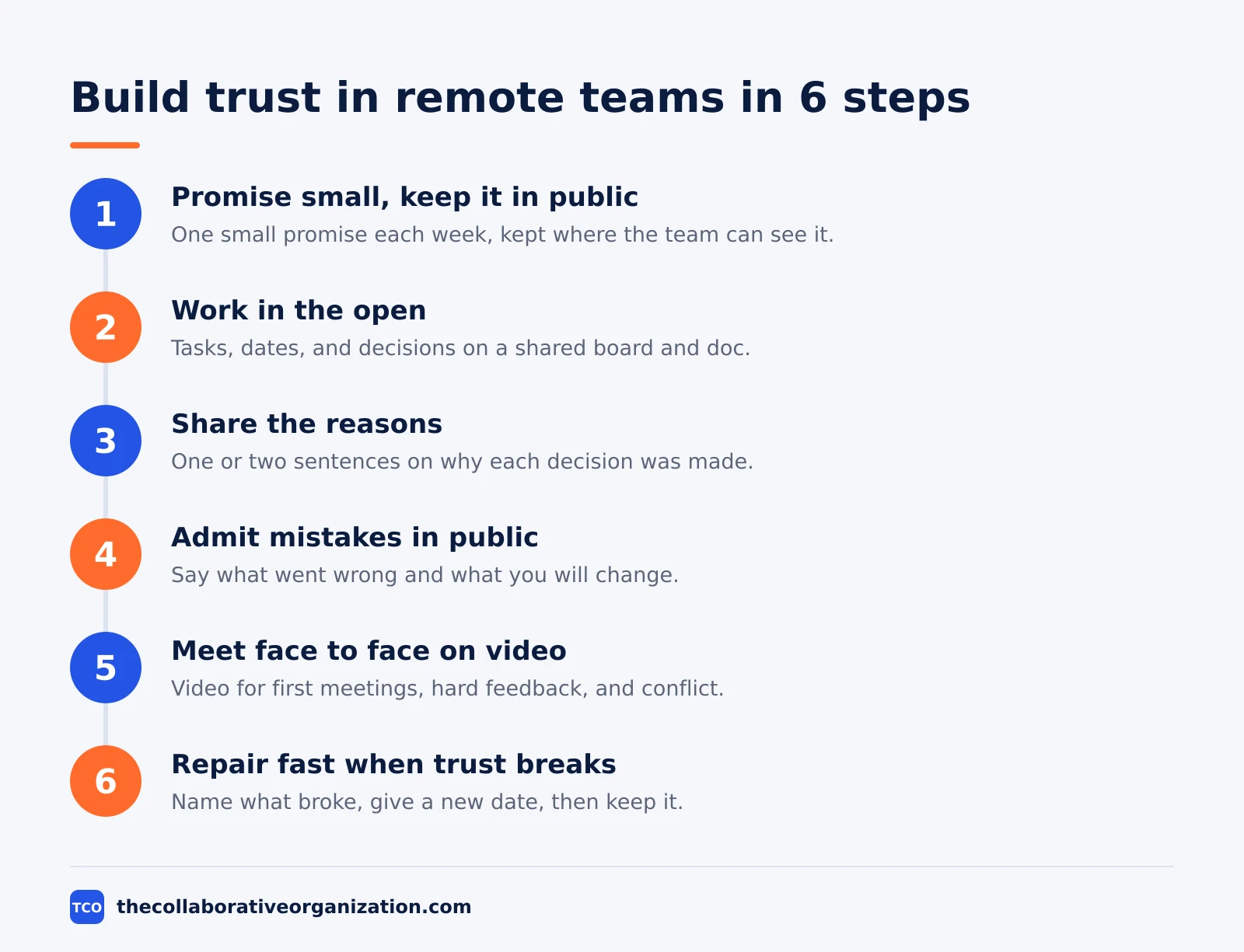
Building trust in a remote team takes six steps, and the first one is a promise you keep in public. The steps below run in order, and each one has a result you can see within weeks.
Step 1: Promise small, then keep the promise in public
Pick one small promise each week, such as a draft by Thursday, and keep it where the team can see it. When it lands, say so in the team channel. A run of small kept promises builds more trust than one grand pledge, because the team can check each one.
Step 2: Work in the open
Put tasks, dates, and decisions on a shared board and in a shared doc. When anyone can see what is done and what is next, nobody has to guess whether work is happening. Open work is the remote version of an open office door.
Step 3: Share the reasons behind decisions
When you decide something, write one or two sentences about why. People accept decisions they disagree with when they can see the reason. Decisions with no reason look like power moves, and power moves kill trust.
Step 4: Admit mistakes in public
When you get something wrong, say so in the team channel and say what you will change. A manager who admits a mistake gives the whole team permission to be honest about theirs. Teams that hide mistakes learn to hide problems too.
Step 5: Meet face to face on video for the talks that matter
Use video for first meetings, hard feedback, and conflict. Tone and face carry meaning that text drops, and a hard talk in writing can read as colder than you meant. Save text for facts and updates, and use video when feelings are involved.
Step 6: Repair fast when trust breaks
When a promise breaks, tell the team at once, say what happened, and give a new date. Then keep the new date. A fast, honest repair can leave trust stronger than before, because the team has seen how you act when things go wrong.
How managers show trust day to day
Managers show trust by giving real choices and judging results, not hours. Let people choose when they do focused work, as long as the overlap hours and the deadlines hold. A team that controls its own day will guard its deadlines more than a team that is watched all day.
A written plan helps too. Gallup found that hybrid teams with a collaboration plan were 66% more likely to be engaged and 29% less likely to be burned out than teams without one.
Share information early, even when it is unfinished. A manager who shares the draft plan, the budget worry, or the client doubt is telling the team: I trust you with the real picture. A manager who shares only finished decisions is telling the team the opposite, even without meaning to.
Pew found in 2023 that 71% of workers with teleworkable jobs who work from home at least some of the time say their manager trusts them a great deal to get work done at home. That figure is the goal to protect: once people feel trusted, they work to keep that trust.
Our guide on how to build psychological safety in a team sets out the habits that keep that feeling alive.
How to repair trust after it breaks
Repair trust by naming what broke, owning your part, and keeping the next promise. Start with the facts, not with excuses. “The report was late because I did not start it in time” repairs trust. “The report was late because the week was busy” does not, because it blames the week instead of the choice.
Then make a small, specific promise and keep it. Trust returns in small steps, so do not try to fix a broken promise with a grand one. Ship the next draft early, answer the next question the same day, and let the team see the change without being told to notice it.
Give the repair time. A team will watch the next three or four promises before it believes the change is real. That is normal, and pushing for instant forgiveness will only slow the repair. If the break came from a team rule, change the rule in writing so the team can see the fix.
Tools that support trust in remote teams
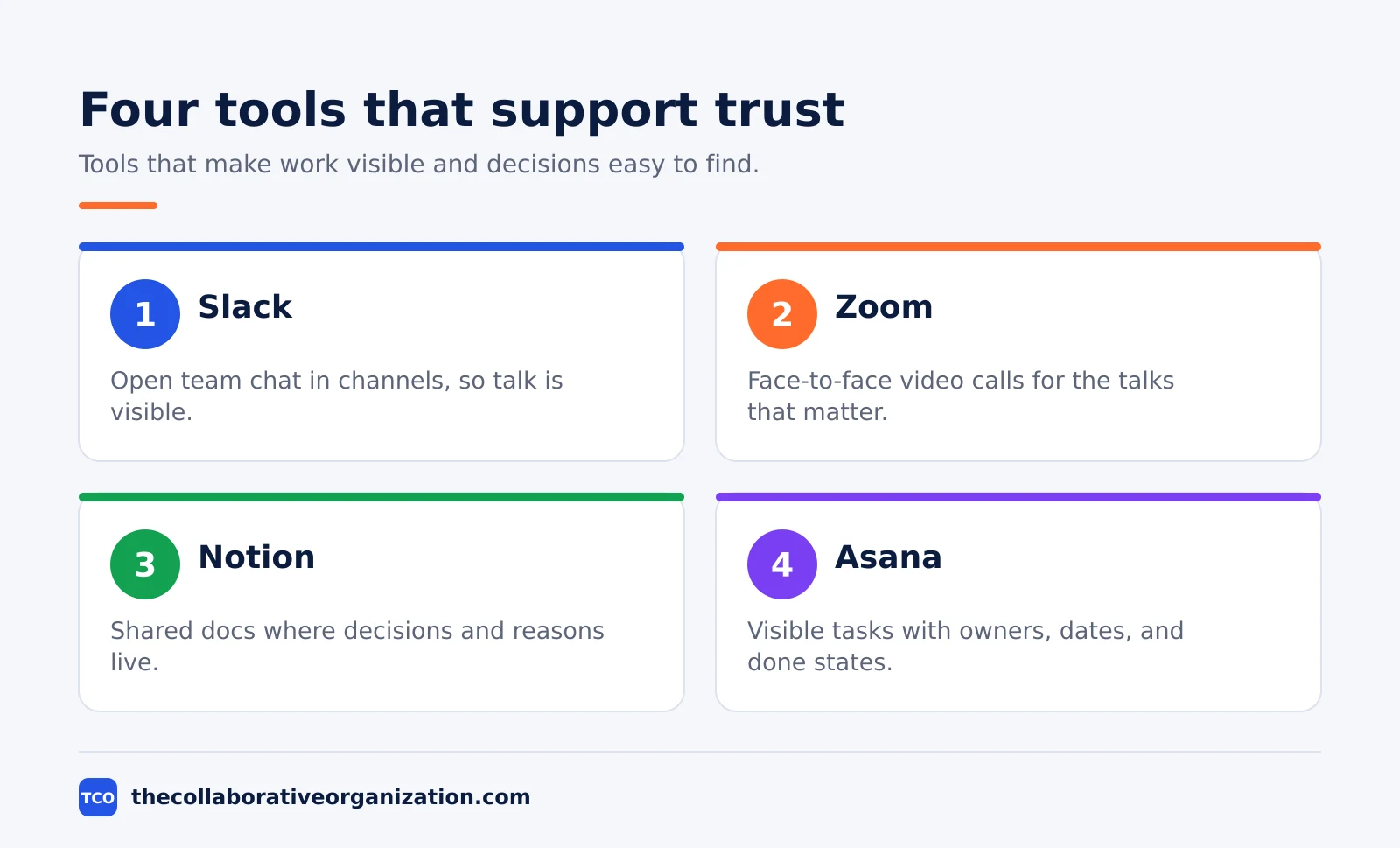
Tools support trust when they make work visible and decisions easy to find. A shared board shows what is done. A shared doc shows why a decision was made. Chat shows who is around and what they are working on. The table below lists one option for each job with its starting price as of November 2026.
| Tool | Best for | Free plan | Starting price (as of November 2026) | Notable limit |
|---|---|---|---|---|
| Slack | Open team chat in channels | Free plan, 90-day message history | $7.25 per user per month (Pro), billed annually | Paid plans bill per active member |
| Zoom | Face-to-face video calls | Free plan, 40-minute meetings | $14.16 per user per month (Pro), billed annually | Pro covers 1 to 99 licenses |
| Notion | Shared docs and decisions | Free plan for personal use | $10 per member per month (Plus), billed annually | Price corroborated by Nov 2026 checks |
| Asana | Visible tasks and dates | Free for up to 2 people | $10.99 per user per month (Starter), billed annually | Free plan covers 2 people |
One warning about tools: never use monitoring software to check whether people are working. It tells the team you do not trust them, and it measures mouse movement, not work. If you need proof of progress, look at the board and the shipped work instead.
Compare the chat options on our team communication software shortlist before you pick one.
Worked example: a new team lead earns trust in 90 days
A new team lead in a 9-person remote team shows how the steps work in order. She joins a team spread across four countries, where the last lead left after a round of missed deadlines. The team is polite in calls and quiet in chat, and nobody raises problems until they are late.
In week one, she writes the team goal and each person’s part in one doc, and asks each person what they need from her. In week two, she promises a decision log by Friday and ships it on Thursday, in public.
In week three, she admits in the team channel that she set a deadline too tight and moves it, with the reason written down. By day 30, she holds a weekly one-to-one with each person and a short team call for decisions only.
By day 60, two people raise risks early for the first time, and the team fixes them before they slip. By day 90, the team ships on time for three weeks in a row, and the quiet chat has become a place where people ask for help. No single act did it. A run of kept promises did.
Common trust mistakes to avoid in remote teams
Most trust damage in remote teams comes from five habits, and each one is a choice the manager can change. Run through the list below once a month.
- Secret decisions. When choices are made in private chats, the team assumes the worst about the reasons.
- Surveillance instead of measures. Tracking keystrokes or screen time tells the team you expect them to cheat.
- Praise in private, blame in public. Credit given quietly feels hidden, while blame given loudly feels like a warning to everyone.
- Promises with no date. A promise without a date is a wish, and a wish that never lands reads as a lie.
- Ignoring time zones. Buffer found in 2023 that 62% of remote workers are on teams that span several time zones, so a meeting set only for head-office hours tells the rest of the team they matter less.
The fix for all five is the same: work in the open, keep small promises, and share the reasons. Our guide to remote vs hybrid vs office work covers how the patterns differ, and the trust rules stay the same in each one.
Owl Labs found in 2025 that 40% of workers would start job hunting if flexibility were removed. That is a reminder that trust and freedom are linked: people stay where they feel trusted.
Sources
- Pew Research Center - About a Third of US Workers Who Can Work From Home Do So All the Time (2023)
- Gallup - State of the Global Workplace 2025 Report (2025)
- Buffer - Key Insights from the 2023 State of Remote Work (2023)
- Owl Labs - State of Hybrid Work 2025 (2025)
- SHRM - Best Practices for Onboarding New Workers in a Hybrid World (2025)
- Slack - Pricing (2026)
- Zoom - Pricing (2026)
- Notion - Pricing (2026)
- Asana - Pricing (2026)
Frequently asked questions
How do you build trust in a remote team quickly?
Make small promises and keep them, in public. Ship the draft when you said you would, answer the question the same day, and write down what you decided. Trust in a remote team grows from a run of kept promises, not from one big speech. After a few weeks of steady follow-through, people start to rely on you without checking.
What destroys trust in remote teams?
Broken promises destroy trust fastest: missed deadlines with no warning, decisions made in private chats, and credit taken for shared work. Silent monitoring also hurts, because people feel watched instead of trusted. The fix is open work: a shared board, written decisions, and honest news about delays before they become surprises.
How do managers show trust to remote employees?
Give people real choices about how they do the work, and judge the result, not the hours online. Share the reasons behind decisions, admit mistakes in public, and let the team see your own work in progress. Pew found in 2023 that 79% of fully remote workers say their manager trusts them a great deal.
Can you build trust without ever meeting in person?
Yes, but it takes more deliberate contact. Use video for first meetings and hard talks, write decisions down so everyone sees them, and create small non-work moments such as a short chat at the start of a call. Buffer found in 2023 that 75% of remote workers feel connected to their colleagues.
How long does it take to build trust in a remote team?
Expect three to six months of steady behaviour before trust feels solid, because remote trust is built from repeated proof, not from one good week. A new team can move faster if the manager sets clear rules early and keeps every promise in the first month. One broken promise can set the clock back by weeks.
Related articles

team communication
Communication Plan for a Project: Template (2026)
A communication plan for a project names who gets which update, in which channel, how often, and from whom. Copy the template and the filled example below.
November 20, 2026 · 10 min read

team communication
How Often Should Managers Communicate With Teams? (2026)
Managers should hold one meaningful conversation with each person every week, plus a weekly team update. See the cadence table for meetings, updates and feedback.
November 20, 2026 · 9 min read
team communication
Upward Communication Examples: 10 That Work (2026)
Upward communication is a message that travels from an employee to a manager or leader. See 10 concrete examples, each with why it works and when to use it.
November 20, 2026 · 9 min read