Psychological Safety at Work: What It Is (2026) | The Collaborative Organization
By The Collaborative Organization Team · November 19, 2026 · Last verified November 19, 2026 · 11 min read
Psychological safety at work is the shared belief among team members that the team is safe for interpersonal risk-taking. It means people can ask a question, admit a mistake, disagree with a plan, or raise a worry without fear of embarrassment, punishment or being pushed aside.
Key takeaways
- Amy Edmondson defined psychological safety in 1999 as a shared belief that the team is safe for interpersonal risk-taking.
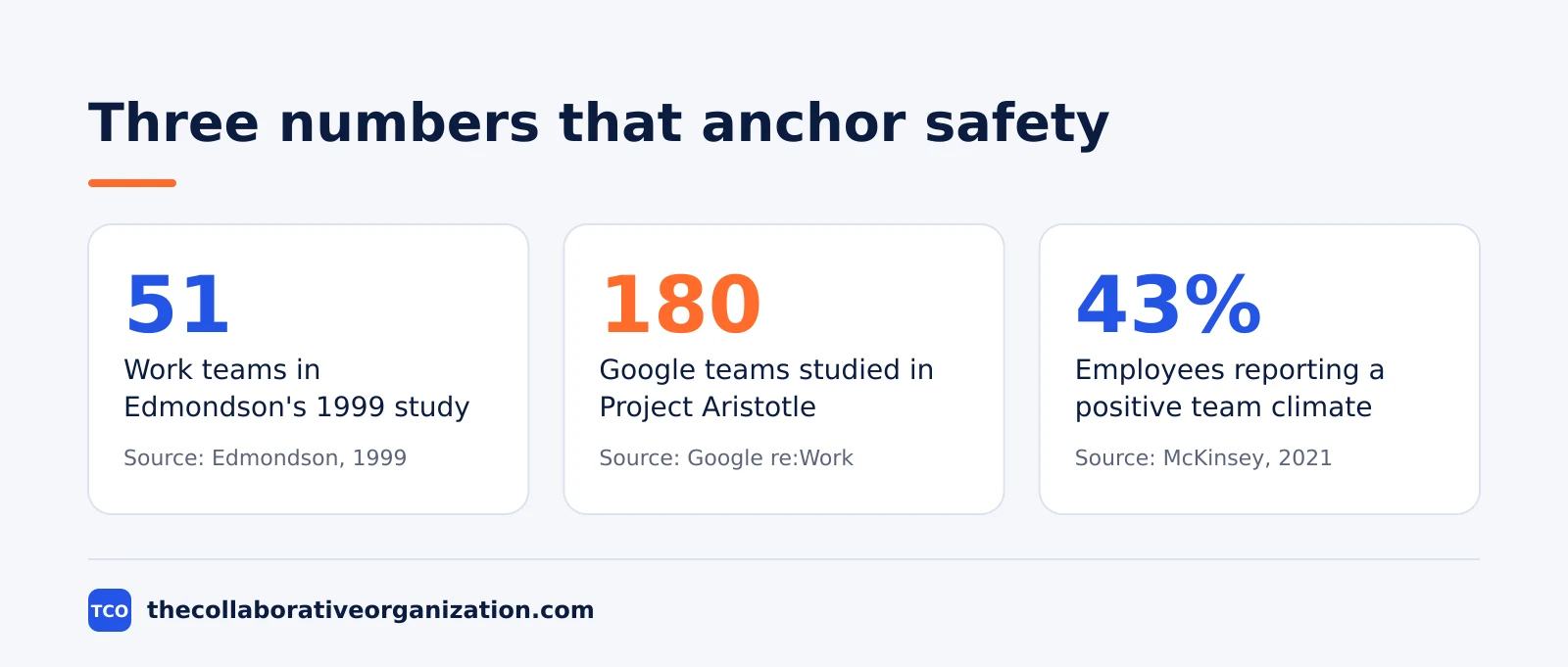
- Her 1999 study of 51 teams in a manufacturing company linked safety to learning behaviour, which linked to performance.
- Google studied 180 teams and ranked psychological safety first among its five dynamics of effective teams.
- Only 43% of employees in a 2021 McKinsey survey reported a positive climate in their team.
- Safety pairs with high standards: high safety plus high standards is the learning zone, not a comfort zone.
What psychological safety at work means
Psychological safety means the team, as a group, believes it is safe to take social risks at work. The risks are ordinary ones: asking a question that shows what you do not know, admitting an error, saying a plan has a flaw, or disagreeing with the boss in front of others.
Amy Edmondson, a professor at Harvard Business School, gave the idea its standard form in 1999. Her paper in Administrative Science Quarterly defined team psychological safety as “a shared belief held by members of a team that the team is safe for interpersonal risk taking”.
Three words do most of the work. “Shared” means safety describes the team, not one brave person; people tend to hold similar beliefs about it. “Belief” means it is about what people expect will happen, not about a written policy. “Interpersonal risk” means the risk is social: looking ignorant, incompetent, negative or disruptive in front of colleagues.
The idea is often confused with comfort, so the distinction matters. A safe team still has hard talks, missed targets and sharp feedback. What it does not have is punishment for speaking up, and that difference is what lets people raise problems early, when they are still cheap to fix.
Where the idea came from
Psychological safety grew out of hospital wards and factory floors, not out of a management fad. Edmondson and Lei trace the idea back to Edgar Schein and Warren Bennis, who wrote in 1965 that people need to feel safe before they can change how they work.
Edmondson’s own path to the idea started in the mid-1990s, when she studied nursing units in two hospitals. She expected the best-led units, with the best relationships, to make the fewest medication errors. The data said the opposite: the best teams reported more errors, not fewer.
Her reading of that surprise shaped the whole field. A detected error rate depends on two things: the errors that actually happen, and the ones people dare to report. The best teams were not making more mistakes; they were the ones willing to talk about them, so the mistakes got counted and fixed.
Three years later she tested the idea in a study of 51 work teams at a manufacturing company. Teams with more psychological safety showed more learning behaviour: seeking feedback, asking for help, discussing errors and trying new approaches. That learning behaviour, in turn, predicted team performance, while team confidence alone did not once safety was taken into account.
The 4 stages of psychological safety
Psychological safety builds in four stages, and each stage rests on the one before it. Timothy R. Clark, founder of LeaderFactor, set out the stages in his 2020 book The 4 Stages of Psychological Safety, and he sums up the whole idea as a culture of rewarded vulnerability.
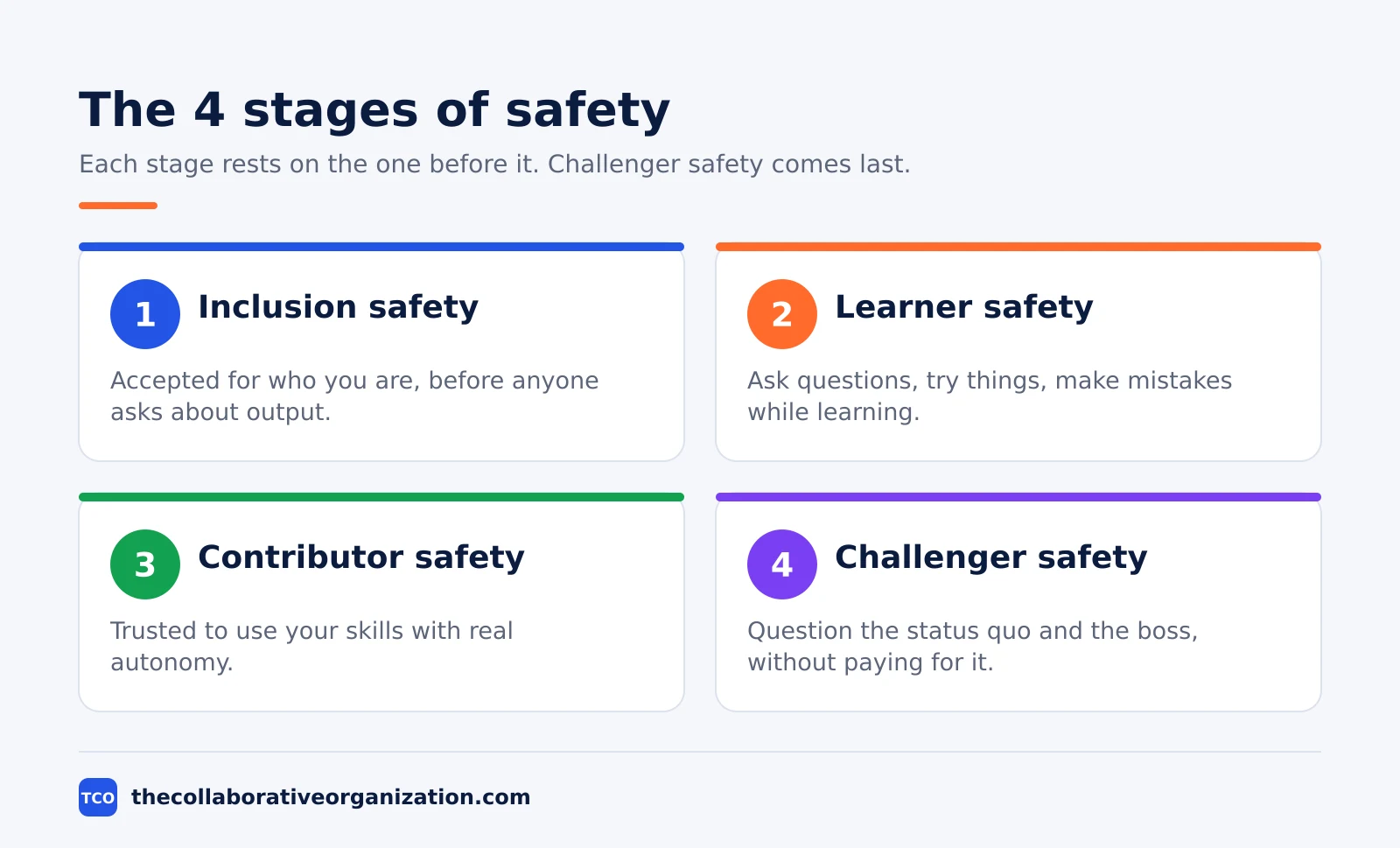
| Stage | What people feel safe to do | The need it meets |
|---|---|---|
| 1. Inclusion safety | Be themselves and belong to the group | To connect and belong |
| 2. Learner safety | Ask questions, try things, make mistakes | To learn and grow |
| 3. Contributor safety | Share ideas and do work that matters | To make a difference |
| 4. Challenger safety | Question the status quo and the boss | To make things better |
Inclusion safety comes first: people feel accepted for who they are, including their differences, before anyone asks about output. Learner safety follows, when asking questions and getting things wrong becomes part of learning rather than a mark against the person.
Contributor safety arrives when people are trusted to use their skills with real autonomy and to add value as full members of the team. Challenger safety is the last and rarest stage, when people can question decisions, including the leader’s, without paying for it later.
Clark tested the order with a survey of 3,366 employees across more than 20 organisations. Asked which activities they would do first on a new team, 65% put getting to know the team first, 63% put learning their role second, 81% put contributing third, and 86% put challenging how things are done last.
What psychological safety is not
Psychological safety is not being nice, not lowering the bar, and not a promise that work will feel easy. Edmondson has said this plainly in interviews and in her 2019 book The Fearless Organization, and the confusion is the most common reason teams get it wrong.
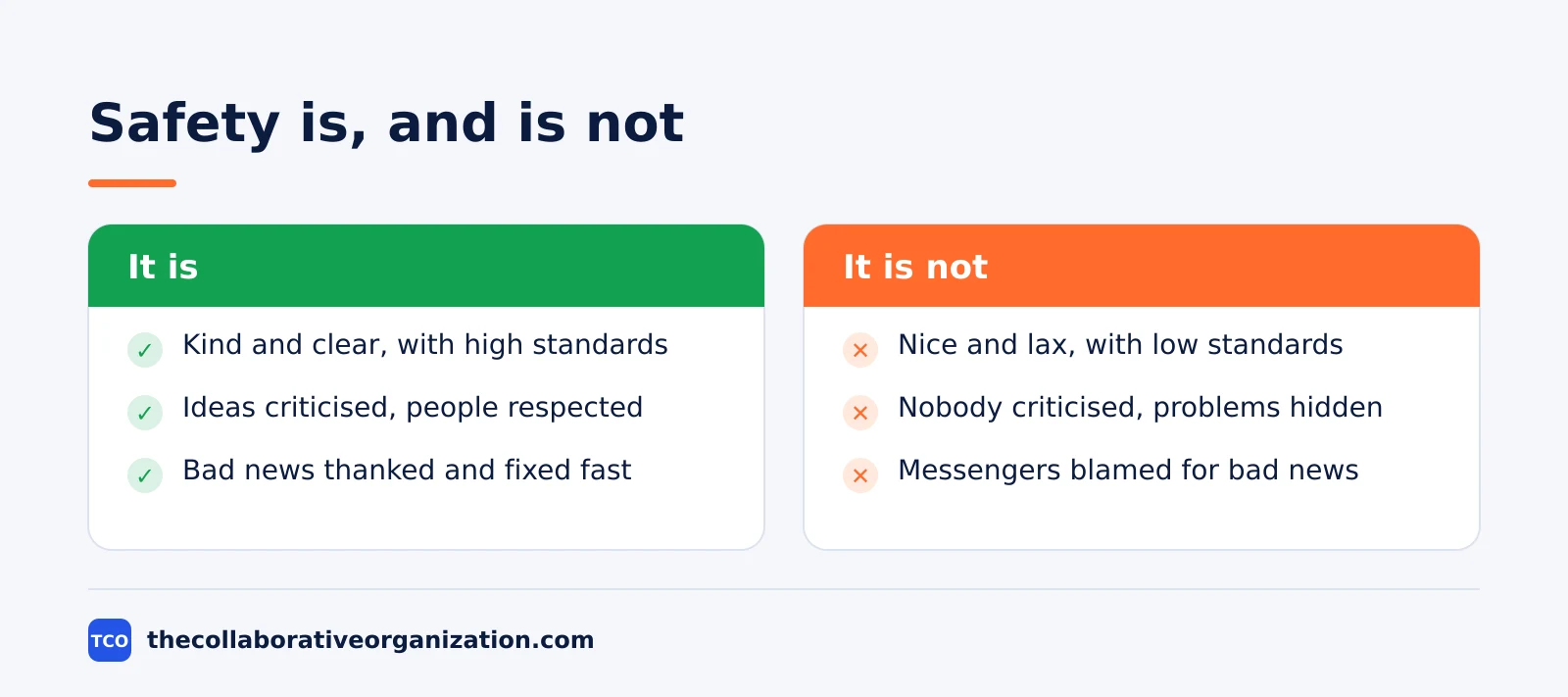
A safe team is kind and clear, not nice and lax. Kind means people treat each other with respect; clear means the team still says hard truths and holds high standards. A team that avoids hard feedback to protect feelings is not safe, it is comfortable, and comfort hides problems until they are expensive.
Safety is also not the same as trust, though the two travel together. Trust lives between two people, while safety lives in the whole team. A pair of colleagues can trust each other deeply while the wider team stays silent, because the shared belief about speaking up is still missing.
The test is simple: when someone raises a problem, does the team thank them and fix it, or does it shoot the messenger? The first answer is safety. The second is a warning sign, even in a team that calls itself friendly.
Signs your team has it, and signs it is missing
A psychologically safe team shows five signs: questions in meetings, open talk about mistakes, dissent before decisions, help asked early, and bad news travelling fast. The signs are visible in ordinary weeks, not only in crises.
Meetings are the easiest place to look. In a safe team, several people speak, questions interrupt the plan, and someone says “I do not understand” without apology. In an unsafe team, the same two people talk, the rest nod, and the real debate happens in side chats after the meeting ends.
Mistakes tell the same story. Safe teams log errors in the open and talk about what caused them. Unsafe teams hide errors, blame individuals, and repeat the same failure because nobody will name it. Edmondson’s hospital finding is the classic case: the teams that reported more errors were the ones learning fastest.
Google’s Project Aristotle adds two more markers from its study of 180 teams. On the strongest teams, speaking time was shared fairly evenly, so no one person held the floor. Members were also skilled at reading how others felt from tone and expression, a habit the researchers called social sensitivity.
Our guide on how to improve team collaboration covers the meeting habits that make these signs show up week after week.
How to measure psychological safety
The best way to measure psychological safety is Edmondson’s seven-item survey from 1999, run anonymously and scored per team. It is the most used instrument in the field, and it asks about concrete experiences rather than feelings.
| Item | Statement (rate 1 to 7) | Scoring |
|---|---|---|
| 1 | If you make a mistake on this team, it is often held against you | Reverse-scored |
| 2 | Members of this team are able to bring up problems and tough issues | Normal |
| 3 | People on this team sometimes reject others for being different | Reverse-scored |
| 4 | It is safe to take a risk on this team | Normal |
| 5 | It is difficult to ask other members of this team for help | Reverse-scored |
| 6 | No one on this team would deliberately act in a way that undermines my efforts | Normal |
| 7 | Working with members of this team, my unique skills and talents are valued and utilized | Normal |
Each member rates the seven statements from 1 (strongly disagree) to 7 (strongly agree). Items 1, 3 and 5 are worded negatively, so their scores are flipped before averaging: a 7 becomes a 1, a 6 becomes a 2, and so on. The team average is the score, not any one person’s answer.
Run the survey per team, not per company, because safety varies team by team inside the same firm. Keep it anonymous, share the team average back to the team, and repeat it every few months. A single survey is a snapshot; the trend over time is what shows whether changes to how the team works are landing.
A 2017 meta-analysis in Personnel Psychology pooled 136 samples covering more than 22,000 people and linked psychological safety to task performance, which is one reason the seven items are still the standard measure. That finding comes to us through a secondary summary, so treat the link as direction, not as a precise effect size.
Worked example: the bug report that never came
A worked example shows what missing safety costs: a bug everyone saw, nobody reported, and a launch that failed in public. Imagine a team of eight shipping a new billing page. During testing, a junior developer notices that refunds show the wrong total. She tells a friend at lunch but says nothing in the review meeting, because the last person who raised a late bug was told to “stop blocking the release”.
The launch goes ahead. Refunds go out wrong for two days, support tickets pile up, and the fix takes a week of senior time. The bug itself was small. The silence around it was the real failure, and it cost far more than the fix would have.
Now run the same week with safety in place. The developer raises the bug in the review, the lead thanks her and moves the launch by a day, and the team adds a refund check to its test list. The launch is one day late and the refunds are right.
The difference was not skill or process; it was whether one person believed she could speak up without paying for it.
Leaders set that belief by how they react to the first piece of bad news. Collaborative leadership explains how leaders who share decisions and admit their own gaps make it easier for everyone else to speak.
Common psychological safety mistakes to avoid
Teams usually damage psychological safety with five habits, and all five are easy to spot once you know them. Check your own team against the list.
- Asking for input, then punishing it. Inviting dissent and then rolling eyes at the first challenge teaches the team to stay quiet. Thank the person first, then debate the idea.
- Confusing safety with comfort. Dropping standards to keep everyone happy creates a cosy team that ships little. Keep the bar high and make it safe to say the bar is missed.
- Measuring the company instead of the team. A company-wide average hides the two teams in trouble. Score each team on its own, and act on the lowest score first.
- Treating one workshop as the fix. A single training day does not change what happens when someone raises a real problem on a Tuesday. Safety is built by repeated reactions, not by one event.
- Blaming the quiet people. Silence is usually a signal about the room, not about the person. Ask what the team does when someone speaks up, before asking why someone stays quiet.
The benefits of collaboration in the workplace show what opens up once these habits change: faster decisions, earlier warnings, and ideas from people who used to stay silent.
For the daily practices that build the habit, our guide on how to create a collaborative culture gives a step-by-step path.
If you want a broader view of what makes teams effective, compare the options on our project management software shortlist, since the tool a team uses shapes how easily people can speak up in writing.
Sources
- Unfreeze - Psychological Safety at Work: Meaning, History, Evidence (2026)
- LeaderFactor - Dr. Timothy R. Clark on Psychological Safety: The 4 Stages (2026)
- Google - The Five Dynamics of Effective Teams (2018)
- McKinsey - Psychological Safety and the Critical Role of Leadership Development (2021)
- PEAKTEAMS - Psychological Safety Survey: Questions and Scoring (2026)
- Same Team Partners - Psychological Safety at Work (2026)
- Personaramic - Psychological Safety: What It Is and What Google Found (2026)
- Factlen - The Science of Psychological Safety (2026)
Frequently asked questions
Is psychological safety the same as trust?
No. Trust is about one person: you trust a teammate to keep a promise or guard a secret. Psychological safety is about the whole team: everyone believes the group is safe for speaking up. A team can have pairs who trust each other and still stay silent in meetings, because the shared belief about risk is missing.
Does psychological safety mean nobody gets criticised?
No, it means the opposite. Safe teams criticise ideas more, not less, because people are not afraid to say what they think. The difference is how the criticism lands: it targets the work, it comes with reasons, and it does not punish the person who raised the issue or made the mistake.
Can you have psychological safety and high standards at the same time?
Yes, and that mix is the point. Edmondson maps safety against standards in four zones, and the best zone pairs high safety with high standards. Low standards plus high safety gives comfort without results, while high standards without safety gives anxiety and silence. Safe teams aim high and speak plainly.
How do you measure psychological safety on a team?
Use Edmondson's seven-item survey from 1999. Each member rates seven statements from 1 to 7, three of them reverse-scored, and the team takes the average. Run it anonymously, score it per team rather than per company, and repeat it every few months to see whether the number moves after you change how the team works.
What is the first sign that psychological safety is missing?
Silence in meetings is usually the first sign. Nobody asks a question, nobody challenges a plan, and problems surface late or through side channels. If the same two people do all the talking and the rest nod along, the team is probably holding back, not agreeing.
Related articles
project management
How to Choose Project Management Software (2026)
Pick project management software in seven steps: define the work, count seats, price the real cost, and run a two-week pilot before you pay.
November 19, 2026 · 10 min read
project management
What Is a RACI Matrix? Definition, Roles and Examples (2026)
A RACI matrix maps who is Responsible, Accountable, Consulted and Informed for each task. Learn the four roles, how to build one, and see a worked example.
November 19, 2026 · 9 min read
project management
Daily Standup Meeting Format That Works (2026)
A daily standup is a 15-minute meeting where Developers inspect progress toward the Sprint Goal and plan the next day. Use this format to run one that ends on time.
November 19, 2026 · 10 min read