What Is a Single Source of Truth (SSOT)? (2026) | The Collaborative Organization
By The Collaborative Organization Team · November 19, 2026 · Last verified November 19, 2026 · 10 min read
A single source of truth, or SSOT, is the practice of creating and changing each fact in exactly one authoritative place, while every other system reads a copy from that place. If the customer address lives in the CRM, the billing system reads it from the CRM instead of keeping its own copy that can drift apart.
Key takeaways
- A single source of truth means each data element is mastered in only one place, and every other copy is derived from it.
- An SSOT is about who may write a value, not about storing all data in one database.
- MuleSoft’s 2026 Connectivity Benchmark Report found the average organization runs 957 applications, with only 27 percent of them connected.
- The benefits are fewer contradictions, less reconciliation, simpler integration and a clear audit trail.
- An SSOT does not make the data right; it only stops copies from disagreeing.
What a single source of truth is
A single source of truth is a rule about writing, not a rule about storage. For any fact the business knows, one system is the owner: the only place where that fact can be created or changed. Every other place that needs the fact reads it, displays it or transforms it, but never stores an independent copy that can drift.
Wikipedia states the idea in the same terms: SSOT is the practice of structuring information so that every data element is mastered, or edited, in only one place. The same entry notes the two main gains: easier prevention of mistaken inconsistencies, and greatly simplified version control.
The problem it fixes is simple and common. When the same fact lives in two places, those two places will disagree sooner or later. Sales quotes one price, finance invoices another, and the warehouse ships to an old address. Nobody is lying; each copy was right when it was made, and then they drifted.
Why teams need one: the scale of the problem
Most teams now run so many systems that the same fact lives in several of them at once. MuleSoft’s 2026 Connectivity Benchmark Report, a survey of 1,050 IT leaders published in February 2026, found that the average organization runs 957 applications, and only 27 percent of them are connected. That gap is where copies drift and arguments start.
The same report, as summarized by ERP Information, found that IT teams spent 36 percent of their time designing, building and testing custom integrations, and 82 percent of IT leaders named data integration as one of their biggest challenges. When systems do not talk, people become the sync layer, copying values by hand between tools.
Our guide on how many SaaS apps does a company use covers the same growth in app counts, and why the count keeps rising even as teams try to cut it. The SSOT is the answer to the disagreement that growth creates, not to the growth itself.
How a single source of truth works
An SSOT works by naming one owner for each field, then pointing every reader at that owner. The work is a table, not a tool: one row per fact, with the owning system, the person who owns the rule, and the systems that read it. When a fact changes, it changes in one place, and every reader sees the new value.
Take a product price. The billing system owns the list price. The website, the sales CRM and the quote tool all read it from billing.
Nobody edits the price in the CRM, because the CRM copy is a read-only view. If the price changes, billing changes it once, and the change flows everywhere.
Paligo describes the same idea for documents: maintain one authoritative version of every content component, such as a safety warning or a procedure, and reuse it everywhere it is needed. When the source changes, every output that references it updates automatically, with no hunting for copies.
Single source of truth vs single version of the truth
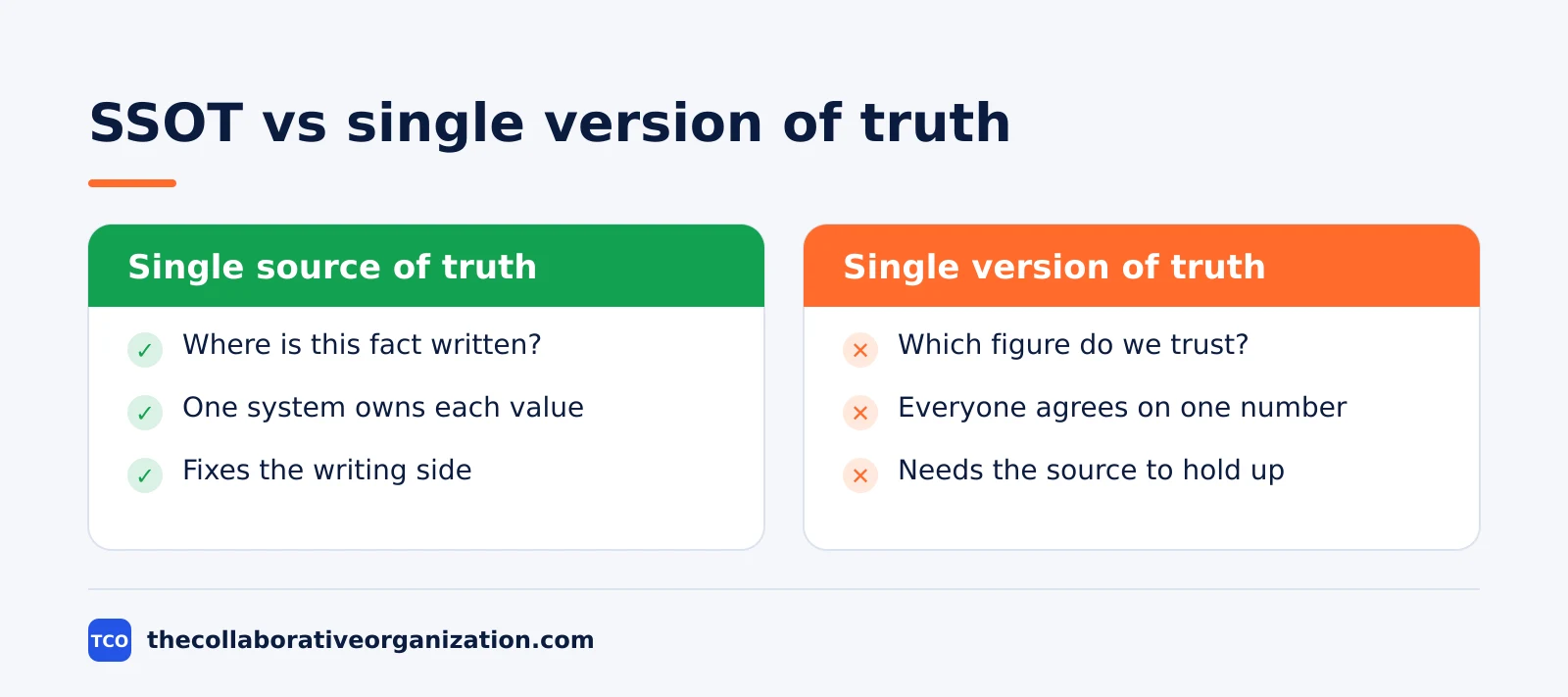
A single source of truth is about where a fact is written, while a single version of the truth is about what everyone agrees is true. The two ideas are related, but they are not the same, and mixing them up leads teams to buy a dashboard when they need a rule.
| Idea | Question it answers | Example |
|---|---|---|
| Single source of truth | Where is this fact written? | The CRM owns the customer address |
| Single version of the truth | Which figure do we all trust? | The board report uses the CRM address |
| Data warehouse | Where do we store copies for reporting? | Nightly copies from CRM, billing and stock |
| Master data management | How do we govern shared facts? | Rules, owners and quality checks for each fact |
A dashboard can show one version of the truth for a meeting, and still be wrong the next day if three systems hold three different addresses. The SSOT fixes the writing side, so the agreed figure stays agreed. A data warehouse helps reporting, but it is a store of copies, not an owner, so it cannot replace the rule.
Benefits of a single source of truth
Every benefit of an SSOT follows from removing conflicting copies of the same value. The list below is the payoff teams see once one fact, then a second, then a third, has a single owner.
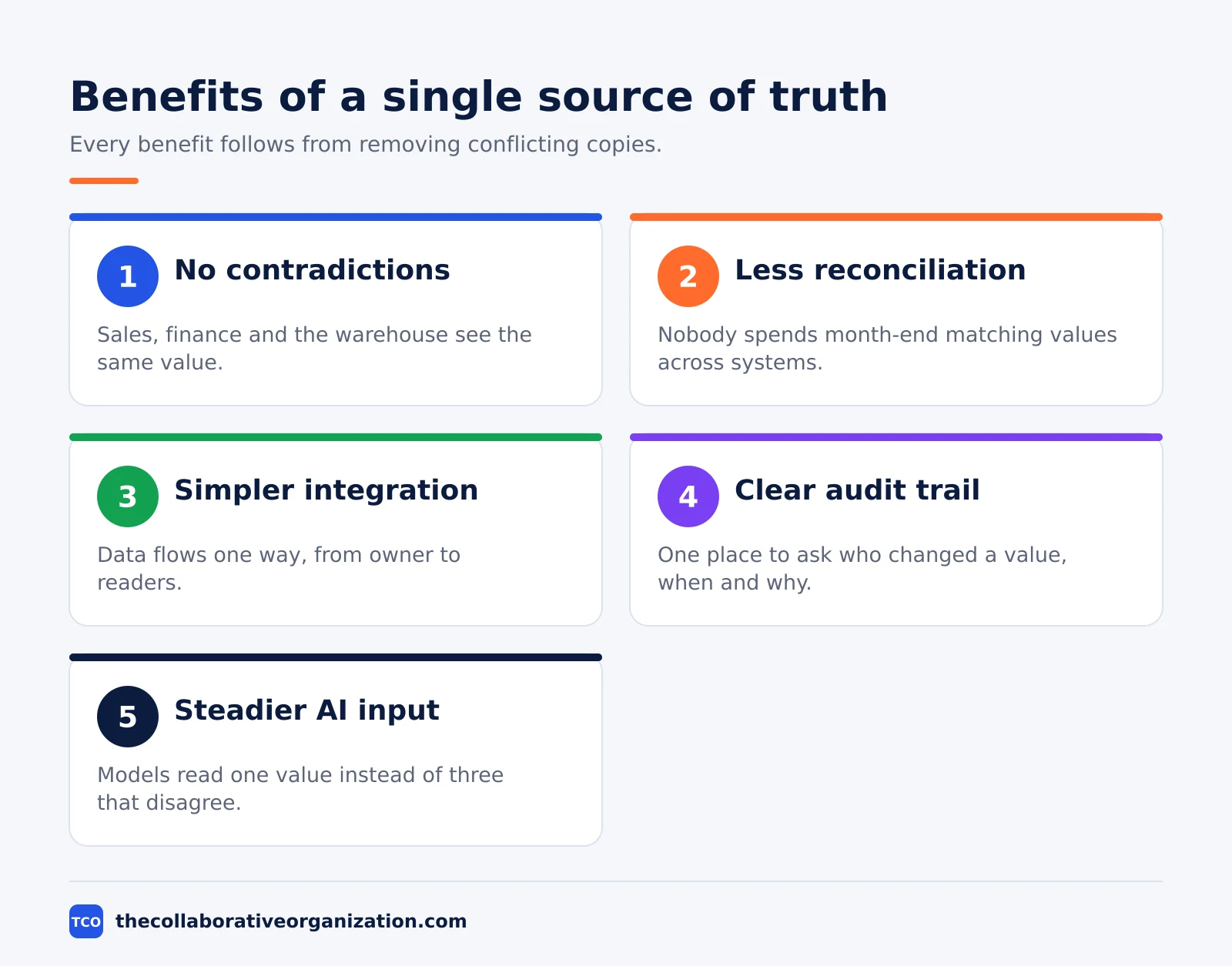
- No contradictory values in daily work. Sales, finance and the warehouse see the same credit limit, address and price, so the argument about which copy is right stops happening.
- Less reconciliation. When values cannot diverge, nobody spends month-end matching them across systems. The time goes to the work itself.
- Simpler integration. Data flows one way, from owner to readers, instead of every system syncing with every other system. That is far fewer connections to build and keep.
- A clear audit trail. There is one place to ask who changed a value, when and why. Distributed stores produce distributed logs that must be pieced together.
- Steadier input for AI. Agents and models are only as consistent as the data they read, and an SSOT gives them one value to read instead of three that disagree.
Meltwater makes the same point for reporting: a single source of truth keeps data reliable, accurate and comparable, and it cuts the silos that form when each team keeps its own copy.
What a single source of truth does not fix
An SSOT removes contradictions between systems, but it does not make the data right. If the owning system holds a wrong address, every reader now shares the same wrong address, faster than before. Quality checks still belong at the owner, with rules on who may change a value and how it is checked.
It also adds a dependency. When every reader depends on one owner, the owner must stay up, and changes to it need care. A team that picks an owner with no backup plan trades many small disagreements for one big point of failure. Name a backup owner, and keep a simple export of the owned facts.
Finally, an SSOT does not fix a definition argument. If sales counts revenue at the order date and finance counts it at the invoice date, one source will not settle the argument. The team must agree on the definition first, then point the systems at it.
How to build one: a worked example
A small team can build an SSOT for one fact in a week, and the method below is an illustration of how that week runs. Imagine a team of 12 people selling software, with prices in the billing system, the CRM and a spreadsheet. Quotes keep going out at old prices.
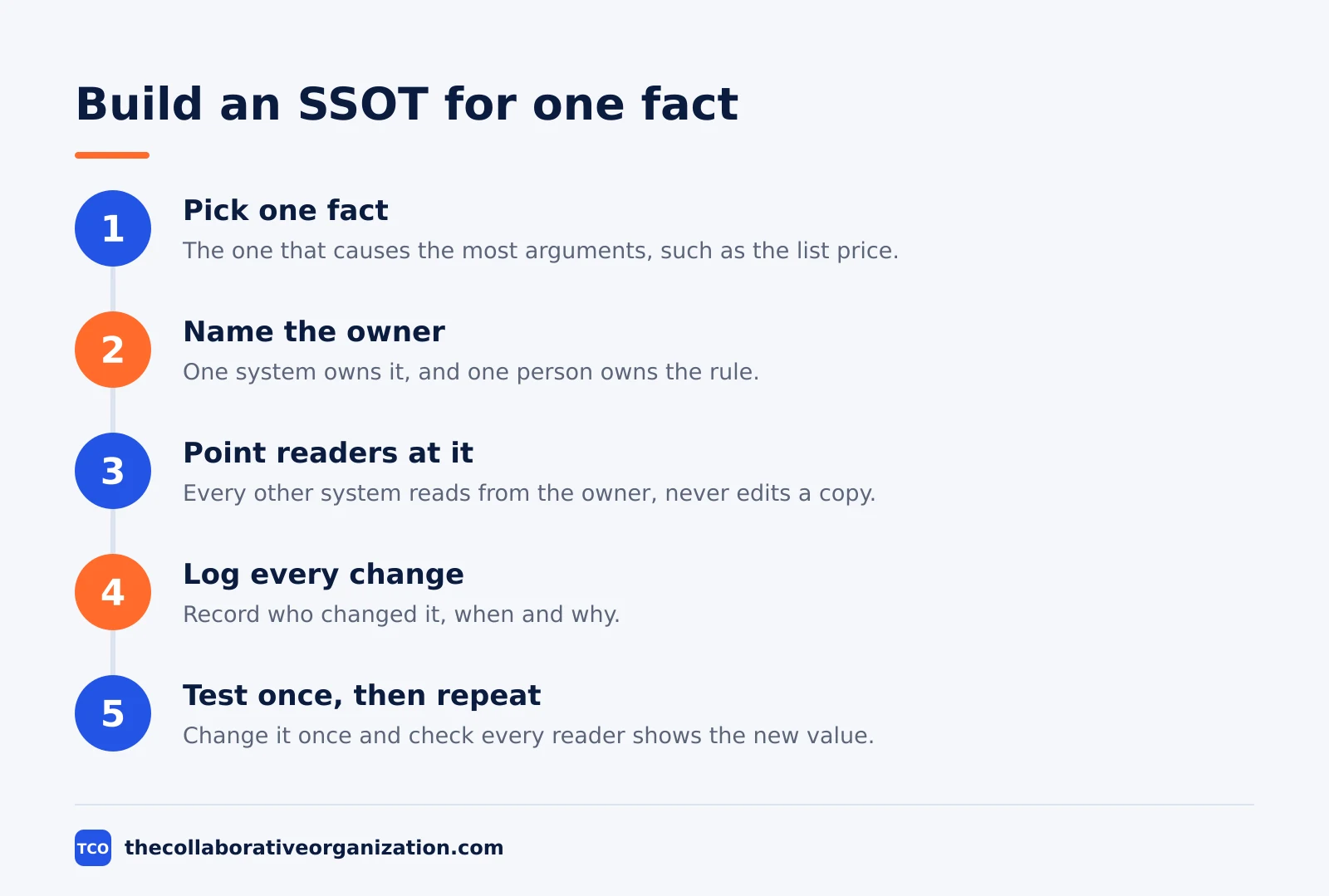
First, the team picks one fact: the product list price. They name the billing system as the owner, and the finance lead as the person who owns the rule. They list every place the price appears, and they change each one to read from billing instead of storing its own copy. The spreadsheet becomes a read-only view.
Next, they set two rules: only the finance lead may change the price in billing, and every change is logged with a date and a reason.
They test the change by updating a price once and checking that the website, the CRM and the quote tool all show the new value. When the test passes, they pick the next fact: the customer credit limit, owned by finance in the same way.
Tools that support a single source of truth
The tool matters less than the rule, but a shared workspace makes the rule easy to follow. A wiki or docs tool can hold the ownership table, the definitions and the change log in one place the team already opens. Our document collaboration software shortlist compares the options.
| Tool | Best for | Free plan | Starting price (as of November 2026) | Notable limit |
|---|---|---|---|---|
| Confluence | Ownership tables and definitions with page history | Free for up to 10 users | $7.15 per user per month (Standard), billed monthly for 1 to 100 users | Page headline of $5.78 is a blended rate for a 300-user team |
| Notion | Small teams that want the ownership table next to the data | Free plan with limited blocks for 2 or more members | $10 per member per month (Plus), billed annually | $12 per member per month when billed monthly |
The Confluence price comes from Atlassian pricing: the page headline shows $5.78 per user per month for Standard and $11.16 for Premium, which are blended rates for a 300-user team. A team of 1 to 100 users pays $7.15 on Standard and $14.10 on Premium, billed monthly, after Atlassian raised both rates on 13 October 2026.
The Notion pricing page lists Plus at $10 per member per month billed annually, or $12 billed monthly.
A wiki vs knowledge base page is often the home for the ownership table, since it is the place the team already checks for agreed facts. Keep the table there, link it from each system that reads from the owner, and review it when a system changes.
Common single source of truth mistakes to avoid
Most SSOT efforts fail in the same few ways, and all of them are easy to spot before the work starts. Run through the list below each time you add a new fact to the source.
- Declaring one database instead of naming owners. An SSOT is a rule about who may write each value, not a plan to move all data into one store.
- Trying to fix every fact at once. Pick the one fact that causes the most arguments, prove the method on it, then add the next.
- Naming a system but no person. A system cannot answer for a wrong value. Every owned fact needs one person who owns the rule.
- Letting readers keep editing their copies. A copy that anyone can edit is not a copy, it is a second source. Make reader copies read-only.
- Skipping the definition. If two teams define revenue differently, one source will not settle it. Agree on the definition first.
- No audit trail. If nobody can say who changed a value, when and why, trust in the source will fade, and teams will start keeping their own copies again.
Sources
- ERP Information - Single Source of Truth (SSOT): Meaning and How to Build One (2026)
- Wikipedia - Single source of truth (2026)
- Paligo - What is Single Source of Truth (SSOT)? (2026)
- Meltwater - What Is a Single Source of Truth and Why Do You Need It? (2026)
- BixTech - How to Create a Trusted Single Source of Truth (SSOT) (2026)
- Salesforce - MuleSoft Connectivity Report announcement (2025)
- Atlassian - Confluence Pricing (2026)
- Notion - Pricing (2026)
Frequently asked questions
What does SSOT stand for?
SSOT stands for single source of truth. It is the practice of creating and changing each data element in exactly one authoritative system, so every other system works from a copy of it. The idea is also called a single point of truth, or SPOT.
Is a single source of truth one database?
No. An SSOT does not require one database. It requires that, for each field, everyone knows which system owns it. Customer addresses might live in the CRM, prices in the billing system, and stock in the warehouse system, with each system reading the others.
What is the difference between a single source of truth and a single version of the truth?
A single source of truth is about where a fact is written: one system owns each value. A single version of the truth is about agreement: everyone accepts the same figure as the trusted one. You need the first to make the second hold up when numbers are checked.
When should you not build a single source of truth?
Skip it when the data is small, the team is small, and one shared document already gives everyone the same answer. An SSOT adds rules, owners and sync work, so it pays off when several systems or teams keep disagreeing about the same customer, product or price.
How do you start building a single source of truth?
Pick one fact that causes the most arguments, such as the product price or the customer credit limit. Name the system that owns it, name one person who owns the rule, and point every other system at that owner. Prove it works on one fact before you add the next.
Related articles
document collaboration
Airtable vs Google Sheets: Which to Use in 2026
Airtable is a database with views and automations; Google Sheets is a free spreadsheet. Learn the limits, the 2026 prices, and which one fits your team's data.
November 19, 2026 · 7 min read
document collaboration
Confluence vs SharePoint: Which to Use in 2026
Confluence is a wiki built around pages; SharePoint is a document platform built around files. Learn the differences, the 2026 prices, and which one fits your team.
November 19, 2026 · 7 min read

document collaboration
How to Document Processes: A Step-by-Step Guide (2026)
To document a process, pick one task, watch it done for real, map the steps and decisions, then test the draft on someone new. Follow the 7 steps in this guide.
November 19, 2026 · 10 min read