SOC 2 Explained for Software Buyers (2026) | The Collaborative Organization
By The Collaborative Organization Team · November 19, 2026 · Last verified November 19, 2026 · 9 min read
SOC 2 is an independent audit of a software vendor’s security controls, run by a licensed CPA firm against the AICPA Trust Services Criteria, and the result is a report you can ask to read. It is the most common proof buyers request when they need to trust a vendor with their data.
Key takeaways
- SOC 2 is an audit, not a certificate: a CPA firm tests a vendor’s controls and writes a report, and there is no pass or fail grade.
- The AICPA defines 61 Trust Services Criteria in five categories: Security, Availability, Processing Integrity, Confidentiality and Privacy.
- Security, the 33 Common Criteria, is in every report in practice, while the other four categories are optional.
- Type 1 tests control design on one date, while Type 2 tests whether controls worked over a period of 3 to 12 months.
- A report covers only the system and period it states, so ask for the latest report and a bridge letter for the gap.
What SOC 2 is
SOC 2 is a report on how a service company manages and protects customer data, written by an independent auditor after testing its controls. SOC stands for System and Organization Controls, and the number 2 marks the version that covers security, availability, processing integrity, confidentiality and privacy.
The AICPA, the American Institute of Certified Public Accountants, sets the rules. It describes a SOC 2 report as an independent examination by a licensed CPA under its attestation standards, testing controls relevant to those five areas. The report includes an opinion on the design and operating effectiveness of the controls that support the system.
Two facts matter for buyers. First, SOC 2 is not a law, and no regulator forces a vendor to hold one. It has become a buying standard because enterprise customers ask for it.
Second, SOC 2 is not a badge you either earn or fail: the auditor gives an opinion and lists exceptions, and you must read the report to see what it actually found.
The five Trust Services Criteria
The AICPA Trust Services Criteria are 61 checks grouped into five categories, and every SOC 2 report is built from them. The current version is the 2017 criteria with revised points of focus from 2022, published as TSP Section 100.
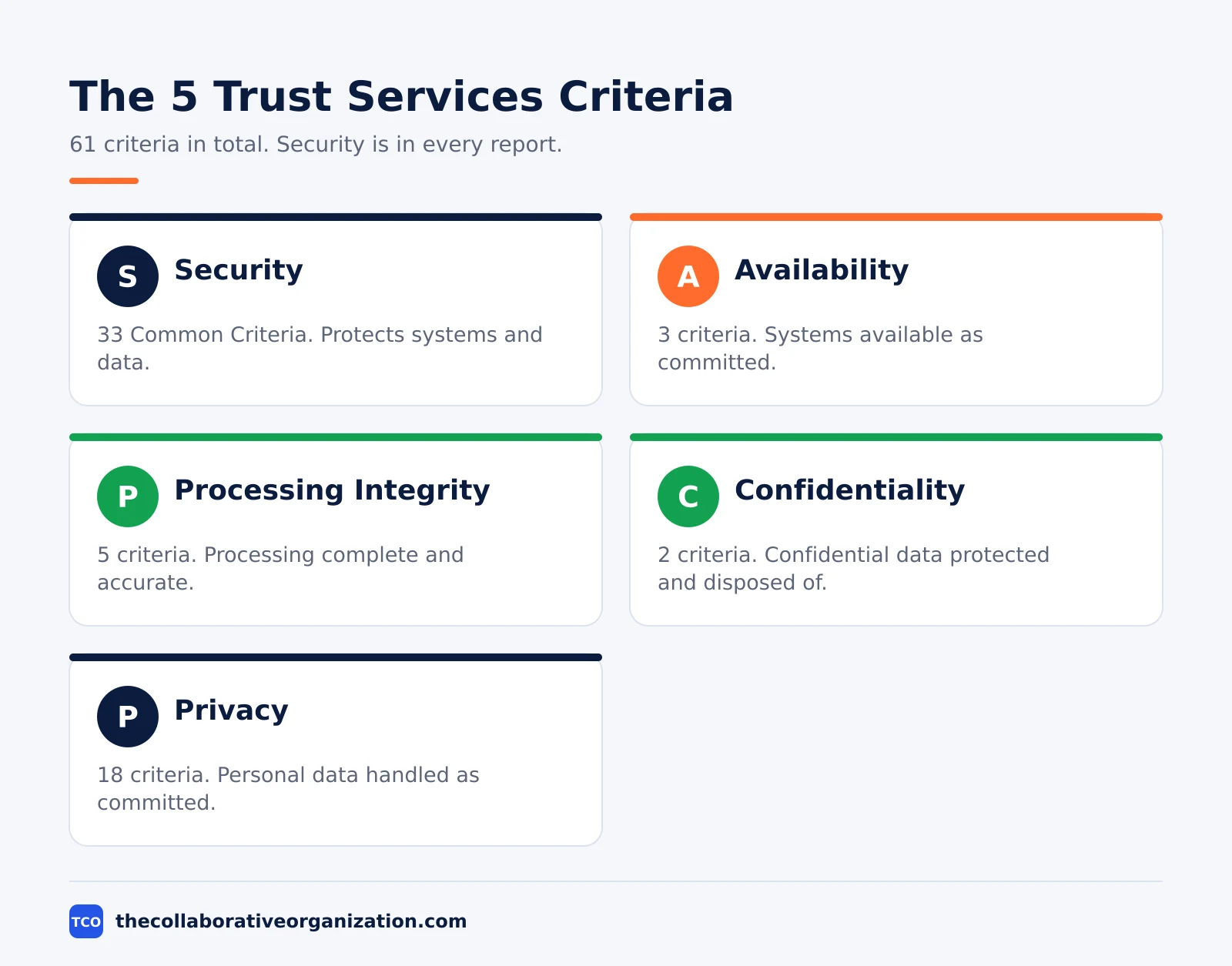
| Category | Code | Criteria | What it tests |
|---|---|---|---|
| Security | CC1-CC9 | 33 | Systems and data are protected against unauthorized access, disclosure and damage |
| Availability | A1 | 3 | Systems are available for operation and use as committed |
| Processing Integrity | PI1 | 5 | Processing is complete, valid, accurate, timely and authorized |
| Confidentiality | C1 | 2 | Information marked confidential is protected and then disposed of |
| Privacy | P1-P8 | 18 | Personal information is collected, used, retained, disclosed and disposed of as committed |
Security is the base layer. Its 33 criteria are the Common Criteria, and they sit under every category, so every report covers them. The first 17 of them map to the COSO 2013 internal control framework, which covers the control environment, risk assessment and monitoring, while CC6 to CC9 add access, operations, change management and risk mitigation.
The other four categories are optional, and a vendor adds them only when its promises to customers call for them. A vendor that promises uptime adds Availability, a payment tool adds Processing Integrity, and a vendor handling personal information may add Privacy.
In a 2024 benchmark of 73 SOC 2 reports, every report covered Security, 75.3% added Availability, 64.4% added Confidentiality, 13.7% added Processing Integrity, and 6.8% added Privacy, according to SOC 2 Auditors.
SOC 2 Type 1 vs Type 2
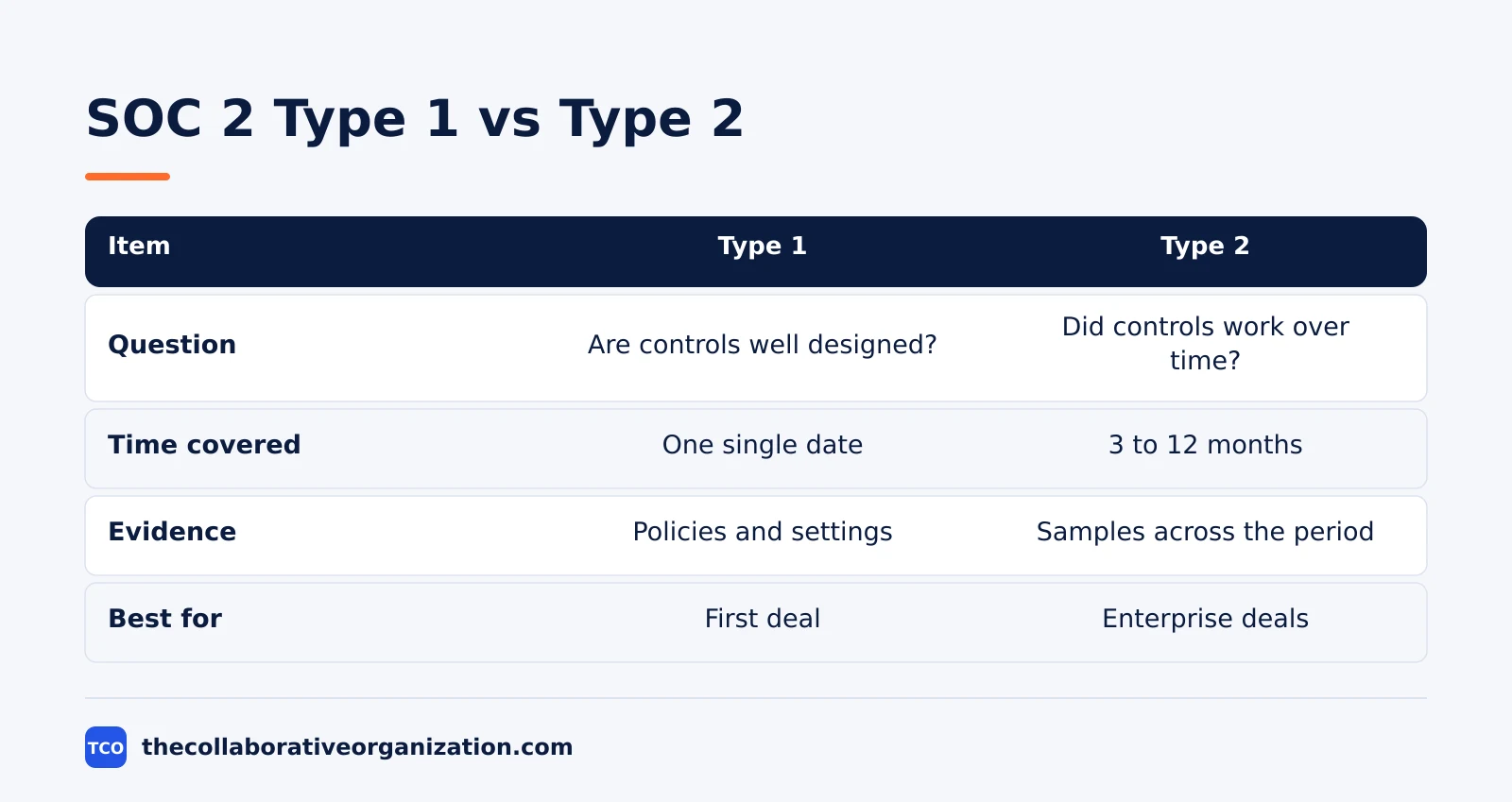
Type 1 and Type 2 use the same criteria, but they answer different questions: Type 1 asks whether controls are well designed on one date, and Type 2 asks whether they kept working for months. That time split is the whole difference.
| Item | Type 1 | Type 2 |
|---|---|---|
| Question answered | Are controls suitably designed? | Did controls operate well over time? |
| Time covered | A single date | An observation period, usually 3 to 12 months |
| Evidence | Policies, settings, walkthroughs | Samples from across the whole period |
| Time to get | Weeks after controls are in place | The period plus weeks of fieldwork |
| What buyers expect | Enough to unblock a first deal | The standard for enterprise deals |
A Type 1 report can be ready in weeks once controls are designed, which makes it useful for a young vendor closing its first large deal. A Type 2 report cannot be rushed, because the calendar is part of the test: the auditor samples controls across the period, and a gap in the middle becomes an exception in the report.
Cyber Veda notes that three months is the shortest period most buyers and auditors accept, and twelve months is the norm once reports are running.
Most enterprise buyers ask for Type 2 in the end. If a vendor offers only Type 1, ask when its first Type 2 period ends, and get that date in writing before you sign a long contract.
How to read a SOC 2 report
Read a SOC 2 report in four parts: the opinion, the system description, the tests of controls, and the exceptions. The opinion comes first, and it tells you whether the auditor found the controls suitably designed and, for Type 2, operating well.
The system description is the vendor’s own account of what the system does, which parts are in scope, and which controls it runs. Check the scope first: a report that covers only the main app says nothing about a side product or a new data centre. Check the period too, and note the end date.
The tests of controls show what the auditor sampled and what it found. Look for exceptions, the cases where a control did not run as described, and read the vendor’s response to each one.
One exception about a late access review is normal; a pattern of exceptions about the same control is a warning sign. Our guide on how to evaluate SaaS software explains how to weigh security evidence next to price and fit.
What to ask a vendor for
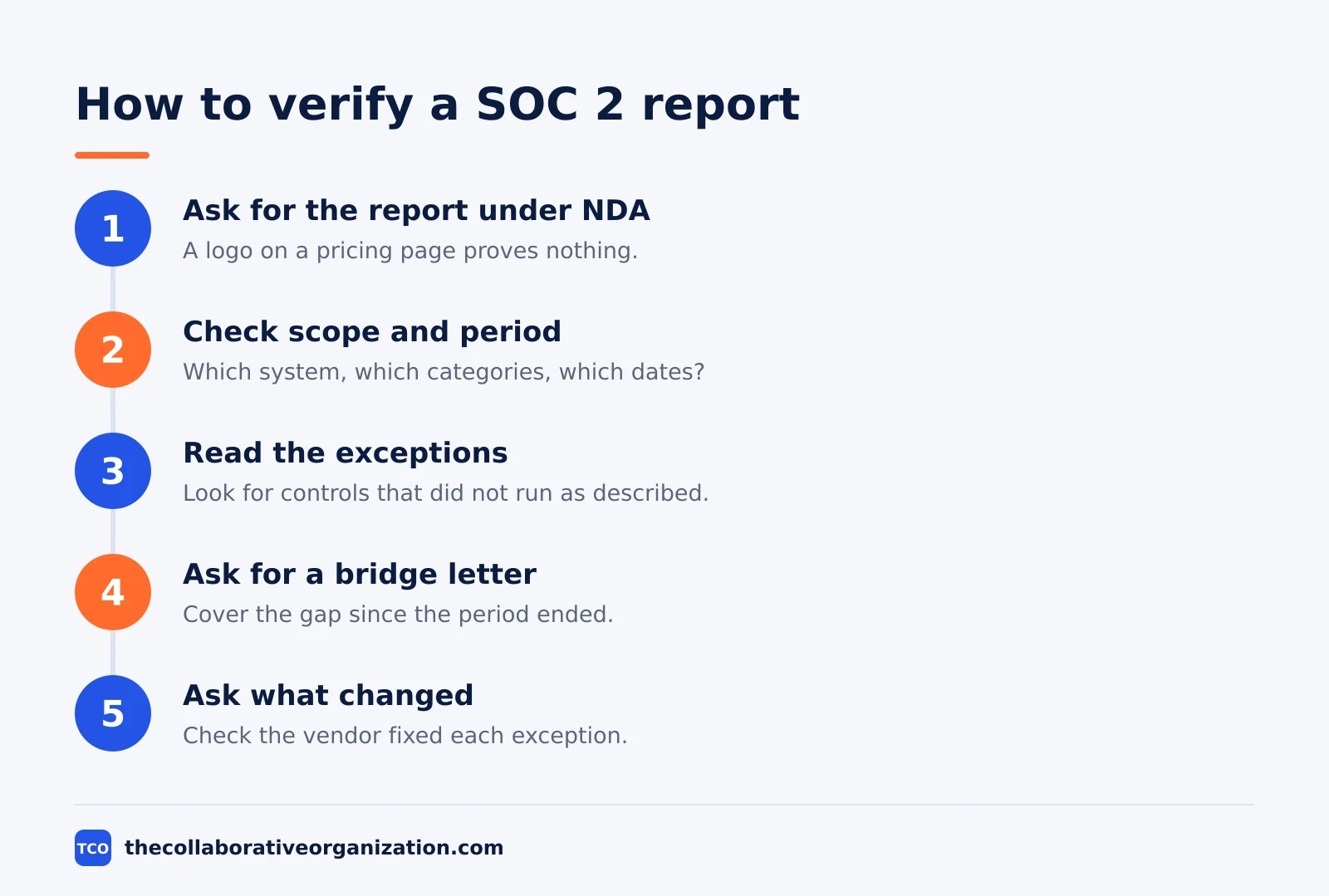
Ask for the report itself under NDA, not a logo or a one-line claim, and ask five follow-up questions before you rely on it. A vendor that holds a real report can share it with a serious buyer.
Ask which categories are in scope, and whether the report is Type 1 or Type 2. Ask for the period it covers and a bridge letter for the gap since it ended. Ask whether the auditor listed any exceptions, and what the vendor did about them.
Ask which sub-processors are named in the report, since your data may flow to them too.
Put the answers in your RFP so they become part of the deal. Our guide on how to write an RFP for software shows how to ask for security evidence in a form you can compare across vendors.
If the vendor has no report, ask what it has instead: an ISO 27001 certificate, a penetration test summary, or a dated plan to start a Type 2 period.
SOC 2 vs ISO 27001
SOC 2 and ISO 27001 both test security controls, but SOC 2 is an auditor’s report on a vendor’s own controls, while ISO 27001 is a certificate against a fixed standard. Buyers often ask for both, and they are not interchangeable.
ISO 27001 certifies that a company runs an information security management system that meets the standard, and the certificate is issued by an accredited body after an audit.
SOC 2 has no certificate and no fixed control list: the vendor picks its controls, and the auditor tests them against the criteria outcomes. That makes SOC 2 more flexible, and also harder to compare across vendors without reading the reports.
A vendor can hold one without the other, and many large vendors hold both.
If you must pick one proof to ask for, pick the one your own customers or regulators ask you for, since that is the proof you will need to pass on. GetSOC2 notes that most first reports are Security only, with Security plus Availability the second most common shape.
Worked example: a buyer checks a vendor
A buyer who spends one hour on a SOC 2 report can learn more than a week of sales calls will reveal. Imagine a 50-person company buying a CRM, and the vendor sends its latest SOC 2 Type 2 report under NDA.
The buyer first checks the cover page: the period is 1 January to 31 December 2025, the scope is Security and Availability, and the report is six weeks old. Next the buyer reads the opinion, which is clean, then scans the exceptions.
There are two: one access review ran late in March, and one backup test missed its target time in July. The vendor’s responses show both were fixed and re-tested.
The buyer then checks the sub-processor list and finds the CRM uses a cloud host and an email service the buyer already approves.
The buyer asks for a bridge letter covering January 2026 to today, and the vendor sends it the next day. The deal moves ahead, and the buyer sets a calendar reminder to ask for the next report when it lands.
Common SOC 2 mistakes to avoid
Buyers make the same five mistakes with SOC 2, and each one comes from trusting a claim instead of reading the report. Avoid them and the report becomes a useful tool.
- Trusting the logo. A SOC 2 logo on a pricing page proves nothing about scope, period or exceptions. Ask for the report under NDA.
- Accepting an old report. A report that ended 18 months ago says nothing about controls today. Ask for the latest report and a bridge letter.
- Ignoring the scope. A report that covers only the main app does not cover a new module or a side product. Check the system description.
- Skipping the exceptions. Exceptions are where the real story sits. Read them, and ask what changed since.
- Treating SOC 2 as a guarantee. A clean report means controls ran during the period, not that a breach is impossible. Keep your own checks, and test the tool yourself in a trial, as our guide on how to run a software trial advises.
The AICPA proposed new criteria in an exposure draft dated 27 October 2026, with comments due by 15 January 2027, and the draft would cut the set from 61 criteria to 50. That draft is not final, so reports today still use the 2017 criteria. For a wider view of the project, see our software guides hub.
Sources
- SOC 2 Auditors - SOC 2 Trust Services Criteria: 5 Categories, 61 Criteria (2026)
- AICPA - System and Organization Controls: SOC Suite of Services (2026)
- Cyber Veda - SOC 2 Type 1 vs Type 2: Which Do You Need? (2026)
- GetSOC2 - SOC 2 Trust Services Criteria Explained (2026)
- Uproot Security - SOC 2 Trust Services Criteria: All 5 Principles Explained (2026)
- AICPA - Auditors Meet Urgent Demand for AI Assurance (2026)
Frequently asked questions
What does SOC 2 mean for a software buyer?
SOC 2 means an independent CPA firm checked a vendor's security controls against a set of criteria and wrote a report on what it found. For a buyer, it is evidence that the vendor runs the controls it claims to run, at least for the period the report covers. It is not a pass or fail certificate, so read the report itself.
Is SOC 2 a legal requirement?
No. SOC 2 is not a law, and no regulator forces a SaaS vendor to hold one. It has become a standard request in B2B buying because enterprise customers ask for it before they sign. A vendor without SOC 2 is not breaking a law, but it may lose deals to vendors that have a report.
How long is a SOC 2 report valid?
A Type 2 report covers a stated period, often 12 months, and it says nothing about controls after that period ends. Buyers usually ask for the latest report plus a bridge letter covering the gap since it ended. Reports need annual renewal, so a report that is two years old is not current evidence.
What is the difference between SOC 2 Type 1 and Type 2?
Type 1 checks whether controls are suitably designed at a single point in time, while Type 2 checks whether they operated well over a period, usually 3 to 12 months. Type 1 is faster to get and can unblock a first deal, but most enterprise buyers ask for Type 2 in the end.
Does SOC 2 mean a vendor cannot be hacked?
No. SOC 2 shows that controls were designed and, in a Type 2 report, operated during the period, but it does not promise that no breach will happen. It also covers only the system and period stated in the report. Treat it as strong evidence about process, not as a guarantee of safety.
Related articles

guides
Free Project Management Templates: 7 to Copy (2026)
Seven free project management templates from monday, Wrike, Teamwork, Smartsheet, ClickUp, Asana and Trello, with what each one is for and what free really costs.
November 20, 2026 · 7 min read

guides
Project Proposal Template: Copy and Win Work (2026)
A project proposal template pitches the work before it is approved: problem, solution, scope, budget, timeline and terms. Copy the template and filled example.
November 20, 2026 · 10 min read

guides
Action Plan Template: Goal to Done in One Page (2026)
An action plan template turns one goal into owned steps with dates, dependencies and a success measure. Copy the table and see it filled for a support team.
November 20, 2026 · 11 min read