How to Create a Collaborative Culture at Work (2026) | The Collaborative Organization
By The Collaborative Organization Team · November 19, 2026 · Last verified November 19, 2026 · 9 min read
To create a collaborative culture, set one shared vision, name leaders who model it, fix the processes and rewards that block it, and give the team shared tools and regular feedback. Culture is built by what gets measured, rewarded and repeated every day, not by a poster on the wall. The seven steps below take about 90 days.
Key takeaways
- A collaborative culture is built by shared goals, shared facts and shared rewards, not by a mission statement.
- Atlassian reports that companies with collaborative cultures are five times as likely to be high performing.
- The seven steps run in order: vision, leaders, audit, chances to work together, team time, rewards, feedback.
- Most teams see real improvement within one to two quarters when leaders model the change.
- Deloitte found 73% of firms say remaking the manager role matters, yet only 7% have made great progress.
What a collaborative culture is
A collaborative culture is a work environment where teamwork is the default, built into how people work every day rather than saved for brainstorms and crises. Atlassian defines it this way, and adds that the default assumption is that collective thinking produces better results than individual thinking.
That assumption has to show up in processes, incentives and leadership behaviour, not just in values on the wall. When people see that sharing facts and helping other teams is what gets rewarded, they do it. When they see solo heroes get promoted, they work alone.
The payoff is real. Atlassian reports that companies with collaborative cultures are five times as likely to be high performing, because engaged people are more productive, more flexible and more likely to stay. The figures are in Atlassian’s guide to collaborative culture, updated in November 2026.
What you need before you start
You need three things before step one: a sponsor, a baseline and a small budget of time. Without them, the effort fades after the launch meeting.
- A sponsor with real power. Find a leader who can change rewards and approve new tools. Culture change without a sponsor is a side project.
- A baseline. Ask the team five short questions: can you find the facts you need, do you know the shared goal, do you feel safe disagreeing, do other teams help you, and do rewards favour teamwork? Keep the answers for the 90-day review.
- Time set aside. Plan one hour a week for the first month. Mural advises leaders to model the behaviour they want, and that takes visible time, not just words.
- A way to change how work is rolled out. New habits need new routines, and our guide on change management for new software covers how to carry a team through a change without losing them.
Expect pushback. Deloitte’s Global Human Capital Trends 2025 found that 73% of firms say remaking the manager’s role is important or very important, yet only 7% say they have made great progress. The gap is reported in a 2026 guide to building collaborative culture.
How to create a collaborative culture in 7 steps
The seven steps below run in order, and each one takes about two weeks. Rushing them turns culture into a campaign, and campaigns end.
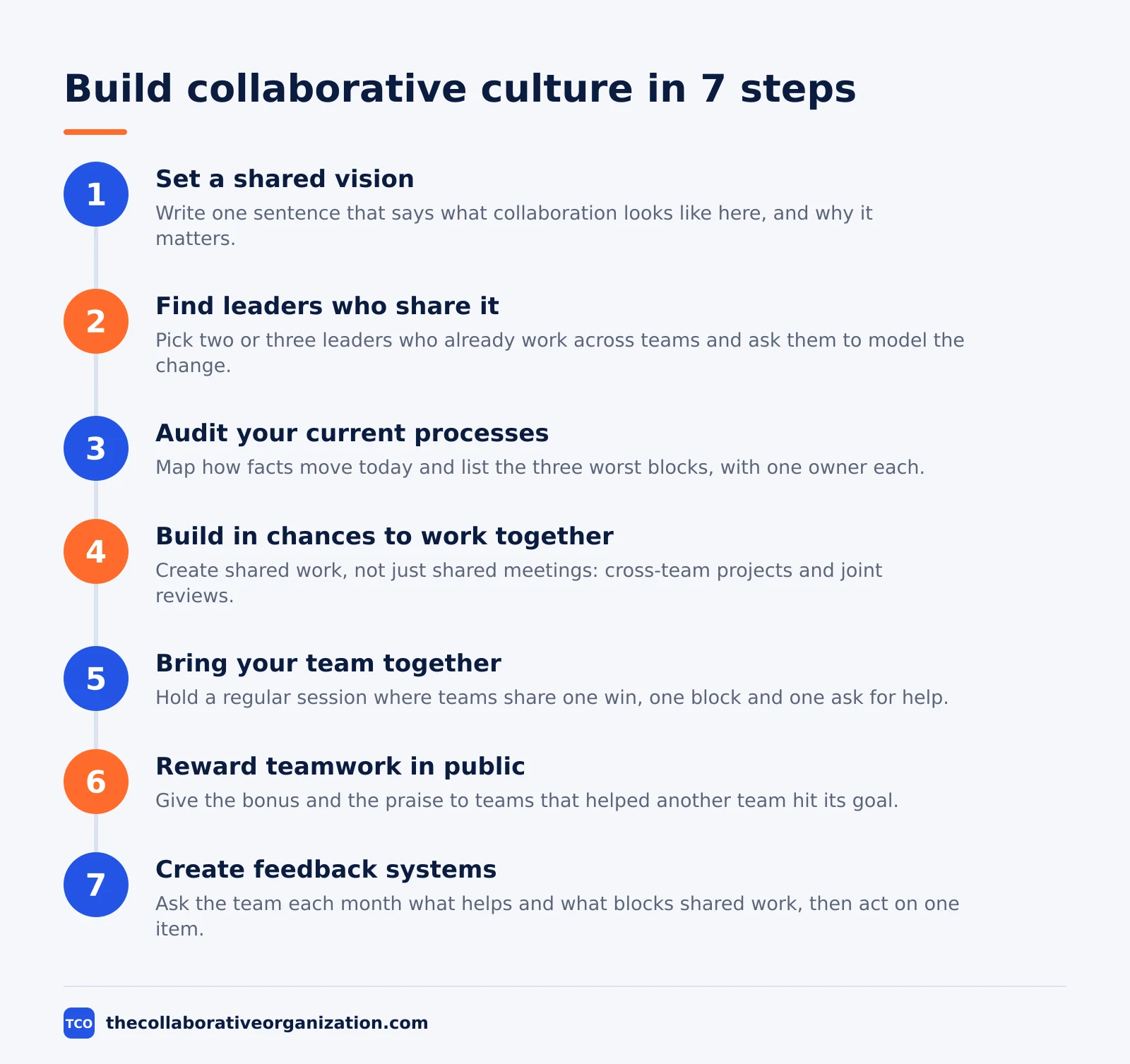
Step 1: Set a shared vision
Write one sentence that says what collaboration looks like here, and why it matters. The vision should name the shared goal and the behaviour that serves it, such as “we share facts early so no team is surprised.” Outcome: every team can repeat the vision in its own words.
Step 2: Find leaders who share the vision
Pick two or three leaders who already work across teams and ask them to model the change. They should share their own plans first, ask for input in public, and credit other teams. Indeed lists finding collaborative leaders as the second step, right after setting the vision.
Step 3: Audit your current processes
Map how facts move today: where plans live, who approves what, and where handoffs stall. List every place where one team waits on another. Outcome: a short list of the three worst blocks, with one owner each.
Step 4: Build in chances to work together
Create shared work, not just shared meetings. Cross-team projects, paired tasks and joint reviews give people a reason to talk. Nulab advises creating collaborative spaces, physical or virtual, where joint work can happen every day.
Step 5: Bring your team together
Hold a regular session where teams share what they learned, not just what they shipped. Keep it short and useful: one win, one block, one ask for help. Outcome: teams start asking each other for help before problems grow.
Step 6: Reward teamwork in public
Change what gets praised, promoted and paid. Give the bonus, the shout-out and the promotion to the team that helped another team hit its goal. Atlassian puts it plainly: no culture plan survives a reward system that fights it, so check who gets promoted first.
Step 7: Create feedback systems
Ask the team every month what helps and what blocks shared work. Use a short survey and one open question, then act on one item and say what you changed. Talkspirit lists talking to employees first as the starting point for any culture change.
A 90-day plan for building a collaborative culture
The table below turns the seven steps into a 90-day calendar. Each month has one focus and one check.
| Month | Focus | Key action | Check at month end |
|---|---|---|---|
| Days 1-30 | Vision and leaders | Set the vision, pick the leaders, run the baseline survey | Every team can repeat the vision |
| Days 31-60 | Processes and chances | Fix the three worst blocks, start one cross-team project | Handoffs have named owners |
| Days 61-90 | Rewards and feedback | Change one reward, run the first feedback round | The survey scores move up |
Name one owner for each handoff you fix. Our guide to what a RACI matrix is shows how to map who does the work, who approves it and who needs to know, so shared work does not stall between teams.
Keep the plan visible. Put the 90-day table on the shared team page, with the dates and the owners, so anyone can see what happens next and who owns it.
Worked example: a 30-person team builds a collaborative culture
A 30-person support and product team, split across two offices, ran the seven steps over one quarter. This is an illustration of the process, not a real case.
The sponsor was the head of operations, who set the vision in one sentence: “No customer waits more than a day for an answer, because support and product share what they know.” The baseline survey found that only 4 of 30 people could find the product roadmap without asking, and that support learned about new features after customers did.
In month two, the team fixed the three worst blocks: the roadmap moved into one shared doc, one product owner took charge of the handoff, and a weekly 30-minute session replaced five separate status meetings.
In month three, the first bonus went to the support agent who spotted a bug pattern and shared it with product before it hit more customers. The repeat survey showed 24 of 30 people could now find the roadmap, and the average answer time fell from two days to under one day.
How to measure a collaborative culture
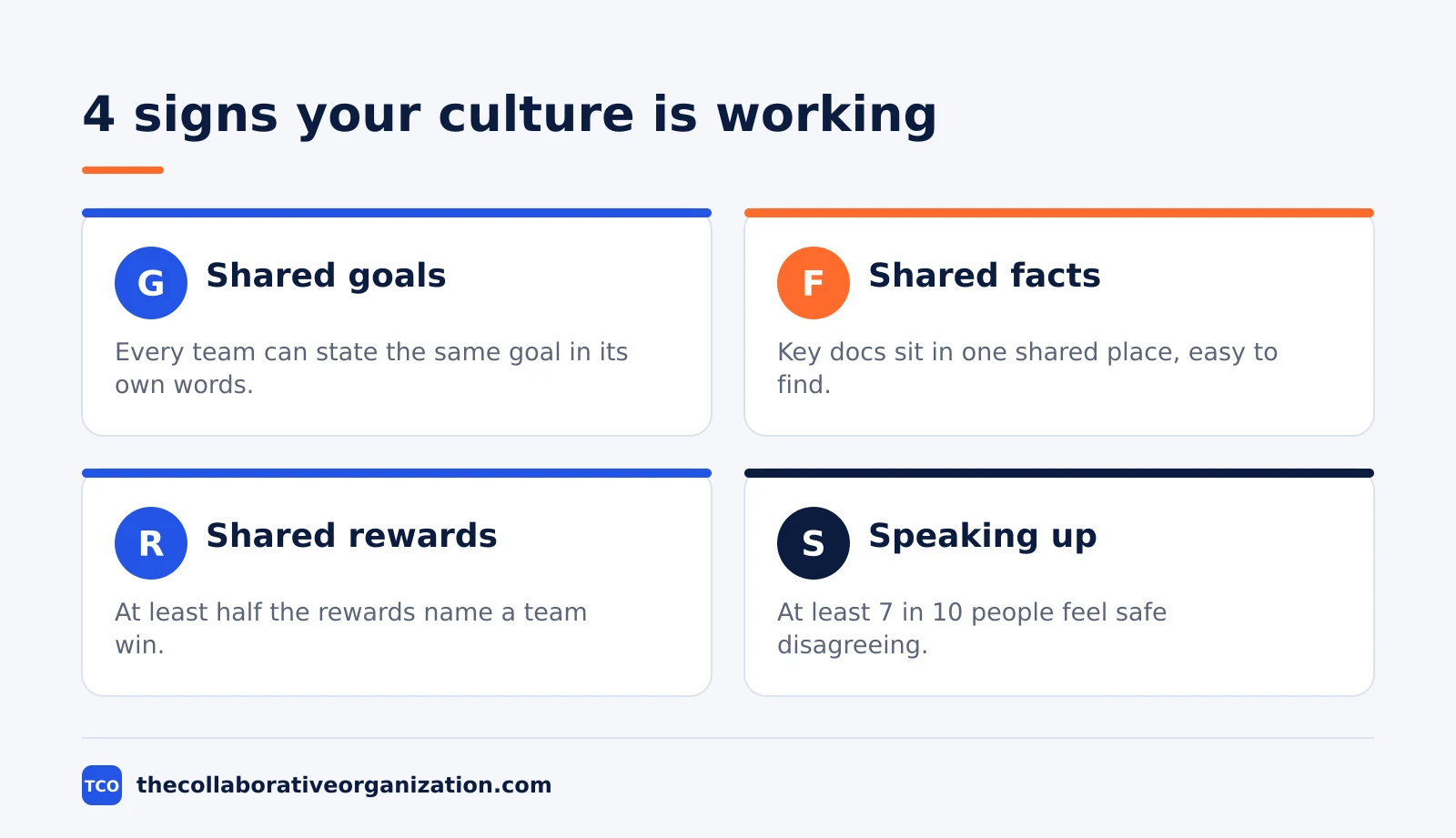
Measure four things each quarter: shared goals, shared facts, shared rewards and speaking up. Numbers beat gut feel, because culture is easy to claim and hard to prove.
| Measure | How to count it | A good sign after 90 days |
|---|---|---|
| Shared goals | Ask five people to state the goal in their own words | At least 4 of 5 give the same goal |
| Shared facts | Count how many key docs sit in one shared place | The roadmap, plans and numbers are all findable |
| Shared rewards | Count how many rewards went to team wins | At least half the rewards name a team |
| Speaking up | Ask if people feel safe disagreeing in meetings | At least 7 in 10 say yes |
Review the numbers with the team, not just with managers. A short review at the end of a sprint works well, and our guide on how to run a sprint planning meeting shows how to build that review into the team’s rhythm.
If a number does not move, change the setup. A low “speaking up” score usually means the reward system still favours solo wins, not that the team lacks courage.
Tools that support a collaborative culture
Tools carry the culture once the goals and rewards are shared, by holding the facts where everyone can see them. Pick the ones the team will open every day.
| Tool | Best for | Free plan | Starting price (as of November 2026) | Notable limit |
|---|---|---|---|---|
| Asana | Teams that want every task to have a named owner | Free for 2 people | $10.99 per user per month, billed annually | Free plan covers 2 people |
| monday.com | Teams that want a shared board of goals and owners | Free plan for up to 2 seats | $9 per seat per month (Basic), billed annually | Paid plans need at least 3 seats |
| ClickUp | Teams that want docs, chat and tasks in one place | Free Forever plan | $9 per user per month (Core), billed annually | Yearly billing needed for that price |
The Asana price comes from Asana pricing: the Personal plan is free for 2 users, and Starter is $10.99 per user per month when billed annually. On the monday.com pricing page, Basic is $9 per seat per month billed annually, with a 3-seat minimum. The ClickUp pricing page lists Core at $9 per user per month billed yearly.
Getting people to use a new tool is its own job. Our guide on how to get team buy-in for new software covers how to win over the teams that will use it daily.
Compare the main options on our project management software shortlist before you commit. Eden Workplace adds one more point: start by asking employees what they need, then shape the change around their answers.
Common collaborative culture mistakes to avoid
Five mistakes turn a culture plan into a poster campaign. Each one is easy to spot once you know it.
- Announcing values without changing rewards. If solo wins still get the bonus, people work solo, whatever the values say.
- Buying tools first. A new chat app with the old goals just moves the silo into a new system.
- Running a launch event and stopping. Culture is built by what repeats weekly, not by one good day.
- Asking for feedback and ignoring it. One ignored survey teaches the team that speaking up changes nothing.
- Forgetting remote staff. If decisions happen in the hallway, remote people learn last. Write decisions down the same day.
Sources
- Atlassian - How to Create a Collaborative Culture and Foster Teamwork (2026)
- Indeed - 9 Steps To Create a Collaborative Culture at Work (2025)
- Nulab - Don’t just collaborate: build a collaborative culture (2026)
- Mural - Culture Of Collaboration (2025)
- Talkspirit - How to Build a Collaborative Culture at Work (2026)
- Eden Workplace - How To Create a Collaborative Workplace (2026)
- The Enterprise World - Building a Collaborative Culture in the Workplace (2026)
- Asana - Pricing (2026)
- monday.com - Pricing (2026)
- ClickUp - Pricing (2026)
Frequently asked questions
How long does it take to create a collaborative culture?
Structural changes like shared docs and visible goals can shift in weeks, but trust and feedback habits take longer. Atlassian says most teams see meaningful improvement within one to two quarters when leaders model the change consistently, so plan for at least 90 days.
Can one manager create a collaborative culture alone?
One manager can change their own team, but a whole company needs leaders at several levels pulling the same way. Start with your team, show the results, and use them to win over the next level. A single team that works well together is the best proof.
Do you need new tools to build a collaborative culture?
No. Tools help only after the goals, owners and rewards are shared. Start with one shared goal and one shared place for facts, using the tools you already have. Add new tools when the team outgrows the old ones, not before.
How do you get remote workers into a collaborative culture?
Write decisions down, keep facts in one shared place, and give remote staff the same say as office staff. Remote workers miss hallway talks, so the written record is their hallway. Make sure meeting times rotate fairly across time zones.
What is the biggest mistake when building a collaborative culture?
Rewarding solo wins while asking for teamwork. If promotions and bonuses go to lone heroes, people will work alone, whatever the values poster says. Change what gets measured and rewarded first, and the behaviour follows.
Related articles

project management
How to Choose Project Management Software (2026)
Pick project management software in seven steps: define the work, count seats, price the real cost, and run a two-week pilot before you pay.
November 19, 2026 · 10 min read

project management
What Is a RACI Matrix? Definition, Roles and Examples (2026)
A RACI matrix maps who is Responsible, Accountable, Consulted and Informed for each task. Learn the four roles, how to build one, and see a worked example.
November 19, 2026 · 9 min read
project management
Daily Standup Meeting Format That Works (2026)
A daily standup is a 15-minute meeting where Developers inspect progress toward the Sprint Goal and plan the next day. Use this format to run one that ends on time.
November 19, 2026 · 10 min read