Collaborative Leadership Explained: Traits and Examples (2026) | The Collaborative Organization
By The Collaborative Organization Team · November 19, 2026 · Last verified November 19, 2026 · 10 min read
Collaborative leadership is a way of leading where the leader involves the team in shaping decisions, solving problems and setting direction, instead of handing orders down from the top. The leader acts as a facilitator: they run the process, ask the questions and make sure every voice is heard. The team owns the result together.
Key takeaways
- Collaborative leadership shares the power to decide, not just the facts about a decision that is already made.
- Its six core traits are trust, clear communication, delegation, facilitation, comfort with disagreement and openness to feedback.
- It is the opposite of command and control, where orders flow one way from the top down.
- Atlassian reports that companies with collaborative cultures are five times as likely to be high performing.
- It works best for complex choices with no single right answer, and worst in a true emergency.
What collaborative leadership is
Collaborative leadership is a management approach where the leader actively involves team members in shaping decisions, solving problems and setting direction. Indeed defines it as an inclusive style that gathers input from many sources before acting, with the leader in the role of facilitator rather than isolated director.
Three behaviours mark the real thing. First, the leader structures input before deciding, so quieter people and dissenting views surface. Second, the leader shares authority, not just information, so the team shapes the direction.
Third, the team shares ownership of the outcome, including when things go wrong. These three marks come from Risely, which lists them as the test of genuine collaborative leadership.
The style rests on shared control. Pumble lists free information flow, shared decision-making, mutual support, shared accountability and a “we” mindset over a “me” mindset as its core features.
How collaborative leadership differs from command and control
Command and control sends orders down; collaborative leadership sends thinking around the whole team. The two styles differ in where facts live, who decides and who owns the result.
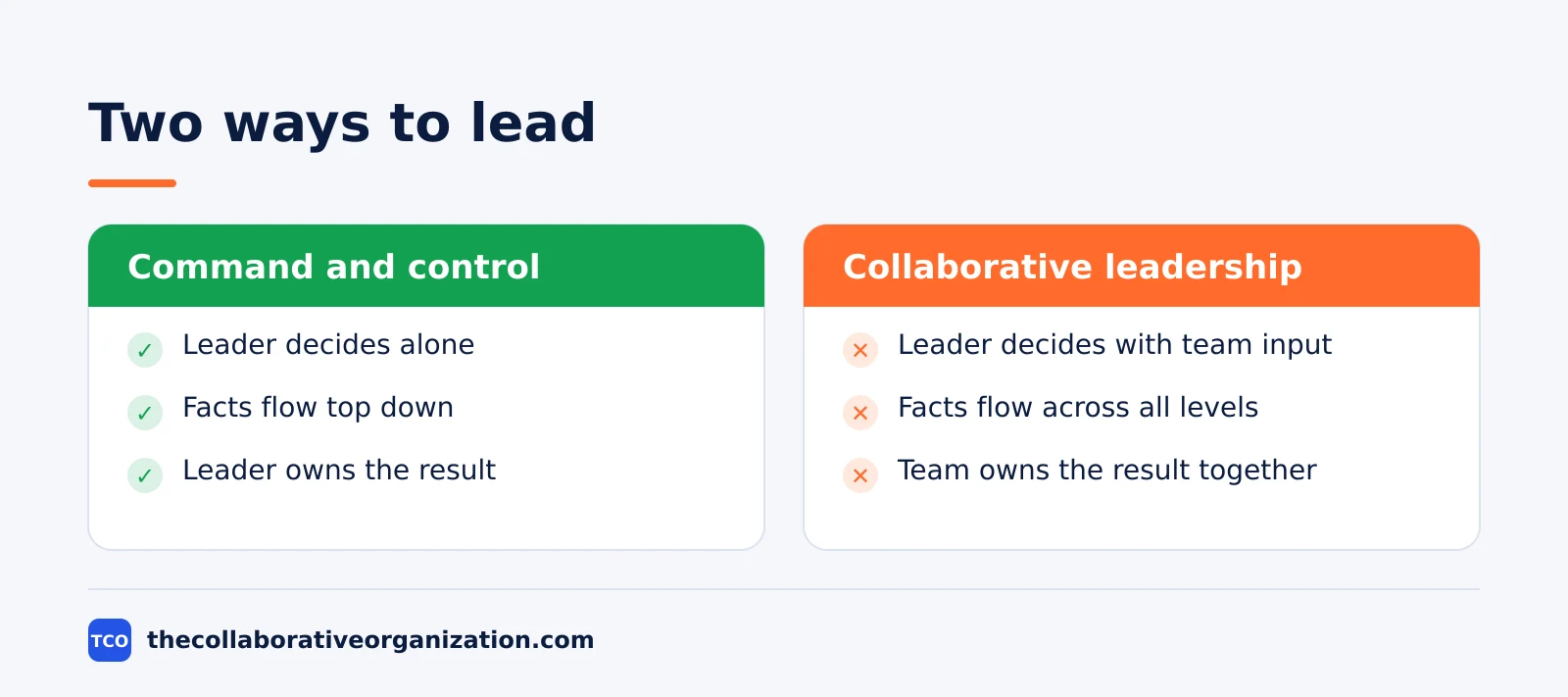
| Point | Command and control | Collaborative leadership |
|---|---|---|
| Who decides | The leader alone | The leader with team input |
| Information flow | Top down, on a need-to-know basis | Open across all levels |
| Role of the leader | Director who gives orders | Facilitator who runs the process |
| Accountability | The leader owns the result | The team owns the result together |
| Speed | Fast for simple orders | Slower to decide, faster to carry out |
Pumble calls collaborative leadership the opposite of the traditional command-and-control approach, which runs orders down a chain from senior management to the lowest level. In the collaborative style, everyone works across the usual lines, sharing control and duty instead of leaving both at the top.
Speed is the real trade-off. A top-down order is fast to give and slow to carry out, because people who had no say often drag their feet. A shared decision takes longer to reach, then moves fast because the team already agreed.
The six traits of a collaborative leader
Six traits show up again and again in leaders who run this style well, and each one can be practised. None of them needs a title or a big budget.
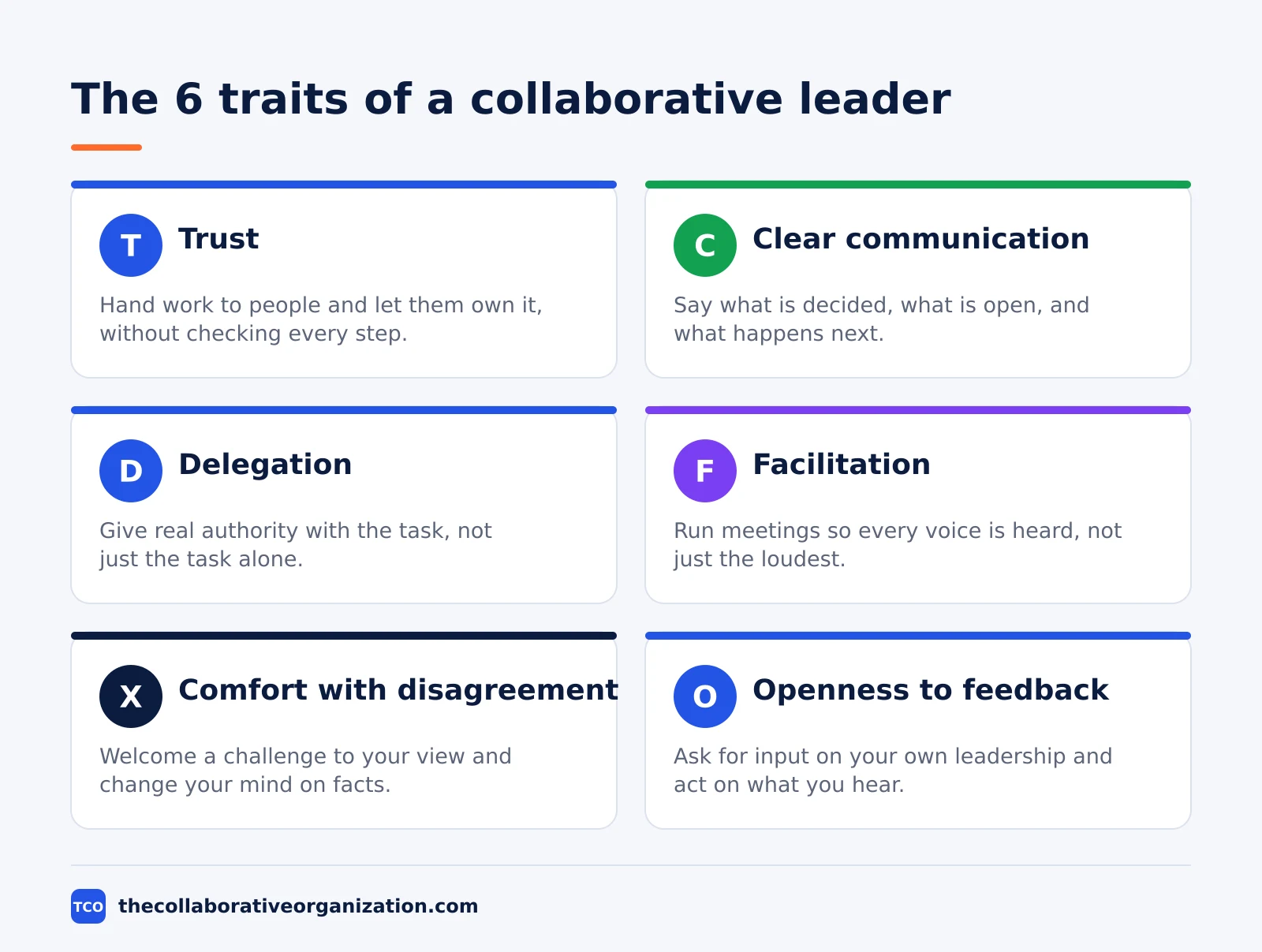
| Trait | What it looks like in practice |
|---|---|
| Trust | You hand work to people and let them own it, without checking every step |
| Clear communication | You say what is decided, what is open, and what happens next |
| Delegation | You give real authority with the task, not just the task alone |
| Facilitation | You run meetings so every voice is heard, not just the loudest |
| Comfort with disagreement | You welcome a challenge to your own view and change your mind on facts |
| Openness to feedback | You ask for input on your own leadership and act on what you hear |
Trust comes first because the rest depends on it. ClickUp lists trust and delegation together: collaborative leaders trust their team members and hand them tasks, giving them ownership of the work instead of watching over each step.
Facilitation is the skill most leaders skip. It means asking questions before giving your own view, calling on people who have not spoken, and keeping the talk on the question at hand. Without it, “collaboration” becomes a meeting where two loud voices decide.
How collaborative decisions work
A collaborative decision follows four steps: frame the question, gather input, decide, then own the result together. Skipping any step breaks the chain.
First, frame the question in one sentence and name what is already fixed. A team that thinks everything is open will feel misled when it learns some choices were made already. Say what is open and what is not.
Second, gather input in a structured way. Ask for views in writing before the meeting, so the first speaker does not set the tone for everyone else. Give each option a short defence from a different person, as a structured session does.
Third, decide and say who decided. The leader may make the final call after hearing the team, or the team may vote. Either way, the choice and the reasons go in writing the same day.
Fourth, assign owners. Every action from the decision gets one name and one date. Our guide to what a RACI matrix is shows how to map who does the work and who signs it off, so shared decisions do not end with nobody owning the next step.
This is also where clear roles help. Our guide to scrum roles and responsibilities explains how a product owner, a scrum master and the team split decision rights in agile teams.
When collaborative leadership works best, and when it does not
Collaborative leadership works best for complex choices with no single right answer, and worst when speed matters more than input. Knowing the line is part of the skill.
Use it when the problem crosses teams, when the team holds facts the leader lacks, or when the plan will fail without the team’s buy-in. A pricing change, a rebrand or a new way of working all fit, because the people who carry out the plan know things the leader does not.
Skip it in a true emergency, such as a live outage or a safety issue. When seconds matter, one person decides, explains why, and brings the team back into the next choice. It also fits badly when the facts are missing: asking a team to decide without the numbers is not collaboration, it is guessing together.
Atlassian makes the business case for the style: companies with collaborative cultures are five times as likely to be high performing, and leadership behaviour is the single biggest lever in building that culture. The figures are in Atlassian’s guide to collaborative culture, updated in November 2026.
Worked example: a product decision made together
A six-person product team had to choose between two features for the next release, and the lead ran the choice as a shared decision. This is an illustration of the process, not a real case.
The lead framed the question in one sentence: which feature helps more paying customers in the next quarter? The facts were fixed: the team had three weeks, and only one feature would ship. Each option got a 15-minute defence from a different engineer, with the numbers on the table.
The team debated the trade-offs for 30 minutes, then the lead made the call: ship the reporting feature, because 40% of support tickets asked for it, against 12% for the other option. The engineer who had argued for the other feature owned the launch plan anyway, because the process had been fair.
The feature shipped on time, and support tickets about reporting fell by a third in the next month.
How to practise collaborative leadership
Start small: share one decision a week, and build the habit from there. Five moves cover the basics.
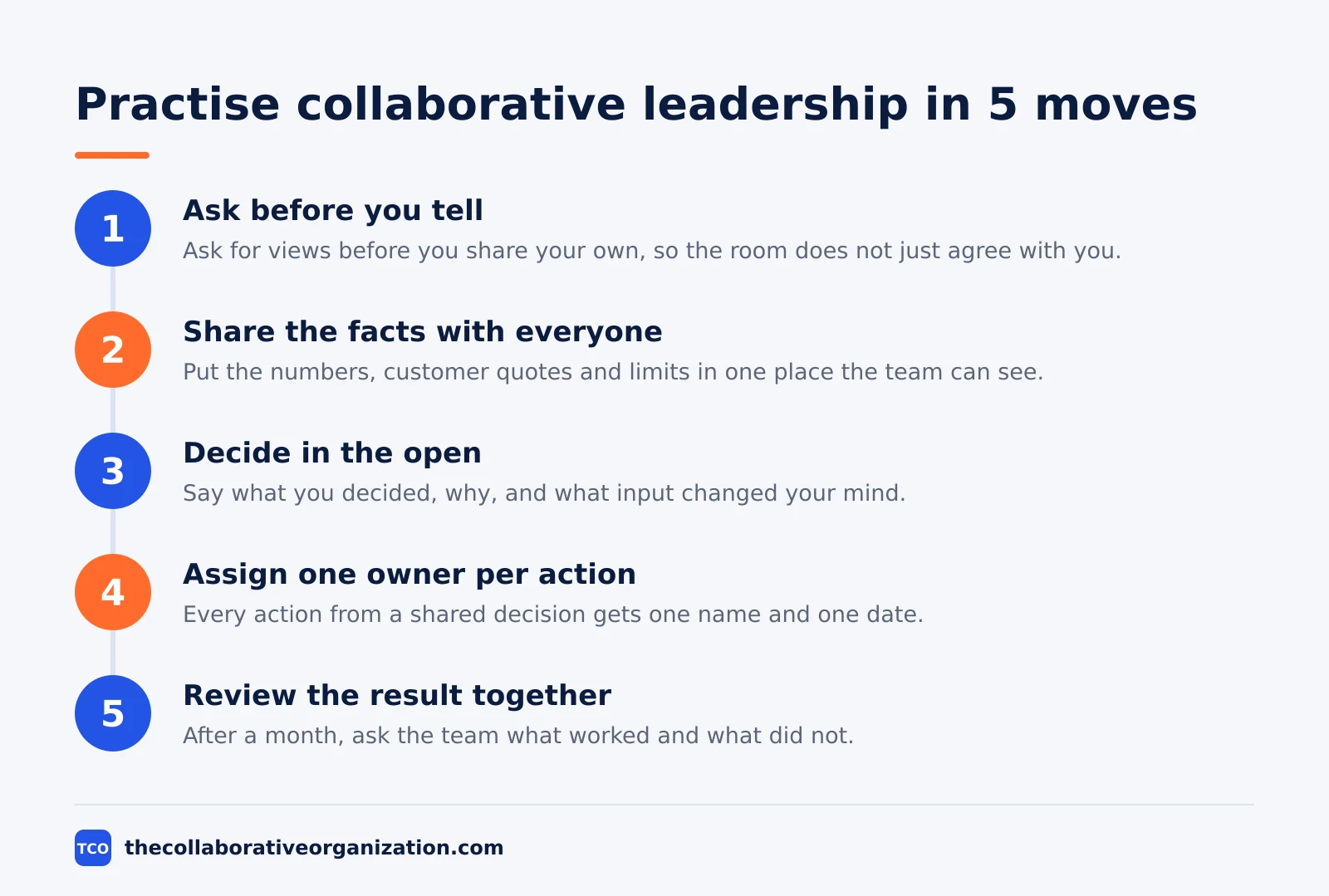
Step 1: Ask before you tell
In your next meeting, ask for views before you share your own. People anchor on the first view they hear, and if that view is yours, the rest of the room just agrees.
Step 2: Share the facts with everyone
Put the numbers, the customer quotes and the limits in one place the team can see. Free information flow across all levels is one of the core features Pumble lists for this style.
Step 3: Decide in the open
Say what you decided, why, and what input changed your mind. When people see their input in the result, they bring better input next time.
Step 4: Assign one owner per action
Every action from a shared decision gets one name and one date. Shared ownership of the outcome still needs single owners for each task.
Step 5: Review the result together
After a month, ask the team what worked and what did not. A short review at the end of a sprint works well, and our guide on how to run a sprint planning meeting shows how to build that review into the team’s rhythm.
Tools that support collaborative leadership
Tools cannot create a collaborative leader, but they can make shared work visible so the team can act on it. The leader’s job is the process; the tool’s job is the shared record.
| Tool | Best for | Free plan | Starting price (as of November 2026) | Notable limit |
|---|---|---|---|---|
| Asana | Teams that want every task to have a named owner | Free for 2 people | $10.99 per user per month, billed annually | Free plan covers 2 people |
| monday.com | Leaders who want a shared board of who owns what | Free plan for up to 2 seats | $9 per seat per month (Basic), billed annually | Paid plans need at least 3 seats |
| ClickUp | Teams that want docs, chat and tasks in one place | Free Forever plan | $9 per user per month (Core), billed annually | Yearly billing needed for that price |
The Asana price comes from Asana pricing: the Personal plan is free for 2 users, and Starter is $10.99 per user per month when billed annually. On the monday.com pricing page, Basic is $9 per seat per month billed annually, with a 3-seat minimum. The ClickUp pricing page lists Core at $9 per user per month billed yearly.
A shared board helps most when the team already trusts the process. Compare the options on our project management software shortlist and pick the one the team will open every day.
A short daily check-in also keeps shared decisions moving. Our guide on the daily standup meeting format shows a 15-minute shape that works.
Common collaborative leadership mistakes to avoid
Five mistakes turn shared leadership into slow, confused leadership. Each one is easy to spot once you know it.
- Asking for input after you decided. People learn fast when their input changes nothing, and they stop giving it.
- Confusing collaboration with consensus. Not every choice needs a unanimous vote. The leader can hear the team and still decide.
- Sharing facts but not authority. Telling the team everything while keeping every choice is not collaboration, it is a briefing.
- Letting the loudest voice win. Without a facilitator, two confident people decide and the rest of the team checks out.
- No owner for the outcome. Shared ownership still needs one name per action, or the decision fades after the meeting.
Sources
- Indeed - Collaborative Leadership: 9 Ways To Be a Collaborative Leader (2025)
- Pumble - Collaborative Leadership: Creating Team-Centric Mindset (2026)
- ClickUp - How to Practice Collaborative Leadership (2026)
- Risely - Collaborative Leadership: When It Works and Fails (2026)
- Atlassian - How to Create a Collaborative Culture and Foster Teamwork (2026)
- Asana - Pricing (2026)
- monday.com - Pricing (2026)
- ClickUp - Pricing (2026)
Frequently asked questions
What is collaborative leadership in simple terms?
It is a way of leading where the leader asks the team for input, shares the power to decide, and lets the group own the result together. The leader still leads, but by running a good process instead of giving orders. The team shapes the direction, so it commits to the outcome.
Is collaborative leadership the same as having no leader?
No. A collaborative leader still sets the goal, runs the process and makes the final call when the group cannot agree. The difference is that the input and the thinking are shared. Without a leader to run the process, shared decisions drift and nobody owns the result.
When does collaborative leadership not work?
It fits badly in a true emergency, when seconds matter and one person must decide at once. It also fits badly when the team lacks the facts to judge the choice. In those cases, decide fast, explain why, and bring the team back into the next decision.
Can a new manager use collaborative leadership?
Yes, and it often helps. A new manager who asks good questions learns the team fast and earns trust early. The key is to be clear about what is open for input and what is already fixed, so the team does not feel misled when some choices are already made.
How do you measure collaborative leadership?
Watch three things over a quarter: how many decisions include input from more than one person, how often the team meets the dates it set together, and whether people speak up in meetings. If input rises and dates hold, the style is working.
Related articles

project management
How to Choose Project Management Software (2026)
Pick project management software in seven steps: define the work, count seats, price the real cost, and run a two-week pilot before you pay.
November 19, 2026 · 10 min read
project management
What Is a RACI Matrix? Definition, Roles and Examples (2026)
A RACI matrix maps who is Responsible, Accountable, Consulted and Informed for each task. Learn the four roles, how to build one, and see a worked example.
November 19, 2026 · 9 min read

project management
Daily Standup Meeting Format That Works (2026)
A daily standup is a 15-minute meeting where Developers inspect progress toward the Sprint Goal and plan the next day. Use this format to run one that ends on time.
November 19, 2026 · 10 min read