Process vs Procedure: What Is the Difference? (2026) | The Collaborative Organization
By The Collaborative Organization Team · November 19, 2026 · Last verified November 19, 2026 · 10 min read
A process is a set of linked activities that turns inputs into outputs, while a procedure is the specified way to carry out that process. The process is the what and the result; the procedure is the how, in order, by named people. Confusing the two is the most common reason process documents fail an audit.
Key takeaways
- A process turns inputs into outputs through linked activities across roles.
- A procedure is the specified way to carry out a process, in a set order.
- Not every process needs a procedure; the test is whether the steps must be fixed.
- The hierarchy runs process, then procedure, then work instruction, with detail rising at each step.
- ISO 9001:2015 has no mandated documented procedure, unlike the 2008 version with six.
- Map the process first, then write the procedure that turns the map into steps.
What is a process?
A process is a set of linked activities that takes an input, does work with it, and creates an output. It has a purpose, an owner, measurable outcomes, and links to other processes. Almost anything a company does can be described as a process: hiring, buying supplies, handling a complaint, or closing a sale.
The ISO definition is short and worth keeping. Advisera cites ISO 9000, which defines a process as a set of interrelated or interacting activities that transforms inputs into outputs. The key is the transformation: an input goes in, work happens, and a different output comes out.
A process does not enter into the detail of each activity. It shows the stages, the owners, and the handoffs, and it leaves the fine steps to the layer below.
A hiring process, for example, runs from a request to hire through quotes and checks to a purchase order for the chosen contractor. The map shows the flow; it does not tell the recruiter which button to click.
What is a procedure?
A procedure is the specified way to carry out an activity or a process, in a set order. When a process must happen one way, and the team has written down how it happens, that written way is the procedure. It tells the team who does what, in what order, using which inputs, and producing which outputs.
The same ISO source defines a procedure as a specified way to carry out an activity or a process. The word specified does the work: a procedure fixes the method.
A contract review process, for example, gains a procedure when the team agrees on one way customers give a purchase order, one set of steps to review and approve it, and one way to record and share the order.
A procedure also answers why the work runs that way. It states the reason for the order, the checks that catch errors, and the point where a problem goes up to a manager. That is why a procedure reads as a method, not as a map. The map shows the stages; the procedure walks the team through them.
Process vs procedure: side-by-side table
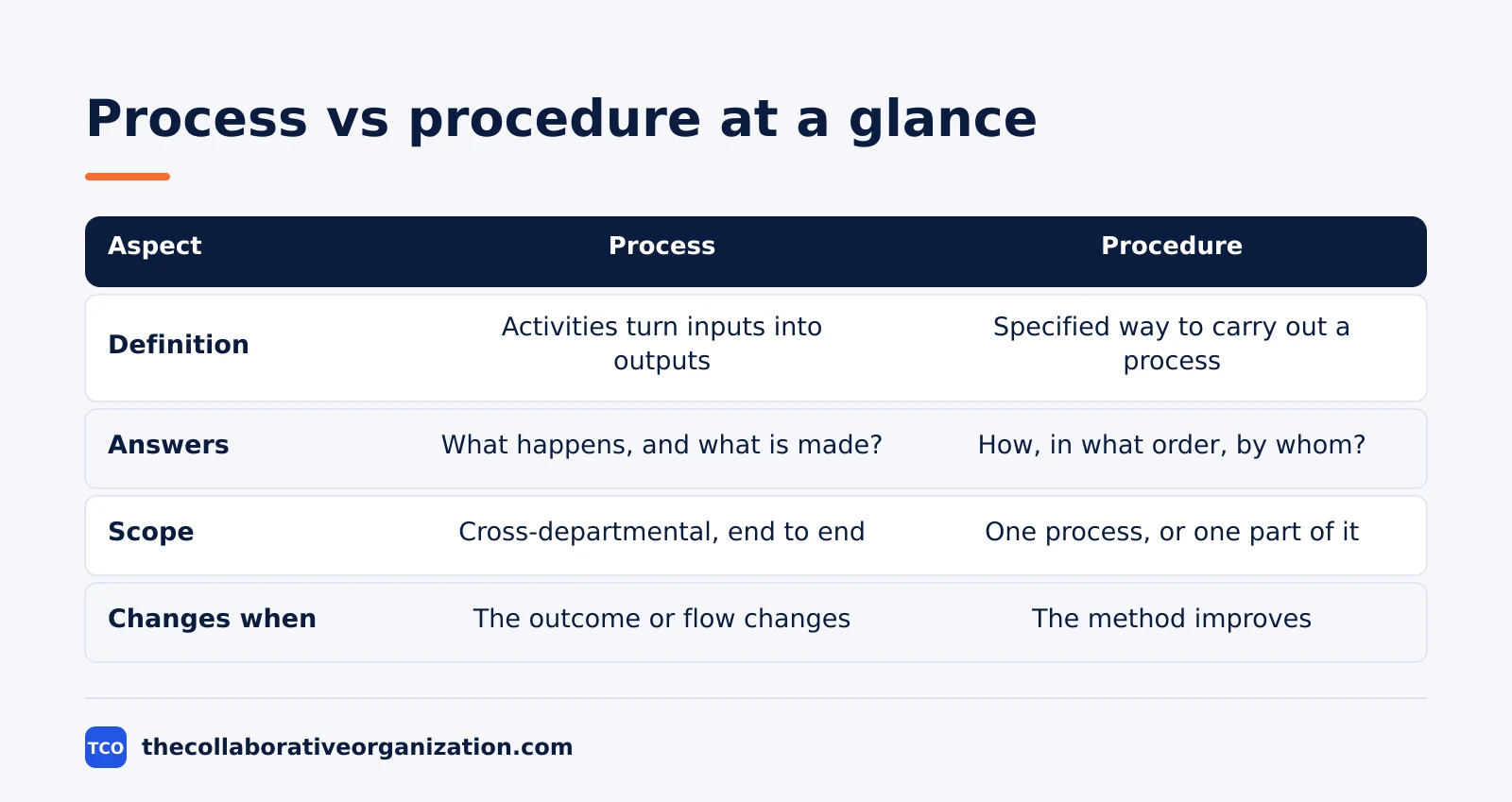
The table below shows the split in one line: a process is outcome-based, and a procedure is method-based. Every other row follows from that split.
| Aspect | Process | Procedure |
|---|---|---|
| Definition | Linked activities that turn inputs into outputs | The specified way to carry out a process |
| Answers | What happens, and what does it produce? | How does it happen, in what order, by whom? |
| Scope | Cross-departmental, end to end | One process, or one part of it |
| Level of detail | Stages, owners, and handoffs | Ordered steps without full task detail |
| Changes when | The outcome or the flow changes | The method improves |
| ISO 9001 role | Defines how work and results link up | Specifies the method for consistent results |
| Example | Hiring a contractor, from request to order | The agreed steps to review and approve the order |
Workflawless sets out the same split: a process is the highest level, with a purpose, an owner, and measurable outcomes, while a procedure describes how one process is performed step by step. Standard operating procedures sit at the procedure level, detailed enough to cut doubt but broad enough to stay stable as people come and go.
The hierarchy: process, procedure, work instruction
The three layers form a stack, with detail rising as you go down and scope narrowing at each step. A process maps the flow, a procedure fixes the method, and a work instruction gives the exact steps for one task.
At the top, the process shows the stages from input to output and names the owner of each stage. In the middle, the procedure turns one process into ordered steps, with the roles, the inputs, and the checks.
At the bottom, the work instruction breaks one task into steps with the precision to do it right: tool settings, acceptance tests, and photos of a correct result. Orienteed states the order plainly: a process is the highest level, followed by procedures, and finally work instructions.
The stack also tells you where to fix a problem. If the outcome is wrong, look at the process: the stages, the owners, or the handoffs. If the outcome is right but the method varies, look at the procedure.
If one task varies between people, look at the instruction. Fixing the wrong layer wastes a week and leaves the real fault in place.
One layer can exist without the next. A team can run a process with no procedure, and a procedure can exist with no work instructions below it. The stack is a guide to detail, not a rule that every level must be filled.
When a process needs no procedure
Not every process needs a procedure, and the test is whether the work must follow one set of steps. If skilled people can reach the same result by different routes, a procedure would only slow them down.
Advisera gives two clear cases. A trained machinist given a drawing decides how to make the part from skill and judgement, because there is no one right way to cut it.
A software team writes code in different styles, because the result matters more than the route. In both cases the team has a process but no procedure, and that is fine.
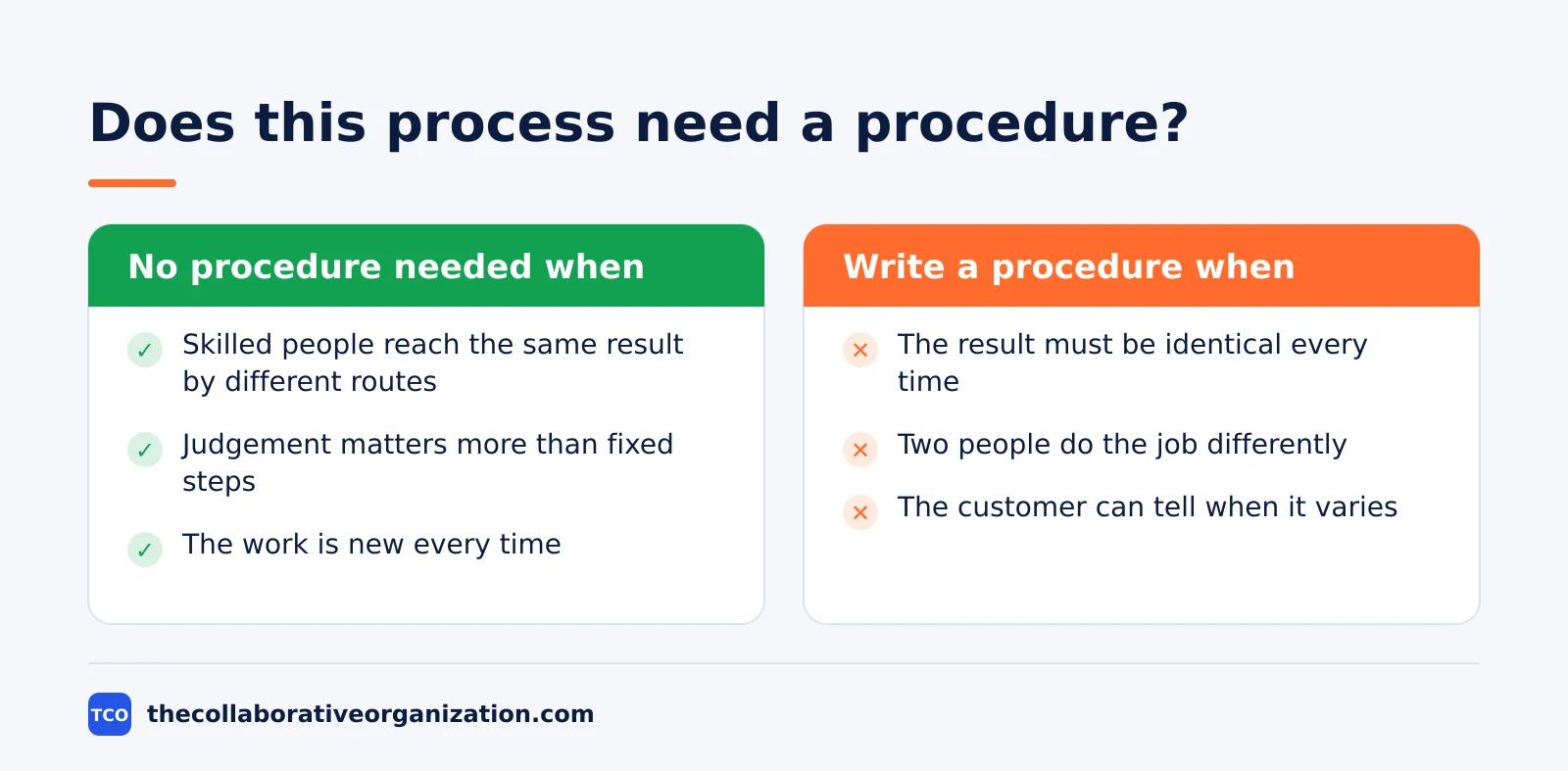
The same logic applies to expert work in any team. A doctor relies on experience to deal with what is found during surgery, and no written procedure covers every case. A senior designer solves a new brief from judgement, not from a fixed sequence. Writing a procedure for such work would freeze the very skill the team pays for.
The risk runs the other way too. When a process must produce the same result every time, skipping the procedure invites drift. If two people do the same job differently and the customer can tell, the process needs a procedure. The question is never whether procedures are good; it is whether this process needs one.
What ISO 9001:2015 actually requires
ISO 9001:2015 requires a process approach and the documented information a quality system needs, but it lists no mandated documented procedure. That change from the 2008 version still catches teams out.
The 2008 version listed six documented procedures that a quality system needed. The 2015 version removed that fixed list, and it is now the company’s job to decide whether to document a procedure to get consistent results.
The standard also keeps the process approach as a core principle: teams must understand their processes, how they link, and which ones need a fixed method.
Conformance1 makes the same point: a procedure is a specified way to carry out an activity or a process, and a process is a set of activities that transforms inputs into outputs, with every process built to meet an objective. Understanding the link between the two is the heart of running a quality system, not a paperwork exercise.
The audit test follows from that. An auditor checks whether the process is defined, whether its results are consistent, and whether the documents staff use are current. A team with a clear process and a short procedure passes. A team with a thick manual no one reads does not.
Worked example: handling a customer complaint
Imagine a software team that handles customer complaints, and each complaint takes a different path. The support lead maps the process first: a complaint arrives, a support agent logs it, a product owner triages it, an engineer fixes it, and the agent closes it with the customer. Each stage names one owner, and the output is a closed complaint with a record of the fix.
Then the team writes a procedure for the one path that must never vary: a complaint about lost data. It lists the steps in order: log the complaint within one hour, freeze the account change, tell the customer what happens next, and hand the case to the on-call engineer.
The case closes only after the customer confirms the data is back. The procedure names the roles, the time limits, and the record that proves each step happened.
The split shows its value in the first month. Other complaints still flex, because the process map lets skilled staff choose the best route. Lost-data complaints never vary, because the procedure fixes the steps. The team also gains a clear owner for each stage, which is the same habit a RACI matrix teaches: one name owns each outcome.
Tools that hold processes and procedures
Asana, monday.com, and Notion all hold a process map and its procedures, but the tool tracks the work while the documents say how it is done. Pick the tool the team will open every day.
Asana suits teams that want every stage to have a named owner and a due date, with templates for repeatable flows. Monday.com suits teams that want a visual board where each stage has a status the whole team can see.
Notion suits teams that want the process map, the procedure, and the work instructions in one workspace, linked page to page.
| Tool | Best for | Free plan | Starting price (as of November 2026) | Notable limit |
|---|---|---|---|---|
| Asana | Teams that want every stage to have a named owner | Free for 2 people | $10.99 per user per month (Starter), billed annually | Free plan covers 2 people |
| monday.com | Teams that want a visual board with stages and status | Free plan for up to 2 seats | $9 per seat per month (Basic), billed annually | Paid plans need at least 3 seats |
| Notion | Teams that want the map, the procedure, and the detail in one place | Free plan for solo use | $10 per member per month (Plus), billed annually | Free plan limits blocks when 2 or more members join |
The Asana price comes from Asana pricing: Starter is $10.99 per user per month when billed annually. On the monday.com pricing page, Basic is $9 per seat per month billed annually, with a 3-seat minimum.
The Notion pricing page lists Plus at $10 per member per month billed annually, as confirmed by November 2026 checks. See the full shortlist on our project management software shortlist before you buy.
Read our guide on how to choose project management software for seat counts and free-plan caps.
Common process vs procedure mistakes to avoid
Most process documents fail in the same five ways, and all five come from mixing the layers. Check the list before you write the next page.
- Writing a procedure when the process needs a map. The team gets ordered steps for a flow no one has agreed, and the steps solve the wrong problem.
- Writing a process that reads like a procedure. The map drowns in detail, and no one can see the stages, the owners, or the handoffs.
- Documenting a procedure for expert work. Skilled staff ignore it, and the document teaches the team that procedures are fiction.
- Skipping the procedure where the result must be identical. Two people do the same job differently, and the customer can tell.
- Never reviewing the map. Stages change, owners leave, and the process describes work no one does. Set a review date on every process, and keep the habit in the guides index alongside your other working documents.
Sources
- Advisera - ISO 9001:2015 Process vs Procedure: Some Practical Examples (2016)
- Workflawless - Process Documentation and SOPs for ISO 9001 (2026)
- Orienteed - Understanding the Difference Between Process, Procedures, and Work Instructions (2024)
- Conformance1 - Processes and Procedures (2021)
- Mitti - A Guide to ISO 9001 Work Instructions (2026)
- Asana - Pricing (2026)
- monday.com - Pricing (2026)
- Notion - Pricing (2026)
Frequently asked questions
What is the difference between a process and a procedure?
A process is a set of linked activities that turns inputs into outputs, while a procedure is the specified way to carry out that process. The process says what happens and what it produces; the procedure says how it happens, in what order, and by whom.
Can a process exist without a procedure?
Yes. Not every process needs a procedure. The test is whether the work must follow one set of steps. When skilled people can reach the same result by different routes, you have a process with no procedure, and writing one would only slow them down.
Is an SOP a process or a procedure?
An SOP is written at the procedure level. It gives the agreed way to carry out a recurring activity so any qualified person can do it the same way. The process above it maps the whole flow from input to output, and work instructions below it give the fine detail for single tasks.
Does ISO 9001 require a documented procedure for every process?
No. ISO 9001:2015 has no mandated documented procedure. The company decides whether to document a procedure to get consistent results. ISO 9001:2008 listed six documented procedures, but the 2015 version removed that fixed list.
How do you map a process before writing a procedure?
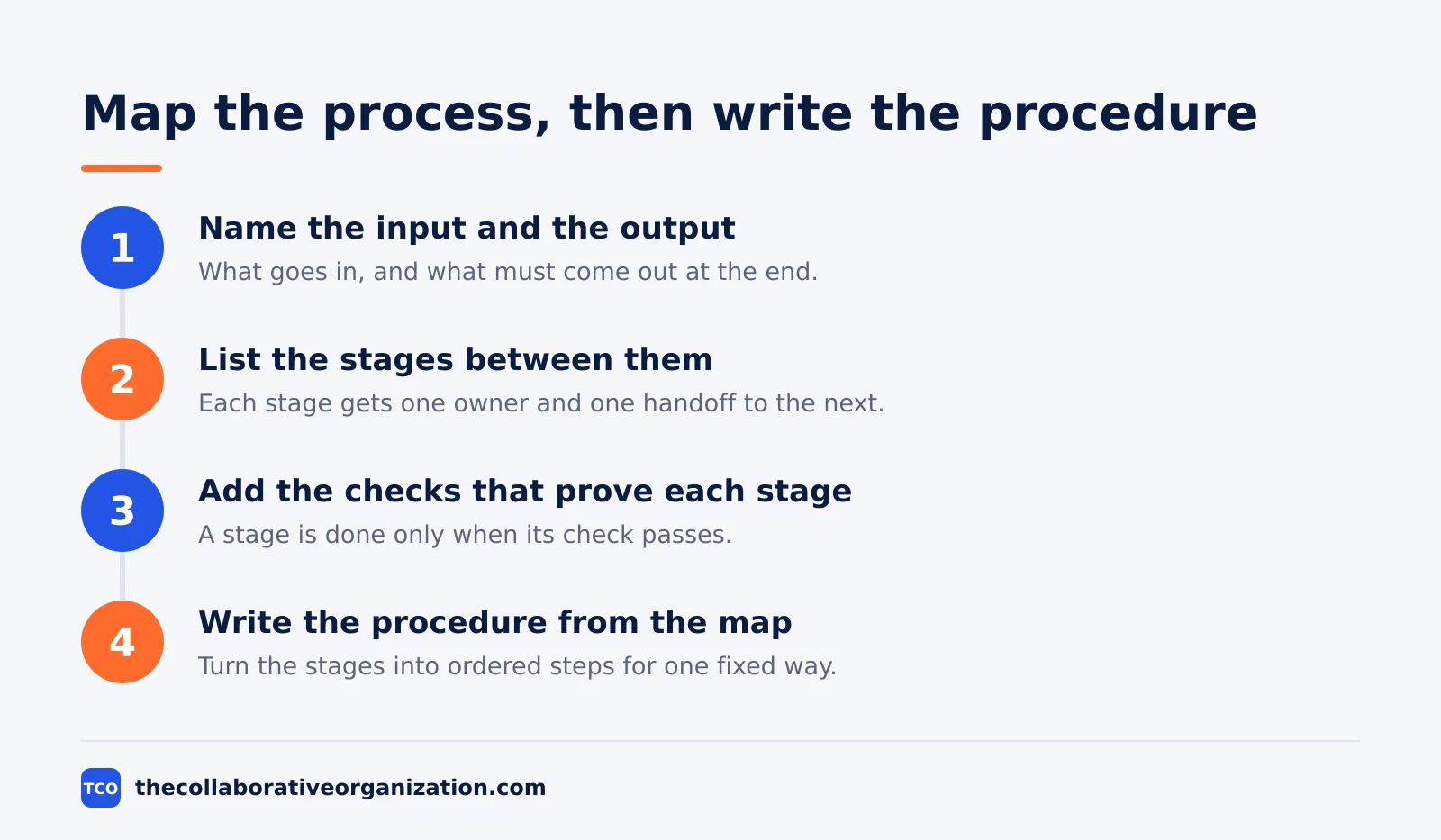
Start with the input and the output, then list the stages between them and name the owner of each stage. Add the handoffs between roles and the checks that show each stage worked. Only then write the procedure, which turns that map into ordered steps for one way of doing the work.
Related articles
guides
Free Project Management Templates: 7 to Copy (2026)
Seven free project management templates from monday, Wrike, Teamwork, Smartsheet, ClickUp, Asana and Trello, with what each one is for and what free really costs.
November 20, 2026 · 7 min read
guides
Project Proposal Template: Copy and Win Work (2026)
A project proposal template pitches the work before it is approved: problem, solution, scope, budget, timeline and terms. Copy the template and filled example.
November 20, 2026 · 10 min read
guides
Action Plan Template: Goal to Done in One Page (2026)
An action plan template turns one goal into owned steps with dates, dependencies and a success measure. Copy the table and see it filled for a support team.
November 20, 2026 · 11 min read