GDPR Compliance for SaaS Tools (2026) | The Collaborative Organization
By The Collaborative Organization Team · November 19, 2026 · Last verified November 19, 2026 · 10 min read
GDPR is the EU law that governs how personal data is collected and used, and it reaches any SaaS tool that serves people in the EU, wherever the vendor sits. If your team buys software that touches EU personal data, GDPR is part of the buying decision, not an afterthought.
Key takeaways
- GDPR is Regulation (EU) 2016/679, in force since 25 May 2018, with 99 articles in 11 chapters.
- It applies to EU organisations and to any vendor that offers services to, or monitors, people in the EU.
- Most B2B SaaS vendors are processors for customer data and controllers for their own marketing and staff data.
- Article 5 sets seven principles, and Article 6 gives six lawful bases, one of which every processing activity needs.
- Fines reach 20 million euros or 4% of worldwide annual turnover, whichever is higher, for the most serious breaches.
What GDPR is
GDPR, the General Data Protection Regulation, is the EU law that sets the rules for processing personal data, and it has applied since 25 May 2018. Its full name is Regulation (EU) 2016/679, adopted on 27 April 2016, and it replaced the older data protection directive with one law that applies directly in every EU member state.
The law covers personal data, which means any information about an identified or identifiable person: names, email addresses, IP addresses, location data and more. Processing covers almost anything done with that data, from collection and storage to sharing and deletion.
The text has 99 articles in 11 chapters, read with 173 recitals, and the EUR-Lex text is the official source to check when a claim is in doubt.
GDPR is not a SaaS checklist. It is a law about people and their data, and a SaaS tool is in scope when it processes personal data for EU users. That is why buyers ask vendors about GDPR, and why vendors publish privacy pages, data processing agreements and sub-processor lists.
Who GDPR applies to
GDPR applies to organisations established in the EU, and to organisations outside the EU that offer goods or services to people in the EU or monitor their behaviour there. That second part is what catches most SaaS vendors.
A US vendor with EU customers, EU users, or EU-targeted marketing is usually in scope for that processing, even with no office in Europe. The test is the people, not the servers: if the data belongs to people in the EU, the law follows it.
A vendor with no EU users and no EU targeting is outside scope, but that is rare for a tool sold on the open web.
Non-EU companies in scope must usually appoint a representative in the EU under Article 27, unless the processing is occasional and low risk. Enforcement sits with national supervisory authorities, with a lead authority for cross-border cases, coordinated by the European Data Protection Board.
Our guide on how to evaluate SaaS software explains how to check a vendor’s privacy claims during a shortlist.
Controller vs processor
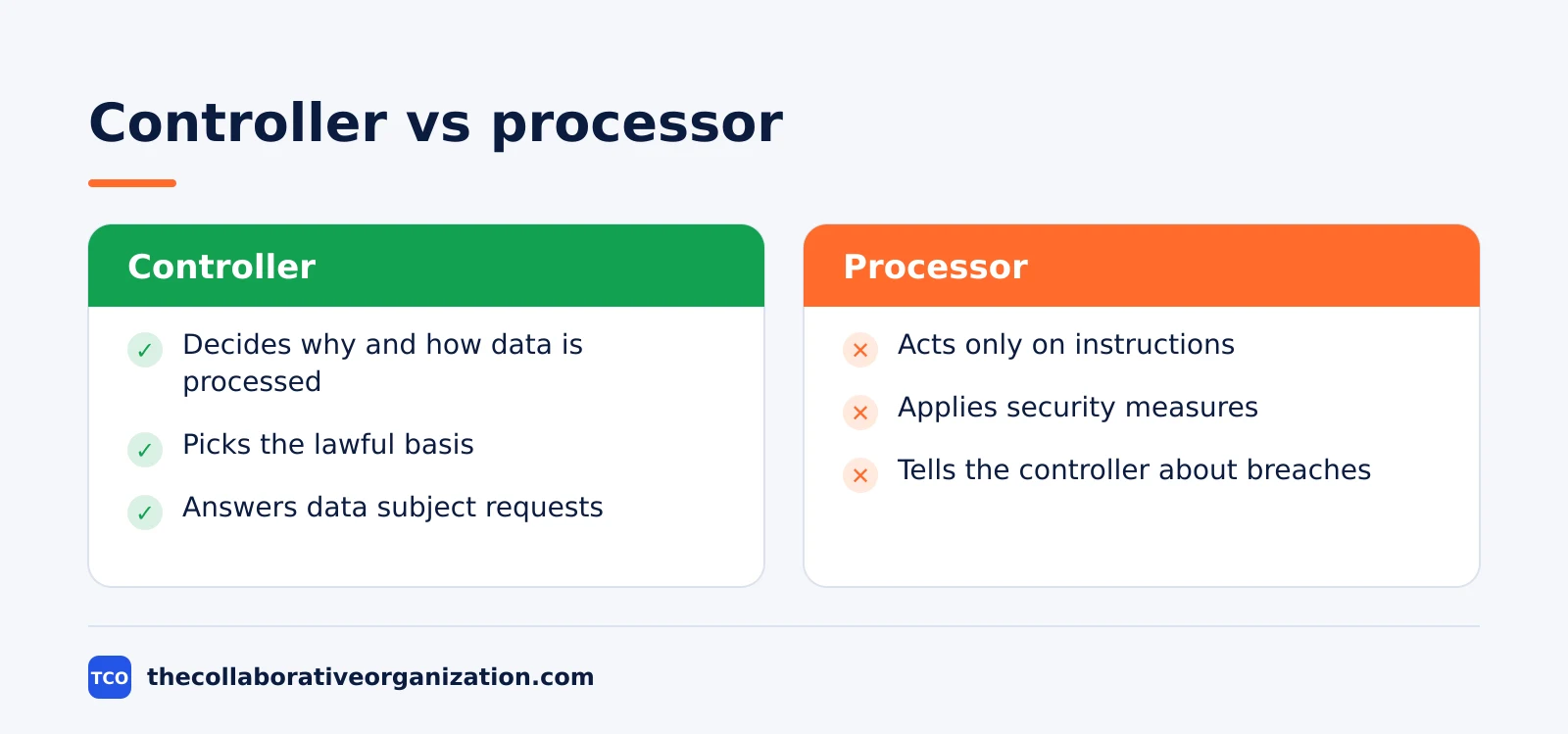
A controller decides why and how personal data is processed, while a processor handles personal data on a controller’s behalf, and the role decides which duties apply. Most B2B SaaS deals have both roles in the same room.
| Item | Controller | Processor |
|---|---|---|
| Decides | Purposes and means of processing | Nothing on its own; follows instructions |
| Typical SaaS role | Your customer, for data in the product | Your vendor, for data in the product |
| Key duties | Lawful basis, rights, records, breach notice | Security, sub-processor rules, help with rights |
| Contract | Must sign a DPA with each processor | Must sign a DPA and act only on instructions |
For the customer data inside a product, the customer is usually the controller and the vendor is the processor. The customer decides what data to collect and why, and the vendor runs the platform that stores and processes it. The same vendor is a controller for its own marketing, sales and employee data, where it sets the rules itself.
That split matters when something goes wrong. A processor must tell the controller about a breach without undue delay, and the controller must then notify its authority within 72 hours. A vendor that claims it has no GDPR duties because it is “only a processor” is wrong: processors have real duties, they are simply narrower than the controller’s.
The seven principles and six lawful bases
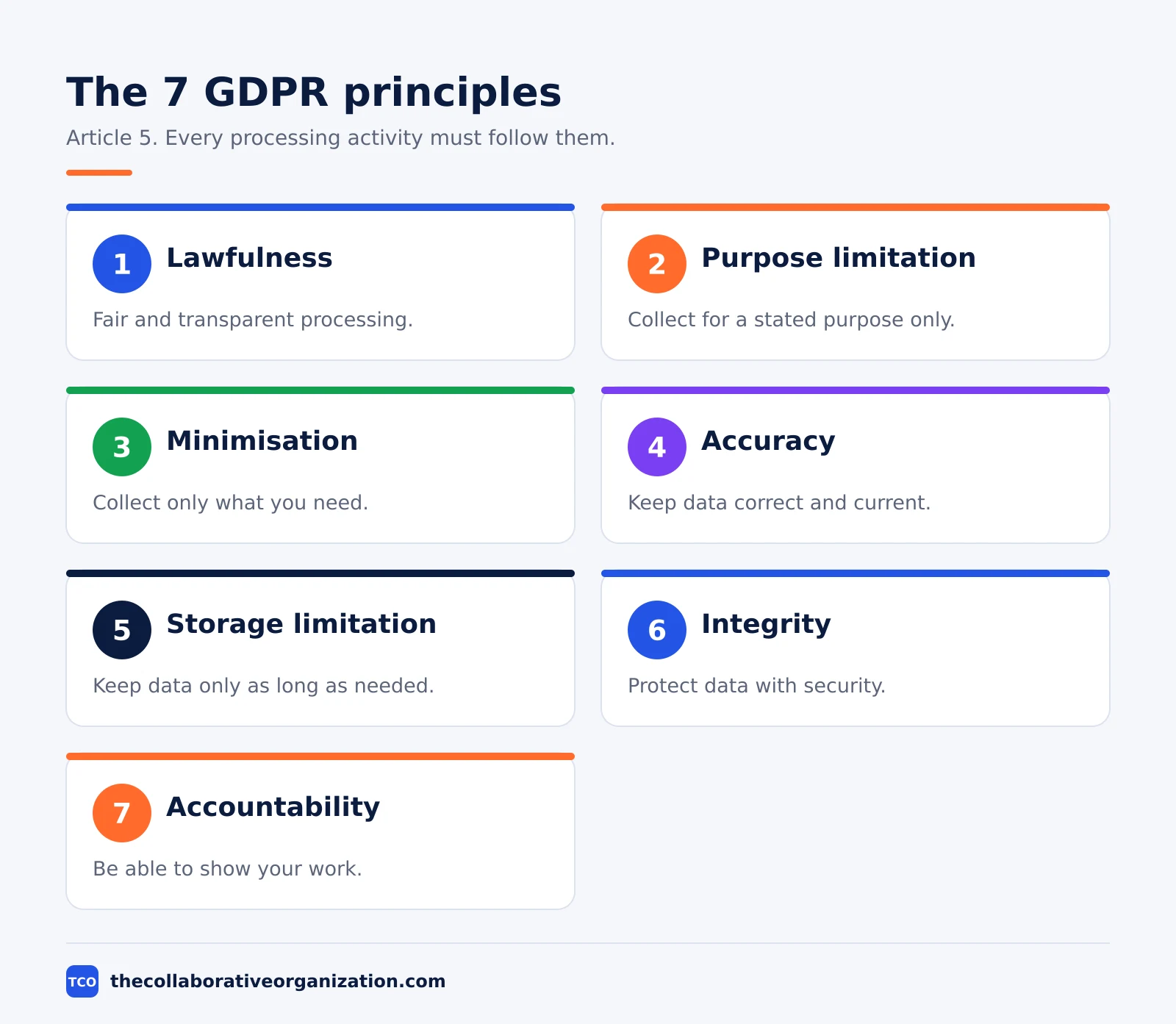
Article 5 sets seven principles every processing activity must follow, and Article 6 gives six lawful bases, one of which each activity needs. Together they are the test a buyer can apply to any vendor claim.
The seven principles are lawfulness, fairness and transparency; purpose limitation; data minimisation; accuracy; storage limitation; integrity and confidentiality; and accountability. In plain terms: collect data for a stated purpose, collect only what you need, keep it correct, keep it only as long as needed, protect it, and be able to show your work.
The six lawful bases are consent, contract, legal obligation, vital interests, public task and legitimate interests. SaaS vendors rely mostly on contract, for running the account, legal obligation, for invoicing records, and legitimate interests, for security monitoring and fraud prevention, each with a written balancing test.
Consent is only one of the six, and it is the wrong basis for most B2B processing, since consent must be freely given and easy to withdraw.
Rights of data subjects
GDPR gives people rights over their own data, and a SaaS vendor must be able to honour them when a customer asks. Articles 15 to 22 list the rights: access, rectification, erasure, restriction, data portability, objection, and rights about automated decision-making.
Access means a person can ask what data a company holds about them and get a copy. Erasure, often called the right to be forgotten, means they can ask for deletion when the data is no longer needed or the basis is gone. Portability means they can ask for their data in a common format to take elsewhere.
These rights are not absolute: a vendor can refuse erasure when it must keep records for a legal duty, for example.
For a buyer, the practical question is how fast the vendor helps. A customer that receives a request must answer it, and it needs the vendor to find, export or delete the data in its product.
Ask the vendor how it handles deletion requests, how long export takes, and whether deletion covers backups. A vendor that cannot answer those questions will slow every request your team receives.
International transfers
Personal data may leave the EU only with a safeguard, and the safeguard most SaaS vendors use is the EU standard contractual clauses. Chapter V of GDPR sets the transfer rules, and they apply even when the vendor stores data in the EU but gives access to staff elsewhere.
The main safeguards are an adequacy decision, where the European Commission has found a country offers enough protection, and standard contractual clauses, or SCCs, which are contract terms the Commission has approved. Since the Schrems II court ruling in 2020, vendors using SCCs must also assess whether the destination country’s laws undermine the protection, and add extra measures where needed.
That is why buyers ask where data is stored and who can access it. A vendor that stores data in the EU but routes support tickets to a team outside it still transfers data, and the transfer needs a safeguard.
Ask for the vendor’s transfer map, its SCCs, and its list of sub-processors, and check whether each sub-processor sits in the EU or outside it.
What to ask a SaaS vendor
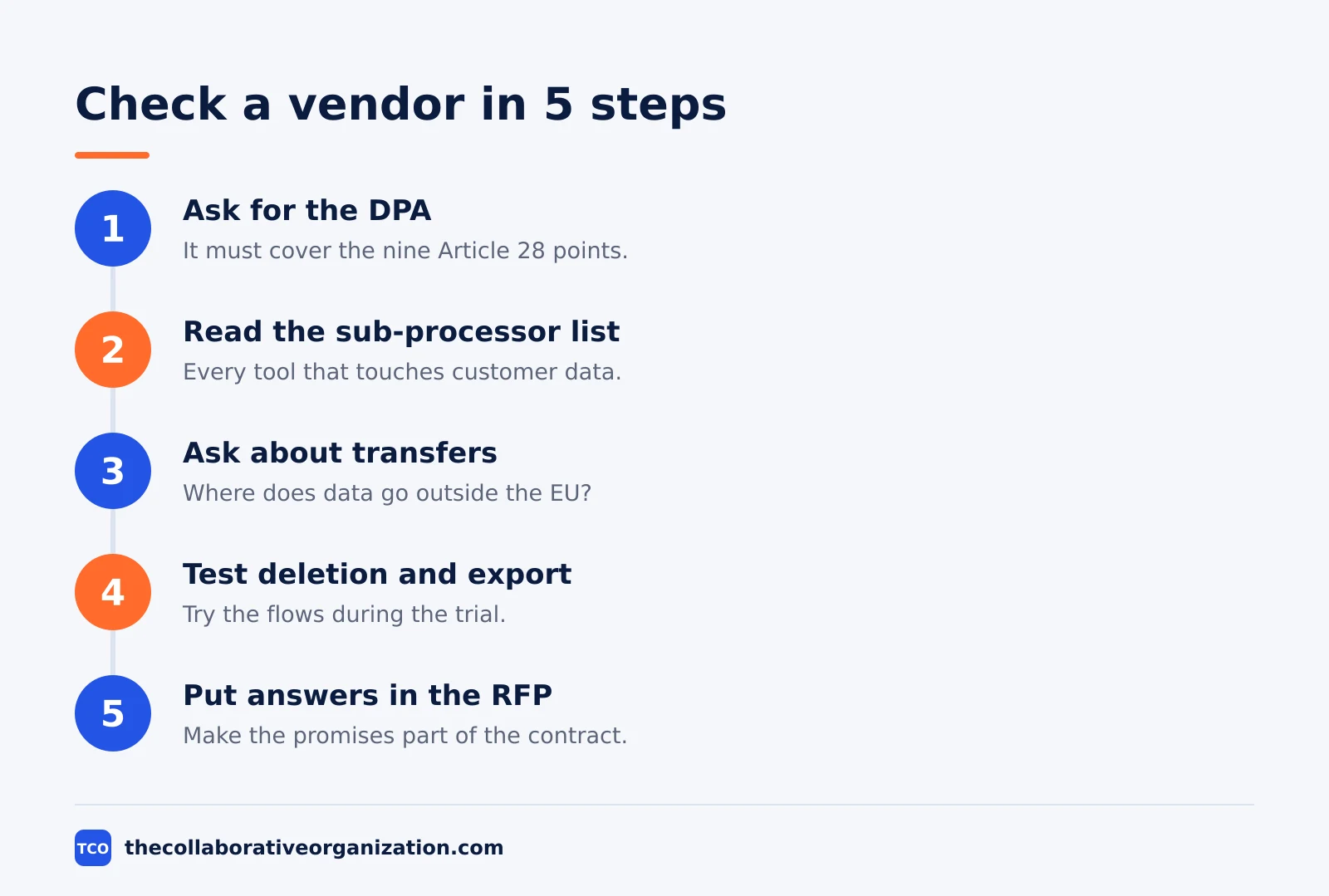
Ask a vendor for its DPA, its sub-processor list, and its transfer map before you sign, and check that the DPA covers the nine points Article 28 requires. A vendor that sells to EU customers should have all three ready.
Article 28 requires a written contract that covers the subject matter, duration, nature and purpose of processing, the types of personal data and categories of data subjects, and the processor’s duties.
Those duties are: act only on instructions, keep data confidential, apply security measures, get approval for sub-processors, help with data subject rights, notify breaches, and return or delete data at the end of the service.
SecurePrivacy lists the same nine elements as the core of a compliant DPA.
Also ask for a record of processing activities, known as a RoPA, which Article 30 requires, and ask whether the vendor runs data protection impact assessments, or DPIAs, under Article 35 for high-risk processing.
Put the answers in your RFP, as our guide on how to write an RFP for software advises, so the vendor’s answers become part of the contract.
Worked example: a buyer checks a CRM
A buyer who asks for three documents can judge a CRM’s GDPR position in a single afternoon. Imagine a 30-person company buying a CRM that will hold contact details for EU customers.
The buyer asks for the DPA, the sub-processor list, and the privacy notice. The DPA names the vendor as processor, lists the data types, and promises deletion within 30 days of the contract ending.
The sub-processor list shows a cloud host in the EU, an email service in the US, and an analytics tool in the US, each with SCCs in place. The privacy notice states the lawful bases and the retention periods.
Two gaps appear. The analytics sub-processor was added last month, and the vendor gave no notice, while its DPA promises 30 days’ notice for new sub-processors. The buyer also finds that the CRM keeps deleted contacts in backups for 90 days.
The buyer accepts the backup delay as standard, but asks the vendor to fix its notice process before signing, and tests the deletion flow in a trial, as our guide on how to run a software trial recommends.
Common GDPR mistakes to avoid
Most GDPR problems in SaaS buying come from five errors, and each one is easy to prevent with a short check. Run through the list before you sign.
- No DPA in place. A controller may only use processors that give enough guarantees and sign an Article 28 contract. No DPA means no deal, however good the tool looks.
- Forgetting sub-processors. Every tool that touches customer data, from error tracking to support chat, is a sub-processor that must be listed and covered.
- Assuming EU storage means no transfer. Staff access, support tickets and analytics can move data outside the EU even when the database sits in it. Ask about access, not only storage.
- Collecting data with no lawful basis. Every field, every integration and every export needs a basis. If the vendor cannot name one, the data should not be collected.
- No plan for data subject requests. A request to delete or export data will arrive, and the vendor must be able to find the data fast. Test the export and delete flows during the trial.
Fines are the headline, but the real cost is usually the deal that stalls: a buyer that cannot get a DPA or a transfer answer will pick another vendor. Workstreet notes that serious violations can draw fines of up to 20 million euros or 4% of worldwide annual turnover, whichever is higher. For more checks, see our software guides hub.
Sources
- EUR-Lex - Regulation (EU) 2016/679, General Data Protection Regulation (2016)
- Workstreet - GDPR Compliance Guide for SaaS Companies (2026)
- iCompaas - GDPR Compliance Guide: Roles, Transfers, Controls (2026)
- ShieldKey Solutions - GDPR for SaaS: Compliance Without Slowing Down Product (2026)
- SecurePrivacy - The SaaS DPA Guide: GDPR Requirements, Subprocessors, and Automation (2026)
- GDPR-Law - GDPR Article 83: Administrative Fines and Penalties Explained (2026)
Frequently asked questions
Does GDPR apply to a SaaS company outside the EU?
Yes, if it offers goods or services to people in the EU or monitors their behaviour there. A US vendor with EU customers, EU users or EU-targeted marketing is usually in scope, even with no office in Europe. The vendor must then follow GDPR for that processing and usually appoint an EU representative.
Is my SaaS vendor a controller or a processor?
For the customer data inside its product, a B2B SaaS vendor is usually a processor, because the customer decides what data to collect and why. The same vendor is a controller for its own marketing, sales and employee data, where it sets the rules itself. The role decides which duties apply, so check the contract.
What is a data processing agreement?
A data processing agreement, or DPA, is the written contract GDPR Article 28 requires between a controller and each processor. It sets out the subject matter, duration, nature and purpose of processing, the data types and data subject categories, and the processor's duties on security, sub-processors, breach notice and deletion.
What are the fines for breaking GDPR?
GDPR sets two tiers of fines. The lower tier reaches 10 million euros or 2% of worldwide annual turnover, whichever is higher. The higher tier reaches 20 million euros or 4% of worldwide annual turnover, whichever is higher, and it covers breaches of the core principles, data subject rights and transfer rules.
How fast must a SaaS vendor report a data breach?
Under Article 33, the controller must notify its supervisory authority without undue delay and within 72 hours of becoming aware of a personal data breach, unless the breach is unlikely to result in a risk to people. A processor must tell the controller without undue delay, so the 72-hour clock can start.
Related articles

guides
Free Project Management Templates: 7 to Copy (2026)
Seven free project management templates from monday, Wrike, Teamwork, Smartsheet, ClickUp, Asana and Trello, with what each one is for and what free really costs.
November 20, 2026 · 7 min read

guides
Project Proposal Template: Copy and Win Work (2026)
A project proposal template pitches the work before it is approved: problem, solution, scope, budget, timeline and terms. Copy the template and filled example.
November 20, 2026 · 10 min read

guides
Action Plan Template: Goal to Done in One Page (2026)
An action plan template turns one goal into owned steps with dates, dependencies and a success measure. Copy the table and see it filled for a support team.
November 20, 2026 · 11 min read