What Is a Project Charter? Definition and Parts (2026) | The Collaborative Organization
By The Collaborative Organization Team · November 19, 2026 · Last verified November 19, 2026 · 11 min read
A project charter is a formal document that authorizes a project to start and gives the project manager authority to use the organization’s people, money and time. It states why the project exists, what it must deliver, who is in charge, and what success looks like. Without it, a project has no agreed starting point.
Key takeaways
- A project charter formally authorizes a project and names the project manager, in the words of the PMBOK Guide.
- The charter stays high level: purpose, objectives, scope, budget, milestones, risks and the sponsor who signs it.
- Atlassian advises keeping a charter to one or two pages so a sponsor can read and sign it fast.
- A charter is not a project plan: the charter authorizes the work, and the plan explains how the work will run.
- PMI data from 2018 found that 52% of projects completed in the prior 12 months had scope creep, which a clear charter helps to prevent.
What a project charter is
A project charter is the document that turns an idea into an approved project. It is written during initiation, the first phase of a project, and it is the record that the organization has agreed to spend resources on this work. The charter answers four questions: why are we doing this, what will it deliver, who is in charge, and how will we know it worked.
The PMBOK Guide defines it in plain terms. A charter is a document issued by the project initiator or sponsor that formally authorizes a project and gives the manager authority to apply organizational resources to it, as PMI records. That authority is the point: before the charter, the manager has no formal right to book people’s time or spend money.
The charter also works as a reference for the whole project. When a new request arrives mid-project, the team checks it against the charter’s scope and objectives. If the request sits outside what was agreed, it needs a formal change, not a quiet yes. That is why teams keep the charter short and visible instead of filing it away.
What goes in a project charter
A charter covers the purpose, objectives, scope, budget, milestones, risks, stakeholders and the people who approve it, all at a high level. The PMBOK Guide, Eighth Edition, lists these as the typical elements, and a small project may cover them in a page while a large public project needs more. What never belongs in a charter is detail: no full schedule, no task list, no line-by-line budget.
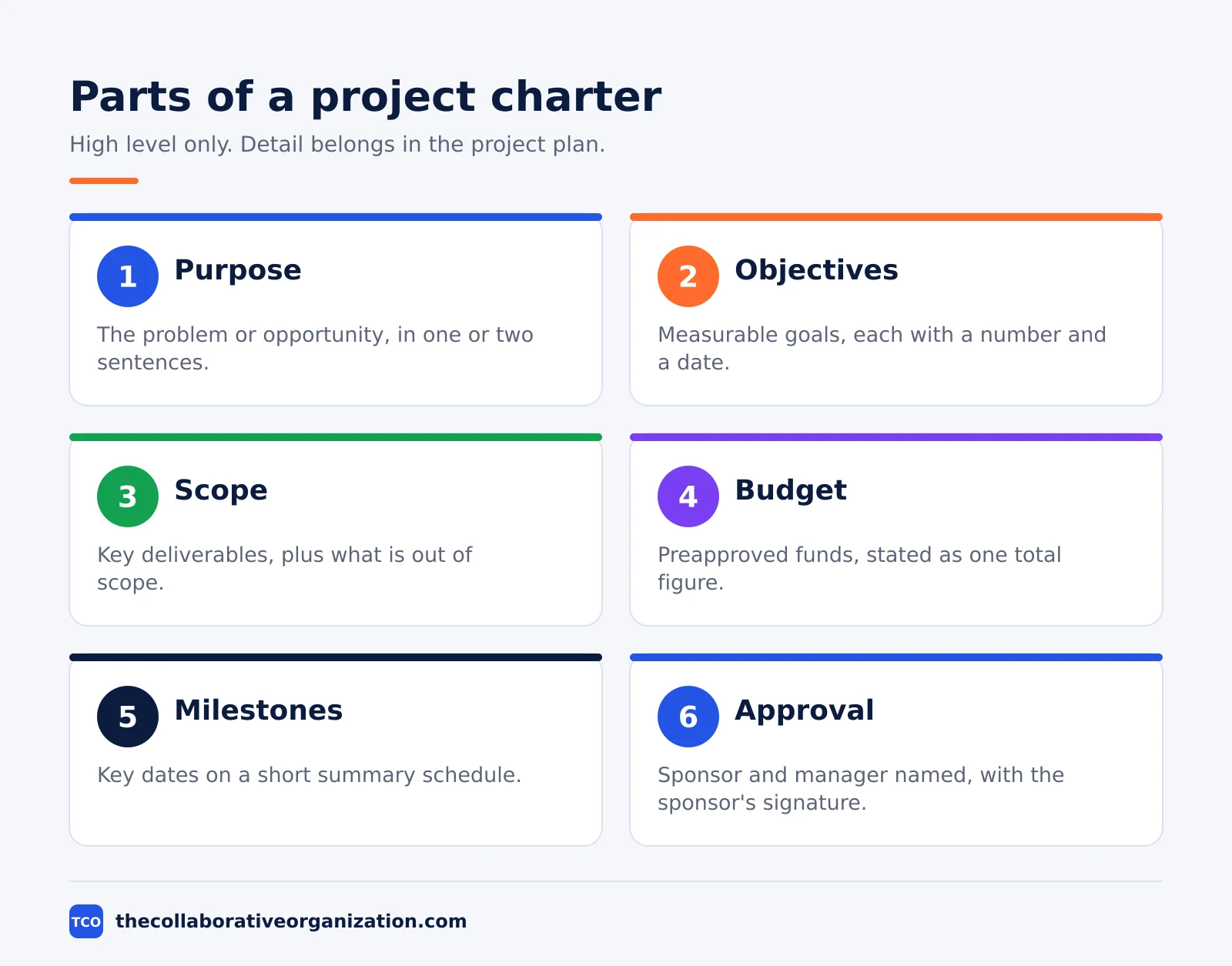
| Part | What it records |
|---|---|
| Purpose | The problem or opportunity, in one or two sentences |
| Objectives | Measurable goals and the success criteria for each one |
| Scope | High-level deliverables and boundaries, including what is out of scope |
| Budget | Preapproved financial resources, as a total figure |
| Milestones | Key dates on a summary schedule |
| Risks | Overall project risk as seen at the start |
| Stakeholders | Key people and groups, with the sponsor named |
| Approval | The project manager, their authority level, and who signs off |
Three parts do the most work. The purpose stops the project from drifting into work nobody asked for. The scope section, with its out-of-scope list, is the main guard against “scope creep”, the uncontrolled growth of a project after work starts. The approval section names the sponsor and the manager, so everyone knows who can decide and who can spend.
Who writes a project charter, and who signs it
The sponsor issues the charter, and the project manager usually helps to write it. In the PMBOK Guide, Eighth Edition, the charter is produced by the Initiate Project or Phase process, and it can be developed by the sponsor or the project manager working with the initiating entity. The sponsor is the person or group that provides the money and backing, and their signature is what makes the document binding.
That split matters in practice. The sponsor owns the business reason and the budget, while the manager owns the delivery detail. When the manager drafts the charter, the sponsor still has to read it, challenge it and sign it. A charter the sponsor has not read is paper, not approval.
Atlassian puts the same point in practical terms: involving key stakeholders in creating the charter builds buy-in and brings in views the manager alone would miss. The charter should be reviewed and approved by the people named in it, not passed around after the fact.
Project charter vs project plan vs project proposal
A proposal pitches the project, a charter authorizes it, and a plan explains how to run it. The three documents look alike at a glance, and teams mix them up often. Each one has a different job, a different author and a different moment in the project.
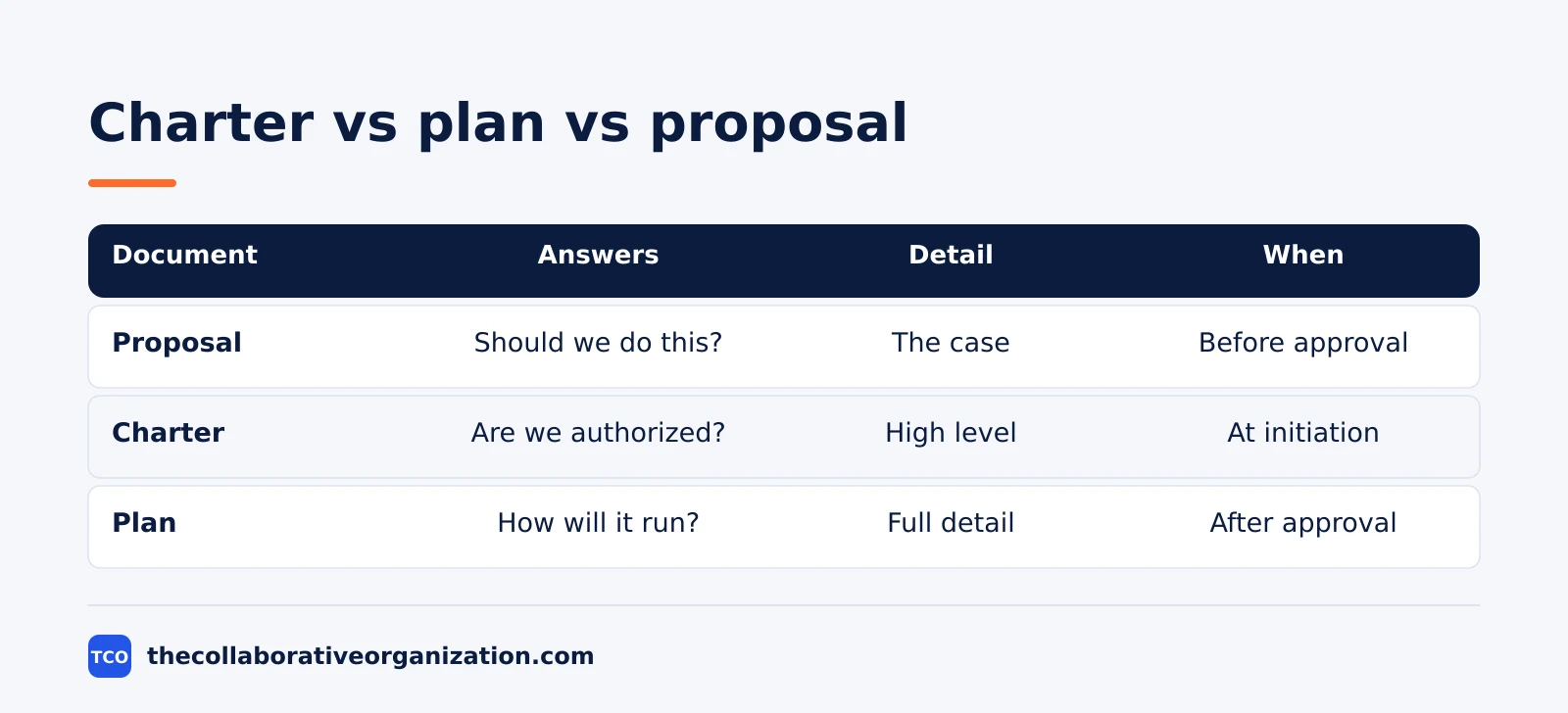
| Document | Question it answers | Detail level | When it appears | | --- | --- | --- | | Project proposal | Should we do this, and why? | The case for the work | Before approval | | Project charter | Are we authorized, and who is in charge? | High level, 1-2 pages | At initiation | | Project plan | How will the work run, day by day? | Full detail | After approval |
Our guide to project charter vs project plan compares the two in depth, including which parts of each document a sponsor reads first. The short version is that the charter is a promise and the plan is the working detail that keeps that promise.
A proposal becomes a charter only when someone with budget authority signs it. Until that signature, the project has a good idea and no authority. Teams that skip the charter step often find this out late, when two managers disagree about who owns a decision and there is no signed page to settle it.
Project charter example: a new customer portal
A short example shows how the parts fit on one page. Imagine a mid-size company that wants a customer portal so clients can check orders and raise support tickets. The sponsor is the operations director, the manager is the internal project lead, and the budget is $120,000 over five months. These figures are an illustration, not a real project.
The purpose reads: “Customers now phone or email for order updates, which takes support staff about 15 hours a week. The portal will let customers check orders and raise tickets online.” The objectives are measurable: cut order-status calls by half within three months of launch, and answer 90% of tickets within one working day.
Scope names three deliverables: a login page, an order-status page and a ticket form. Out of scope: a mobile app and any change to the warehouse system.
Milestones are design sign-off in month two, a tested portal in month four, and launch in month five. The main risk is that the warehouse data feed is late, so the charter names a fallback: launch with manual order updates for the first month. The sponsor signs, and the manager can now book the developer and designer.
How to write a project charter in 6 steps
Writing a charter takes six steps, and the first three need no template at all. Start with the business reason, agree the scope, then write the page the sponsor will sign. The steps below follow the shape ClickUp uses in its charter guide: aim, roles, budget, risks, timeline and success measures.
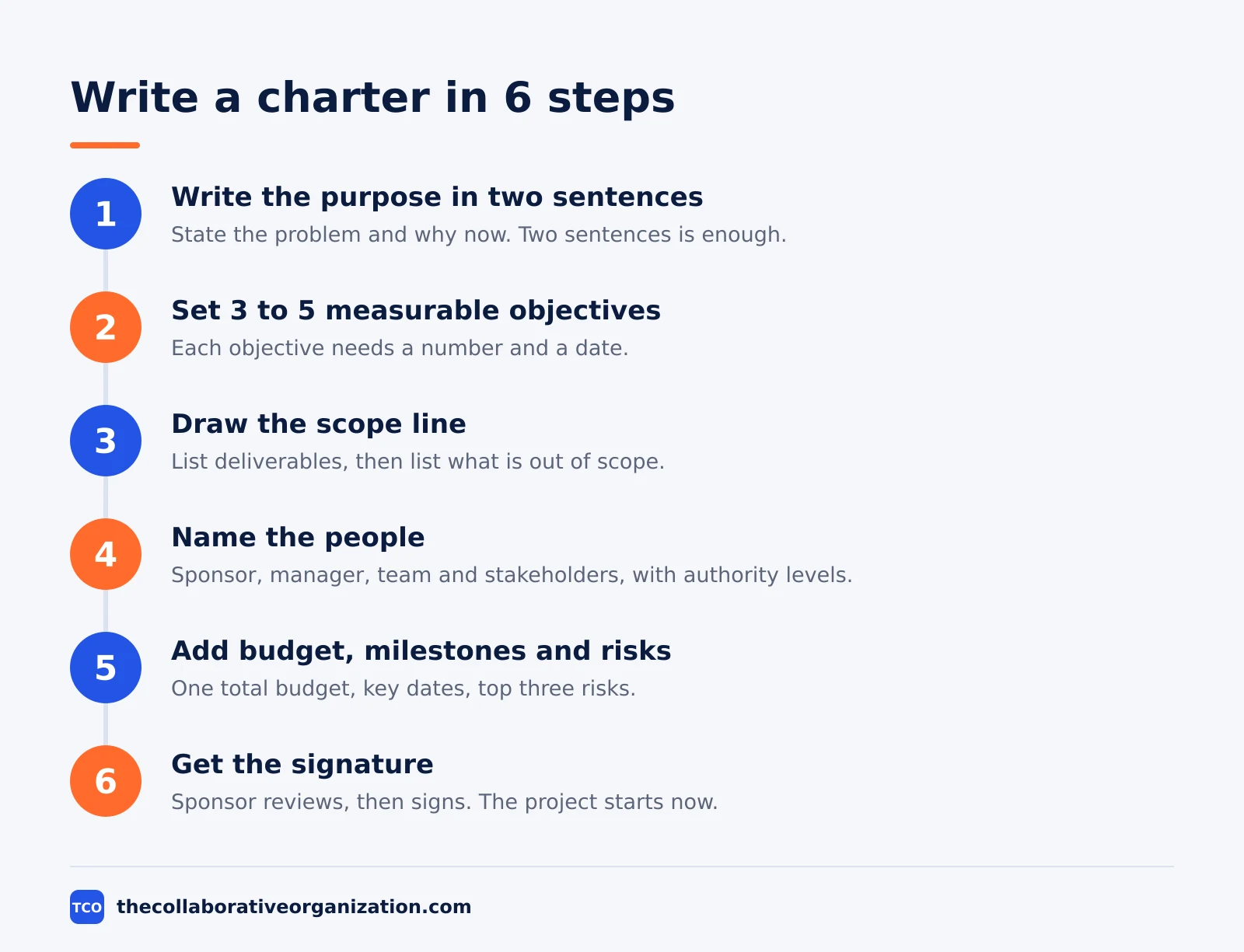
Step 1: Write the purpose in two sentences
State the problem or opportunity and why now. If you cannot state it in two sentences, the project is not ready for a charter yet.
Step 2: Set 3 to 5 measurable objectives
Each objective needs a number and a date, such as “cut order-status calls by 50% within three months of launch.” Vague goals such as “improve service” cannot be measured, so they cannot prove success.
Step 3: Draw the scope line
List the key deliverables, then list what is out of scope. The out-of-scope list is the part teams skip most often, and it is the part that prevents the most arguments later.
Step 4: Name the people
Record the sponsor, the project manager, the core team and the key stakeholders. Give the manager’s authority level in writing, such as approval to spend up to $5,000 without asking again.
Step 5: Add budget, milestones and risks
Put in the preapproved budget as a total, the key dates, and the top three risks with a one-line response for each. Keep each risk to one sentence.
Step 6: Get the signature
Send the charter to the sponsor and the key stakeholders for review, then get the sponsor’s signature. The signed charter is the start of the project, and the project plan builds on it.
When to use a project charter, and when to skip it
Use a charter whenever the work needs money, people from more than one team, or a decision that outlives a meeting. It fits any project with a budget, a deadline and more than one stakeholder. Atlassian notes that projects without a proper charter tend to struggle with direction and stakeholder alignment for the whole project.
The case is strongest when the project crosses teams. A portal project touches support, development and operations, and each team has its own priorities. The charter gives them one agreed page to point at when those priorities clash.
Skip a formal charter only for tiny work with no budget and no outside stakeholder, such as a two-day internal fix. Even then, an email from the person who asked for the work, stating the goal and the deadline, does the same job in miniature. The test is simple: if someone could later ask “who approved this?”, write the charter.
Tools that hold your charter and plan
A project tool keeps the charter next to the plan, the tasks and the dates, so the team reads it instead of losing it. Store the signed charter as a document in the project workspace, link it from the project overview, and point every new team member at it first. If you have not picked a tool yet, compare the options on our project management software shortlist before you file the charter.
| Tool | Best for | Free plan | Starting price (as of November 2026) | Notable limit |
|---|---|---|---|---|
| Asana | Teams that want the charter linked to tasks and dates | Free for 2 people | $10.99 per user per month (Starter), billed annually | Free plan covers 2 people |
| ClickUp | Teams that want the charter as a doc inside the project | Free Forever plan | $9 per user per month (Core), billed yearly | Yearly billing needed for that price |
The Asana price comes from Asana pricing: the Personal plan is free for 2 users, and Starter is $10.99 per user per month when billed annually.
The ClickUp price comes from ClickUp pricing: Core is $9 per user per month billed yearly, shown against a regular price of $12, so the $9 figure may be promotional.
A project brief often sits next to the charter in the same workspace. The brief explains the work to the team, while the charter proves the work was approved. Keep both, and link the brief back to the charter so nobody confuses the two.
Common project charter mistakes to avoid
Most charters fail in the same five ways, and all five are easy to spot before the sponsor signs. Run through the list below each time a charter is drafted.
- Vague objectives with no numbers. “Improve customer service” cannot be measured. Give each objective a number and a date.
- No out-of-scope list. Without it, every new request looks like part of the project, and the scope grows without a decision.
- No named sponsor. A charter signed by the project manager alone authorizes nothing, because the manager cannot approve their own budget.
- Detail that belongs in the plan. Task lists, full budgets and schedules make the charter long, and long charters do not get read.
- A charter that is never updated. When the scope or budget moves beyond what was approved, the sponsor must agree again, or the charter stops matching the real project.
The last mistake is the quiet one. Teams write a good charter, then change the project three times without touching it. Six months later the charter describes a project nobody is running. Review it at each phase gate, as part of normal project management, and update it when the approved scope changes.
Sources
- PMI - Financing the Project (PMBOK Guide summary) (2008)
- Atlassian - Project Charter Guide: Definition, Examples and Template (2026)
- ClickUp - How to Write a Project Charter (with Examples) (2026)
- Villanova University - PMBOK Initiating Process Group: Charter and Free Templates (2026)
- Flowlu - What Is a Project Charter? Definition, Key Elements, Example (2026)
- Asana - Pricing (2026)
- ClickUp - Pricing (2026)
Frequently asked questions
Who writes a project charter?
The sponsor or project initiator issues the charter, often with help from the project manager. In the PMBOK Guide, Eighth Edition, the charter is produced during the Initiate Project or Phase process, and the sponsor is the person who authorizes the project and gives the manager authority to use resources.
How long should a project charter be?
Aim for one to two pages on a small or mid-size project, and up to four pages on a large one. A charter is a high-level agreement, not a plan, so it should fit on a few pages that a busy sponsor can read and sign in one sitting. If it runs longer, move the detail into the project plan.
Is a project charter the same as a project plan?
No. The charter authorizes the project and sets its purpose, scope, budget and manager at a high level. The project plan comes after approval and holds the detail: the schedule, the task list, the full budget and the risk register. The charter says the project may start; the plan says how it will run.
Can a project start without a charter?
Work can start, but it starts without agreed authority, budget or scope. That leaves the project manager with no formal backing when priorities clash or new requests arrive. Even a one-page charter signed by the sponsor fixes that, because it records who approved the work and what success looks like.
When should you update a project charter?
Update it when the sponsor changes, the scope shifts in a major way, or the budget or deadline moves beyond what was approved. Small changes belong in the project plan, not the charter. Any change to the charter needs the sponsor to agree again, since the charter is the record of what was authorized.
Related articles
project management
How to Choose Project Management Software (2026)
Pick project management software in seven steps: define the work, count seats, price the real cost, and run a two-week pilot before you pay.
November 19, 2026 · 10 min read
project management
What Is a RACI Matrix? Definition, Roles and Examples (2026)
A RACI matrix maps who is Responsible, Accountable, Consulted and Informed for each task. Learn the four roles, how to build one, and see a worked example.
November 19, 2026 · 9 min read
project management
Daily Standup Meeting Format That Works (2026)
A daily standup is a 15-minute meeting where Developers inspect progress toward the Sprint Goal and plan the next day. Use this format to run one that ends on time.
November 19, 2026 · 10 min read