Waterfall vs Hybrid Project Management (2026) | The Collaborative Organization
By The Collaborative Organization Team · November 19, 2026 · Last verified November 19, 2026 · 9 min read
Waterfall runs a project in fixed phases from start to finish, while hybrid keeps the fixed phases and runs Agile sprints inside them. Waterfall plans everything up front, then builds, tests and ships in order. Hybrid fixes the parts that cannot change, such as the launch date and compliance checks, and lets the rest change in sprints.
Key takeaways
- Waterfall is a sequential lifecycle, documented by Winston Royce in a 1970 paper.
- Hybrid mixes Waterfall phases for planning with Agile sprints for the work that can change.
- Hybrid adoption rose from 20% to 31% of projects between 2020 and 2023, in PMI data.
- In the 18th State of Agile Report (2025), 74% of organizations said they use hybrid or home-grown Agile models.
- Pure Waterfall fits fixed requirements, fixed budgets and regulated work.
- Hybrid fits the common middle case: a fixed launch date with a product that still needs feedback.
The core difference between Waterfall and hybrid
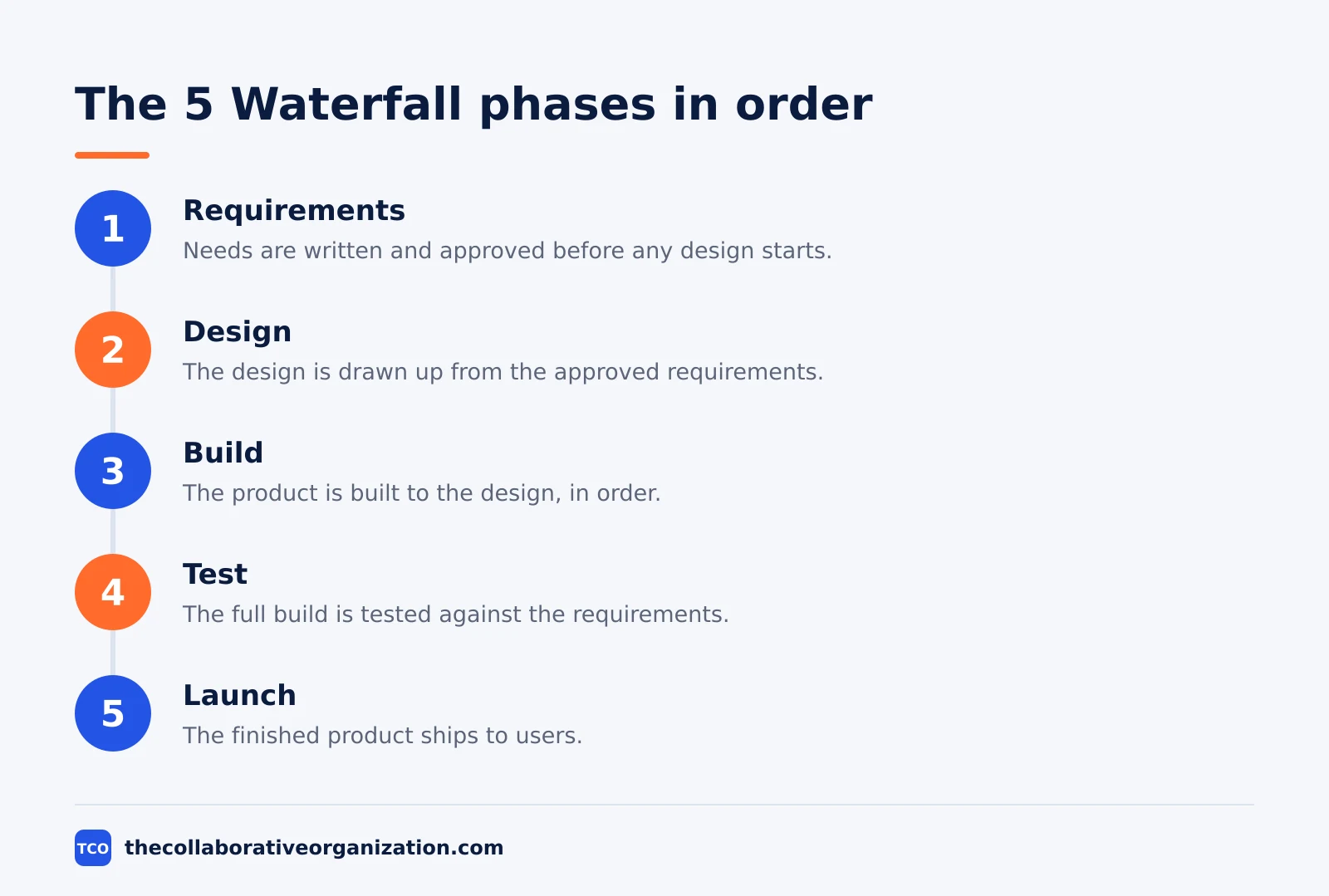
Waterfall fixes the plan, the scope and the order of work up front; hybrid fixes only the parts that cannot change. In Waterfall, each phase must finish before the next starts: requirements, then design, then build, then test, then launch. A change late in the project means going back up the chain.
Hybrid breaks that chain in the middle. The phases still set the gates, dates and budget, but the build phase runs as sprints. Each sprint delivers a working piece, stakeholders see it, and the next sprint adjusts. Our guide to Agile versus Waterfall covers the pure comparison in more depth.
The name matters less than the split. A team that fixes its launch date and its safety checks but builds in sprints is doing hybrid, even if nobody calls it that. A team that writes a full plan and never revisits it is doing Waterfall, even if it holds a daily stand-up.
Waterfall vs hybrid at a glance
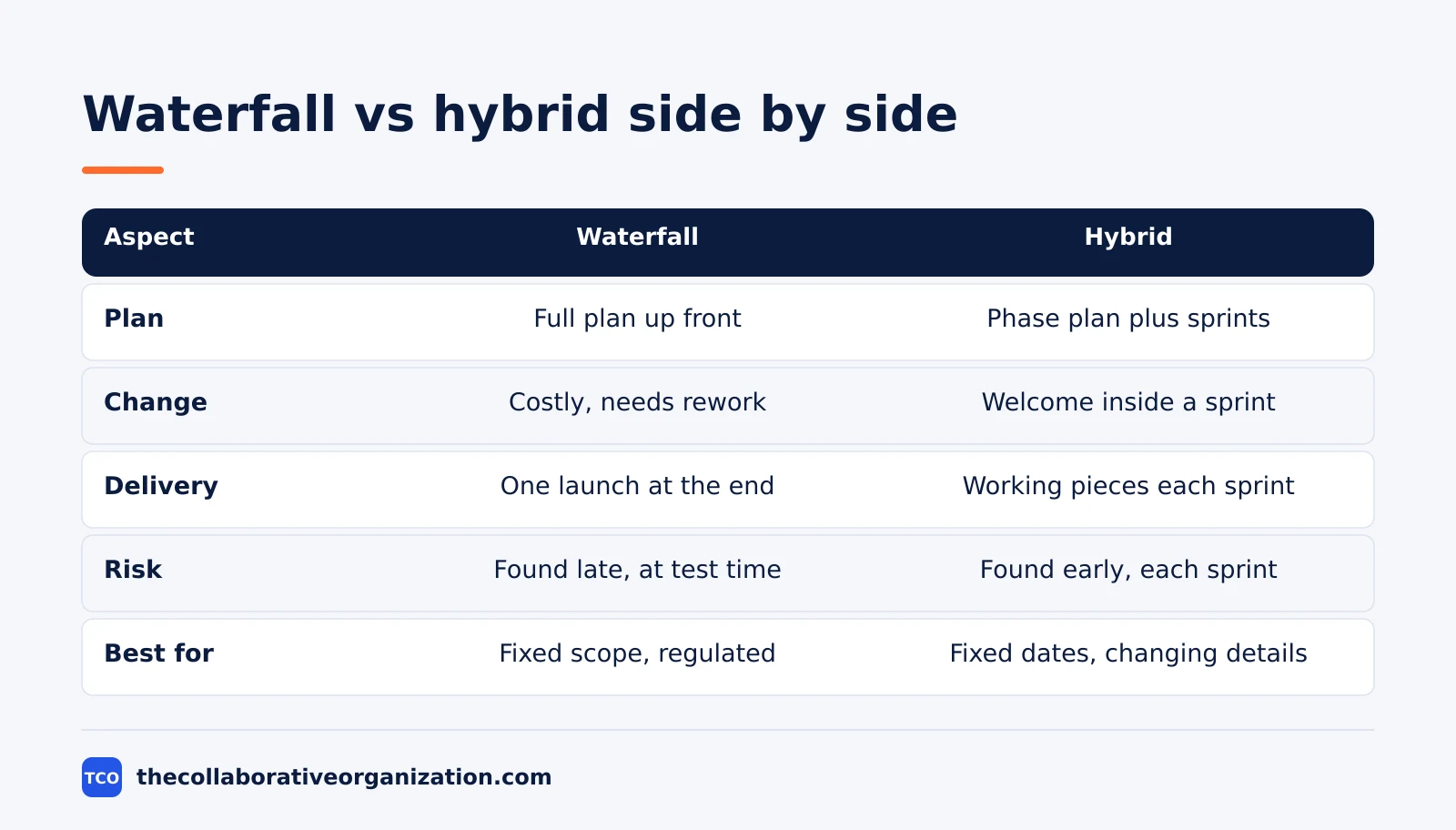
The table below shows the split in one place: planning, change, risk and proof. Use it when a sponsor asks why the project needs both a phase plan and a sprint backlog.
| Aspect | Waterfall | Hybrid |
|---|---|---|
| Plan | Full plan up front | Phase plan up front, sprint plans per cycle |
| Change | Costly, needs rework up the chain | Welcome inside a sprint |
| Delivery | One launch at the end | Working pieces each sprint |
| Risk | Found late, at test time | Found early, each sprint |
| Best for | Fixed scope and regulated work | Fixed dates with changing details |
| Team roles | Phase owners and sign-offs | Phase owners plus Product Owner |
One row deserves a second look: risk. In Waterfall, testing comes near the end, so a wrong assumption can sit unseen for months. In hybrid, each sprint puts a working piece in front of users, so the same mistake surfaces in weeks.
How Waterfall works
Waterfall works as five phases in order, each with a sign-off before the next starts. Requirements are written and approved, design follows, then build, then test, then launch. The model was documented by Winston Royce in 1970, and it still fits work where the end state is known before the work starts.
The strength of Waterfall is clarity. Everyone can see the plan, the dates and the budget, and each phase has a named owner and a gate. The weakness is the same clarity: a requirement missed at the start is found at the end, when fixing it costs the most.
Royce’s 1970 paper described the sequential lifecycle that later teams named Waterfall.
Waterfall fits construction, regulated products and fixed-price contracts, where the scope is set by law, safety or a signed agreement. It fits poorly when the customer cannot describe what they want until they see it working, since the first working version arrives at the end.
How hybrid works
Hybrid works as Waterfall on the outside and Agile on the inside. The project keeps phase gates, a budget and a launch date, and the build work inside each phase runs as sprints of one month or less. Each sprint ends with a working piece and a review, and the next sprint adjusts based on what the review showed.
The split is decided before work starts and written into the plan. Fixed parts use phases: contracts, safety checks, launch dates and compliance sign-offs. Changing parts use sprints: screens, workflows and features that need user feedback. The Scrum Guide sets the sprint rules hybrid teams borrow, including the one-month limit.
Adoption has grown fast. PMI data summarized in 2026 shows hybrid use rising from 20% to 31% of projects between 2020 and 2023, while purely predictive approaches fell by 24% in the same period. The Digital.ai report found the same direction: 74% of organizations now use hybrid or home-grown models.
Choose Waterfall if the work is fixed and regulated
Choose Waterfall when the requirements, the budget and the deadline are all known at the start and cannot move. Regulated work is the clearest case: a medical device, a tax filing system or a building must meet rules that are written down before the work starts. A fixed-price contract is another, since the price was set from a fixed scope.
Waterfall also fits a team that has done the same project many times before. The plan is a template, the phases are known, and the risk sits in execution rather than discovery. Our guide on how to choose project management software helps when the team needs a tool to hold the phase plan.
- Scope is set by law, safety or contract. Change needs a formal change request, not a sprint review.
- The end state is known. The customer can describe the result before the work starts.
- Testing must wait for a complete build. Parts cannot be tested alone in a meaningful way.
- The team repeats a known project. The plan is proven, so the value is in following it.
Choose hybrid if dates are fixed but details change
Choose hybrid when the launch date is fixed but the product still needs feedback. This is the most common project shape: a date promised to customers, a budget approved by finance, and screens that nobody has tested yet. Hybrid holds the date and lets the details change inside the sprints.
Hybrid also fits a Waterfall organization that wants faster feedback without rewriting its whole method. The phase gates stay, the reporting stays, and the build phase becomes sprints. The Agile values guide explains the mindset behind the sprint side of the blend.
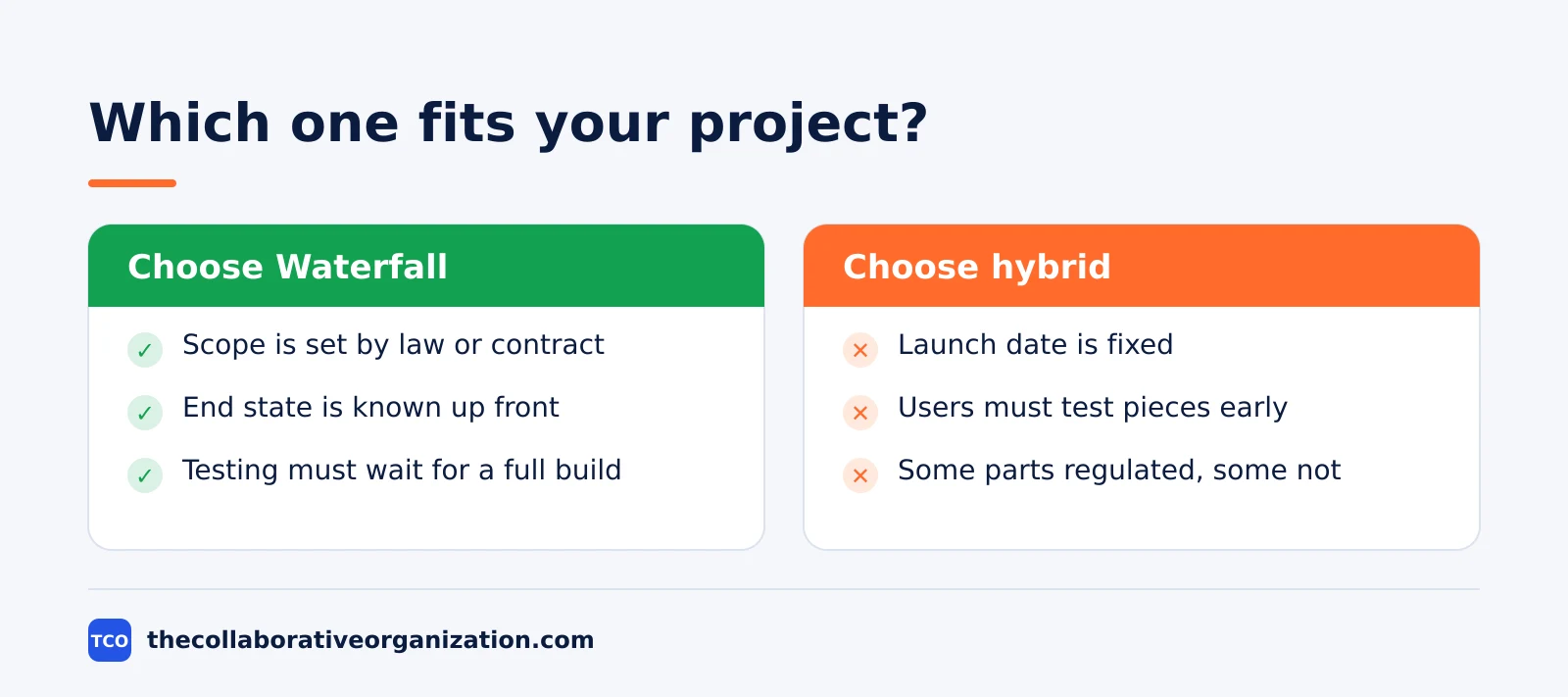
- The launch date cannot move. Sprints fit inside the phases instead of replacing them.
- Users need to see working pieces early. Each sprint delivers something testable.
- Some parts are regulated and some are not. Phases cover the regulated parts, sprints cover the rest.
- The team wants Agile feedback without dropping its gates. Hybrid keeps both.
Can you combine Waterfall and Agile in one project?
Yes, that combination is the definition of hybrid, and it is now the most common way large projects run. The 18th State of Agile Report found 74% of organizations using hybrid or home-grown models, and the shift has run for years rather than months. Teams stopped asking which method wins and started asking which parts of the project need which method.
The combination works when the joins are managed. Each phase gate checks two things: the phase plan is on track, and the sprint backlog matches it. When the two drift apart, the project manager reconciles them at the gate.
The combination fails when nobody owns the joins. A team that runs sprints but never updates the phase plan ends up with two truths, and the sponsor trusts the wrong one. Name one person to keep the phase plan and the backlog in step, and review the split at every gate.
Worked example: a bank rebuilds its onboarding flow
A bank rebuilding its customer onboarding flow shows the hybrid split in practice. The launch date is fixed by a regulatory deadline, the identity checks are set by law, and the screens have never been tested with real customers. Pure Waterfall would test the screens at the end, and pure Agile would have no fixed date.
The project keeps three Waterfall phases: design, build and launch, each with a gate. Inside the build phase, the team runs two-week sprints. Sprint 1 delivers the identity check screen, and five customers test it. They fail at the document upload step, so Sprint 2 fixes the upload flow before the team builds the next screen.
At the build gate, the phase plan and the sprint backlog agree: the regulated checks are done, the screens are tested, and the launch date holds. The fixed parts stayed fixed, and the changing parts changed early, when fixes were cheap.
Tools that support Waterfall and hybrid teams
A tool helps when it shows both the phase plan and the sprint backlog in one place. Hybrid teams need a timeline for the gates and a board for the sprints, and a tool that shows only one side hides the drift. Our project management software shortlist compares the options side by side.
| Tool | Best for | Free plan | Starting price (as of November 2026) | Notable limit |
|---|---|---|---|---|
| Asana | Teams that want timelines plus boards | Free for 2 people | $10.99 per user per month (Starter), billed annually | Free plan covers 2 people |
| monday.com | Teams that want a visual board with phases | Free plan for up to 2 seats | $9 per seat per month (Basic), billed annually | Paid plans need at least 3 seats |
| Wrike | Teams that want Gantt charts and request forms | Free plan for small teams | $10 per user per month (Team), billed annually | Team plan lacks time tracking |
The Asana price comes from the Asana pricing page: Starter is $10.99 per user per month billed annually.
The monday.com pricing page lists Basic at $9 per seat per month billed annually.
Wrike lists Team at $10 per user per month billed annually on its pricing page.
Common Waterfall vs hybrid mistakes to avoid
Most hybrid projects fail at the joins, and the five mistakes below are the usual causes. Run through the list at each phase gate.
- Running sprints with no phase plan. Sprints without gates drift, and the sponsor learns the date is at risk too late.
- Freezing the plan and the backlog. A hybrid plan that never changes is Waterfall with extra meetings.
- Letting the backlog and the phase plan disagree. One person must keep them in step, and the gate must check both.
- Testing only at the end. Hybrid earns its keep by testing each sprint, so skipping sprint reviews wastes the blend.
- Applying hybrid to a two-week task. A small task with one owner needs a due date, not a blended method.
Sources
- Prospeo - Waterfall Pros and Cons: What the Data Says (2026)
- Digital.ai - 18th State of Agile Report Marks the Start of the Fourth Wave (2025)
- Apollo Technical - 51 Project Management Statistics To Know (2026)
- Veritis - Waterfall vs Agile vs DevOps Methodologies Comparison (2025)
- Scrum Guides - Scrum Guide (2020)
- Asana - Pricing (2026)
- monday.com - Pricing (2026)
- Wrike - Pricing (2026)
Frequently asked questions
What is hybrid project management?
Hybrid project management mixes Waterfall and Agile in one project. Fixed phases set the plan, dates and budget, while Agile sprints run inside those phases for the work that can change. A team might fix the launch date and the compliance checks up front, then build the product in two-week sprints inside each phase.
Is hybrid better than pure Waterfall?
It is better when some parts of the project are fixed and others are not. Pure Waterfall fits work where the requirements, the budget and the deadline are all known at the start. Hybrid fits the common middle case: a fixed launch date with a product that still needs feedback. The method should match the project, not the other way round.
When should you not use hybrid project management?
Skip hybrid when the project is small and simple enough for one method, or when the team has no one to run both sides. Hybrid adds coordination work: someone must keep the phase plan and the sprint backlog in step. A two-week task with one owner needs a due date, not a blended method.
Who decides which parts use Waterfall and which use Agile?
The project manager decides with the sponsor and the team, and the choice is written into the plan before work starts. Fixed parts such as contracts, safety checks and launch dates use Waterfall phases. Parts that need user feedback, such as screens and workflows, use sprints. The split is reviewed at each phase gate.
Can a hybrid project still fail if the plan is good?
Yes. A good plan does not fix unclear ownership, late feedback or a team that skips its own rules. Hybrid projects fail most often at the joins: the phase plan says one thing and the sprint backlog says another. A short weekly check that compares the two catches that drift before it costs a phase.
Related articles
guides
Free Project Management Templates: 7 to Copy (2026)
Seven free project management templates from monday, Wrike, Teamwork, Smartsheet, ClickUp, Asana and Trello, with what each one is for and what free really costs.
November 20, 2026 · 7 min read
guides
Project Proposal Template: Copy and Win Work (2026)
A project proposal template pitches the work before it is approved: problem, solution, scope, budget, timeline and terms. Copy the template and filled example.
November 20, 2026 · 10 min read
guides
Action Plan Template: Goal to Done in One Page (2026)
An action plan template turns one goal into owned steps with dates, dependencies and a success measure. Copy the table and see it filled for a support team.
November 20, 2026 · 11 min read