SOP vs Work Instruction: What Is the Difference? (2026) | The Collaborative Organization
By The Collaborative Organization Team · November 19, 2026 · Last verified November 19, 2026 · 10 min read
A standard operating procedure describes a whole process, who owns each stage and in what order the stages run, while a work instruction shows one person exactly how to do one task inside that process. The SOP governs; the instruction executes. Most teams that do repeatable work need both, because each one fixes a different kind of error.
Key takeaways
- An SOP defines what a process is, why it exists, and who is responsible for each stage.
- A work instruction defines how one specific task gets done, down to tools, settings, and checks.
- SOPs sit higher in the document hierarchy, and work instructions sit closest to the work.
- ISO 9001:2015 does not mandate either document by name, but it requires controlled documented information.
- Choose an SOP when the risk is coordination across roles, and a work instruction when the risk is execution error.
- The SOP governs the process, the instruction executes one task, and neither one proves the step happened.
What is a standard operating procedure?
A standard operating procedure, or SOP, is a formal document that describes a routine business process from start to finish. It states the purpose and scope, the roles involved, the sequence of work, the inputs and outputs, the controls, and when to raise a problem. It answers what must happen, in what order, and by whom.
The audience is wide. Quality staff, supervisors, auditors, and engineers all read the same SOP, because it is the agreed way to run a recurring activity so that any qualified person can perform it the same way.
The Write Direction puts it plainly: an SOP defines what a process is, why it exists, and who is responsible, and it sits higher in the documentation hierarchy than a work instruction.
An SOP also carries the controls that keep a process honest. It names the owner, the records to keep, and the checks that show the process ran as planned. When an auditor asks how a process works, the SOP is the document the team hands over first.
What is a work instruction?
A work instruction is a task-level document that tells one person exactly how to complete one job. It covers one task at one station, with the tool to use, the part to fit, the sequence to follow, and the test that shows the job is done right.
The reader is the operator doing the job, not the auditor. Rewo describes work instructions as step-by-step directions that show an operator how to perform one job at the workstation, usually with photos or video, so the task is done the same way on every shift.
That level of detail is the point: two people reading the same instruction should do the job the same way.
Work instructions live closest to the point of work. They sit at the station, on the screen, or in the app the operator opens, not in a manual on a shelf. When a task needs photos of a correct result or a decision tree for variations, that detail belongs in the instruction, not in the SOP above it.
SOP vs work instruction: side-by-side table
The table below shows the split in one line: the SOP coordinates work between people, and the work instruction cuts variation at the point of work. Every other row follows from that split.
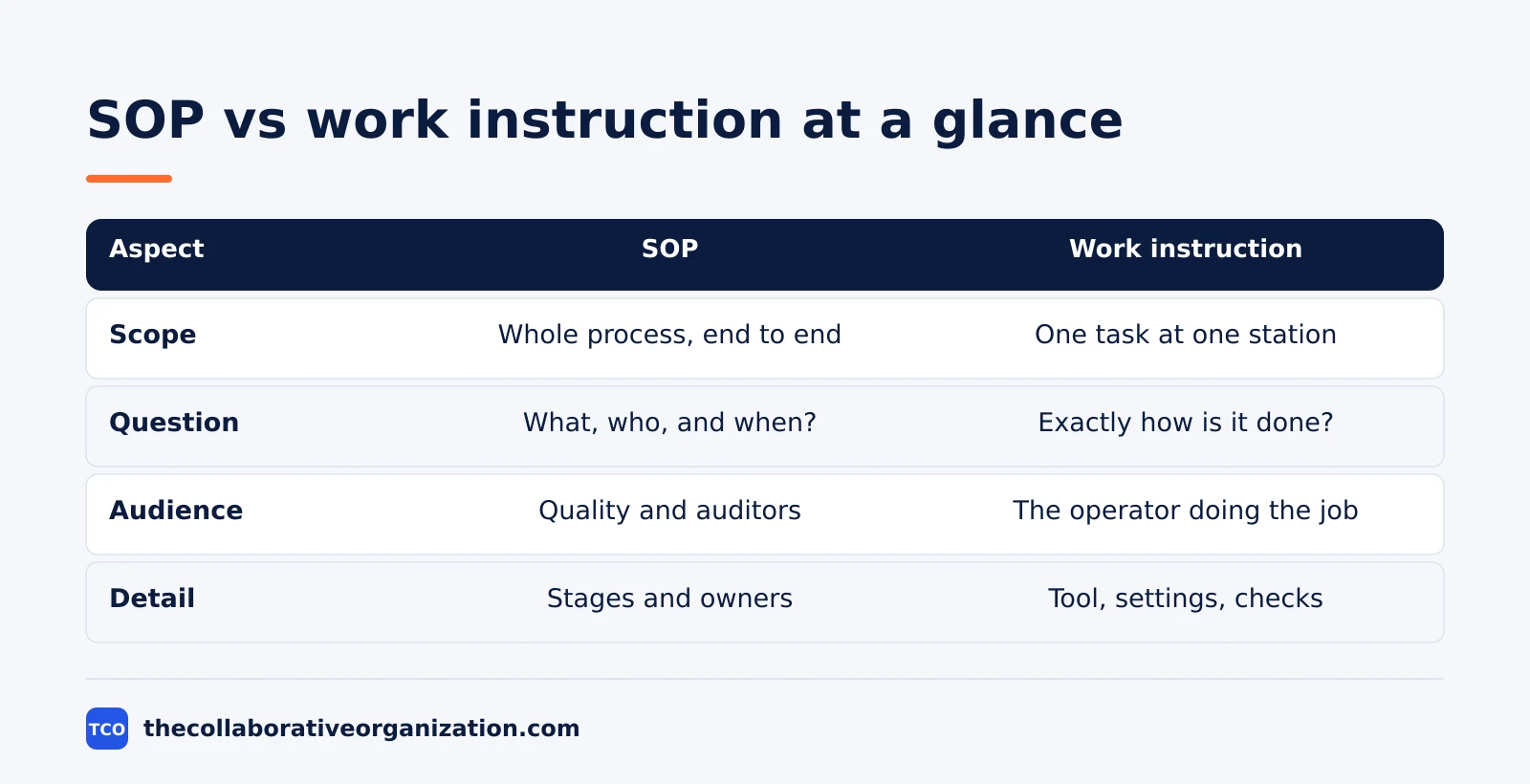
| Aspect | SOP | Work instruction |
|---|---|---|
| Scope | A whole process, end to end | One task at one station |
| Primary question | What must happen, who owns it, and when? | Exactly how does one person do this task? |
| Audience | Quality, supervisors, auditors, engineers | The operator doing the job |
| Level of detail | What happens, in what order, by whom | Tool, settings, sequence, and acceptance test |
| Who owns it | Process or quality owner, under document control | The engineer for that station |
| Where it lives | Quality manual or controlled document set | At the station, on screen, or in the work app |
| Audited against | The quality system and its standard | The SOP above it and the product spec |
PowerArena draws the same line: the SOP describes a process with its scope, sequence, and owners, while the instruction describes one task in the detail the person performing it needs. The SOP governs, and the instruction executes.
The document hierarchy: policy, process, SOP, instruction
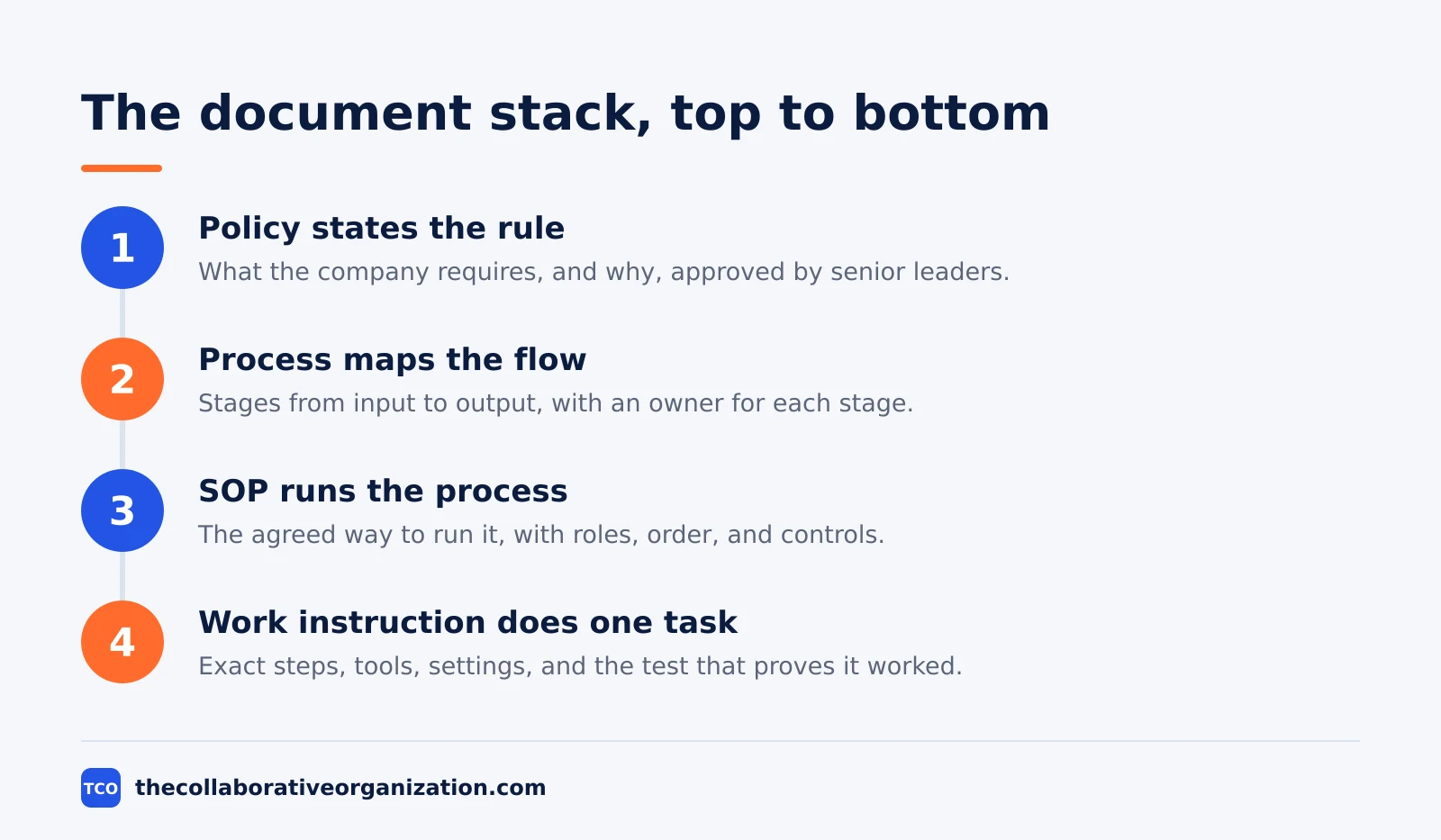
The four documents form a stack, with each layer adding detail that the layer above does not carry. A policy states the rule and a process maps the flow. Below them, an SOP runs the process, and a work instruction does one task.
At the top, a policy says what the company requires and why. Below it, a process turns inputs into outputs across roles. The SOP then gives the agreed way to run that process, and the work instruction gives the exact steps for one task inside it.
Mitti sets out the same stack: a process orchestrates the work, a procedure gives the method, an SOP gives standard guidance on who does what and when, and a work instruction gives every step for one task.
The stack also tells you where to fix a problem. If the issue crosses roles, write or revise the SOP. If the issue happens while one person performs a task, write or revise the work instruction. Fixing the wrong layer wastes a week: a new instruction will not fix a handover that the SOP never defined.
One layer never proves the work happened. Neither the SOP nor the instruction records whether the step was done; records and checklists do that job. A team that confuses a document with proof will pass an audit on paper and fail it in practice.
What ISO 9001:2015 actually requires
ISO 9001:2015 requires the documented information a quality system needs to work, but it does not mandate documents named SOP or work instruction. That freedom surprises teams that expect the standard to hand them a template.
The standard asks for the documented information it lists, plus whatever the organisation judges necessary for its quality system to be effective. Clause 7.5.1 notes that the extent differs with the size of the organisation, the complexity of its processes, and the competence of its people.
An auditor asks whether the process is controlled and the documents are current where they are used, not whether a file carries a given title.
Work instructions still earn their place in most systems. Under clause 7.5, teams must maintain the information needed to plan, operate, and control their processes. Under clause 8.5.1, the information that defines the work must be available where it is needed.
For tasks that affect product quality, a work instruction is the usual way to meet that bar, even though the standard never orders one by name.
Which one should you write first?
Write the SOP first when the main risk is coordination, and write the work instruction first when the main risk is a costly execution error. The risk, not the template, decides the order.
Write the SOP when several roles hand work to each other, when auditors need one agreed method, or when new staff cannot tell who owns each stage. The SOP settles the handover before anyone writes the fine detail. Our guide on how to choose project management software helps when the process also needs a tool to track the work.
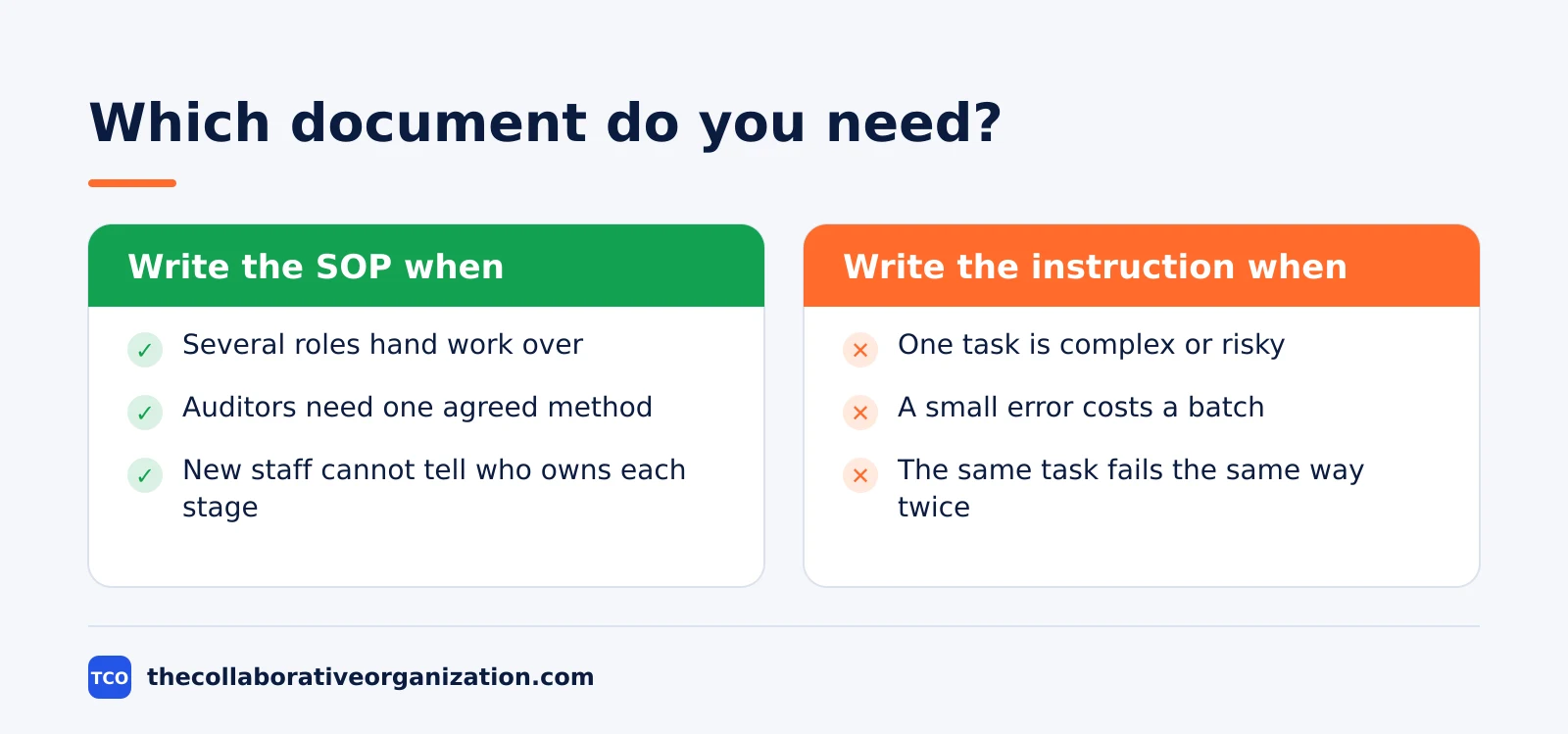
Write the work instruction when one task is complex, precise, or dangerous, and when a small error costs a batch, a customer, or a shift. A wiring sequence, a calibration, or a safety check all need instruction-level detail before they need a process map.
If the same task fails the same way twice, the instruction is missing, whatever the SOP says.
Write both when the process repeats across shifts and the task inside it can go wrong. The SOP keeps the stages in order, and the instruction keeps each stage the same. Teams that skip the SOP get fast work with bad handovers; teams that skip the instruction get tidy handovers with uneven work.
Worked example: onboarding a new client
Imagine a small agency that onboards five new clients a month, and each onboarding takes a different path. The ops lead writes an SOP first. It lists the stages: sales hands over, the account manager opens the project, the team sets up access, and the client signs off the launch. Each stage names one owner and the record that proves it happened.
Then the team writes work instructions for the three tasks that fail most. One instruction shows how to set up client access, with the exact permissions, the order of the steps, and the test that proves access works.
A second shows how to run the launch checklist, and a third shows how to file the signed agreement. Each instruction names one role, fits on one screen, and links back to the SOP.
The result is easy to see. Handovers stop depending on memory, because the SOP names the owner of each stage. Setup stops varying by person, because the instruction gives the exact steps. The team also gains a clear owner for each document, which is the same habit a RACI matrix teaches: one name owns each outcome.
Tools that hold SOPs and work instructions
Asana, monday.com, and ClickUp all hold SOPs as tasks and templates, but none of them replaces the document itself. The tool tracks who does each stage and when; the SOP and the instruction say how the work is done.
Asana suits teams that want every task to have a named owner and a due date. Monday.com suits teams that want a visual board with phases and status. ClickUp suits teams that want custom fields for each stage, such as the reviewer and the review date.
Pick the tool the team will open every day, not the one with the longest feature list.
| Tool | Best for | Free plan | Starting price (as of November 2026) | Notable limit |
|---|---|---|---|---|
| Asana | Teams that want every task to have a named owner | Free for 2 people | $10.99 per user per month (Starter), billed annually | Free plan covers 2 people |
| monday.com | Teams that want a visual board with phases and status | Free plan for up to 2 seats | $9 per seat per month (Basic), billed annually | Paid plans need at least 3 seats |
| ClickUp | Teams that want custom fields for each stage | Free Forever plan | $9 per user per month (Core), billed annually | Yearly billing needed for that price |
The Asana price comes from Asana pricing: Starter is $10.99 per user per month when billed annually, and the free plan covers 2 people. On the monday.com pricing page, Basic is $9 per seat per month billed annually, with a 3-seat minimum.
The ClickUp pricing page lists Core at $9 per user per month billed yearly. See the full shortlist on our project management software shortlist before you buy.
Common SOP vs work instruction mistakes to avoid
Most documentation fails in the same five ways, and all five come from writing the wrong document for the problem. Check the list before you write the next page.
- Writing an SOP that reads like a work instruction. The process drowns in detail, and no one can see the stages or the owners.
- Writing a work instruction that skips the acceptance test. The operator finishes the steps but cannot tell whether the result is right.
- Giving one task two owners. The SOP names a stage owner, the instruction names another, and the work waits for someone else.
- Storing instructions far from the work. An instruction in a manual on a shelf is read once; one on the station screen is read every shift.
- Never reviewing either document. Processes change, tools change, and the SOP slowly describes work no one does. Set a review date on every SOP, and keep the habit in the guides index alongside your other working documents.
Sources
- The Write Direction - SOP vs Work Instructions: Key Differences (2026)
- PowerArena - SOP vs Work Instructions: The Difference (2026)
- Rewo - Work Instructions in Manufacturing: How to Write and Use Them (2026)
- Mitti - A Guide to ISO 9001 Work Instructions (2026)
- Advisera - ISO 9001:2015 Process vs Procedure: Some Practical Examples (2016)
- Asana - Pricing (2026)
- monday.com - Pricing (2026)
- ClickUp - Pricing (2026)
Frequently asked questions
What is the difference between an SOP and a work instruction?
An SOP describes a whole process: who is responsible at each stage and in what order the stages run. A work instruction describes how one person performs one task inside that process, in operator-level detail. The SOP governs the process, and the instruction guides the hands doing the work.
Do you need both an SOP and work instructions for ISO 9001?
Not under those names. ISO 9001:2015 asks for the documented information the standard requires, plus what the organisation needs for its quality system to work. Neither title is mandated, so an auditor checks whether the process is controlled and the documents are current where they are used.
Who writes an SOP, and who writes a work instruction?
A process owner or quality engineer usually writes the SOP, because it spans roles and needs document control. The engineer for one station usually writes the work instruction, because it needs the exact tool, settings, and acceptance checks for that one job.
Can a work instruction exist without an SOP?
Yes, but it is weaker on its own. A work instruction tells one person how to do one task, while the SOP says where that task sits in the process and who owns the result. Without the SOP, a good instruction can still produce work that no one checks or hands over correctly.
How detailed should a work instruction be?
Detailed enough that a trained person can do the task the same way on every shift. That usually means the exact tool, the values to enter, the settings to use, safety checks, decision points, and the acceptance test. If two people read it and do the job differently, it needs more detail.
Related articles
guides
Free Project Management Templates: 7 to Copy (2026)
Seven free project management templates from monday, Wrike, Teamwork, Smartsheet, ClickUp, Asana and Trello, with what each one is for and what free really costs.
November 20, 2026 · 7 min read
guides
Project Proposal Template: Copy and Win Work (2026)
A project proposal template pitches the work before it is approved: problem, solution, scope, budget, timeline and terms. Copy the template and filled example.
November 20, 2026 · 10 min read
guides
Action Plan Template: Goal to Done in One Page (2026)
An action plan template turns one goal into owned steps with dates, dependencies and a success measure. Copy the table and see it filled for a support team.
November 20, 2026 · 11 min read