How to Resolve Conflict in a Team: 7 Steps (2026) | The Collaborative Organization
By The Collaborative Organization Team · November 19, 2026 · Last verified November 19, 2026 · 11 min read
To resolve conflict in a team, name the real issue, hear each side without blame, then agree on a fix in writing with an owner and a date. Most team clashes are not about personalities. They are about unclear roles, competing deadlines, or a decision nobody explained, and a short structured talk fixes them faster than weeks of silence.
Key takeaways
- US employees spent an average of 2.8 hours a week dealing with conflict in a 2008 CPP study, worth about $359 billion a year in paid hours.
- The Thomas-Kilmann model gives five styles for handling conflict: competing, collaborating, compromising, avoiding and accommodating.
- No single style is best; the right one depends on how much the issue matters and how much the relationship matters.
- A written agreement with one owner and one date is what turns a good talk into a fixed problem.
- Bring in a neutral mediator when talks stall, when power is uneven, or when the same clash keeps coming back.
What team conflict costs when it is left alone
Unresolved conflict costs time, trust and people, and the bill grows every week it is ignored. A 2008 study by CPP, the publisher of the Thomas-Kilmann assessment, found that US employees spent an average of 2.8 hours a week dealing with conflict, which the study valued at about $359 billion a year in paid hours.
The same study found that 85% of employees experience conflict to some degree, and 57% left a conflict situation with negative feelings such as demotivation, anger or frustration. Avoiding the clash did not help: 25% of employees said avoiding conflict led to sickness or absence from work.
The damage goes past lost hours. Nearly 10% of employees in the CPP study said conflict led to project failure, and more than one-third said it ended with someone leaving the company, by firing or quitting.
In the UK, Acas put the cost of workplace conflict at 28.5 billion pounds in 2021, with resignations alone costing 11.9 billion pounds.
The first step is to see the clash as a work problem with a fix, not as proof that someone is difficult. Our guide on how to improve team collaboration covers the daily habits that keep small frictions from growing into full conflicts.
The 5 conflict styles in the Thomas-Kilmann model
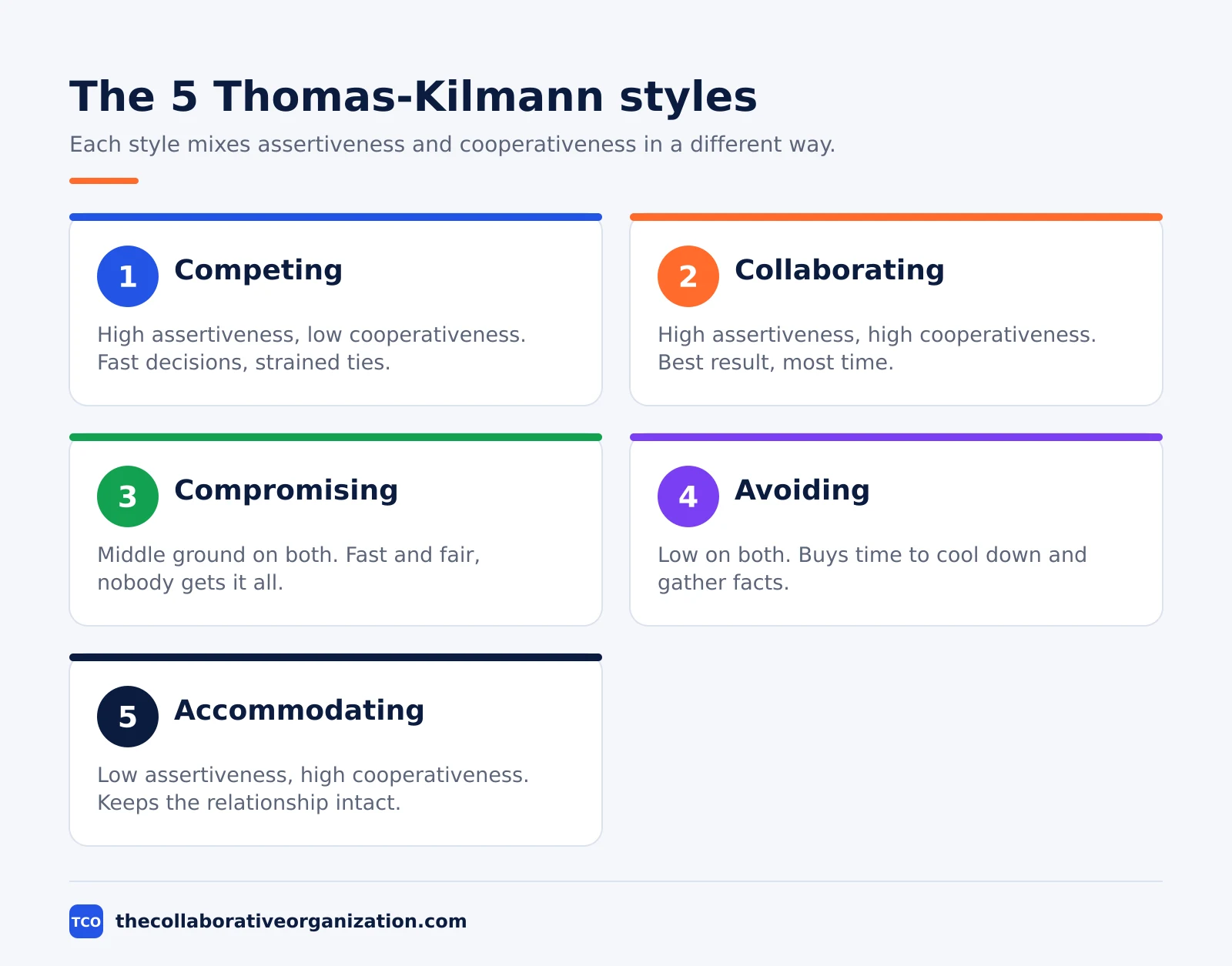
The Thomas-Kilmann model sorts every response to conflict into five styles, based on two questions: how hard do you push for your own needs, and how hard do you work to meet the other person’s needs? Kenneth W. Thomas and Ralph H. Kilmann first published the model in 1974, and the short assessment built on it has since sold more than 10 million copies.
| Style | Your needs | Their needs | Best used when |
|---|---|---|---|
| Competing | High | Low | A fast decision is needed, or safety is at stake |
| Collaborating | High | High | The issue matters to everyone and there is time to talk |
| Compromising | Medium | Medium | Both sides need a fair middle ground, fast |
| Avoiding | Low | Low | Tempers are high, or the issue is trivial |
| Accommodating | Low | High | The issue matters more to the other person |
Competing wins the point and risks the relationship, so save it for emergencies and unpopular calls that cannot wait. Collaborating takes the most time but gives the best result, because both sides get what they need. Compromising is fast and fair, yet nobody gets the full fix they wanted.
Avoiding and accommodating look weak, but each has a place. Avoiding buys time to cool down and gather facts, while accommodating keeps a relationship intact when you are wrong or the point matters little to you. The skill is choosing the style on purpose instead of falling back on the same one every time.
How to resolve conflict in a team in 7 steps
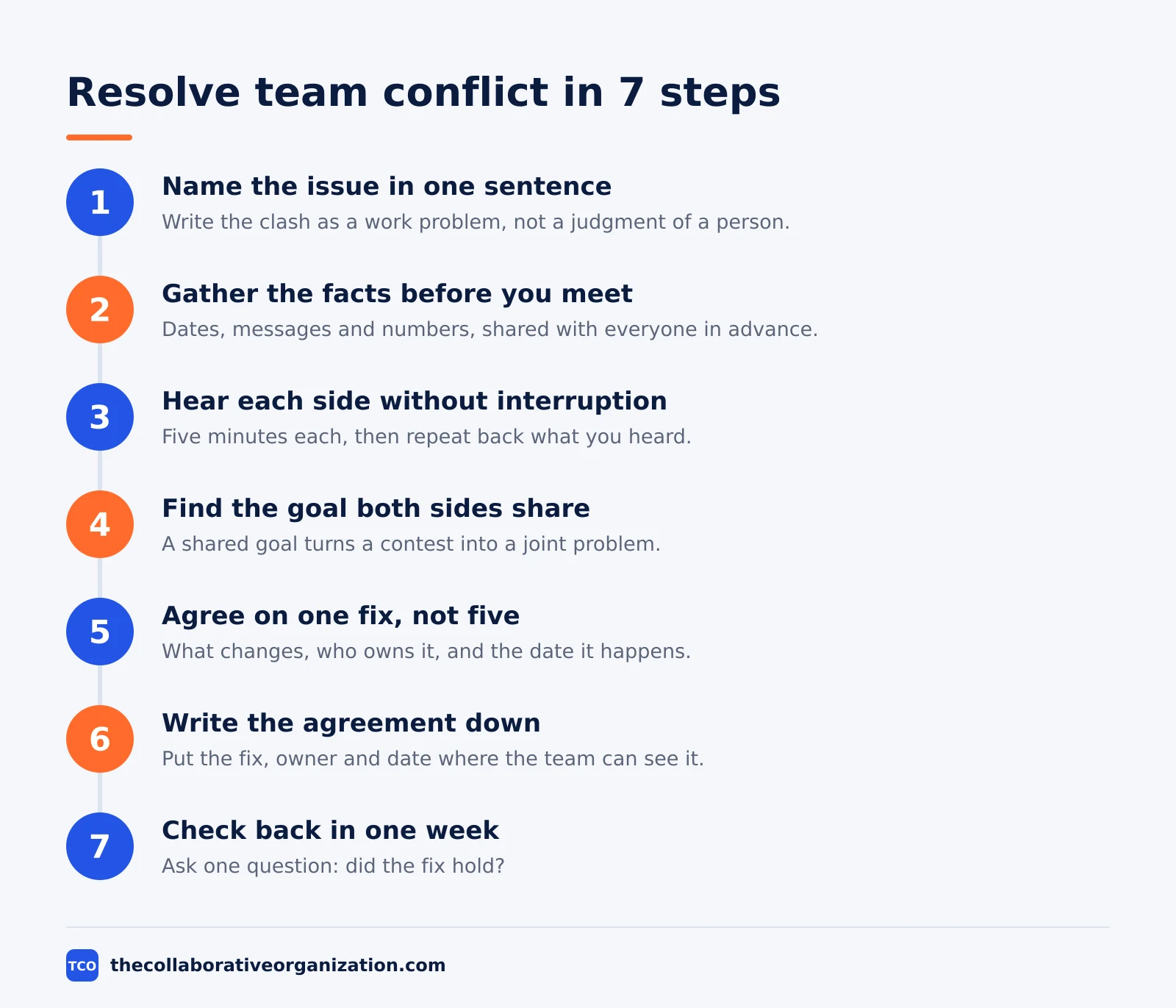
Resolving a team conflict takes seven steps: name the issue, gather facts, hear each side, find the shared goal, agree on a fix, write it down, and check back. The whole process fits in one or two meetings when both sides come ready to talk about the work, not about each other.
Step 1: Name the issue in one sentence
Write the clash as a work problem, not as a judgment of a person. “We disagree on which feature ships first” can be fixed, while “Sam is stubborn” cannot. Ask both sides to agree on that one sentence before you move on.
Step 2: Gather the facts before you meet
Collect the dates, messages, decisions and numbers each side is working from. Many clashes shrink once both sides see the same facts, because half the fight was a different version of events. Share the facts with everyone before the meeting, so nobody is surprised in the room.
Step 3: Hear each side without interruption
Give each person five uninterrupted minutes to say what happened, what they need, and what they worry about. The listener’s only job is to repeat back what they heard, in their own words, until the speaker agrees the summary is fair. This step is slow, and it is the step that makes the rest work.
Step 4: Find the goal both sides share
Ask what both people want for the team, not for themselves. Two developers fighting over a deadline usually share one goal: ship working software on time. A shared goal turns the talk from a contest into a joint problem, and it gives you a test for every fix you propose.
Step 5: Agree on one fix, not five
List the fixes that meet the shared goal, then pick one. A fix needs three parts: what changes, who owns it, and the date it happens. If two fixes both work, pick the simpler one and note the other as a fallback.
Step 6: Write the agreement down
Put the fix, the owner and the date in a shared place where the team can see it, such as the project board or a short note in the team channel. A written agreement stops the same argument from coming back in a new form, because everyone can point to what was decided.
Step 7: Check back in one week
Meet briefly after a week and ask one question: did the fix hold? If yes, close the issue and say so. If no, return to step 3 with fresh facts instead of starting a new argument from scratch.
Worked example: two developers and one deadline
A worked example shows the seven steps on a real clash: two developers, one release date, and two different ideas about what “done” means. Imagine a team of six building a checkout page. Priya wants to ship on Friday with a basic payment flow, while Tom wants to wait until Monday to add fraud checks. The release date is fixed by a client promise, and the argument has now filled two standups.
In step 1, the lead names the issue in one sentence: “We disagree on whether the Friday release can ship without fraud checks.” In step 2, the facts come out: the client contract names Friday, and the fraud checks need six more hours of work. Tom’s worry is real, and Priya’s deadline is real too.
Step 3 gives each of them five minutes. Priya says she fears breaking a client promise; Tom says he fears a chargeback on day one.
In step 4, they agree on the shared goal: a Friday release that does not expose the client to fraud. Step 5 produces one fix: ship Friday with a daily payment cap of $500 until the fraud checks land on Monday, with Tom as owner.
The agreement goes on the board with the date, and a week later the check-in confirms the cap held and the checks shipped. The clash was about risk and timing, not about Priya or Tom, and the steps kept it that way. The same shape fits most team clashes: name it, hear both sides, fix it in writing.
When to bring in a mediator
Bring in a neutral mediator when the two sides cannot talk without blame, when one person has power over the other, or when the same clash has come back three times. A mediator is not a judge. The mediator runs the conversation, keeps it on the work, and helps both sides reach a fix they can live with.
Escalate to a manager first when the conflict blocks a deadline or a decision the team cannot make alone. The manager’s job is to decide, in writing, with reasons both sides can read. That decision ends the debate for now, even if one side disagrees with it.
Some signs mean the conflict needs help from outside the team: raised voices in meetings, people avoiding each other, work being rerouted around one person, or a complaint that touches on harassment or discrimination.
Those cases go to HR, not to a team workshop. What is team collaboration explains how shared goals and clear roles cut down the clashes that need a mediator at all.
Tools that help teams resolve conflict
A shared project tool helps resolve conflict because it puts the facts, the owner and the date in one place both sides can see. When the work, the decision and the deadline live in the same board, there is less room for two versions of what was agreed.
If you have not picked a tool yet, compare the options on our project management software shortlist before you set up the board. The right tool is the one the team opens every day, not the one with the longest feature list.
| Tool | Best for | Free plan | Starting price (as of November 2026) | Notable limit |
|---|---|---|---|---|
| Asana | Tracking the agreed fix with an owner and a date | Free for 2 people | $10.99 per user per month, billed annually | Free plan covers 2 people |
| monday.com | A shared board both sides can see | Free plan for up to 2 seats | $9 per seat per month (Basic), billed annually | Paid plans need at least 3 seats |
| ClickUp | Keeping decisions, docs and tasks in one place | Free Forever plan | $9 per user per month (Core), billed annually | Yearly billing needed for that price |
The Asana price comes from Asana pricing: Starter is $10.99 per user per month when billed annually.
On the monday.com pricing page, Basic is $9 per seat per month billed annually, with a 3-seat minimum.
The ClickUp pricing page lists Core at $9 per user per month billed yearly.
Common team conflict mistakes to avoid
Most team conflicts drag on because of five fixable mistakes, and each one has a simple cure. Run through the list before your next hard conversation.
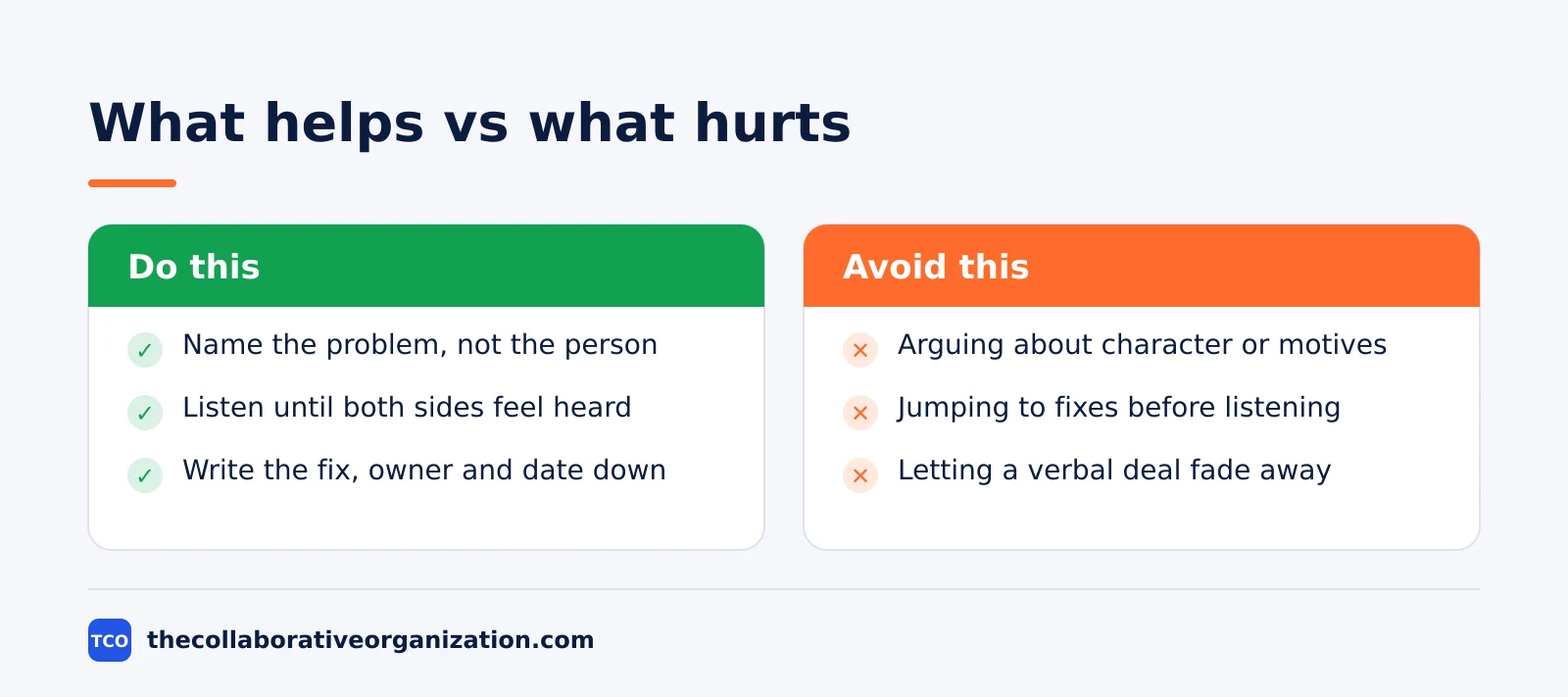
- Arguing about the person, not the problem. “You never listen” starts a fight about character. Restate the issue as a work problem with a date and a fact.
- Skipping the listening step. Jumping to fixes before both sides feel heard leaves one side quietly opposed to the fix, and the clash returns within days.
- Letting the loudest voice win. A fast decision that one side resents is not a resolution. Give the quieter person the same five uninterrupted minutes.
- Agreeing in the room and forgetting it after. A verbal deal fades fast. Write the fix, the owner and the date where the team can see it.
- Treating every clash the same way. A missed deadline and a values clash need different styles. Pick the Thomas-Kilmann style that fits the issue, not the one you always use.
How to tell the fix worked
A fix worked when the work moves again, the same argument stops coming up, and both people can work together without avoiding each other. Watch for three signs in the two weeks after the agreement: the owner met the date, the team stopped re-arguing the decision, and meetings feel normal again.
Count the cost of the next clash too. Note how many hours the conflict took, how many meetings it filled, and whether any work had to be redone. Those numbers make the case for acting early next time, because a one-hour talk beats a two-week cold war.
The difference between collaboration and cooperation matters here as well: a team that truly works together on a fix holds it longer than a team that just splits the work and hopes.
If the fix did not hold, do not blame the process. Go back to step 3 with new facts, or bring in a mediator. A second try with honest listening beats a new argument about the old argument.
Sources
- Kilmann Diagnostics - Use the Thomas-Kilmann Instrument (TKI) to Manage Conflict (2026)
- Kilmann Diagnostics - An Overview of the TKI Assessment Tool (2026)
- Entrepreneur - The Real Cost of Workplace Conflict (2024)
- HR Daily Advisor - Productive vs Unproductive Conflict in the Workplace (2020)
- Mediation International - The True Cost of Unresolved Conflict (2026)
- Asana - Pricing (2026)
- monday.com - Pricing (2026)
- ClickUp - Pricing (2026)
Frequently asked questions
How long does it take to resolve a team conflict?
A simple clash over a task or a deadline can be settled in one 30-minute conversation when both people come ready to listen. A deeper conflict about roles, trust or past decisions usually needs two or three meetings over one to two weeks, plus a written agreement so the fix holds after the talks end.
Should a manager resolve the conflict or let the team sort it out?
Start by letting the two people talk directly, with a clear deadline for a fix. Step in when the talks stall, when one person has power over the other, or when the conflict starts to hurt the work. A manager who jumps in too early takes away the team's chance to learn how to handle the next clash.
What if one person refuses to take part in resolving the conflict?
Name the cost of staying silent, in plain terms: the decision stays blocked, the work stays stuck, or the team keeps working around the gap. Offer a short, structured meeting with a neutral chair. If the person still refuses, the manager must decide, and that decision should be written down with reasons.
Is avoiding a conflict ever the right choice?
Yes, for a short time. Avoiding fits when tempers are high, when the issue is small, or when you need facts before you talk. It fails as a long-term plan, because the problem keeps growing in the background. Set a date to return to it, and keep that promise.
What is the difference between healthy conflict and harmful conflict?
Healthy conflict is about ideas, plans and facts: people disagree about the work and still respect each other. Harmful conflict is about people: blame, sarcasm and old grudges. The first kind sharpens decisions, while the second kind drains trust and slows the whole team down.
Related articles
project management
How to Choose Project Management Software (2026)
Pick project management software in seven steps: define the work, count seats, price the real cost, and run a two-week pilot before you pay.
November 19, 2026 · 10 min read
project management
What Is a RACI Matrix? Definition, Roles and Examples (2026)
A RACI matrix maps who is Responsible, Accountable, Consulted and Informed for each task. Learn the four roles, how to build one, and see a worked example.
November 19, 2026 · 9 min read
project management
Daily Standup Meeting Format That Works (2026)
A daily standup is a 15-minute meeting where Developers inspect progress toward the Sprint Goal and plan the next day. Use this format to run one that ends on time.
November 19, 2026 · 10 min read